Oregon Co-Petitioner (with no or adult children) Acknowledgment About Dissolution / Divorce / Separation
What this document covers
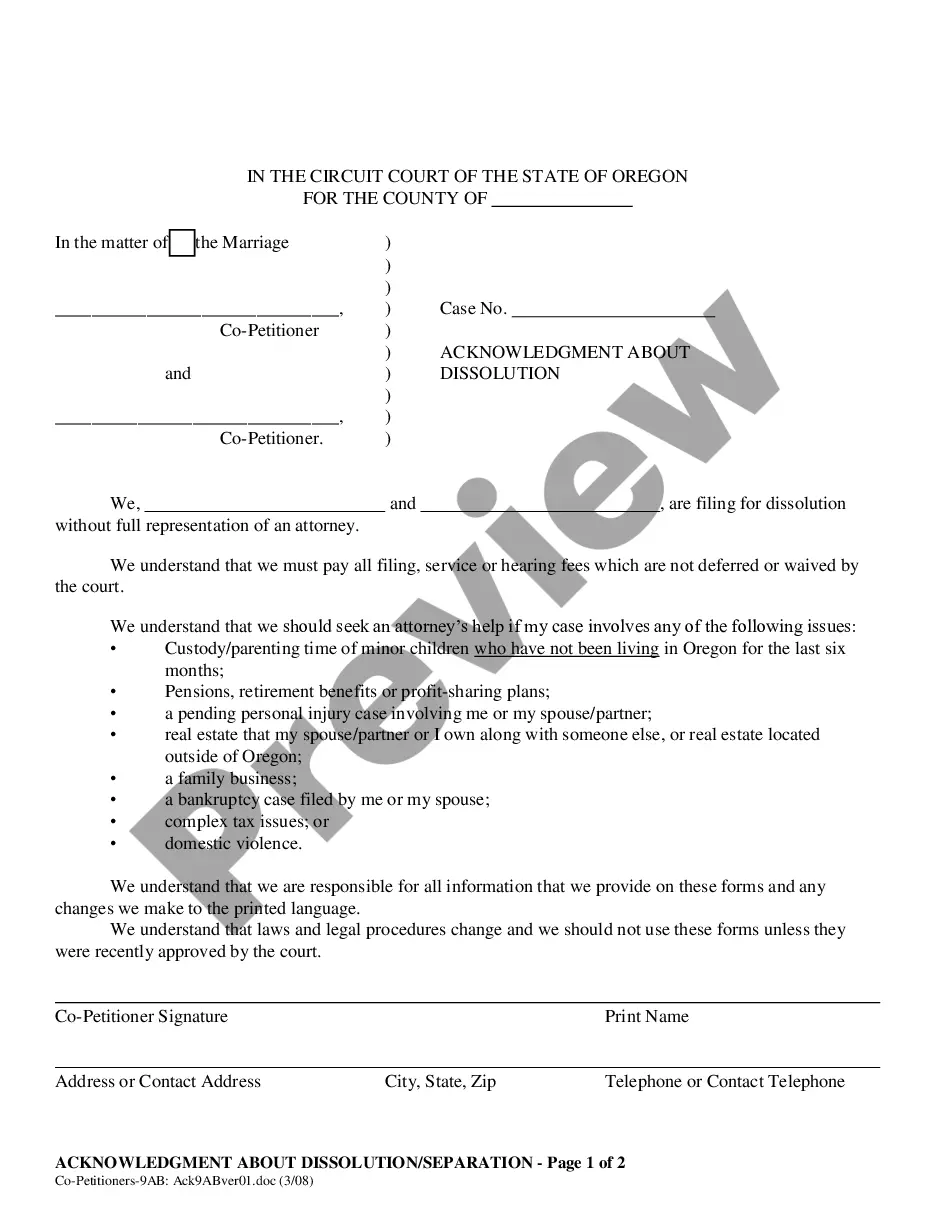
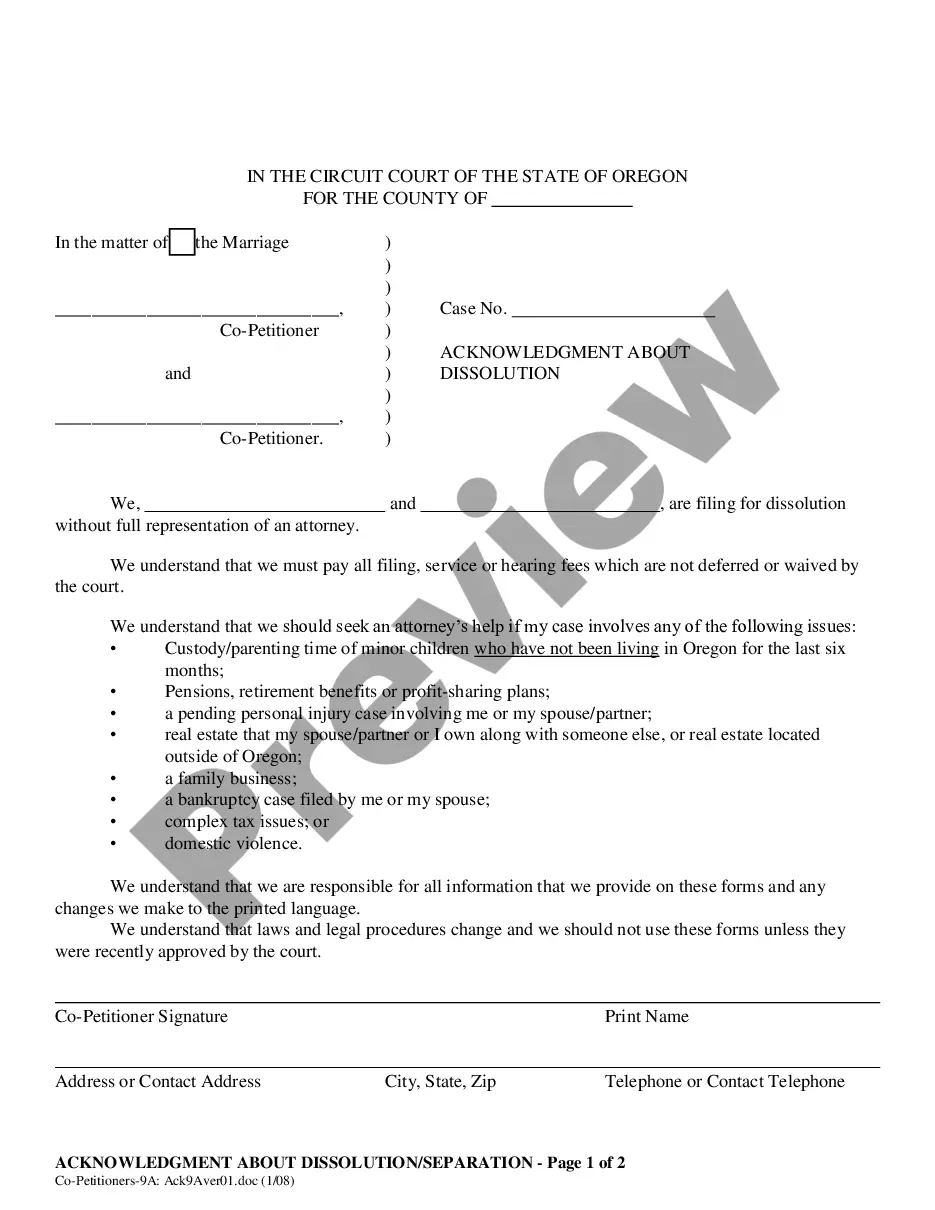
The Co-Petitioner Acknowledgment About Dissolution/Divorce/Separation form is a legal document used during the divorce process when both parties are seeking dissolution without full legal representation. This form outlines the responsibilities of the co-petitioners, including payment of court fees, and suggests that they seek legal advice in specific situations. It serves to clarify the parties' understanding of the dissolution's complexities and their respective obligations.
Key parts of this document
- Identification of the co-petitioners involved in the dissolution process.
- Statement acknowledging that the petitioners are filing without full attorney representation.
- Understanding of the responsibility for court fees and other costs.
- Advisement to consult an attorney for specific issues, such as custody, pensions, and property.
- Signature and contact information for each co-petitioner.

When to use this document
This form is needed when both parties are agreeing to file for divorce or separation without legal representation, particularly in cases involving no children or when there are adult children. It is appropriate to use this form at the time of filing the divorce petition to ensure both parties understand their responsibilities and the implications of proceeding without an attorney.
Intended users of this form
The following individuals should consider using this form:
- Couples seeking a simplified process for divorce without children.
- Parties who have agreed upon the terms of their dissolution.
- Individuals who are aware of their rights and responsibilities but do not wish to engage full legal representation.
Completing this form step by step
- Identify and enter the names of both co-petitioners in the designated fields.
- Review and acknowledge the statement regarding filing without full legal representation.
- Provide details regarding understanding the responsibility for court fees and consult an attorney if necessary.
- Sign and print names where indicated for both co-petitioners.
- Include contact information for both parties to facilitate any necessary communication.
Does this document require notarization?
This form does not typically require notarization unless specified by local law.
Get your form ready online
Our built-in tools help you complete, sign, share, and store your documents in one place.
Make edits, fill in missing information, and update formatting in US Legal Forms—just like you would in MS Word.
Download a copy, print it, send it by email, or mail it via USPS—whatever works best for your next step.
Sign and collect signatures with our SignNow integration. Send to multiple recipients, set reminders, and more. Go Premium to unlock E-Sign.
If this form requires notarization, complete it online through a secure video call—no need to meet a notary in person or wait for an appointment.
We protect your documents and personal data by following strict security and privacy standards.

Make edits, fill in missing information, and update formatting in US Legal Forms—just like you would in MS Word.

Download a copy, print it, send it by email, or mail it via USPS—whatever works best for your next step.

Sign and collect signatures with our SignNow integration. Send to multiple recipients, set reminders, and more. Go Premium to unlock E-Sign.

If this form requires notarization, complete it online through a secure video call—no need to meet a notary in person or wait for an appointment.

We protect your documents and personal data by following strict security and privacy standards.
Common mistakes to avoid
- Failing to read and understand the responsibilities outlined in the form.
- Not including contact information, which can delay court proceedings.
- Omitting signatures or improperly signing the form, leading to potential rejections.
Why use this form online
- Convenience of immediate download and access anywhere.
- Editability allows for personal customization before submission.
- Reliability through professionally drafted templates that meet legal standards.
Looking for another form?



Form popularity
FAQ
Joint Petition for a Summary Dissolution. A summary dissolution is a special court process for ending a divorce quickly and efficiently. If all the requirements are met, the court will simply grant the divorce without a hearing.
Oregon law prohibits a judge from granting a separation order for an unlimited duration. Instead, your separation order will last for a specified period of time, such as six months or a year. Once the separation period has expired, you and your spouse will have to decide whether you want to proceed with a divorce.
Filing for legal separation in Oregon addresses and resolves some of the same financial issues as a divorce, including benefits, property division and distribution, child custody and support, parenting time, and spousal support.
If you and your spouse cannot agree and one of you will challenge the divorce issues in court, a judge will have to make a decision about the issues. Temporary orders may be issued concerning custody, support, parenting time and costs before your divorce trial.
In a contested divorce the petitioner (plaintiff) petitions the court for a divorce and respondent (defendant) has to respond. When the petition is jointly filed, the spouses are called Co-Petitioners. The husband and wife petition the court together with paperwork that is signed by both parties.
Disadvantages of Legal Separation Unless explicitly stated in your Oregon legal separation agreement, some of the terms of your settlement agreement, including parenting time, child support, child-related expenses, and spousal support may be renegotiated again, if and when you decide to divorce.
Either spouse or domestic partner can decide to end the marriage or partnership. It is not necessary for the other spouse or partner to agree or ?give you? a dissolution. The spouse or partner who does not want to get a dissolution cannot stop the process by refusing to participate in the case.
The Cons of a Legal Separation Disadvantages of legal separation include: The inability to legally remarry; Extra cost if you later decide to divorce; and. Lack of a no-fault option.