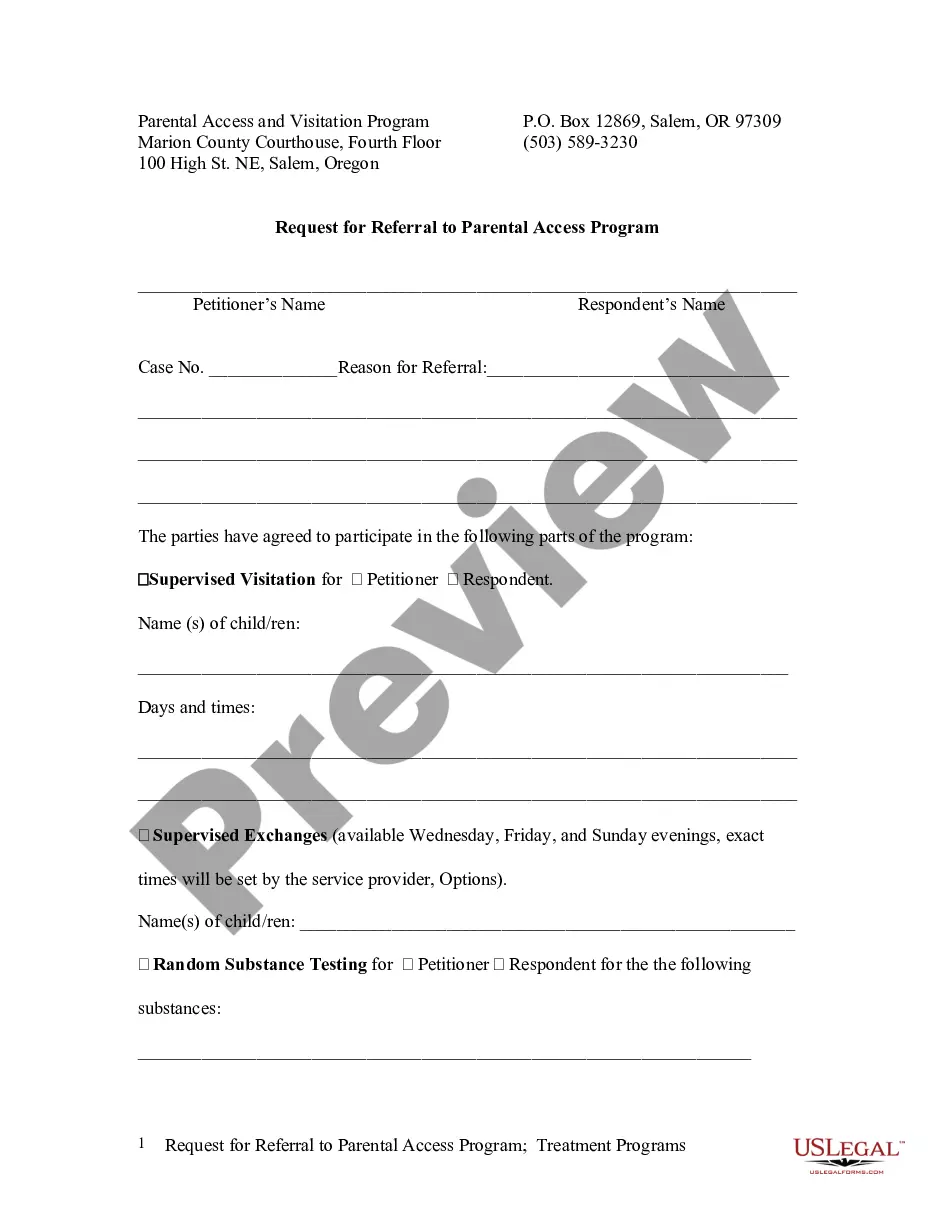
Oregon Request for Referral to Parental Access Program and Treatment Programs
What is this form?
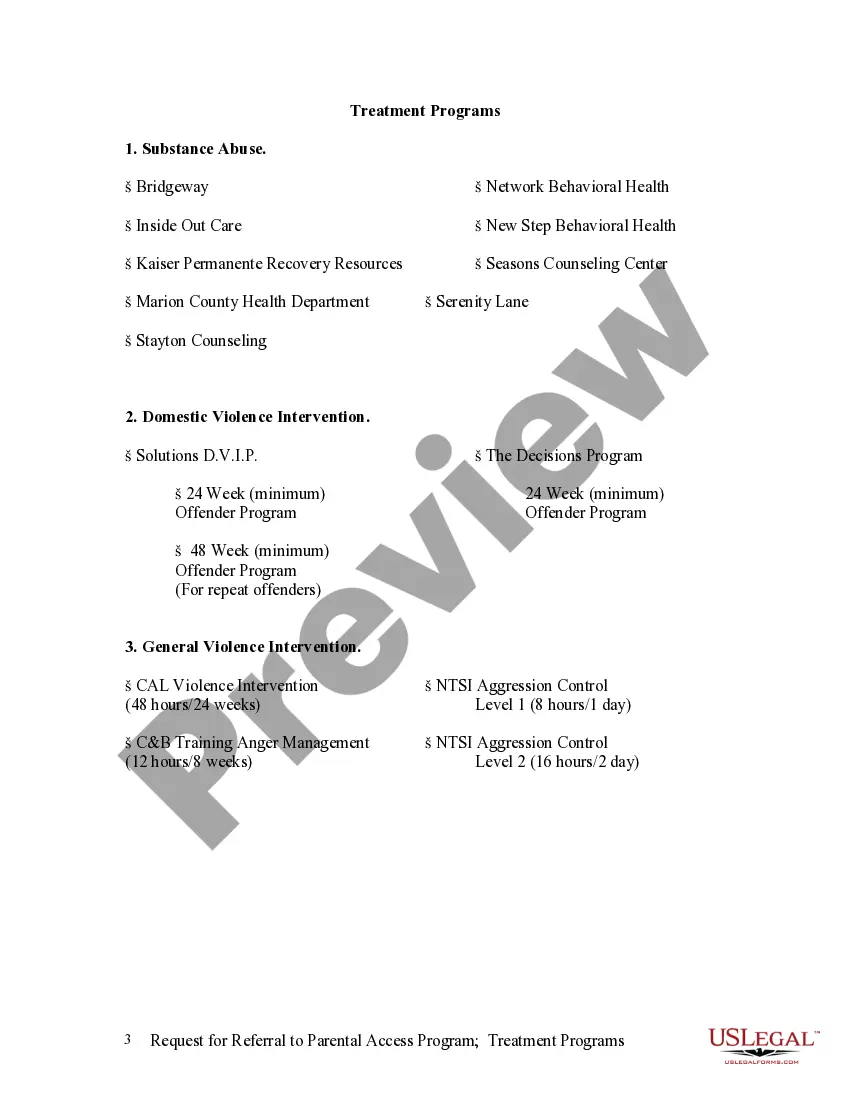
The Request for Referral to Parental Access Program and Treatment Programs is a legal document used to request the court's referral for participation in programs aimed at facilitating parental access and addressing issues such as substance abuse and domestic violence. This form is specific to Oregon and provides a structured way for the parties involved to indicate their consent to participate in various intervention programs and supervised visitation services.
Form components explained
- Petitioner and Respondent Information: Fields to identify the individuals involved in the case.
- Case Number: Space to include the identifying number for your court case.
- Reason for Referral: A section to explain the reason for the referral to the parental access program.
- Program Participation: Options to agree to participate in supervised visitation, supervised exchanges, random substance testing, and various treatment programs.
- Signature Lines: Spaces for both parties to sign and date the form.

When to use this form
This form should be used when parents or guardians are involved in a legal matter where a referral to the Parental Access Program is necessary. Common scenarios include custody disputes, instances of substance abuse, or cases involving domestic violence. By completing this form, parties can voluntarily agree to participate in interventions designed to ensure the safety and well-being of children while fostering healthier family dynamics.
Intended users of this form
- Parents or guardians involved in custody disputes in Oregon.
- Individuals seeking to address substance abuse issues through court-referred programs.
- Those needing assistance with supervised visitation or exchanges due to safety concerns.
- Parties wishing to formally express their agreement to participate in required treatment programs.
Instructions for completing this form
- Identify the parties involved by entering the names of the petitioner and respondent.
- Fill in the case number associated with the legal matter.
- Provide a detailed reason for the referral to the parental access program.
- Specify which parts of the program you agree to participate in, including visitation and treatment options.
- Have both parties sign and date the form before submission to ensure their agreement.
Notarization guidance
Notarization is not commonly needed for this form. However, certain documents or local rules may make it necessary. Our notarization service, powered by Notarize, allows you to finalize it securely online anytime, day or night.
Get your form ready online
Our built-in tools help you complete, sign, share, and store your documents in one place.
Make edits, fill in missing information, and update formatting in US Legal Forms—just like you would in MS Word.
Download a copy, print it, send it by email, or mail it via USPS—whatever works best for your next step.
Sign and collect signatures with our SignNow integration. Send to multiple recipients, set reminders, and more. Go Premium to unlock E-Sign.
If this form requires notarization, complete it online through a secure video call—no need to meet a notary in person or wait for an appointment.
We protect your documents and personal data by following strict security and privacy standards.

Make edits, fill in missing information, and update formatting in US Legal Forms—just like you would in MS Word.

Download a copy, print it, send it by email, or mail it via USPS—whatever works best for your next step.

Sign and collect signatures with our SignNow integration. Send to multiple recipients, set reminders, and more. Go Premium to unlock E-Sign.

If this form requires notarization, complete it online through a secure video call—no need to meet a notary in person or wait for an appointment.

We protect your documents and personal data by following strict security and privacy standards.
Avoid these common issues
- Failing to include both parties' signatures and dates.
- Not specifying the details for supervised visitation or treatment programs.
- Leaving the case number blank.
- Providing incomplete or unclear reasons for referral.
Why use this form online
- Convenience of downloading and completing the form from anywhere.
- Editability allows users to ensure accuracy before submission.
- Reliable templates drafted by licensed attorneys help reduce errors.
- Access to up-to-date legal standards for parental access issues.
Looking for another form?

Form popularity
FAQ
Some people think joint custody means the child lives with each parent 50% of the time.A court cannot award joint custody in Oregon unless both parents agree to it. Sole custody in Oregon means that the parent who has custody makes all major decisions regarding the child.
There is no specific age at which a child can decide to refuse to visit with a parent or change custody arrangements without the court's approval.
Fill out your court forms. Have your forms reviewed. Make at least 2 copies of all your forms. File your forms with the court clerk. Serve your papers on the other parent. File your Proof of Service. Go to your court hearing.
Oregon Custody Law Does Not Favor Either Parent Fathers' rights in Oregon are viewed as equal to mothers' rights. Instead, according to Oregon custody law, courts largely base their decisions on what is in the best interests of the child.
Children are not allowed to decide, only the court can modify visitation/parenting plans. Children over 14 are considered to have some maturity ad the court may listen to their testimony but generally speaking the court frowns on parents...
One parent gets legal custody of the children. Both parents have joint custody. In families with more than one child, one or more children live with one parent and one or more children live with the other parent.
If the parents are unmarried but have paternity established, both will generally have equal custody rights. In fact, Oregon courts almost always favor arrangements where the child can have both parents playing active roles in their life, but will always put the child's best interests first.
The legal definition of an unfit parent is when the parent through their conduct fails to provide proper guidance, care, or support. Also, if there is abuse, neglect, or substance abuse issues, that parent will be deemed unfit.