Ohio Last Will and Testament for a Single Person with Minor Children
What this document covers
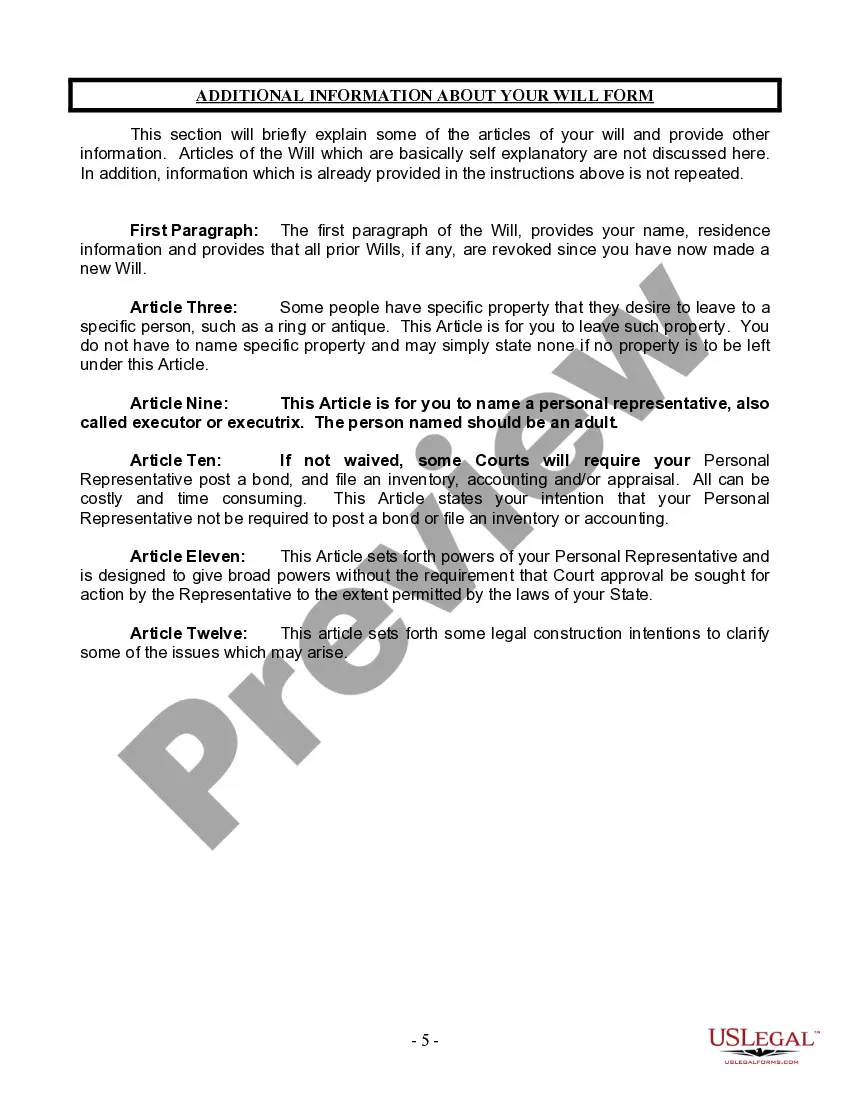
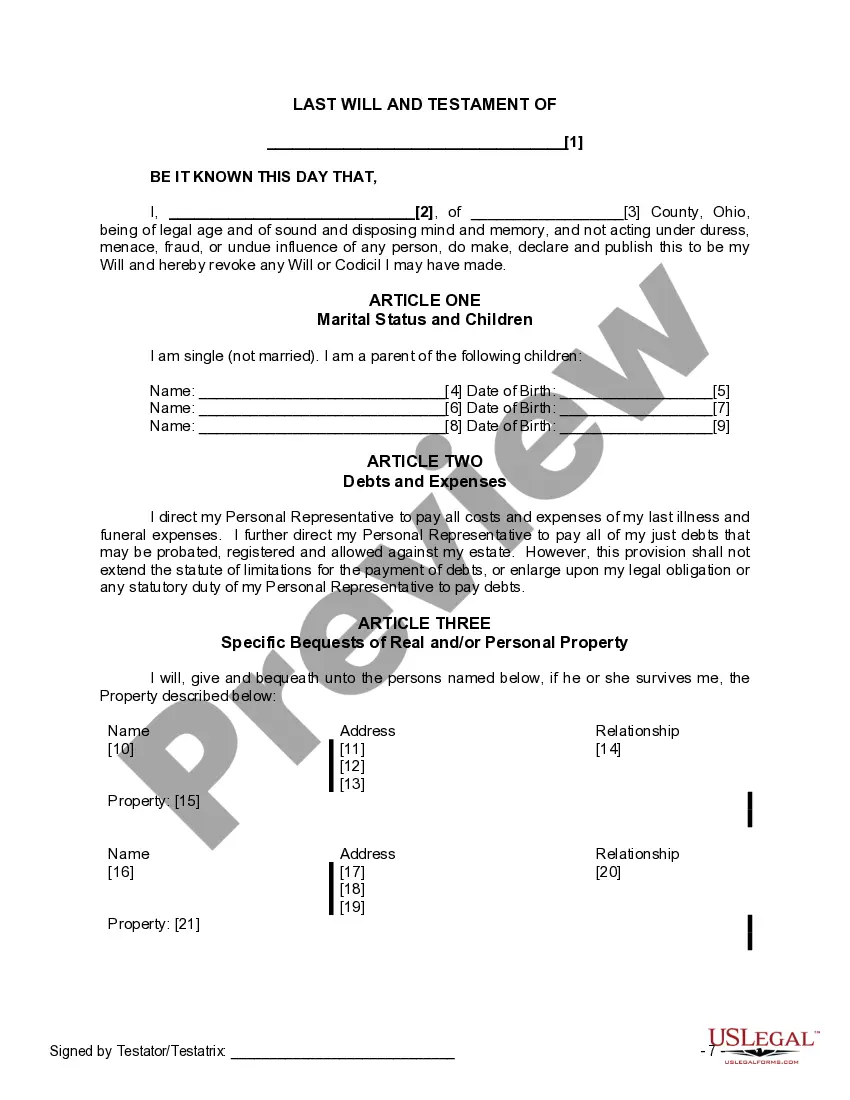
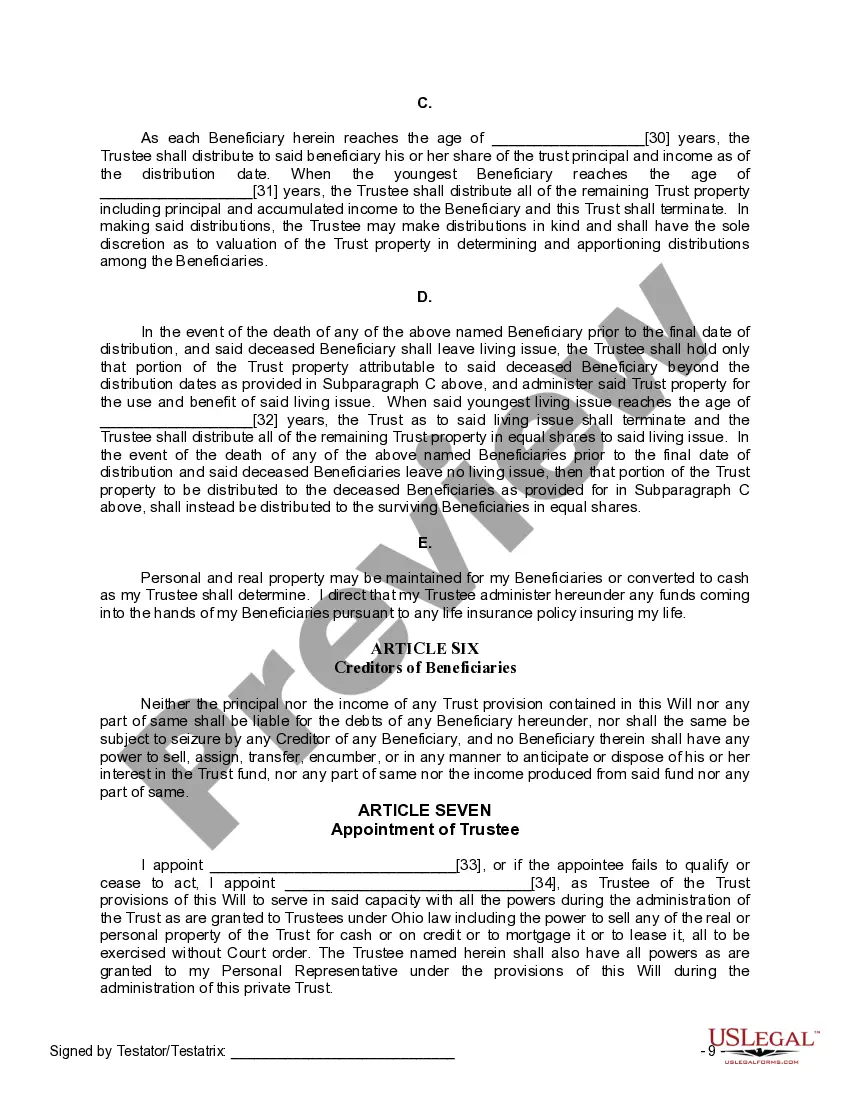
This Last Will and Testament for a Single Person with Minor Children is a legal document designed to specify how your assets will be distributed upon your death, particularly if you are single and have minor children. It includes provisions for appointing a personal representative, distributing property, and naming guardians and trustees for your minor children. This will ensures that your wishes are clearly followed and provides for the well-being of your children in the event of your passing.
What’s included in this form
- Appointment of a personal representative or executor to manage your estate.
- Designating beneficiaries for your property, including specific bequests.
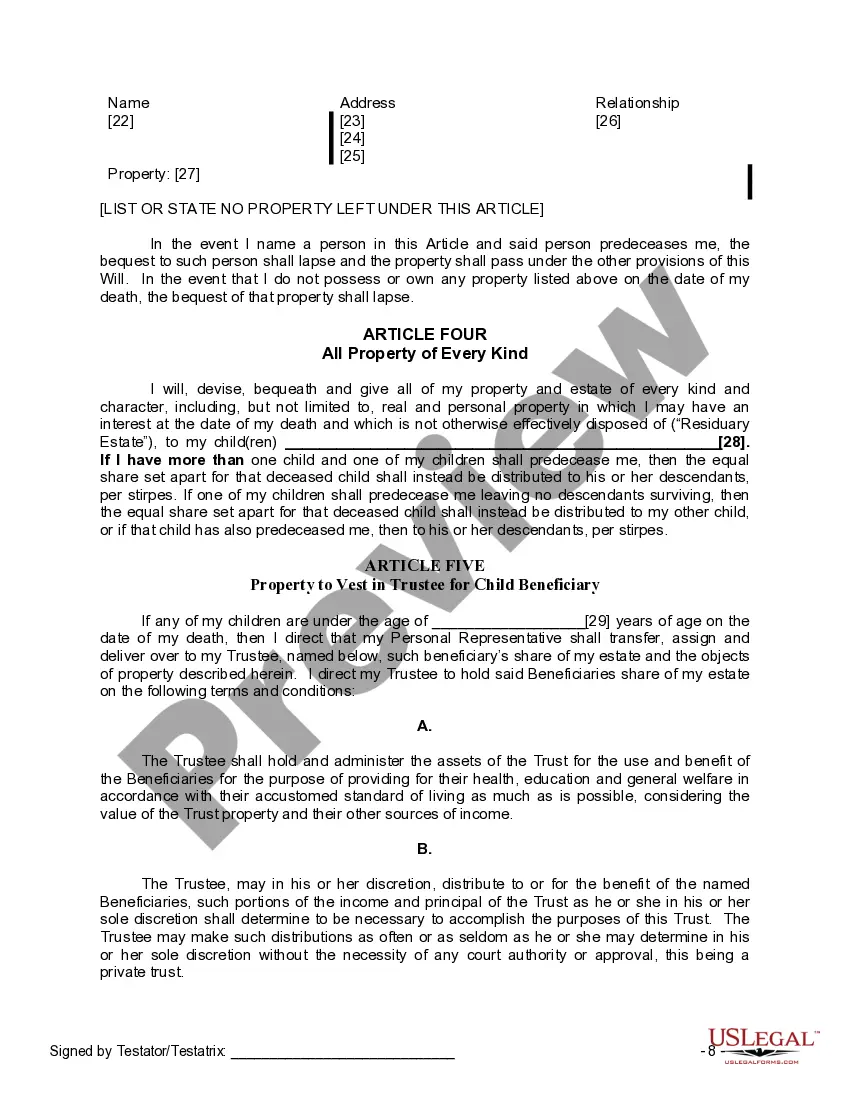
- Establishing trusts for minor children to manage inheritance until they reach a specified age.
- Naming a guardian for your minor children in the event of your death.
- Providing provisions for the waiver of bond and inventory requirements for the personal representative.







Common use cases
You should use this Last Will and Testament if you are a single parent with minor children and wish to outline your wishes regarding the distribution of your assets after your death. This form is especially important if you want to designate a guardian for your children and ensure their financial security. It is also useful if you have specific belongings that you want to leave to specific individuals or if you want your estate to be managed through a trust until your children come of age.
Who can use this document
This form is intended for:
- Individuals who are single and have minor children.
- Parents who wish to clearly outline their wishes regarding guardianship and inheritance.
- Those who have specific wishes regarding the distribution of personal property.
How to prepare this document
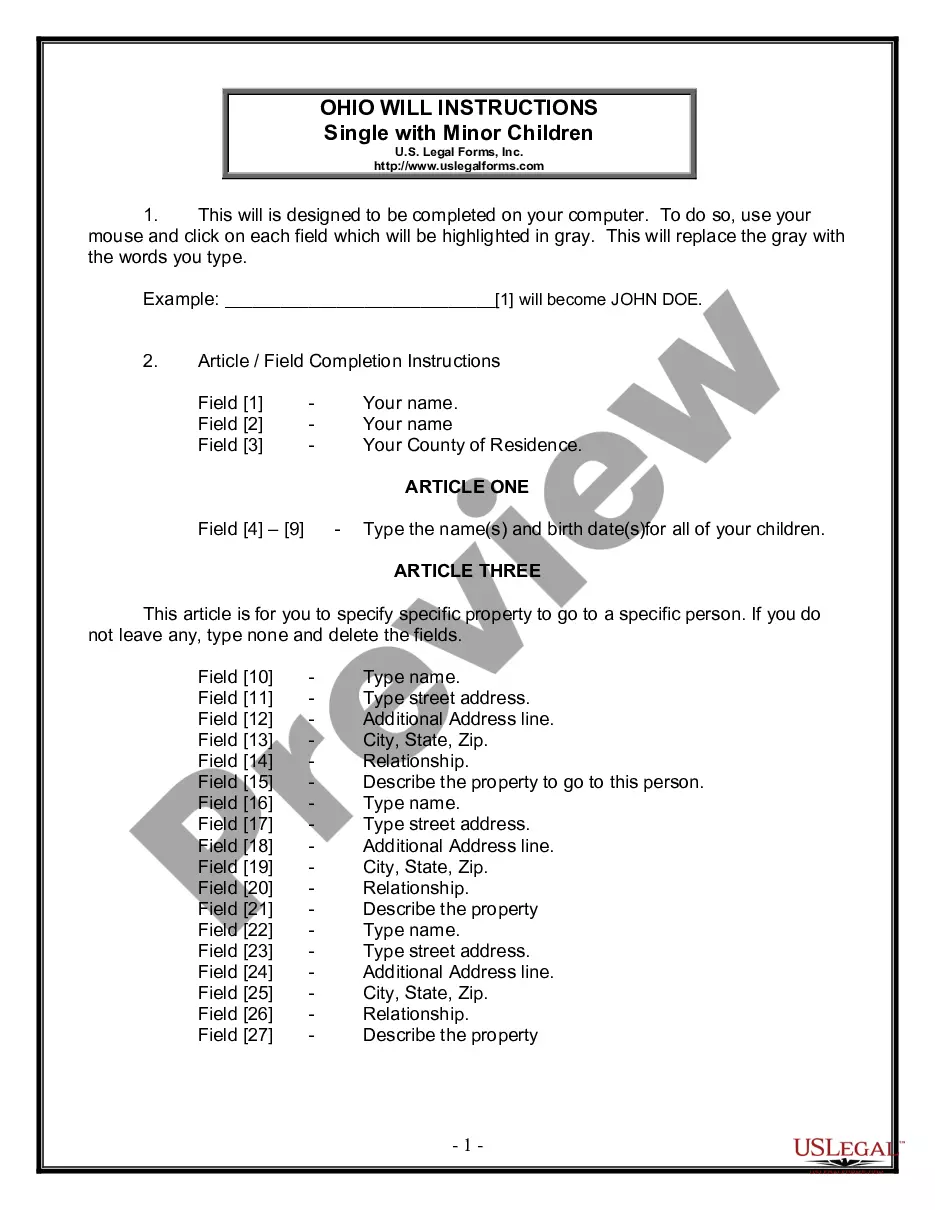
- Begin by entering your name and county of residence at the top of the document.
- Name your minor children in the designated section along with their birth dates.
- Specify any specific property you wish to bequeath to individuals by filling in their names and addresses.
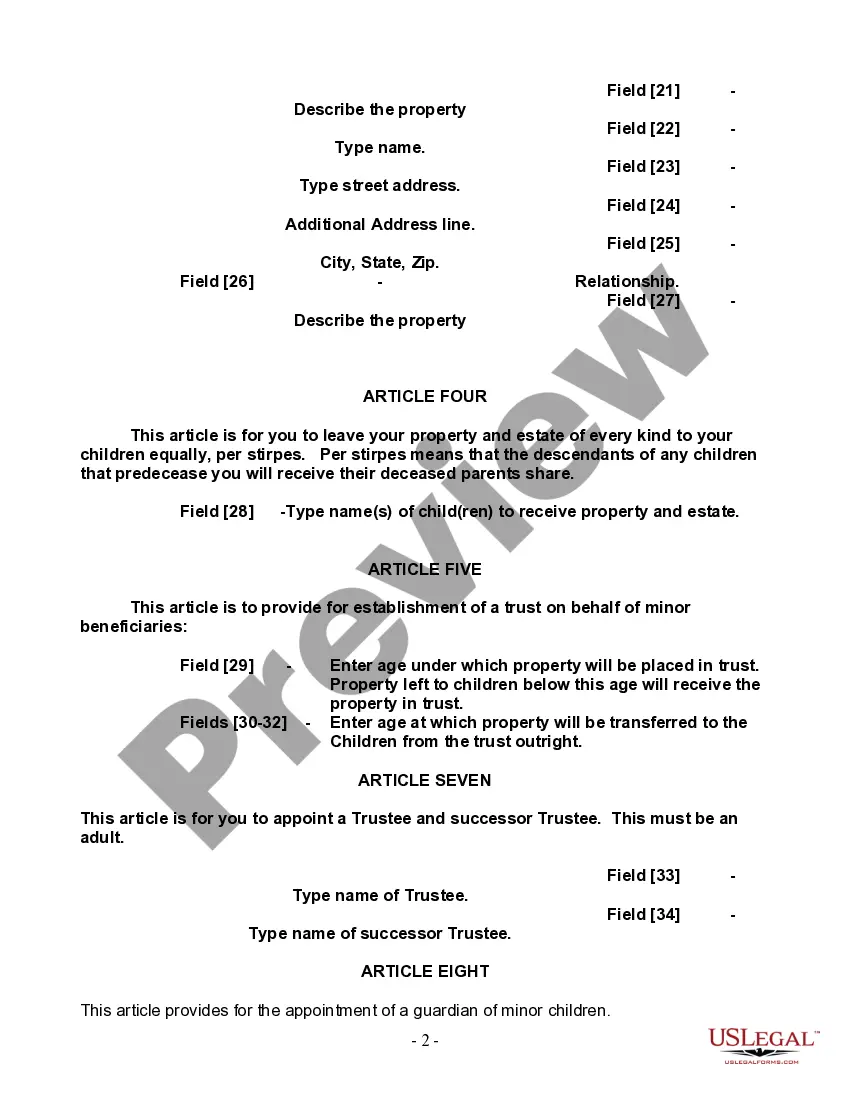
- Appoint a guardian for your children and a trustee if applicable.
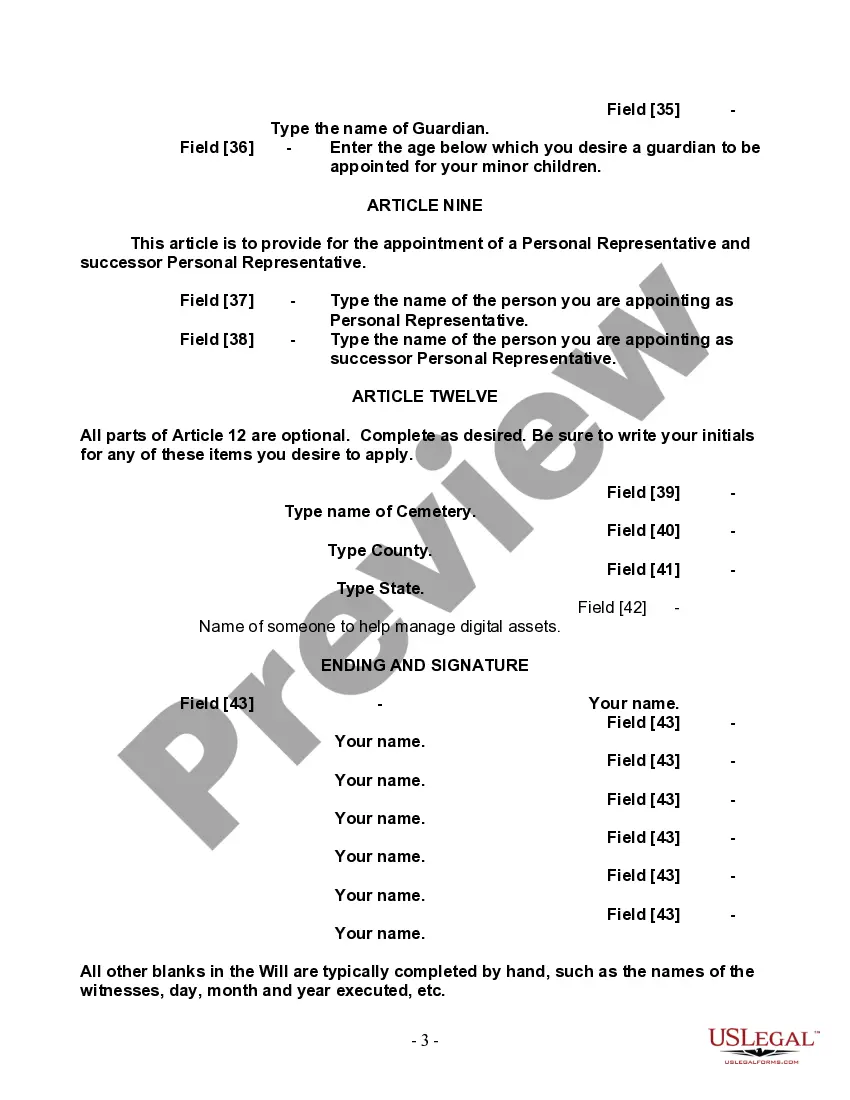
- Ensure that you have at least two witnesses sign the document to validate it, and consider having it notarized for additional security.
Notarization guidance
Yes, this form must be notarized to be legally valid. It includes a self-proving affidavit that requires notarization to ensure it is accepted in probate court. Using US Legal Forms, you can access online notarization services that are available twenty-four seven through secure video calls, making the process straightforward and convenient.
Get your form ready online
Our built-in tools help you complete, sign, share, and store your documents in one place.
Make edits, fill in missing information, and update formatting in US Legal Forms—just like you would in MS Word.
Download a copy, print it, send it by email, or mail it via USPS—whatever works best for your next step.
Sign and collect signatures with our SignNow integration. Send to multiple recipients, set reminders, and more. Go Premium to unlock E-Sign.
If this form requires notarization, complete it online through a secure video call—no need to meet a notary in person or wait for an appointment.
We protect your documents and personal data by following strict security and privacy standards.

Make edits, fill in missing information, and update formatting in US Legal Forms—just like you would in MS Word.

Download a copy, print it, send it by email, or mail it via USPS—whatever works best for your next step.

Sign and collect signatures with our SignNow integration. Send to multiple recipients, set reminders, and more. Go Premium to unlock E-Sign.

If this form requires notarization, complete it online through a secure video call—no need to meet a notary in person or wait for an appointment.

We protect your documents and personal data by following strict security and privacy standards.
Typical mistakes to avoid
- Failing to sign the will in the presence of two witnesses.
- Not providing clear and specific instructions for the distribution of property.
- Neglecting to update the will after major life events, such as marriage or changes in custody of children.
- Overlooking state-specific notarization requirements.
Benefits of completing this form online
- Convenience of completing the form from home at your own pace.
- Editability allows you to make changes easily before finalizing your will.
- Access to legal resources and support if you have questions.
- Stable and reliable templates drafted by licensed attorneys.
Summary of main points
- The Last Will and Testament is crucial for single parents to ensure their minor children's needs are met.
- Completing the form accurately with the necessary details is essential for legal enforcement.
- Ensure the presence of witnesses and a notary as required to avoid challenges in probate.
- Regularly review and update your will as life circumstances change.
Looking for another form?
Form popularity
FAQ
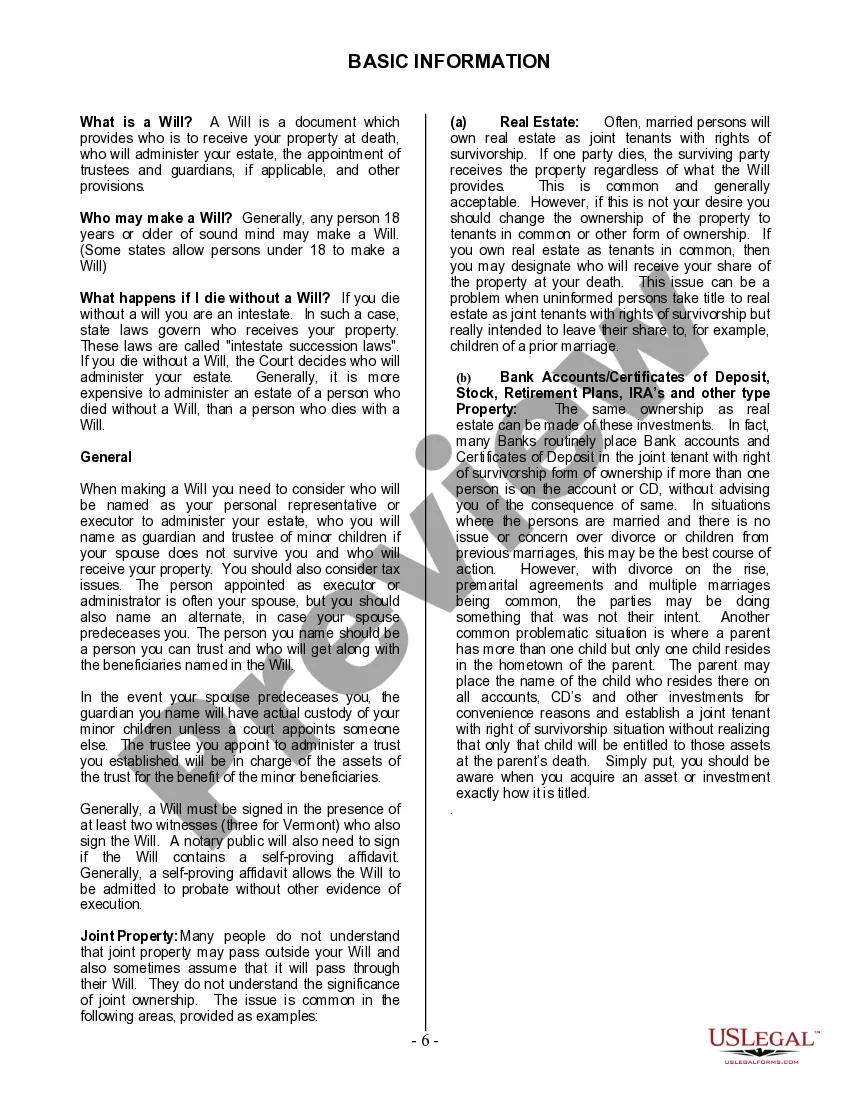
Children who are under the age of 18 are deemed to lack legal capacity to receive a gift. Where a gift in your will is going to a child under 18 (which may be a child of a deceased beneficiary), you can give your executors and trustees the option to make the gift to the child's parent or guardian.
A notarized will does not need to be probated.When a person dies leaving behind a will that is not notarized, the law requires that its validity be ascertained by a notary or by a court. Similarly, any non-notarized modification made to a will must be probated, whether the will is notarized or not.
Will a Probate Proceeding Be Necessary? Generally, only assets that the deceased person owned in his or her name alone go through probate. Everything else can probably be transferred to its new owner without probate court approval. Many common assets do not need to go through probate.
Anyone of legal age (18 years old in most states) and sound mind can make a Will. If you have property that you wish to distribute at the time of your death, you should have a Will.
What happens to the death benefit if you name a minor as a beneficiary? If your beneficiary is under the age of majority when you die, the death benefit will be given to a custodian of the funds to hold on to. This guardian can be court-appointed, but the court will most likely choose the surviving parent.
No. You can make your own will in Ohio, using Nolo's do-it-yourself will software or online will programs. However, you may want to consult a lawyer in some situations. For example, if you think that your will might be contested or if you want to disinherit your spouse, you should talk with an attorney.
So in the majority of instances someone under 18, they cannot make a valid will, and if they are deceased before the age of 18, their estate is subject to the laws of intestacy, and the majority of instances it goes to both parents equally.
A handwritten will, sometimes referred to as a holographic will, is lawful in a majority of states, including Ohio.As with typewritten wills, the will must be signed by the person making the will (the testator) or by some other person in the testator's conscious presence and at the testator's express direction.
Does a will have to be notarized in Ohio? A will does not need to be notarized in order for it to be a valid legal document.