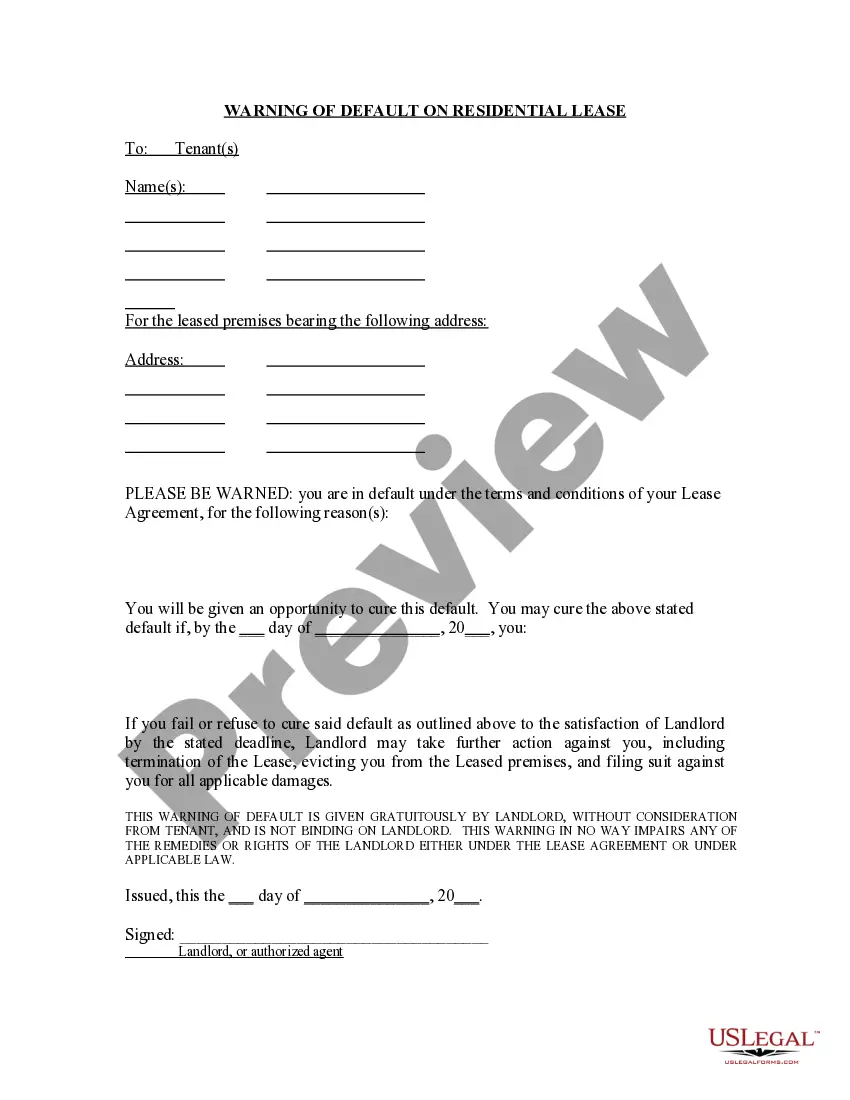
Ohio Warning of Default on Residential Lease
Understanding this form
The Warning of Default on Residential Lease is a formal notice from a landlord to a tenant, indicating concerns over potential lease violations. The purpose of this form is to inform tenants that failure to address specified issues could result in being considered in default under the lease. This differs from other forms, such as eviction notices, as it serves primarily as an alert rather than an immediate action for lease termination.
Key parts of this document
- Date of issuance: This section includes the date the warning is issued.
- Landlord's details: The landlord or authorized agentâs name and signature are required to validate the notice.
- Default conditions: Clear articulation of the conditions that need to be remedied to avoid default.


When this form is needed
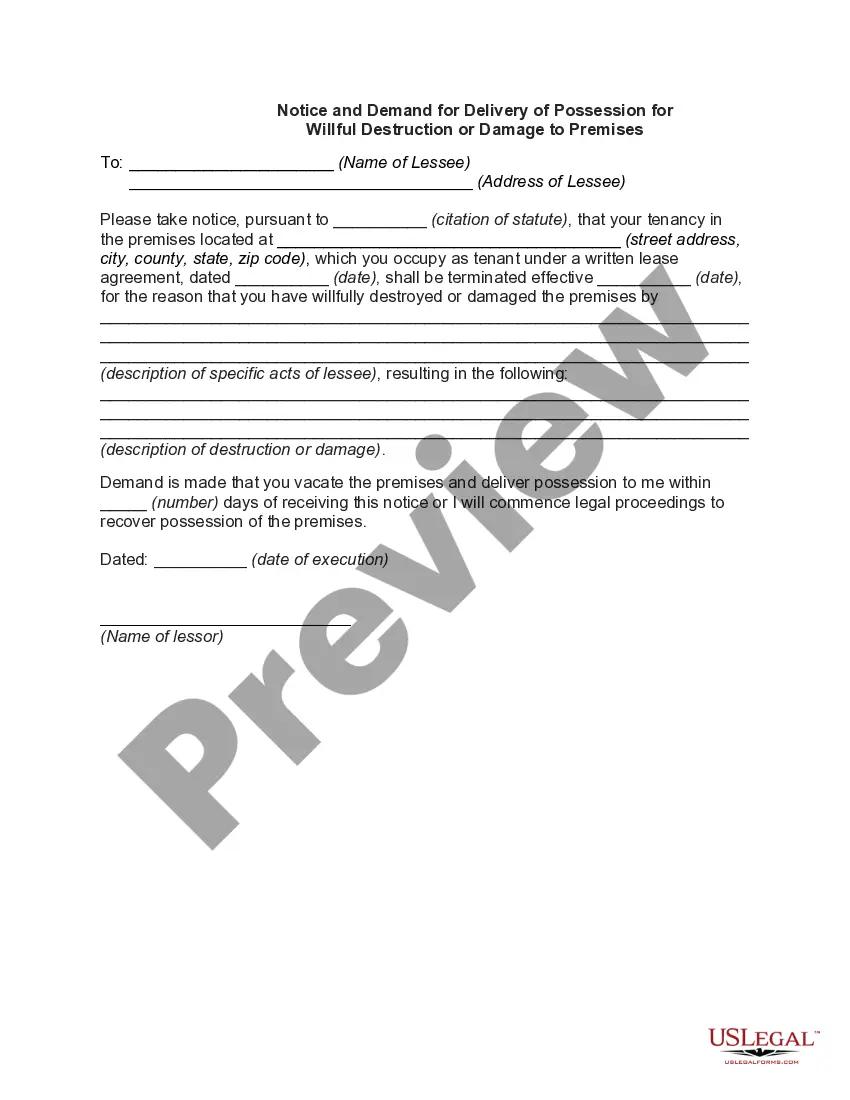
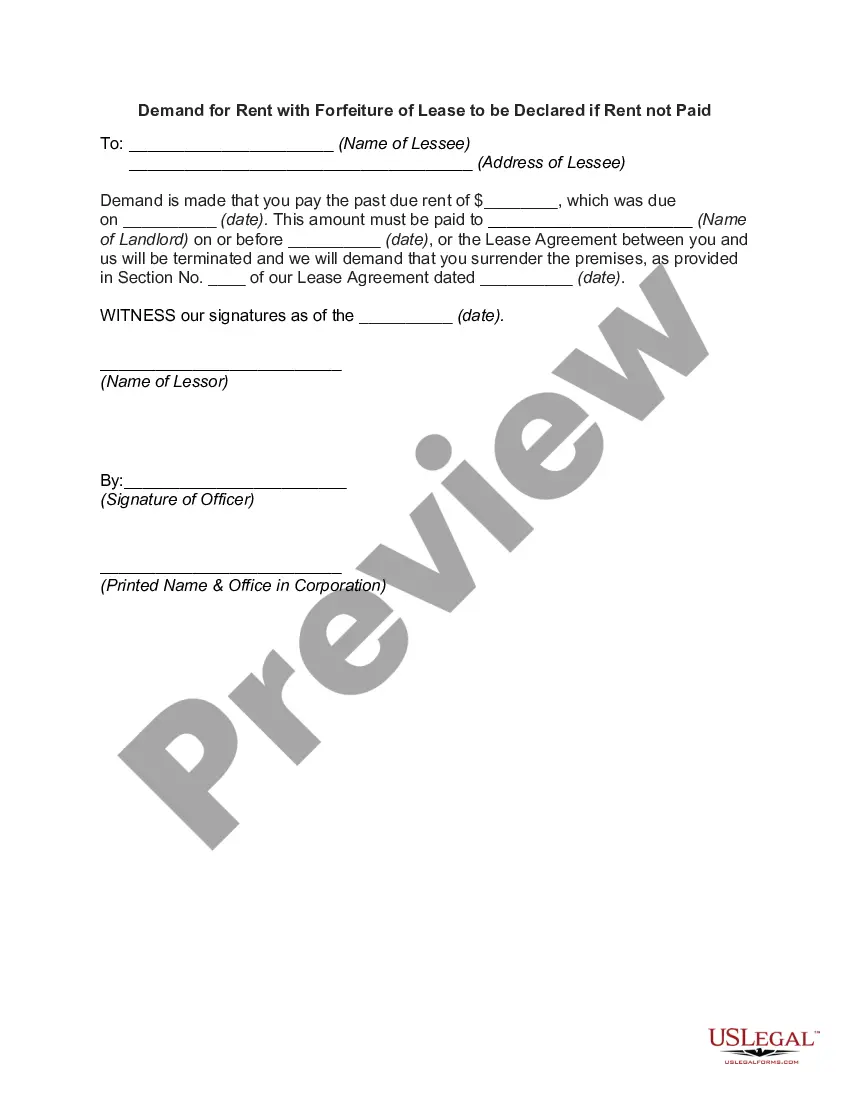
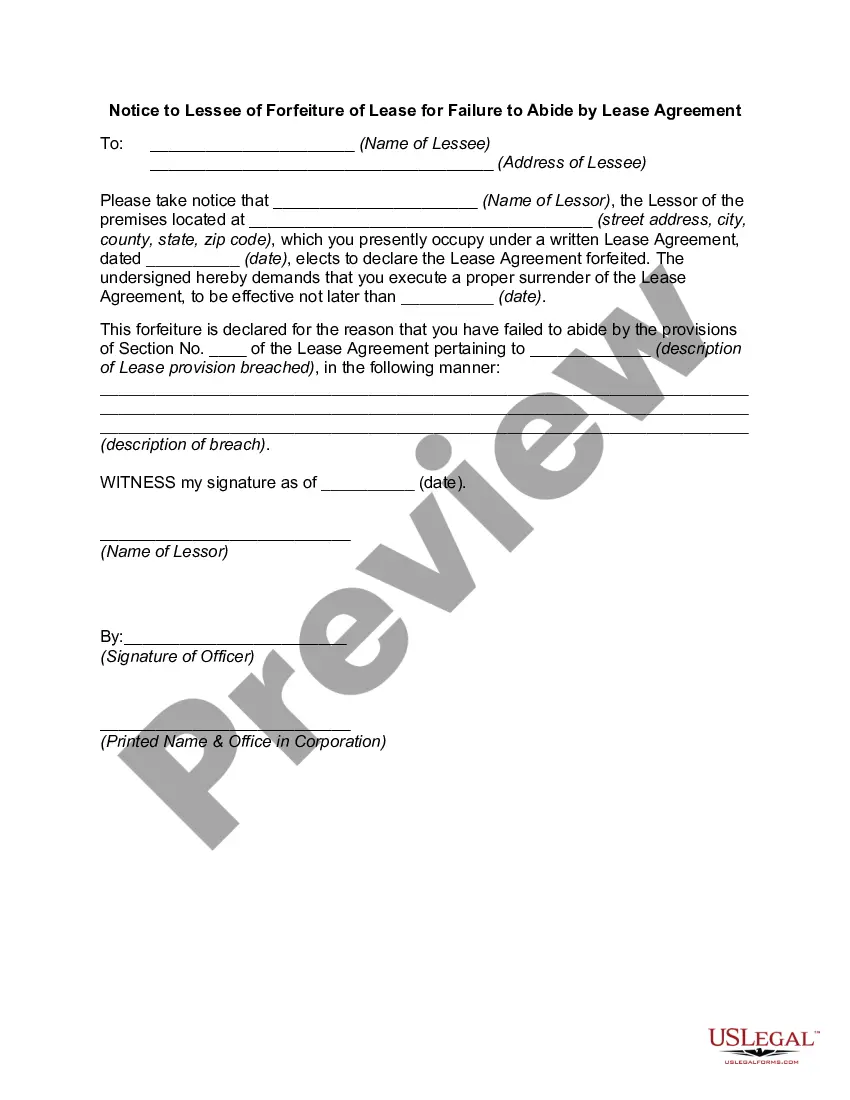
This form should be used when a landlord identifies issues with a tenant that could lead to a breach of the lease agreement. Typical scenarios include late rent payments, failure to maintain the property, or violation of lease terms. Issuing a warning letter provides the tenant with an opportunity to correct these issues before further action is taken.
Who this form is for
Anyone who meets the following criteria should consider using this form:
- Landlords who have tenants under a residential lease agreement.
- Property managers acting on behalf of landlords.
- Individuals seeking to formally communicate potential lease violations to tenants.
Steps to complete this form
Follow these steps to complete the Warning of Default on Residential Lease:
- Identify the date: Write the date of issuance on the form.
- Enter the tenant's name: Clearly state the tenant's name who is being warned.
- Specify the default conditions: Detail the specific issues or violations the tenant must address.
- Sign the form: The landlord or authorized agent should sign the form to validate it.
- Distribute the warning: Ensure that the tenant receives a copy of the completed form.
Is notarization required?
This form does not typically require notarization unless specified by local law. It serves as a formal written notice that can be delivered directly to the tenant, ensuring that they are informed of any concerning issues regarding their lease.
Get your form ready online
Our built-in tools help you complete, sign, share, and store your documents in one place.
Make edits, fill in missing information, and update formatting in US Legal Forms—just like you would in MS Word.
Download a copy, print it, send it by email, or mail it via USPS—whatever works best for your next step.
Sign and collect signatures with our SignNow integration. Send to multiple recipients, set reminders, and more. Go Premium to unlock E-Sign.
If this form requires notarization, complete it online through a secure video call—no need to meet a notary in person or wait for an appointment.
We protect your documents and personal data by following strict security and privacy standards.

Make edits, fill in missing information, and update formatting in US Legal Forms—just like you would in MS Word.

Download a copy, print it, send it by email, or mail it via USPS—whatever works best for your next step.

Sign and collect signatures with our SignNow integration. Send to multiple recipients, set reminders, and more. Go Premium to unlock E-Sign.

If this form requires notarization, complete it online through a secure video call—no need to meet a notary in person or wait for an appointment.

We protect your documents and personal data by following strict security and privacy standards.
Typical mistakes to avoid
- Failing to provide specific details about the default conditions can lead to confusion.
- Not signing the form may render it ineffective as a legal notice.
- Missing the deadline for issuing the warning could impact the landlord's legal options.
Benefits of completing this form online
- Convenience of online access allows for immediate downloading and usage.
- Editable forms enable landlords to customize the warning based on specific situations.
- Created by licensed attorneys, ensuring legal accuracy and compliance.
Looking for another form?







Form popularity
FAQ
Post the eviction notice on the tenant's door. Every eviction starts with posting an eviction notice. File an eviction complaint with the court. Attend the eviction hearing. Apply for a writ of restitution and/or set out. Set the tenant out if necessary.
Notice Requirements for Ohio Landlords A landlord can simply give you a written notice to move, allowing you 30 days as required by Ohio law and specifying the date on which your tenancy will end.
Yes. You can kick that person out. (Unless you've been directed by a court to provide housing for the person.)
The typical Ohio eviction process takes about five weeks. The eviction process starts with the posting of a three day notice. In certain cases, a longer notice is necessary but generally a three day notice covers most of the eviction issues that a landlord can encounter.
Ohio's Three-Day Notice After a tenant fails to pay rent, the first step in the Ohio eviction process is for a landlord to give the tenant a three-day notice, informing the tenant that he or she has three days to move out of the rental unit.
The notice must inform the tenant that the tenant has three days to move out of the rental unit or an eviction action will be brought against the tenant. If the tenant does not move out by the end of three days, then the landlord can go to court and file an eviction lawsuit (see Ohio Rev. Code Ann.
Month-to-month If rent is paid on a month-to-month basis, a landlord must provide the tenant with a 30-Day Notice to Quit. Week-to-week If rent is paid on a week-to-week basis, a landlord must provide the tenant with a 7-Day Notice to Quit.
Addresses. Date. Tenant names. Status and date of the lease. Why the eviction notice is served (clear and concise explanation) Date tenant must vacate the property. Proof of service or delivery of notice.
A 3 Day Notice to Pay Rent or Quit is simply a form used to notify a tenant that they are in violation of their lease for not paying rent and that they have 3 days to pay up or move out. It is the first legal step required before a landlord can move forward with an eviction by filing an unlawful retainer.