New York Warranty Deed from Individual to Husband and Wife as Joint Tenants
What is this form?
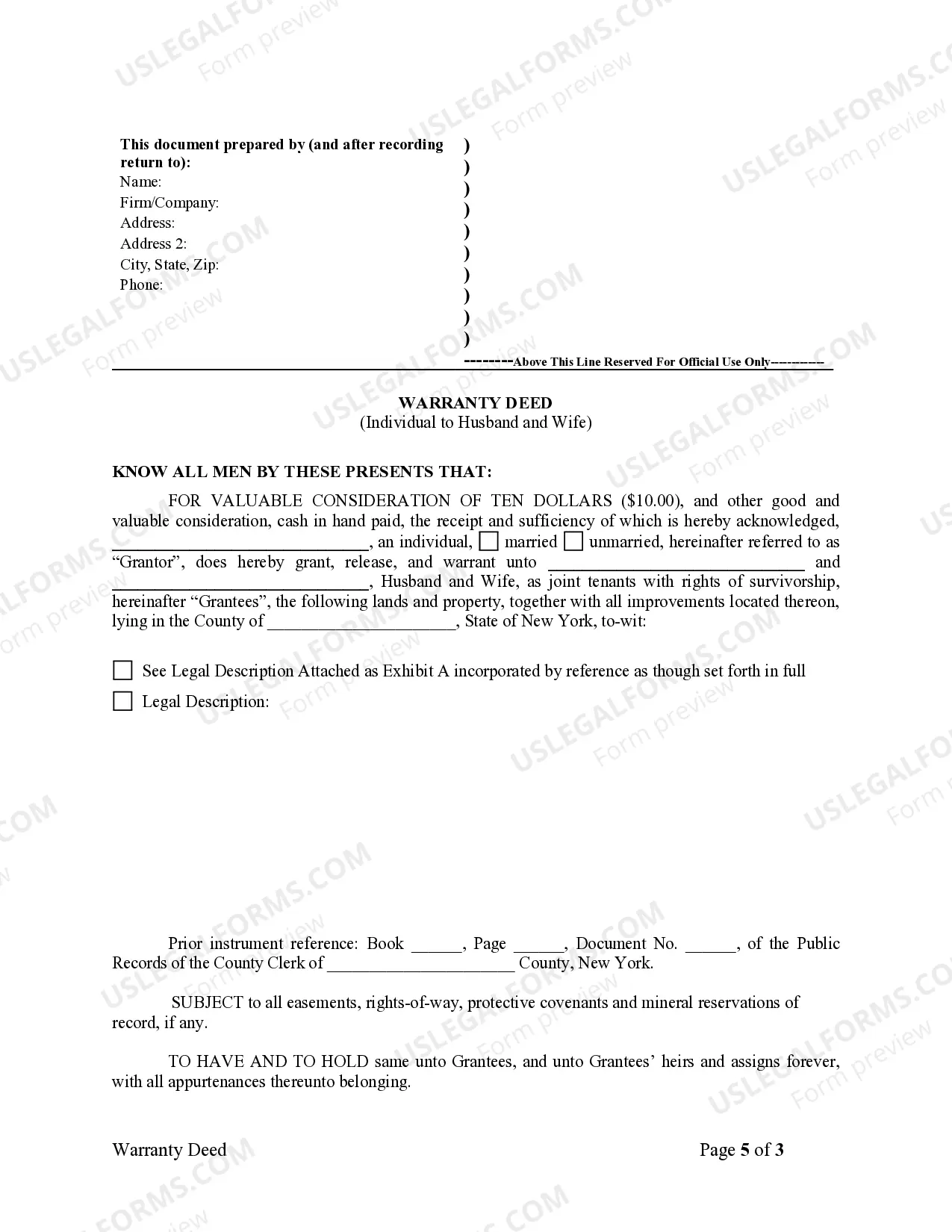
This Warranty Deed from Individual to Husband and Wife as Joint Tenants is a legal document used to transfer ownership of real property from an individual (the grantor) to a married couple (the grantees) as joint tenants. This means that both spouses hold equal ownership, and in the event of the death of one spouse, the surviving spouse automatically inherits the deceased spouse's share. This form is distinct from other types of deeds, such as quitclaim deeds, which do not guarantee a clear title to the property.
Main sections of this form
- Identification of the grantor (individual transferring property) and grantees (husband and wife).
- Description of the property being transferred, including legal description.
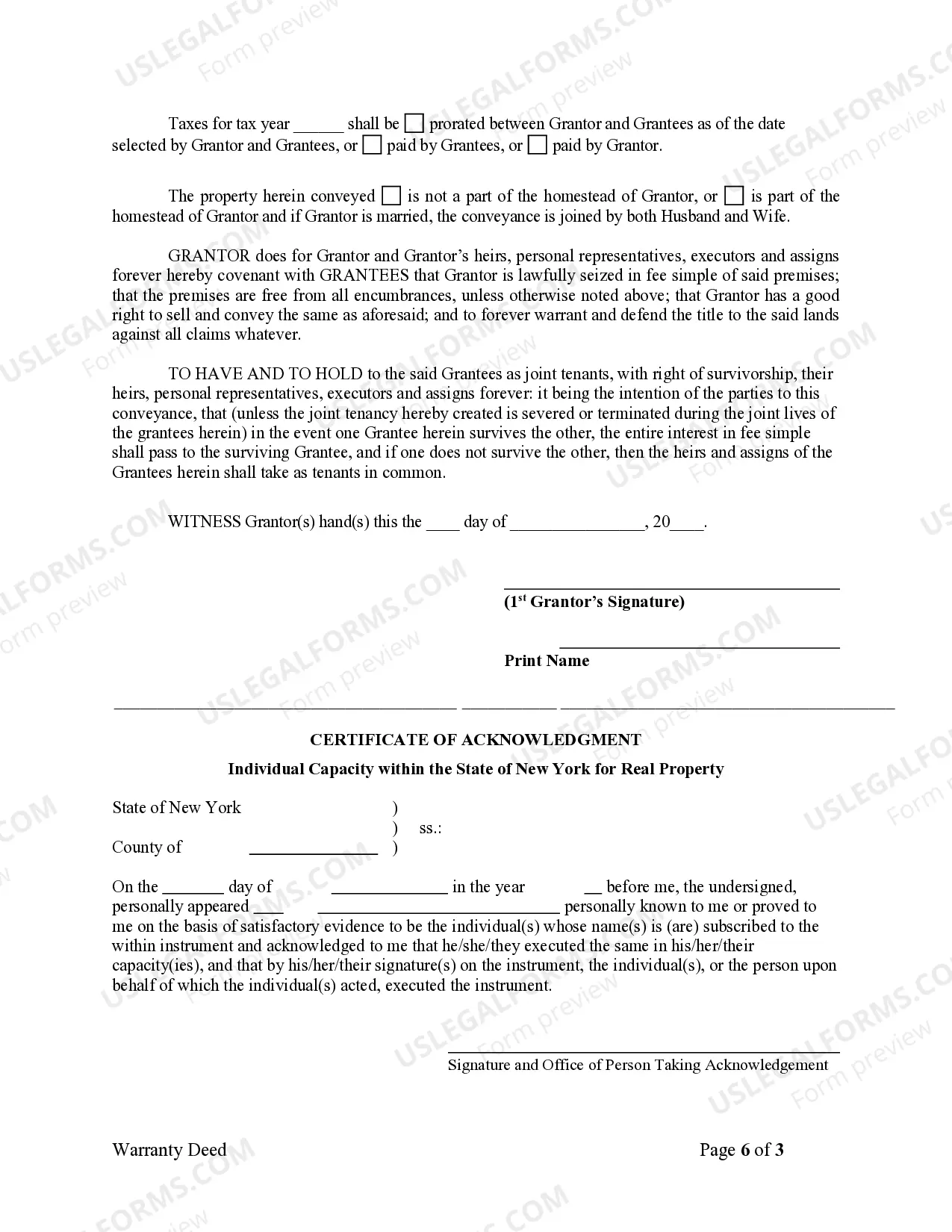
- Clauses detailing the transfer of ownership and rights of survivorship.
- Provisions for the prorating of property taxes.
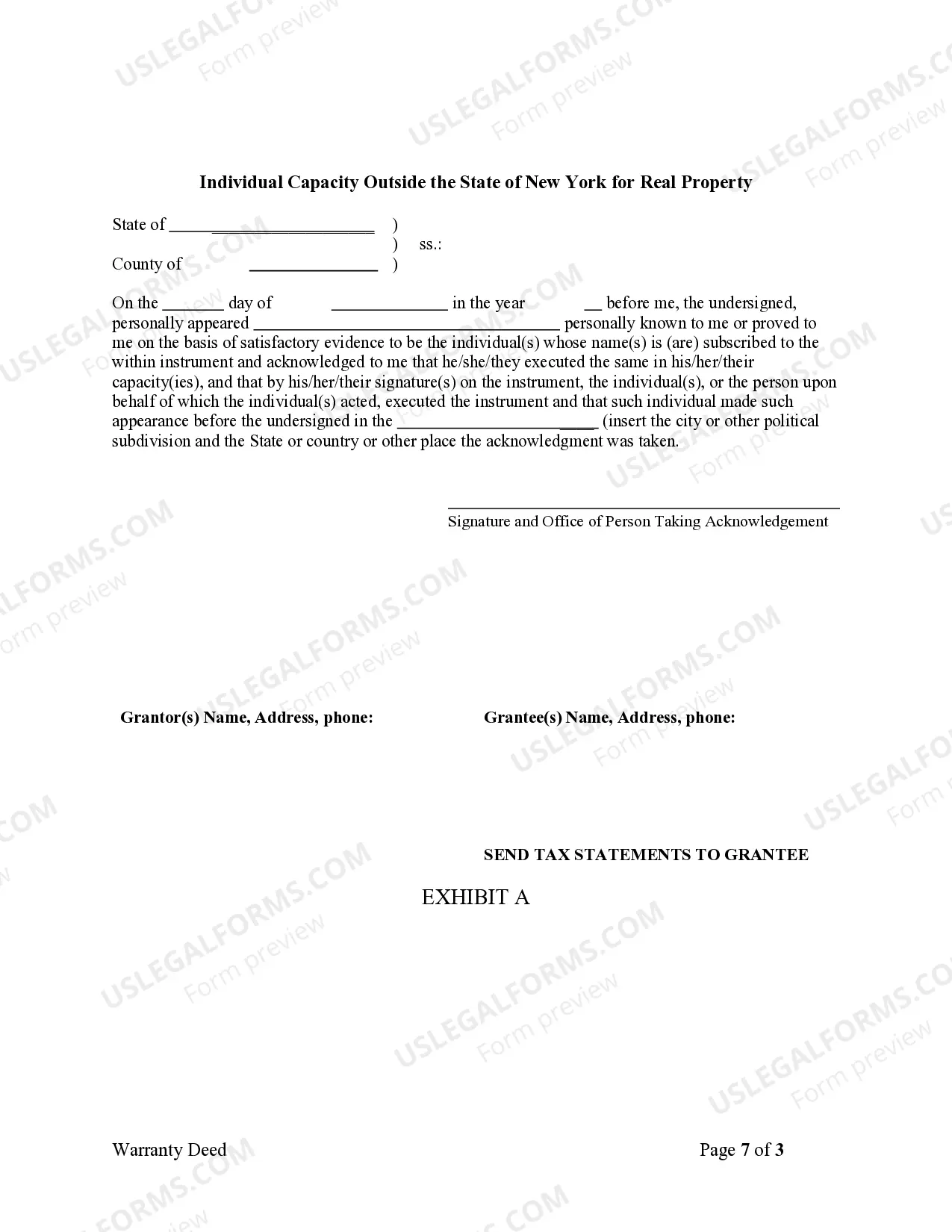
- Signatures of the grantor and acknowledgement by a notary public.






Situations where this form applies
You should use this Warranty Deed when an individual wishes to transfer ownership of real estate to a husband and wife, particularly when they want to hold the title as joint tenants with rights of survivorship. This is commonly used in situations such as marriage, gift transfers, or estate planning where both spouses are to share ownership equally and ensure automatic transfer of ownership upon death.
Who needs this form
- Individuals who own real property and wish to transfer it to their spouse.
- Married couples who want to set up joint ownership of property.
- Anyone involved in estate planning who wishes to clarify property ownership and survivorship rights.
Steps to complete this form
- Identify the grantor and grantees, including their full legal names.
- Specify the legal description of the property being transferred.
- Enter the date of the transfer and the appropriate designation of ownership as joint tenants.
- Prorate any taxes for the property for the current tax year as agreed by both parties.
- Sign the deed in the presence of a notary public to acknowledge the transfer.
Does this document require notarization?
This form must be notarized to be legally valid. US Legal Forms provides secure online notarization powered by Notarize, allowing you to complete the process through a verified video call.
Get your form ready online
Our built-in tools help you complete, sign, share, and store your documents in one place.
Make edits, fill in missing information, and update formatting in US Legal Forms—just like you would in MS Word.
Download a copy, print it, send it by email, or mail it via USPS—whatever works best for your next step.
Sign and collect signatures with our SignNow integration. Send to multiple recipients, set reminders, and more. Go Premium to unlock E-Sign.
If this form requires notarization, complete it online through a secure video call—no need to meet a notary in person or wait for an appointment.
We protect your documents and personal data by following strict security and privacy standards.

Make edits, fill in missing information, and update formatting in US Legal Forms—just like you would in MS Word.

Download a copy, print it, send it by email, or mail it via USPS—whatever works best for your next step.

Sign and collect signatures with our SignNow integration. Send to multiple recipients, set reminders, and more. Go Premium to unlock E-Sign.

If this form requires notarization, complete it online through a secure video call—no need to meet a notary in person or wait for an appointment.

We protect your documents and personal data by following strict security and privacy standards.
Common mistakes
- Failing to provide a complete legal description of the property.
- Not having the document properly notarized.
- Leaving out required signatures, particularly from both spouses.
- Incorrectly prorating property taxes or misunderstanding tax obligations.
Benefits of using this form online
- Convenient access to legally compliant forms tailored for New York state.
- Easy-to-fill form fields that can be completed from a computer or printed for manual completion.
- Time-saving download options, eliminating the need to seek legal assistance for document creation.
Looking for another form?






Form popularity
FAQ
Tags: There are two ways of co-owning property JOINT TENANTS AND TENANTS IN COMMON. The legal entitlements of these are different, with different outcomes for ownership interests on death.
The dangers of joint tenancy include the following: Danger #1: Only delays probate. When either joint tenant dies, the survivor usually a spouse or child immediately becomes the owner of the entire property. But when the survivor dies, the property still must go through probate.
Each party has a full ownership interest in the property. The property will pass instantly to the survivor upon the death of the other without probate. Conveyance by one party without the other breaks the joint tenancy. Seller warrants that he/she has good title and will warrant and defend title.
Joint tenancy is ideal for spousesJoint tenancy might look like an appealing shortcut in estate planning because it contains a right of survivorship, meaning assets avoid the probate process and surviving joint tenants assume immediate control. However, joint tenancy does have substantial risk associated with it.
If you are a joint tenant with your partner, you both have the right to carry on living in the property. However, either of you can give notice to the landlord to end the tenancy (unless it's a fixed-term tenancy).You might be able to negotiate with the landlord so that one of you can take out a new tenancy.
Joint Tenancy Two or more people, including spouses, may hold title to their jointly owned real estate as joint tenants. There is a so-called right of survivorship, which means that when one dies, the property automatically transfers to the survivor without the necessity of probating the estate.
The term joint tenancy refers to a legal arrangement in which two or more people own a property together, each with equal rights and obligations. Joint tenancies can be created by married and non-married couples, friends, relatives, and business associates.
In estate law, joint tenancy is a special form of ownership by two or more persons of the same property. The individuals, who are called joint tenants, share equal ownership of the property and have the equal, undivided right to keep or dispose of the property. Joint tenancy creates a Right of Survivorship.
In California, most married couples hold real property (such as land and buildings) as joint tenants with right of survivorship.For instance, many married couples share real property as joint tenants. This way, upon the death of a spouse, the surviving spouse will own 100% share of the property.