Nevada Name Affidavit of Buyer
Overview of this form
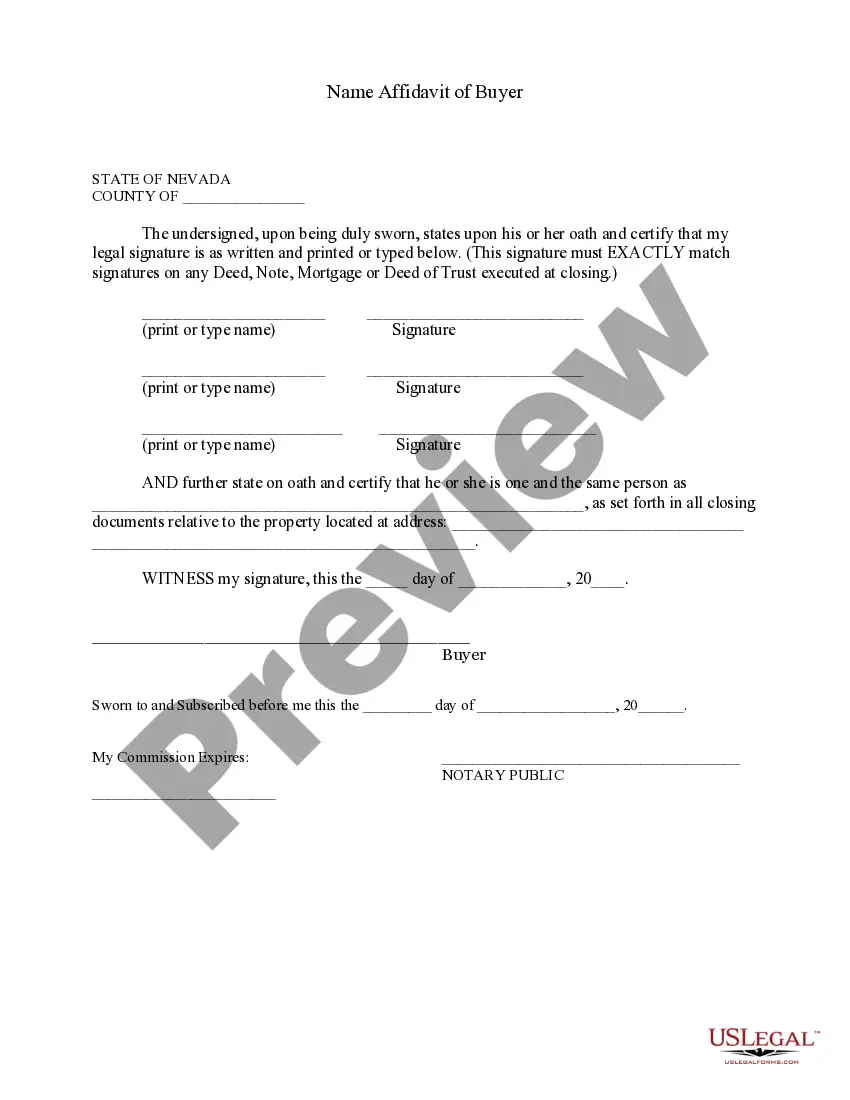
The Name Affidavit of Buyer is a legal document used by buyers to affirm their legal name and any alias names they may use. This affidavit is essential for clarifying any discrepancies in signatures that may arise from variations in how an individualâs name is written. Unlike other types of affidavits, this form specifically addresses the identity of the buyer in property transactions, ensuring that all parties recognize that different names refer to the same individual.
Main sections of this form
- State and county information where the affidavit is executed.
- Section to print or type the legal name of the buyer.
- Signature lines for the buyer, confirming their legal name.
- Certification section that states the buyer's aliases are all the same person.
- Property address details related to the transaction.
- Notary acknowledgment section to validate the affidavit.

Common use cases
This form is typically used in real estate transactions, particularly when a buyer's name may appear differently on various documents. For example, if a buyer has employed different name variations, such as John Smith, John T. Smith, or J.S. Smith, this affidavit serves to unify those names into one legal identity as they pertain to property transactions. It helps prevent potential disputes or confusions at closing or when reinforcing ownership rights.
Who needs this form
This affidavit is intended for:
- Individuals involved in purchasing real estate who have multiple name variations.
- Buyers who need to provide clarity on their legal identity for transaction purposes.
- Real estate agents and attorneys assisting clients in property transactions.
Instructions for completing this form
- Start by filling in the state and county where the affidavit is executed.
- Print or type your full legal name clearly in the designated area.
- Sign the affidavit, ensuring your signature matches all closing documents.
- Specify any other names you have used that are relevant to the property transaction.
- Provide the complete address of the property involved in the transaction.
- Have the affidavit notarized by a licensed notary public.
Does this form need to be notarized?
Yes, this form must be notarized to be legally valid. The affidavit requires a notary public to witness your signature, providing further legitimacy to the document. US Legal Forms offers integrated online notarization, ensuring that you can complete this process conveniently and securely from anywhere, at any time.
Get your form ready online
Our built-in tools help you complete, sign, share, and store your documents in one place.
Make edits, fill in missing information, and update formatting in US Legal Forms—just like you would in MS Word.
Download a copy, print it, send it by email, or mail it via USPS—whatever works best for your next step.
Sign and collect signatures with our SignNow integration. Send to multiple recipients, set reminders, and more. Go Premium to unlock E-Sign.
If this form requires notarization, complete it online through a secure video call—no need to meet a notary in person or wait for an appointment.
We protect your documents and personal data by following strict security and privacy standards.

Make edits, fill in missing information, and update formatting in US Legal Forms—just like you would in MS Word.

Download a copy, print it, send it by email, or mail it via USPS—whatever works best for your next step.

Sign and collect signatures with our SignNow integration. Send to multiple recipients, set reminders, and more. Go Premium to unlock E-Sign.

If this form requires notarization, complete it online through a secure video call—no need to meet a notary in person or wait for an appointment.

We protect your documents and personal data by following strict security and privacy standards.
Common mistakes
- Failing to ensure that the signature matches previous documents exactly.
- Leaving out aliases or different names associated with the buyer.
- Not having the document notarized, which is often a requirement.
- Incorrectly filling out the property address section.
- Not completing the affidavit in the correct county jurisdiction.
Advantages of online completion
- Convenience: Download and complete the form at your own pace.
- Editability: Easily fill in your information before finalizing.
- Reliability: Access forms drafted by licensed attorneys for assurance of compliance with legal standards.
Summary of main points
- The Name Affidavit of Buyer clarifies identity in property transactions.
- It is essential for buyers with multiple names or aliases.
- Proper completion and notarization of the affidavit are crucial for legal validity.
- This form is tailored for use specifically in Nevada.
Looking for another form?




Form popularity
FAQ
After the payment has been transferred, the seller needs to sign the title over to the buyer (instructions are normally provided on the back). The seller will then need to contact the DMV within 5 days to transfer ownership and release themselves from any liability for the vehicle.
This document is required to be notarized or signed in person at the Nevada DMV.
The buyer must complete the back top portion of the title. Legibly write your resident address to ensure your new title is mailed correctly. Ensure you sign and date next to your drivers license number. If you do not have a drivers license write in your identification card number instead.
Completed Application for Title or Registration (Form REG 343) Out-of-state title and registration. License plates (unless already expired, surrendered, or assigned to an interstate-registered vehicle) Weight certificate (for pick-up trucks) $21 for title fee.
If you buy in Nevada, and it does not pass California emissions, tests, you will have to upgrade it before you can sell it in California. Unless the car is new (fewer than 7500 miles) it does not have to have California-specific equipment. It will, however, still have to pass a smog test.
A Nevada bill of sale is a document that acts as proof of ownership for the described item. The parties involved in the bill of sale are referred to as the buyer and the seller. A Nevada bill of sale does not need to be notarized.
Have both parties sign it, create a copy, and then send the bill of sale to the DMV. If anything happens and the buyer fails to register the car, you'll have the proof needed to say the car's ownership has been transferred and it is no longer in your name.
Directly under the statement Assignment of title by registered owner, write in the date the car was sold. On the next line, write in the name or names of the buyers and their address. On the next line, write in the odometer reading. Where it says Signature(s) of buyer, the buyer or buyers must sign the title.