Nevada Final Notice of Default for Past Due Payments in connection with Contract for Deed
What is this form?
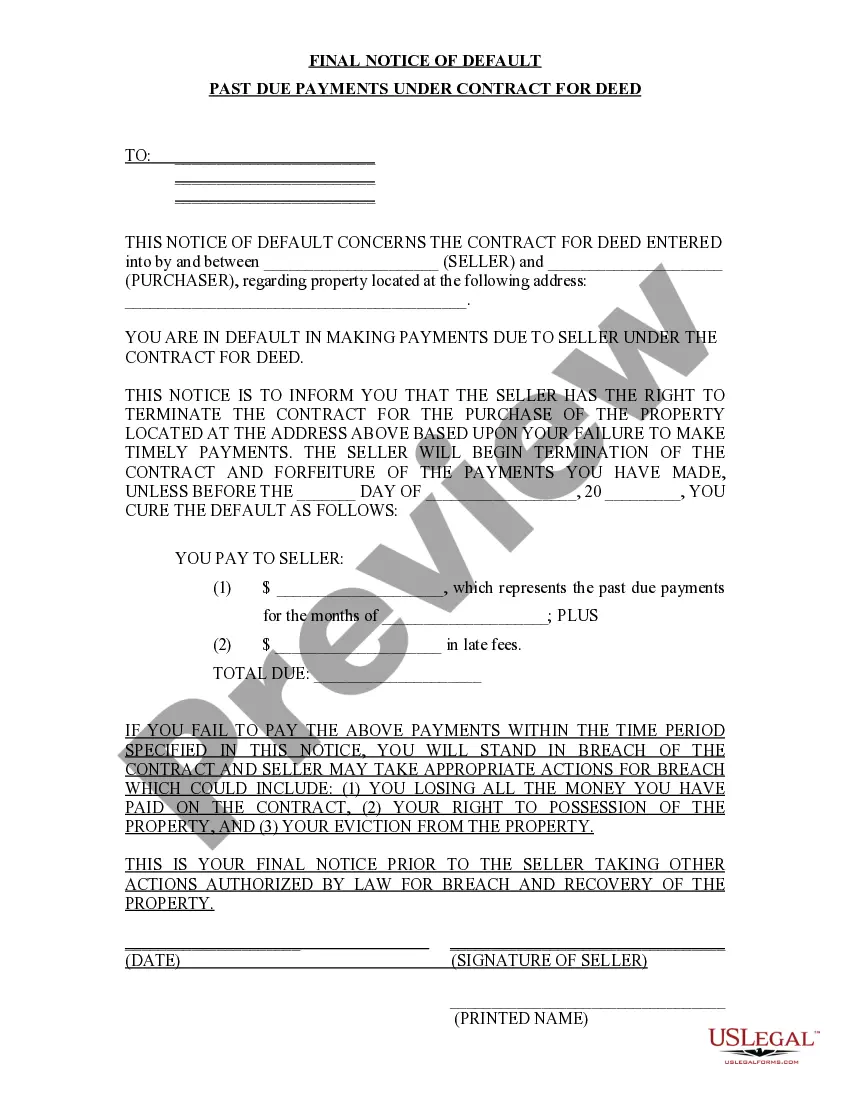
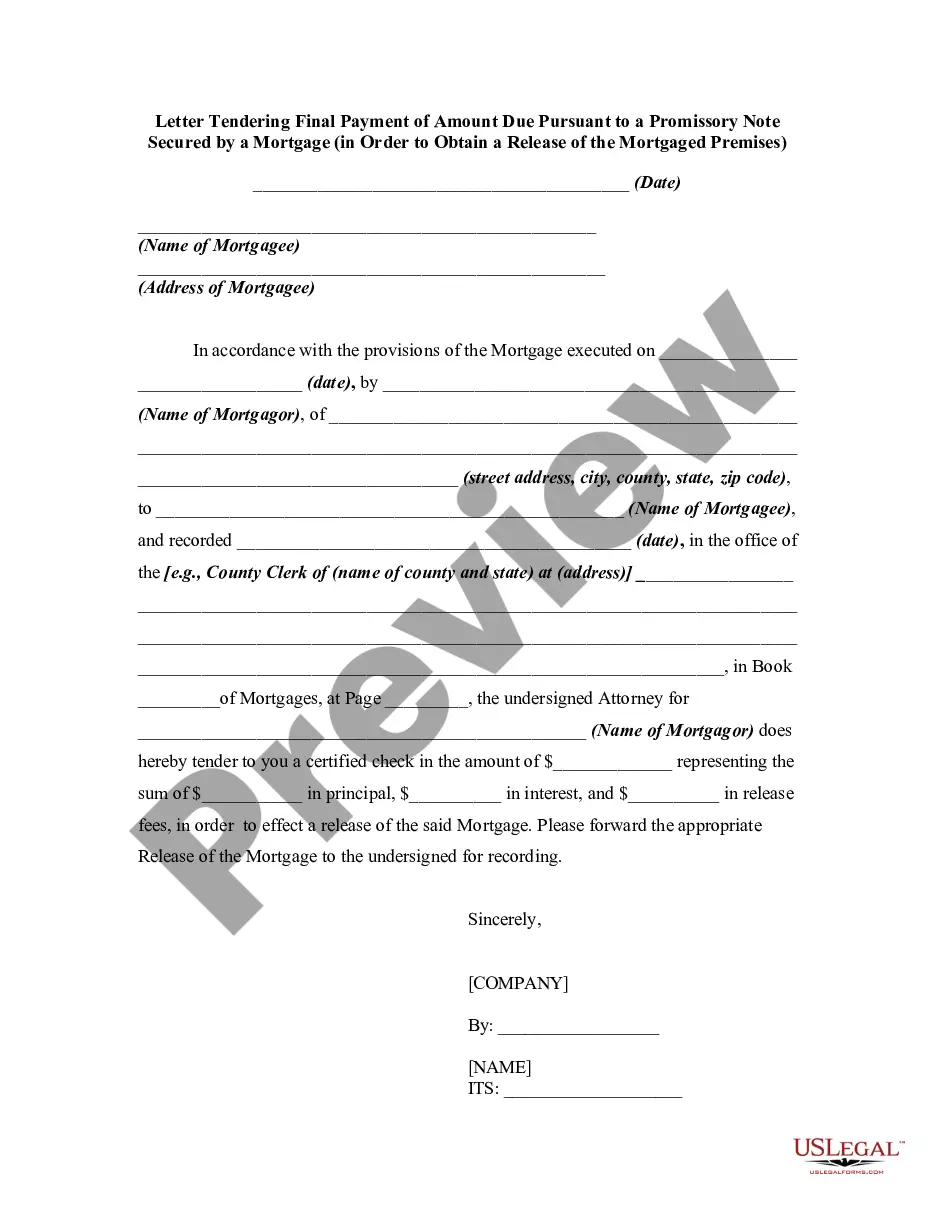
The Final Notice of Default for Past Due Payments in connection with Contract for Deed is a formal document that alerts the purchaser of their failure to make required payments under a contract for deed. This notice serves as the seller's final communication before taking legal actions, such as terminating the contract and potentially evicting the purchaser. Unlike general notices, this form specifically addresses failures in payment related to real estate transactions secured by a contract for deed.
Key parts of this document
- Identification of both the seller and purchaser
- Address of the property associated with the contract
- Details regarding the specific payments missed
- Amount due, including any late fees
- Final deadline for curing the default
- Consequences of failing to make payments

When to use this form
This form should be used when a purchaser has fallen behind on their payments for a property secured under a contract for deed. It is applicable when the seller wishes to inform the purchaser that their contract is in default and provide a final opportunity to make the overdue payments before further legal actions are initiated.
Intended users of this form
This form is intended for:
- Property sellers who have entered into a contract for deed and need to notify the buyer of missed payments
- Purchasers who are behind on payments and are facing potential contract termination
Instructions for completing this form
- Identify the parties involvedâenter the names of the seller and purchaser.
- Specify the address of the property related to the contract for deed.
- Fill in the details of past due payments and any applicable late fees.
- Set a final date for payment to avoid further actions.
- Include the signature of the seller and date when the notice is issued.
Notarization guidance
This form does not typically require notarization unless specified by local law. Make sure to verify local requirements to ensure compliance with any necessary legal standards.
Get your form ready online
Our built-in tools help you complete, sign, share, and store your documents in one place.
Make edits, fill in missing information, and update formatting in US Legal Forms—just like you would in MS Word.
Download a copy, print it, send it by email, or mail it via USPS—whatever works best for your next step.
Sign and collect signatures with our SignNow integration. Send to multiple recipients, set reminders, and more. Go Premium to unlock E-Sign.
If this form requires notarization, complete it online through a secure video call—no need to meet a notary in person or wait for an appointment.
We protect your documents and personal data by following strict security and privacy standards.

Make edits, fill in missing information, and update formatting in US Legal Forms—just like you would in MS Word.

Download a copy, print it, send it by email, or mail it via USPS—whatever works best for your next step.

Sign and collect signatures with our SignNow integration. Send to multiple recipients, set reminders, and more. Go Premium to unlock E-Sign.

If this form requires notarization, complete it online through a secure video call—no need to meet a notary in person or wait for an appointment.

We protect your documents and personal data by following strict security and privacy standards.
Common mistakes to avoid
- Failing to specify the correct amounts due or deadlines.
- Not providing enough detail about the contract terms.
- Neglecting to sign and date the notice.
- Using vague language that could lead to misunderstandings.
Why use this form online
- Convenience of completing the form at your own pace.
- Editable templates that allow for customization to fit specific needs.
- Access to forms drafted by licensed attorneys, ensuring legal accuracy.
Legal use & context
- This form serves as a critical legal step before contract termination.
- It provides evidence of attempts to resolve the payment issue amicably.
- Proper use of this form can safeguard sellers against claims of improper eviction.
Key takeaways
- The Final Notice of Default is essential for notifying purchasers of their payment failures.
- It sets a clear deadline and outlines potential consequences of non-compliance.
- Using this form correctly can help protect the seller's rights and streamline the legal process.
Looking for another form?
Form popularity
FAQ
A few potential ways to stop a foreclosure include reinstating the loan, redeeming the property before the sale, or filing for bankruptcy. (Of course, if you're able to work out a loss mitigation option, like a loan modification, that will also stop a foreclosure.)
The notice of default doesn't affect your credit file, but when the account defaults this will be recorded.If the debt is regulated by the Consumer Credit Act, you must be sent a default notice warning letter and have time to act on it before the default is recorded on your credit file.
You can bring your loan current and stave off the foreclosure sale filing by paying the past due amount, plus penalties.You typically have to reinstate at least five days before the lender's deadline or risk the lender rejecting your payment and proceeding with a sale.
A notice of default is the first step to a bank or mortgage lender's foreclosure process.If the mortgage is not paid up to date, the lender will seize the home. A notice of default is also known as a reinstatement period, notice of public auction, or notice of foreclosure.
Write to the agency making the claim. Present evidence of why the NOD was improperly issued or why you legitimately cannot make payments. Ask the agency in the letter if they will take a lower monthly payment, total settlement or a payment plan. Send a copy of your letter by certified mail.
A notice of default is the first step to a bank or mortgage lender's foreclosure process.If the mortgage is not paid up to date, the lender will seize the home. A notice of default is also known as a reinstatement period, notice of public auction, or notice of foreclosure.
After the lender files the Notice of Default, you get 90 days to bring your past-due bill current. After the 90 days pass, the lender files a Notice of Sale with the clerk. The Notice of Sale displays the location, date and time of the sale. It lists the trustee's name and contact information.
The foreclosure process is defined by California civil code 2924 and begins with the filing of a Notice of Default (NOD) with the county recorder. Once a borrower is at least 90 days behind in making mortgage payments, the lender will file a Notice of Default with the court of the county where the property is located.