New Mexico Warranty Deed from two Individuals to Husband and Wife
Understanding this form
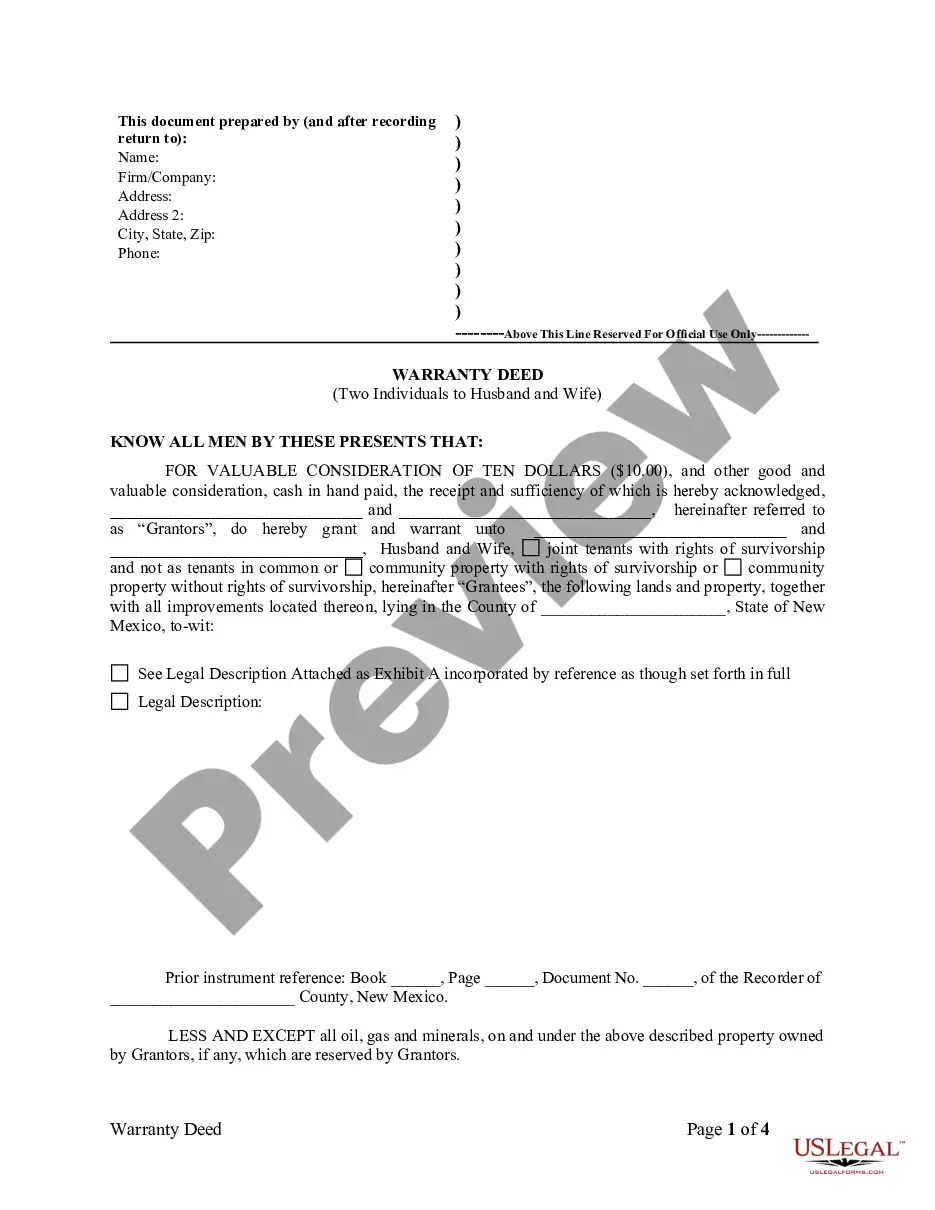
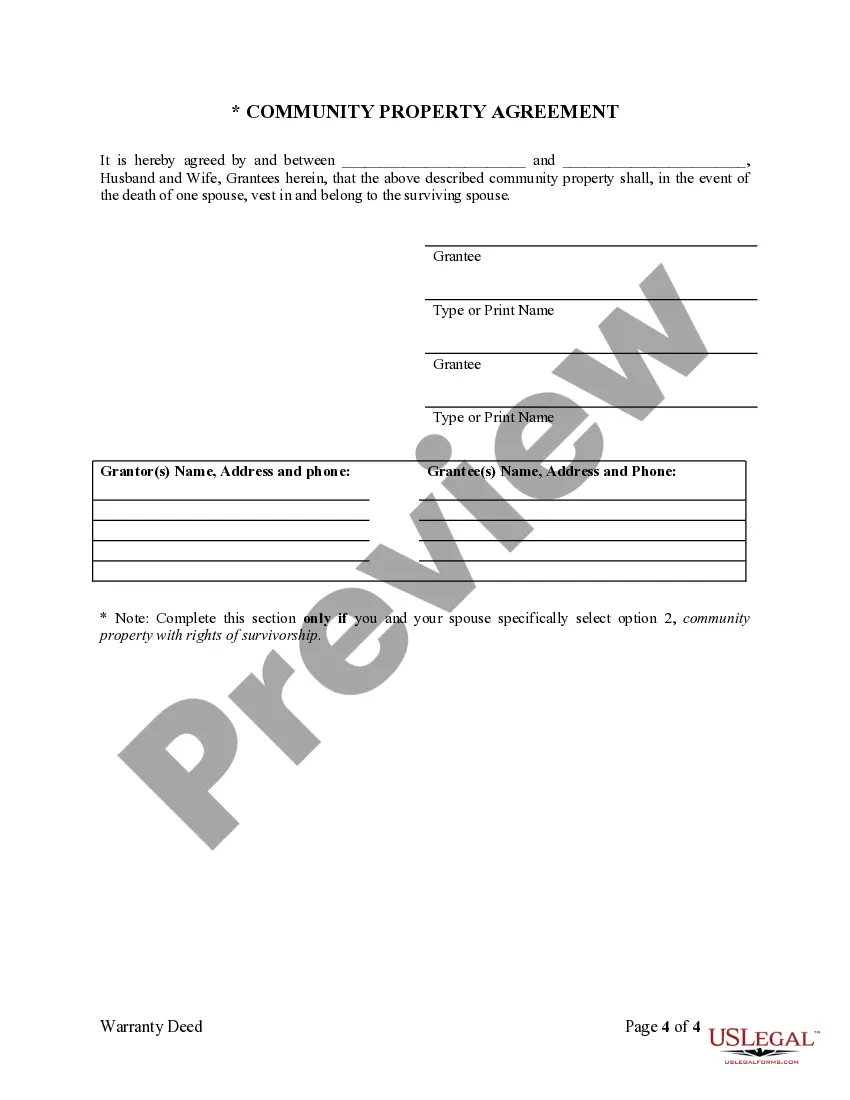
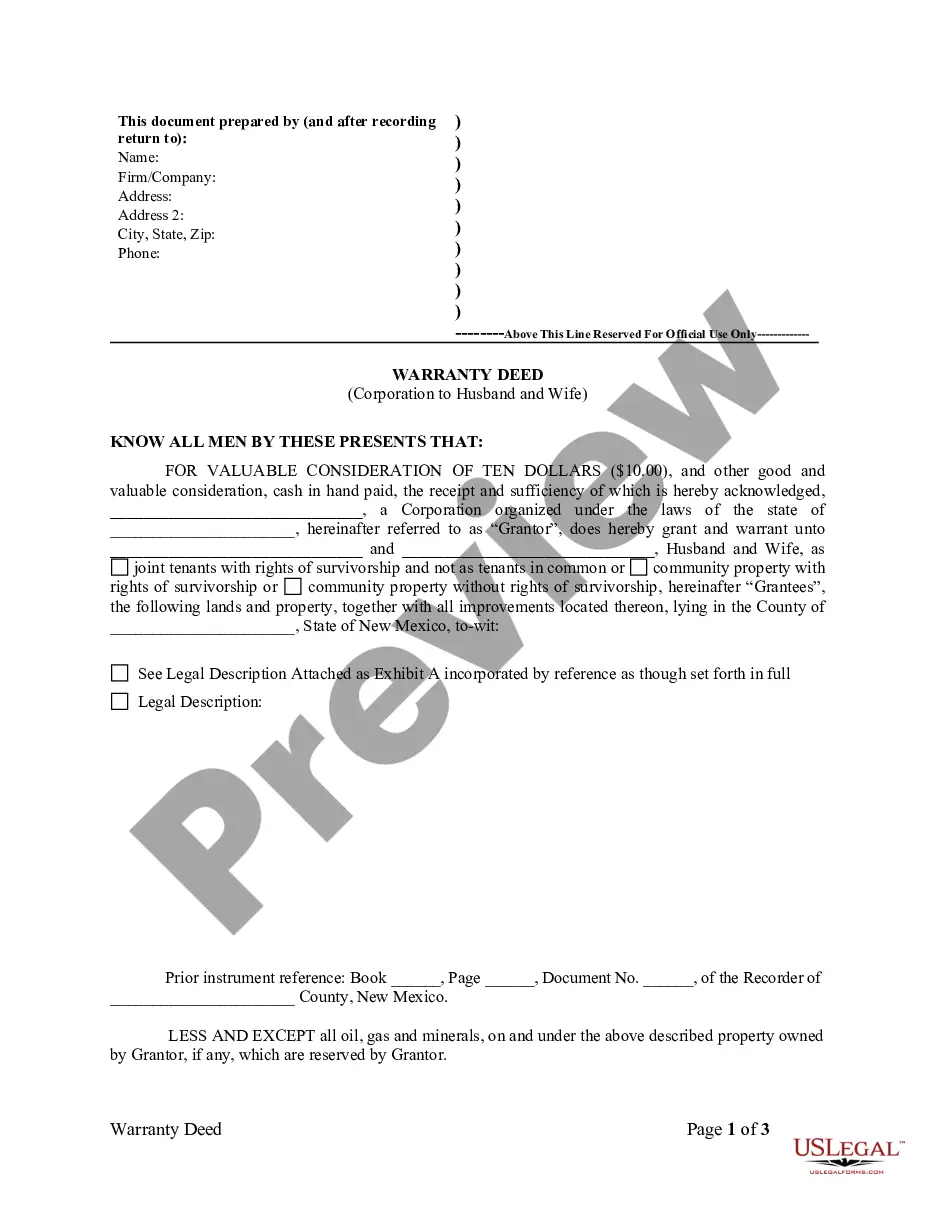
The Warranty Deed from two Individuals to Husband and Wife is a legal document used to transfer property ownership from two individuals (Grantors) to a married couple (Grantees). This warranty deed ensures that the Grantors warrant clear title to the property and that there are no outstanding encumbrances, unless noted otherwise. It is important for married couples acquiring property together as it protects their interests and establishes their ownership jointly.
Key parts of this document
- Legal description of the property being conveyed.
- Explicit warranty of title by the Grantors.
- Provisions for the reservation of oil, gas, and mineral rights.
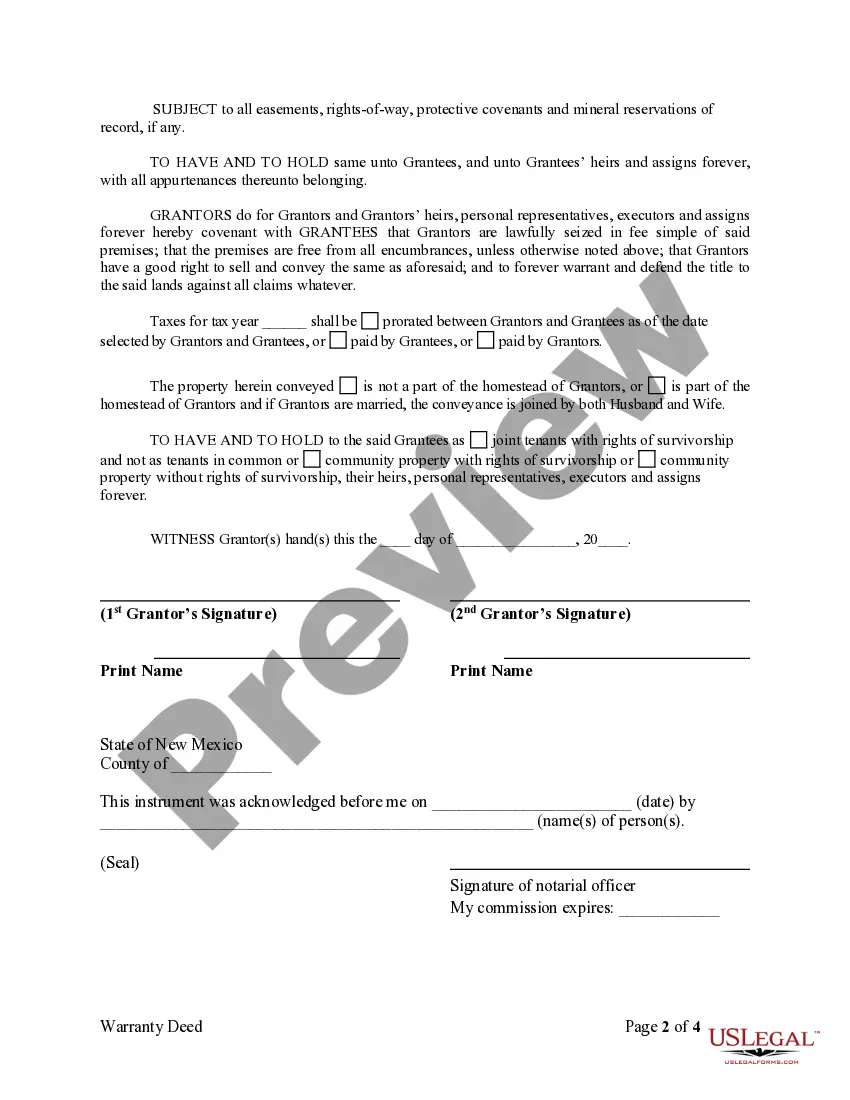
- Details regarding tax prorations for the property.
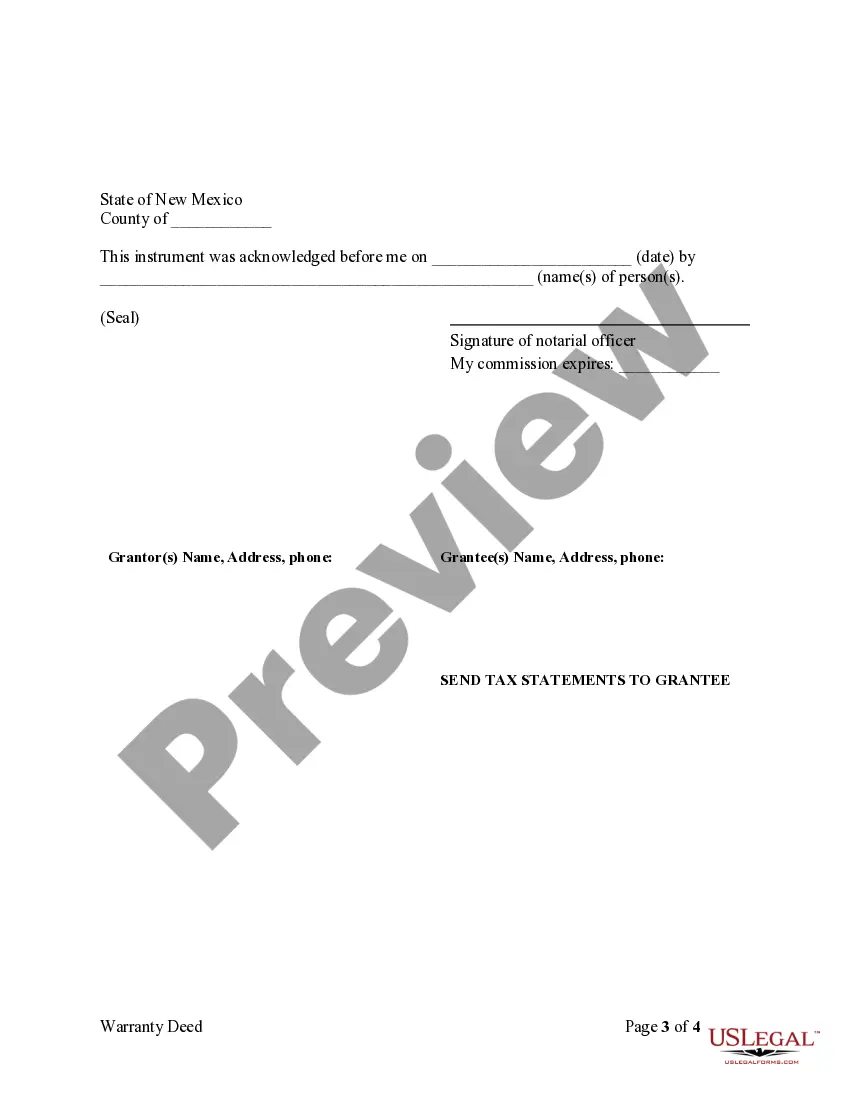
- Signatures of the Grantors and acknowledgment by a notary public.




Situations where this form applies
This form is useful when two individuals are transferring property to a married couple. It is applicable in scenarios such as gifting property to family members, purchasing property in joint names, or when one spouse wants to add another spouse to the title of a property they own. Using this deed helps ensure both parties are legally protected in the transaction.
Who this form is for
This form is intended for:
- Individuals or couples involved in a property transfer.
- Married couples acquiring property jointly.
- Real estate professionals facilitating property transactions.
- Attorneys representing clients in real estate matters.
Steps to complete this form
- Identify the Grantors and Grantees: Clearly state the names of the individuals transferring the property and the names of the husband and wife receiving it.
- Specify the property: Include the legal description of the property being transferred in accordance with state requirements.
- Outline reservations: Indicate any reservations of rights, such as for oil, gas, or minerals, if applicable.
- Fill in tax arrangements: Decide whether taxes for the current year will be prorated or paid by one of the parties and fill in the appropriate details.
- Sign and notarize: Ensure all parties sign the document in the presence of a notary public for it to be legally binding.
Does this form need to be notarized?
To make this form legally binding, it must be notarized. Our online notarization service, powered by Notarize, lets you verify and sign documents remotely through an encrypted video session.
Get your form ready online
Our built-in tools help you complete, sign, share, and store your documents in one place.
Make edits, fill in missing information, and update formatting in US Legal Forms—just like you would in MS Word.
Download a copy, print it, send it by email, or mail it via USPS—whatever works best for your next step.
Sign and collect signatures with our SignNow integration. Send to multiple recipients, set reminders, and more. Go Premium to unlock E-Sign.
If this form requires notarization, complete it online through a secure video call—no need to meet a notary in person or wait for an appointment.
We protect your documents and personal data by following strict security and privacy standards.

Make edits, fill in missing information, and update formatting in US Legal Forms—just like you would in MS Word.

Download a copy, print it, send it by email, or mail it via USPS—whatever works best for your next step.

Sign and collect signatures with our SignNow integration. Send to multiple recipients, set reminders, and more. Go Premium to unlock E-Sign.

If this form requires notarization, complete it online through a secure video call—no need to meet a notary in person or wait for an appointment.

We protect your documents and personal data by following strict security and privacy standards.
Avoid these common issues
- Failing to include a complete legal description of the property.
- Not obtaining signatures from both Grantors if they are married.
- Omitting tax allocation details, leading to confusion later.
- Neglecting to get the document notarized if required by state law.
Why use this form online
- Convenience of downloading the form instantly.
- Editable templates that can be tailored to fit your specific transaction.
- Access to professionally drafted forms ensuring compliance with legal standards.
- Secure online storage options for your completed legal documents.
Looking for another form?

Form popularity
FAQ
If you live in a common-law state, you can keep your spouse's name off the title the document that says who owns the property.You can put your spouse on the title without putting them on the mortgage; this would mean that they share ownership of the home but aren't legally responsible for making mortgage payments.
What Is the Difference Between a Warranty Deed & a Survivorship Deed?A warranty deed is the most comprehensive and provides the most guarantees. Survivorship isn't so much a deed as a title. It's a way to co-own property where, upon the death of one owner, ownership automatically passes to the survivor.
The New Mexico special warranty deed is a legal document used to convey real estate.A special warranty includes a guarantee from the grantor that there are no hidden interests or encumbrances on the property that arose while he or she owned the property.
Joint Tenancy Two or more people, including spouses, may hold title to their jointly owned real estate as joint tenants. There is a so-called right of survivorship, which means that when one dies, the property automatically transfers to the survivor without the necessity of probating the estate.
Each party has a full ownership interest in the property. The property will pass instantly to the survivor upon the death of the other without probate. Conveyance by one party without the other breaks the joint tenancy. Seller warrants that he/she has good title and will warrant and defend title.
A Survivorship Deed transfers residential or commercial property from one property owner (the grantor) to another (the grantee) while allowing them to avoid going through probate when they (the grantor) passes away. The parties transferring property in a Survivorship Deed must have full ownership of the property.
The most recognized form for a married couple is to own their home as Tenants by the Entirety. A tenancy by the entirety is ownership in real estate under the fictional assumption that a husband and wife are considered one person for legal purposes. This method of ownership conveys the property to them as one person.
In estate law, joint tenancy is a special form of ownership by two or more persons of the same property. The individuals, who are called joint tenants, share equal ownership of the property and have the equal, undivided right to keep or dispose of the property. Joint tenancy creates a Right of Survivorship.
In California, all property bought during the marriage with income that was earned during the marriage is deemed "community property." The law implies that both spouses own this property equally, regardless of which name is on the title deed.