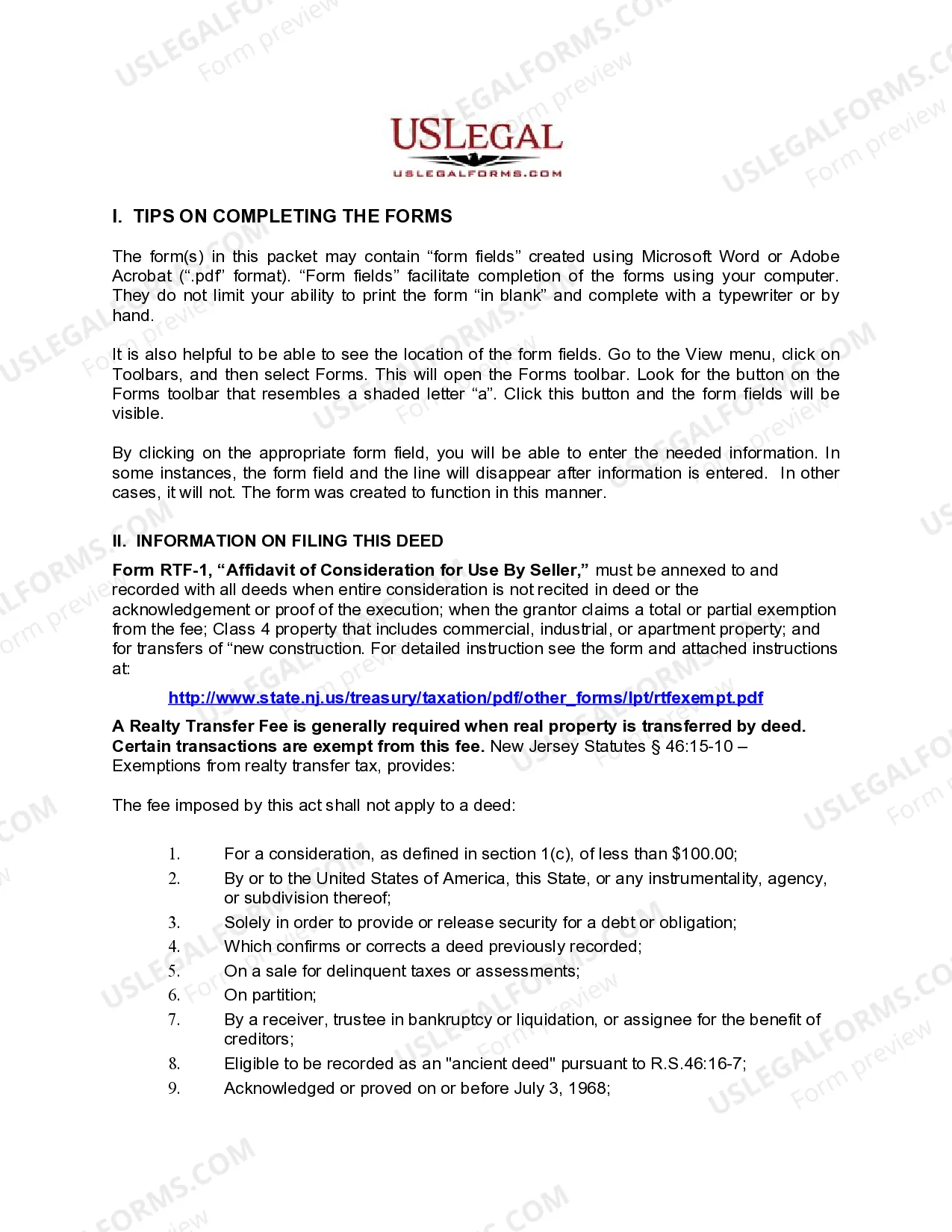
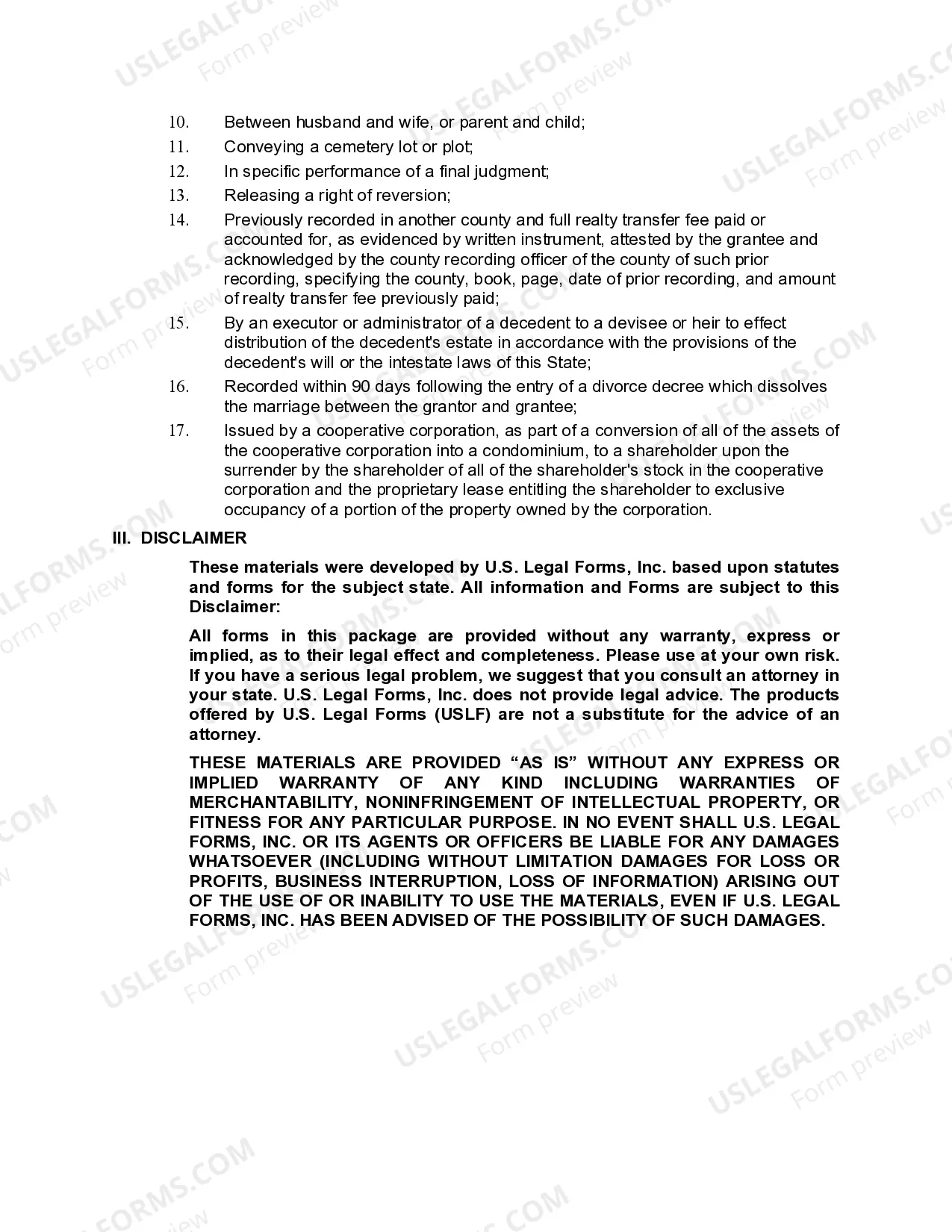
New Jersey Warranty Deed from Husband and Wife to Husband and Wife
About this form
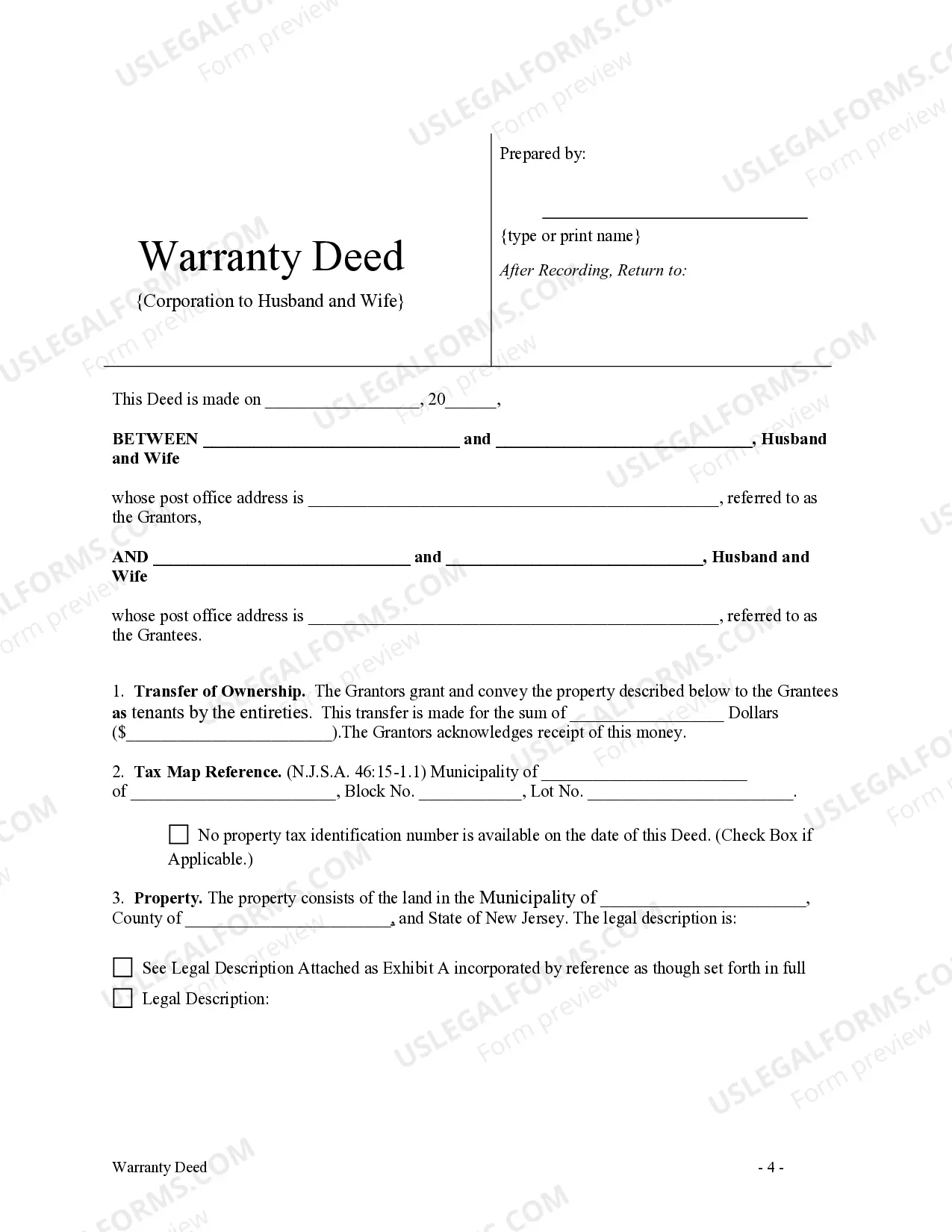
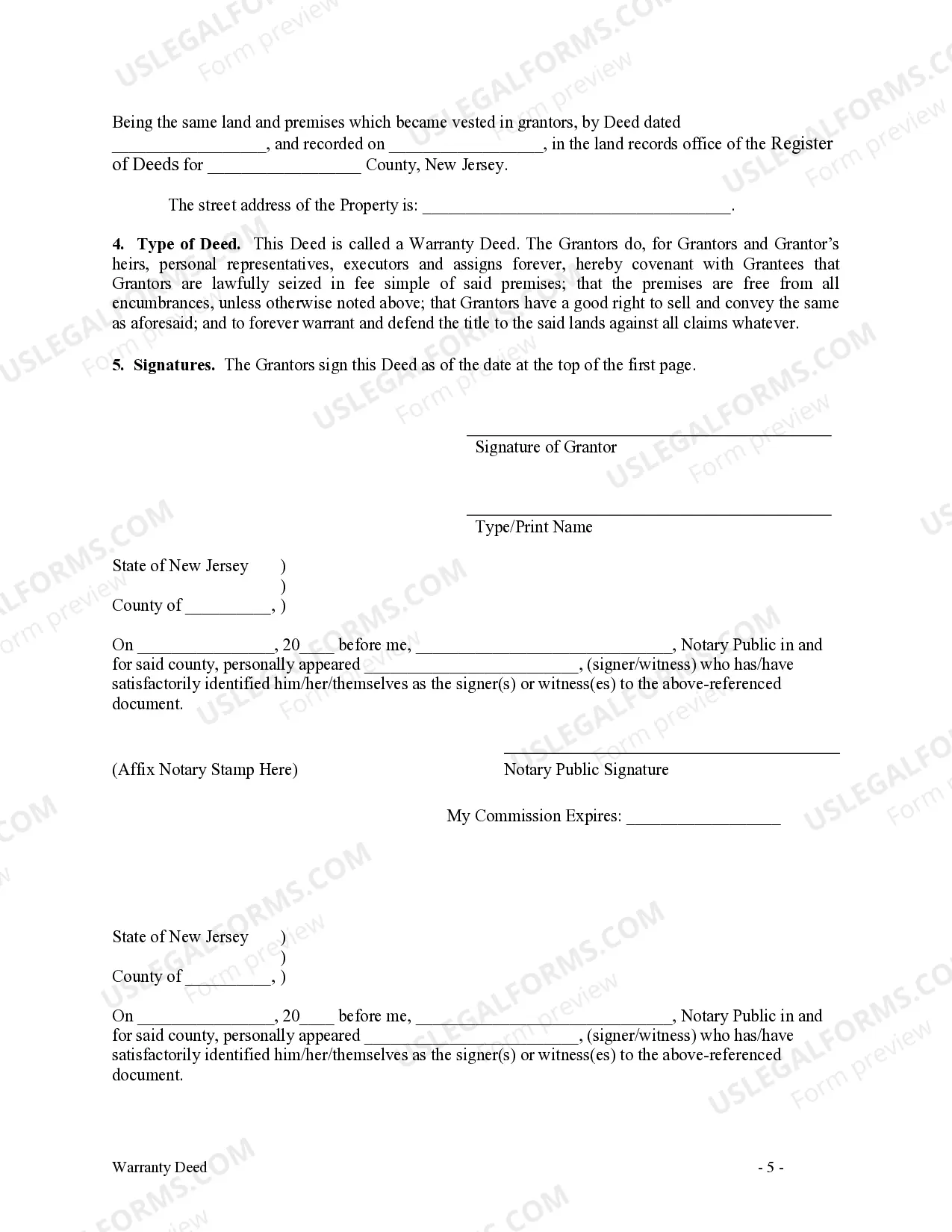
This form is a Warranty Deed from Husband and Wife to Husband and Wife, which is used to transfer ownership of a property between spouses. Unlike other types of deeds, this Warranty Deed provides a guarantee that the grantors own the property free of any encumbrances, allowing for secure ownership transfer with specific warranties on the property title. This deed specifically excludes the transfer of oil, gas, and minerals beneath the property, ensuring that those rights remain with the grantors.
Key parts of this document
- Identification of grantors (the transferring party) and grantees (the receiving party).
- Transfer of ownership terms, including the consideration (amount of money exchanged).
- Description of the property involved, including legal references and location details.
- Covenants related to the warranty, assuring grantees of clear title without encumbrances.
- Signature lines for grantors, along with notary public sections, if necessary.





When to use this document
Who needs this form
- Married couples looking to transfer property ownership between themselves.
- Individuals involved in estate planning or asset management.
- Parties engaged in divorce proceedings that require property division.
- Anyone needing to clarify property rights related to marital assets.
Completing this form step by step
- Identify the grantors and grantees, entering their names and addresses in the designated fields.
- Specify the consideration, indicating the monetary amount exchanged for the property.
- Provide a clear description of the property being transferred, referencing any legal documentation.
- Ensure both grantors sign the deed in the appropriate sections, confirming the transfer.
- Consider having the document notarized to enhance its legal effectiveness.
Is notarization required?
Notarization is required for this form to take effect. Our online notarization service, powered by Notarize, lets you verify and sign documents remotely through an encrypted video session, available 24/7.
Get your form ready online
Our built-in tools help you complete, sign, share, and store your documents in one place.
Make edits, fill in missing information, and update formatting in US Legal Forms—just like you would in MS Word.
Download a copy, print it, send it by email, or mail it via USPS—whatever works best for your next step.
Sign and collect signatures with our SignNow integration. Send to multiple recipients, set reminders, and more. Go Premium to unlock E-Sign.
If this form requires notarization, complete it online through a secure video call—no need to meet a notary in person or wait for an appointment.
We protect your documents and personal data by following strict security and privacy standards.

Make edits, fill in missing information, and update formatting in US Legal Forms—just like you would in MS Word.

Download a copy, print it, send it by email, or mail it via USPS—whatever works best for your next step.

Sign and collect signatures with our SignNow integration. Send to multiple recipients, set reminders, and more. Go Premium to unlock E-Sign.

If this form requires notarization, complete it online through a secure video call—no need to meet a notary in person or wait for an appointment.

We protect your documents and personal data by following strict security and privacy standards.
Common mistakes to avoid
- Failing to include a complete legal description of the property, which can lead to disputes.
- Not indicating the consideration amount, making the deed incomplete.
- Leaving out signatures or dates, rendering the deed invalid.
- Neglecting to verify if notarization is required in specific circumstances.
Advantages of online completion
- Convenience of completing the form from anywhere, reducing the need for in-person visits.
- Editability allows you to tailor the form to your specific needs without hassle.
- Access to accurately drafted legal documents by licensed attorneys, ensuring compliance with state laws.
Key takeaways
- A Warranty Deed from Husband and Wife to Husband and Wife ensures the property title is transferred with guarantees.
- This form is crucial for married couples who want to manage their property ownership effectively.
- Ensure all required fields are completed and that the deed is notarized for legal compliance.
Looking for another form?
Form popularity
FAQ
California married couples generally have three options to take title to their community (vs separate) property real estate: community property, joint tenancy or Community Property with Right of Survivorship. The latter coming into play in California July of 2001.
Many married couples own most of their assets jointly with the right of survivorship. When one spouse dies, the surviving spouse automatically receives complete ownership of the property. This distribution cannot be changed by Will.
In estate law, joint tenancy is a special form of ownership by two or more persons of the same property. The individuals, who are called joint tenants, share equal ownership of the property and have the equal, undivided right to keep or dispose of the property. Joint tenancy creates a Right of Survivorship.
The names on the mortgage show who's responsible for paying back the loan, while the title shows who owns the property. You can put your spouse on the title without putting them on the mortgage; this would mean that they share ownership of the home but aren't legally responsible for making mortgage payments.
In cases where a couple shares a home but only one spouse's name is on it, the home will not automatically pass to the surviving pass, if his or her name is not on the title.
California is a community property state, which is a policy that only applies to spouses and domestic partners.The only property that doesn't become community property automatically are gifts and inheritances that one spouse receives.
In California, all property bought during the marriage with income that was earned during the marriage is deemed "community property." The law implies that both spouses own this property equally, regardless of which name is on the title deed.
It's often easier to qualify for a joint mortgage, because both spouses can contribute income and assets to the application. However, if one spouse can qualify for a mortgage based on his own income and credit, the mortgage does not need to be in both spouses' names unless you live in a community property state.
Joint Tenancy Two or more people, including spouses, may hold title to their jointly owned real estate as joint tenants. There is a so-called right of survivorship, which means that when one dies, the property automatically transfers to the survivor without the necessity of probating the estate.
The most recognized form for a married couple is to own their home as Tenants by the Entirety. A tenancy by the entirety is ownership in real estate under the fictional assumption that a husband and wife are considered one person for legal purposes. This method of ownership conveys the property to them as one person.