New Jersey Seller's Disclosure of Financing Terms for Residential Property in connection with Contract or Agreement for Deed a/k/a Land Contract
About this form
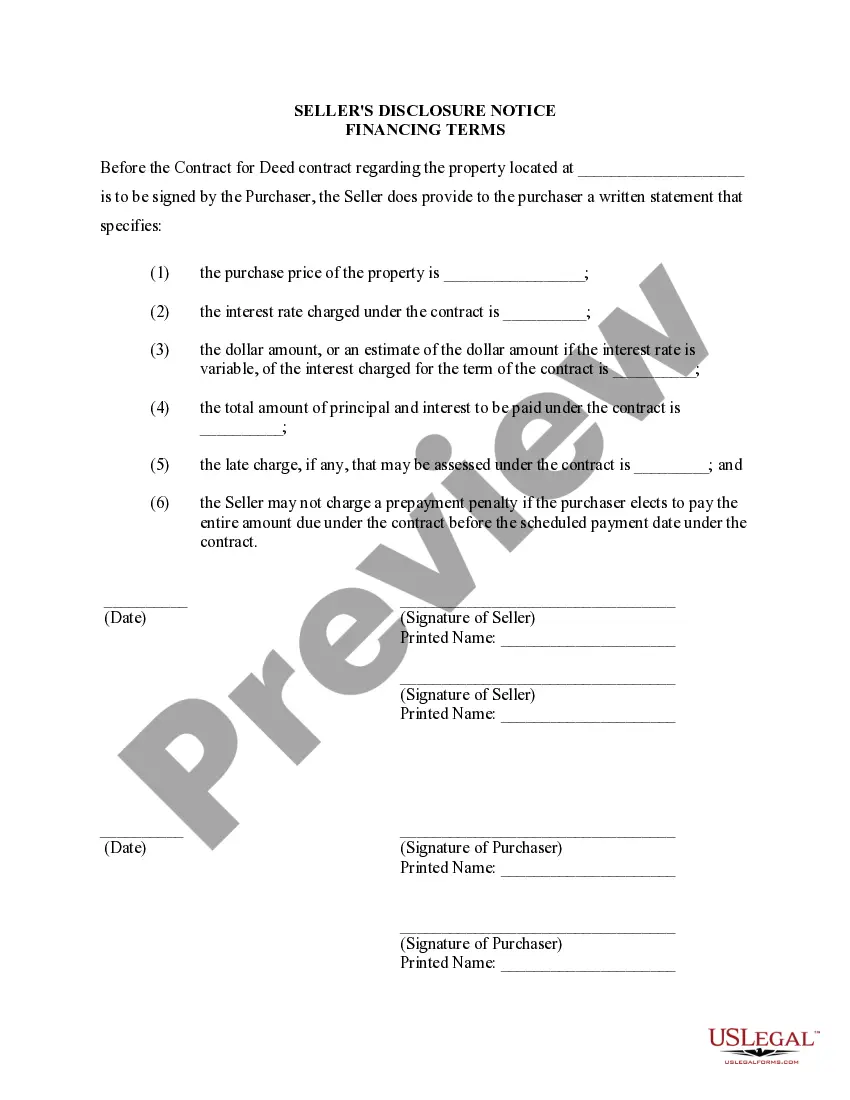
The Seller's Disclosure of Financing Terms for Residential Property serves as a critical notice to the Purchaser regarding the financing details associated with a Contract for Deed. This form provides transparency about the purchase price, interest rate, payment terms, and potential late charges. Unlike other real estate documents, this disclosure specifically focuses on the financial terms tied to seller financing, making it essential for both buyers and sellers in a land contract situation.
Form components explained
- Purchase price of the property.
- Interest rate charged under the contract.
- Estimated total interest charged for the contract term.
- Total amount of principal and interest to be paid.
- Late charge provisions, if any.
- Prepayment penalty details, if applicable.
When this form is needed
This form should be used when a seller is providing financing for the purchase of residential property through a Contract for Deed. It is particularly useful in situations where traditional bank financing is not an option, or both parties have agreed on seller financing terms. This disclosure ensures that the buyer is fully informed of the financial obligations before signing the contract.
Who can use this document
This form is intended for:
- Home sellers who are offering seller financing to potential buyers.
- Homebuyers entering into a Contract for Deed arrangement.
- Real estate agents facilitating transactions involving seller financing.
Instructions for completing this form
- Enter the property address for the Contract for Deed.
- Specify the purchase price of the property.
- Fill in the interest rate charged under the contract.
- Provide an estimate of total interest for the term of the contract.
- Indicate the total amount of principal and interest due under the contract.
- Complete the late charge terms and any prepayment penalty information.
Does this form need to be notarized?
This form does not typically require notarization unless specified by local law. However, it is advisable to consult legal counsel to ensure that all requirements are met for enforceability in your jurisdiction.
Get your form ready online
Our built-in tools help you complete, sign, share, and store your documents in one place.
Make edits, fill in missing information, and update formatting in US Legal Forms—just like you would in MS Word.
Download a copy, print it, send it by email, or mail it via USPS—whatever works best for your next step.
Sign and collect signatures with our SignNow integration. Send to multiple recipients, set reminders, and more. Go Premium to unlock E-Sign.
If this form requires notarization, complete it online through a secure video call—no need to meet a notary in person or wait for an appointment.
We protect your documents and personal data by following strict security and privacy standards.

Make edits, fill in missing information, and update formatting in US Legal Forms—just like you would in MS Word.

Download a copy, print it, send it by email, or mail it via USPS—whatever works best for your next step.

Sign and collect signatures with our SignNow integration. Send to multiple recipients, set reminders, and more. Go Premium to unlock E-Sign.

If this form requires notarization, complete it online through a secure video call—no need to meet a notary in person or wait for an appointment.

We protect your documents and personal data by following strict security and privacy standards.
Avoid these common issues
- Failing to accurately calculate the total interest amount.
- Not including essential details about late charges.
- Leaving out signatures or dates, which can invalidate the document.
Advantages of online completion
- Convenience of downloading and printing the form at your own pace.
- Editability allows for tailoring the form to meet specific transaction needs.
- Reliability, as the forms are drafted by licensed attorneys.
Main things to remember
- The Seller's Disclosure of Financing Terms clearly outlines the financial responsibilities of both parties in a Contract for Deed.
- It is essential for sellers to provide this document before the contract is signed.
- Reviewing state-specific requirements is crucial for compliance.
Looking for another form?
Form popularity
FAQ
Sellers have to disclose any occupants (ie boyfriend, grandparent), who should also sign the contract. Sellers must disclose any official letters that have been received. And it is advisable to disclose any planning matters relating to the house or the neighbourhood.
You will need to include information about all appliances in the home, including which are included in the sale as well as whether they are operational. You will also need to disclose any room additions, damage, or neighborhood noise problems.
But if it can be proven that something was known and omitted, a seller can get in big trouble. A seller may be liable to the buyer for the nondisclosure of material facts, negligent misrepresentation of facts, intentional misrepresentation of facts, or suppression or concealment of facts, Zuetel explains.
Although there's no list of required disclosures a seller must make according to New Jersey's statutes, the state's courts have carved out rules (under what's called the "common law") to protect buyers against sellers who fail to disclose material facts or who hide information about their property.
"Although this will cause some pushback and sometimes isn't looked at as the most ethical, a seller can legally still accept any other offer up until attorney review conclude as the deal isn't officially under contract." For the most part, though, buyers more commonly back out of contracts rather than sellers.
Among the numerous types of things a seller in New Jersey is required to disclose are electrical system hazards; structural problems; roof leakage; termites; environmental hazards; and plumbing, water, and sewage issues.
A realtor has a duty to make a reasonable inquiry of the seller, and to perform a visual inspection of the property, to determine material facts related to the property.However, an accidental death in a home caused by some physical condition there, may require disclose even absent a specific inquiry about the event.
Sellers should disclose anything that required a permit in their home. These are usually significant items that should be disclosed. Examples include the heating system, air conditioning, the roof, or anything related to the plumbing or electrical systems.
Although there's no list of required disclosures a seller must make according to New Jersey's statutes, the state's courts have carved out rules (under what's called the "common law") to protect buyers against sellers who fail to disclose material facts or who hide information about their property.