New Jersey Contract for Deed Package

Overview of this form package
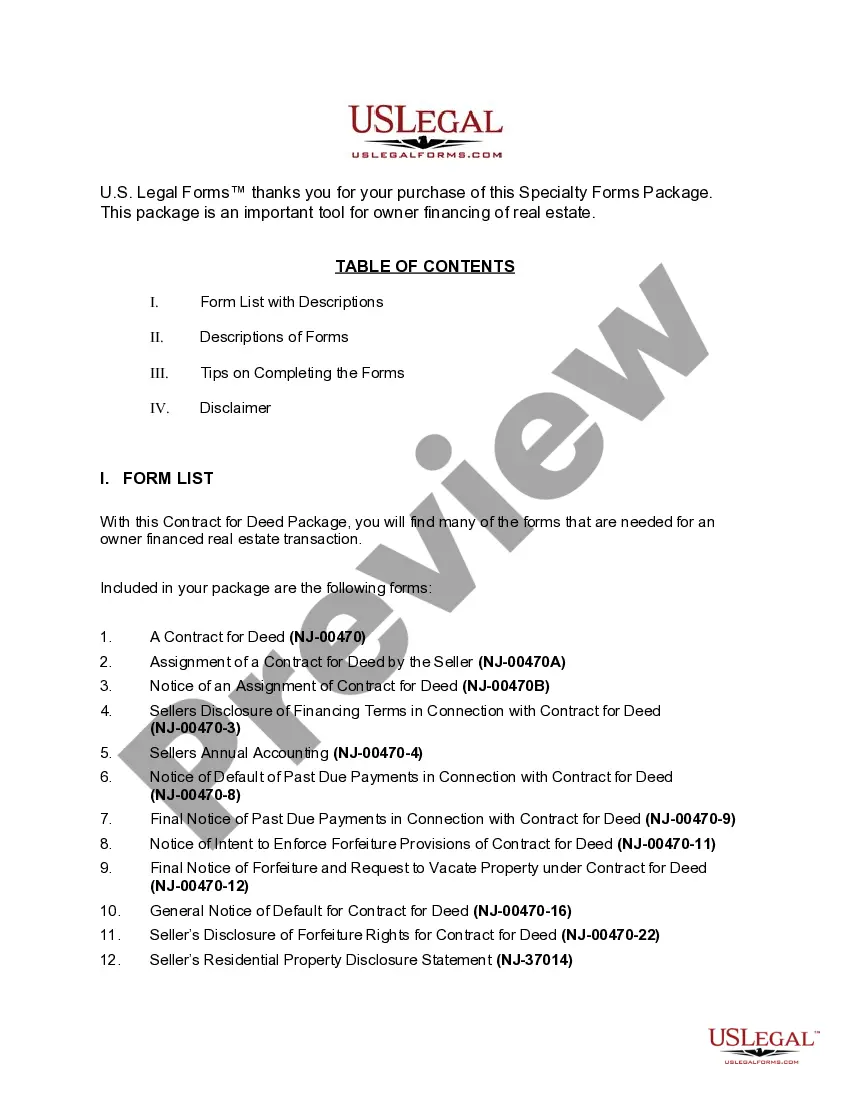
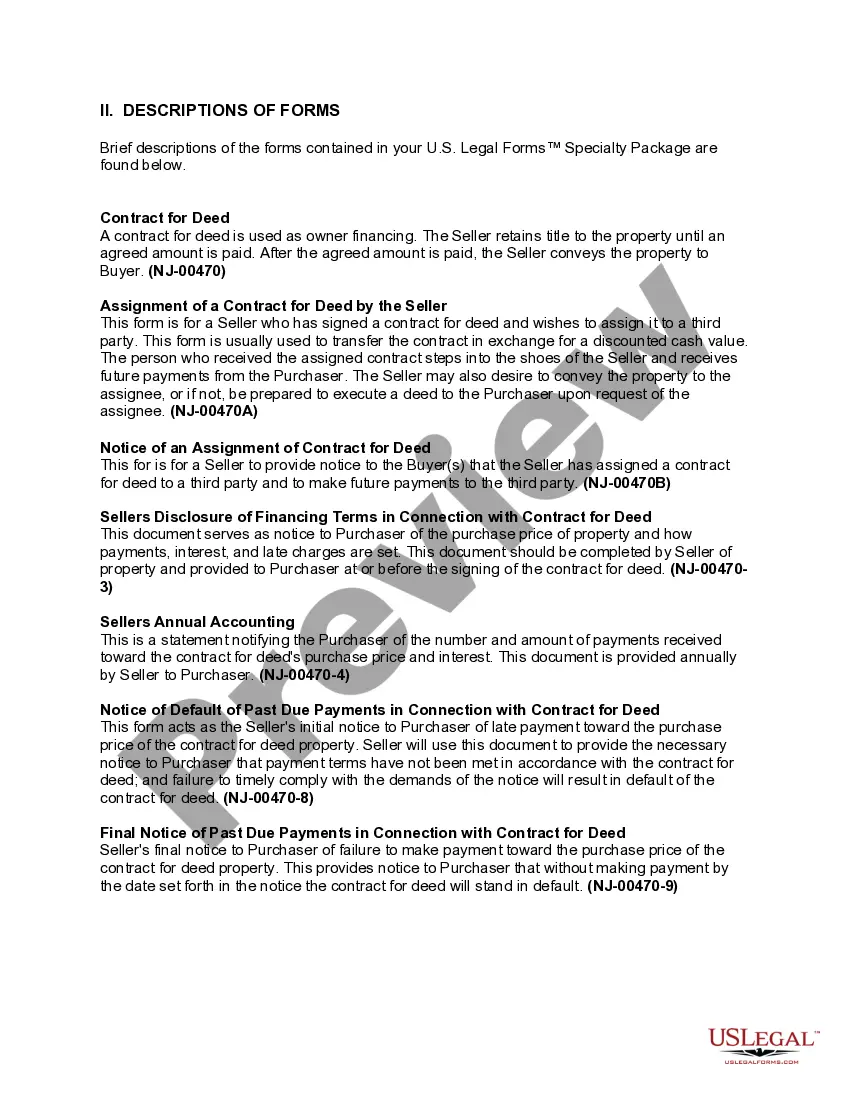
The New Jersey Contract for Deed Package contains vital legal documents designed for owner financing of real estate transactions using a Contract for Deed. This package includes eleven specific forms essential for ensuring clear communication and compliance between buyers and sellers, providing both parties with a detailed understanding of payment terms and responsibilities. Unlike standard real estate agreements, this package is tailored to the unique requirements of owner financing, making it an indispensable tool for real estate transactions in New Jersey.
Forms you’ll find in this package
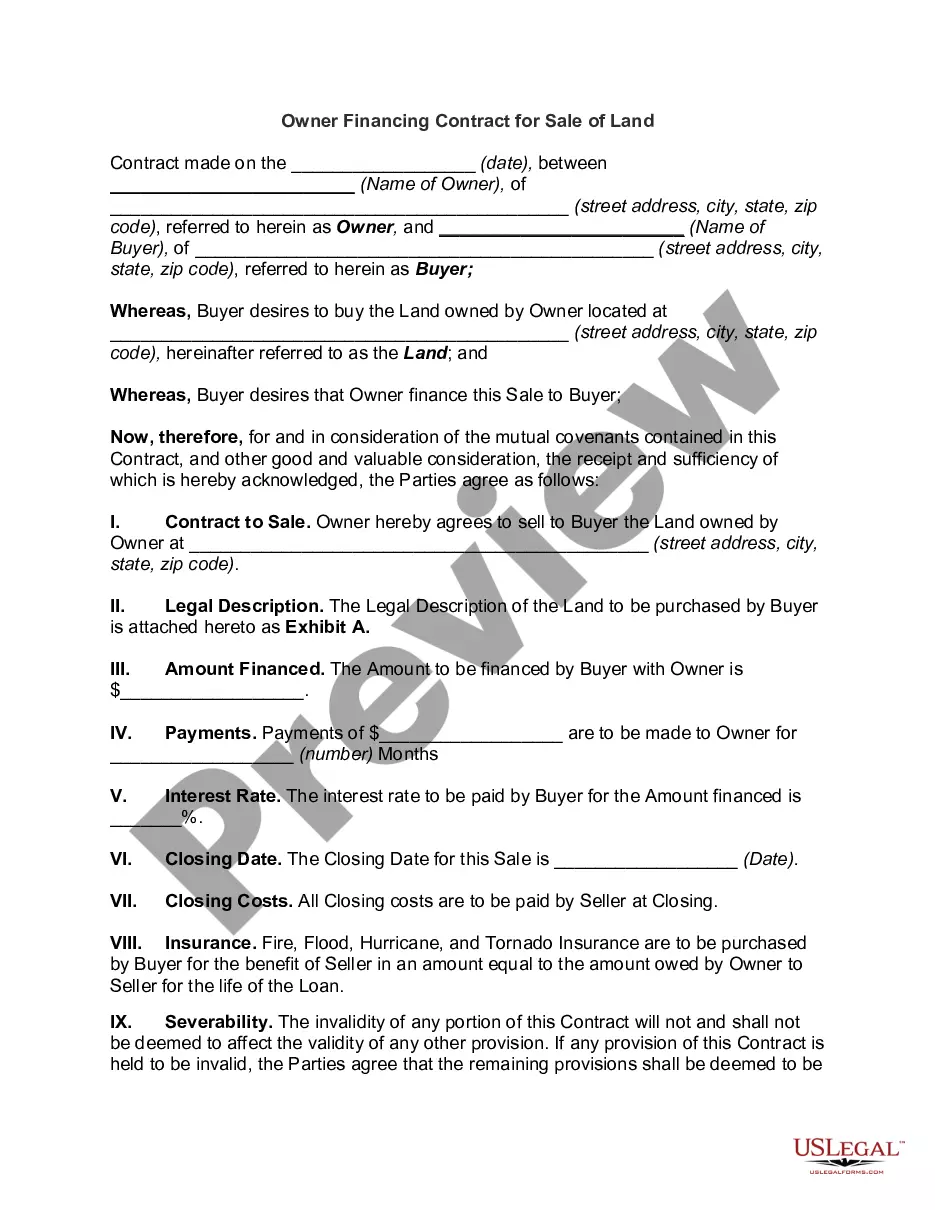
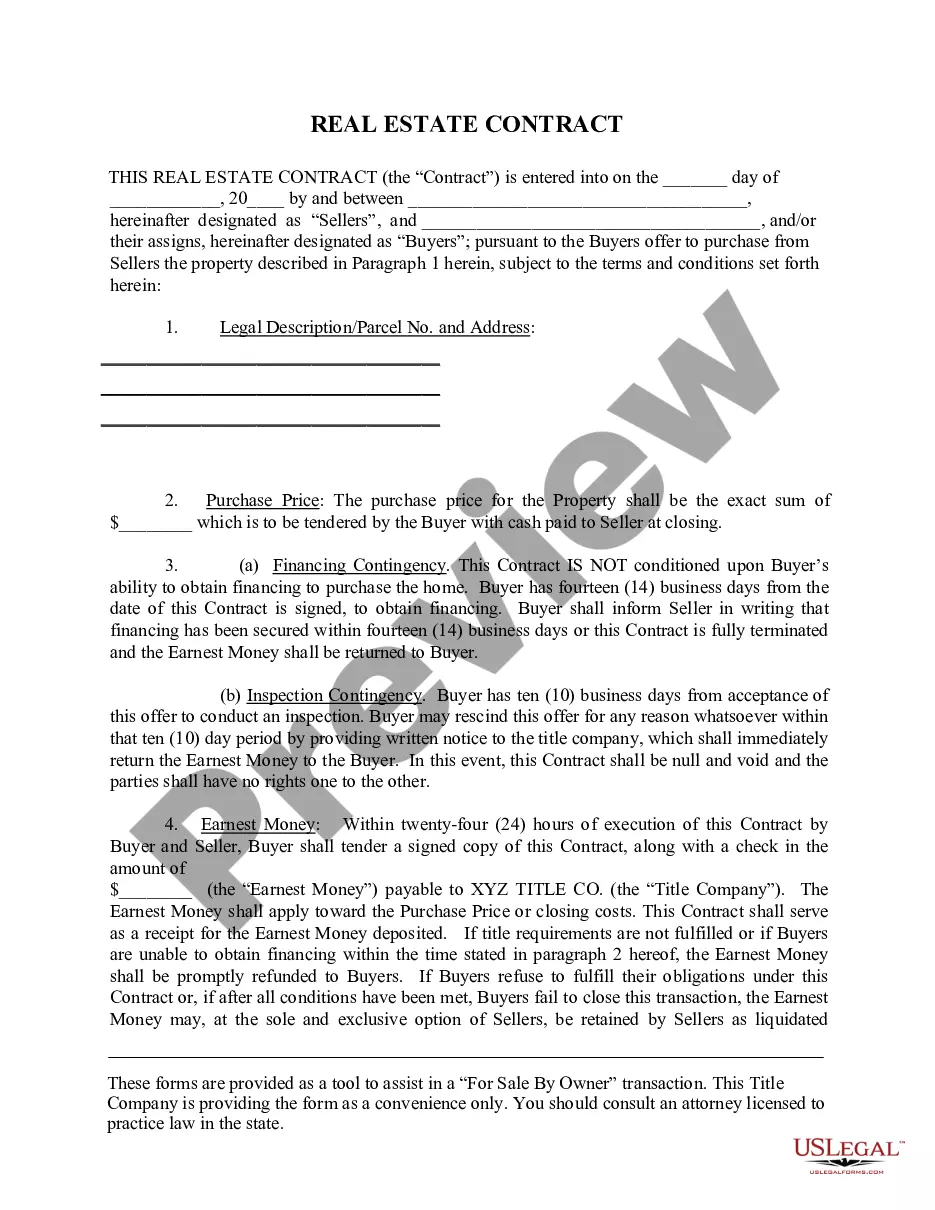
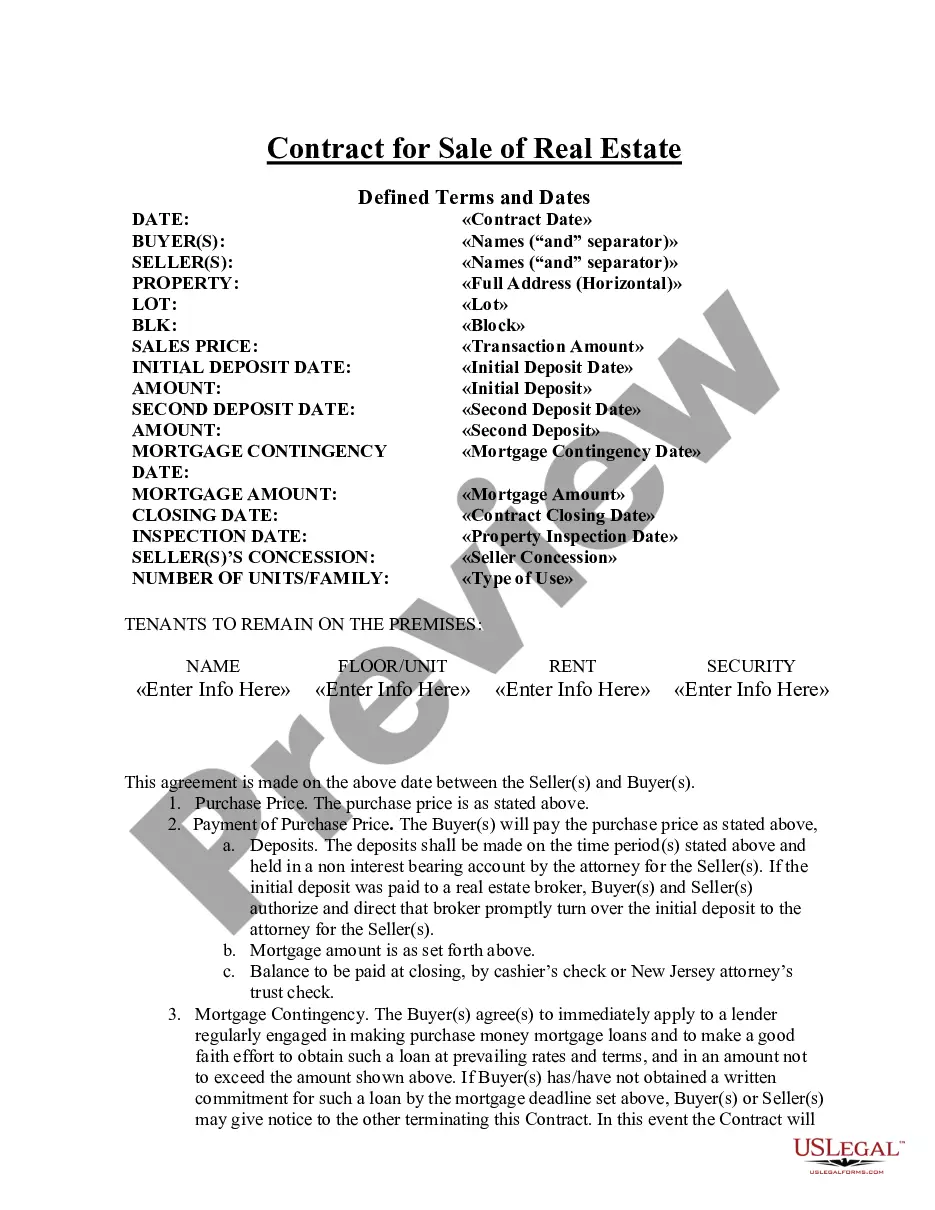
- Agreement or Contract for Deed for Sale and Purchase of Real Estate a/k/a Land or Executory Contract
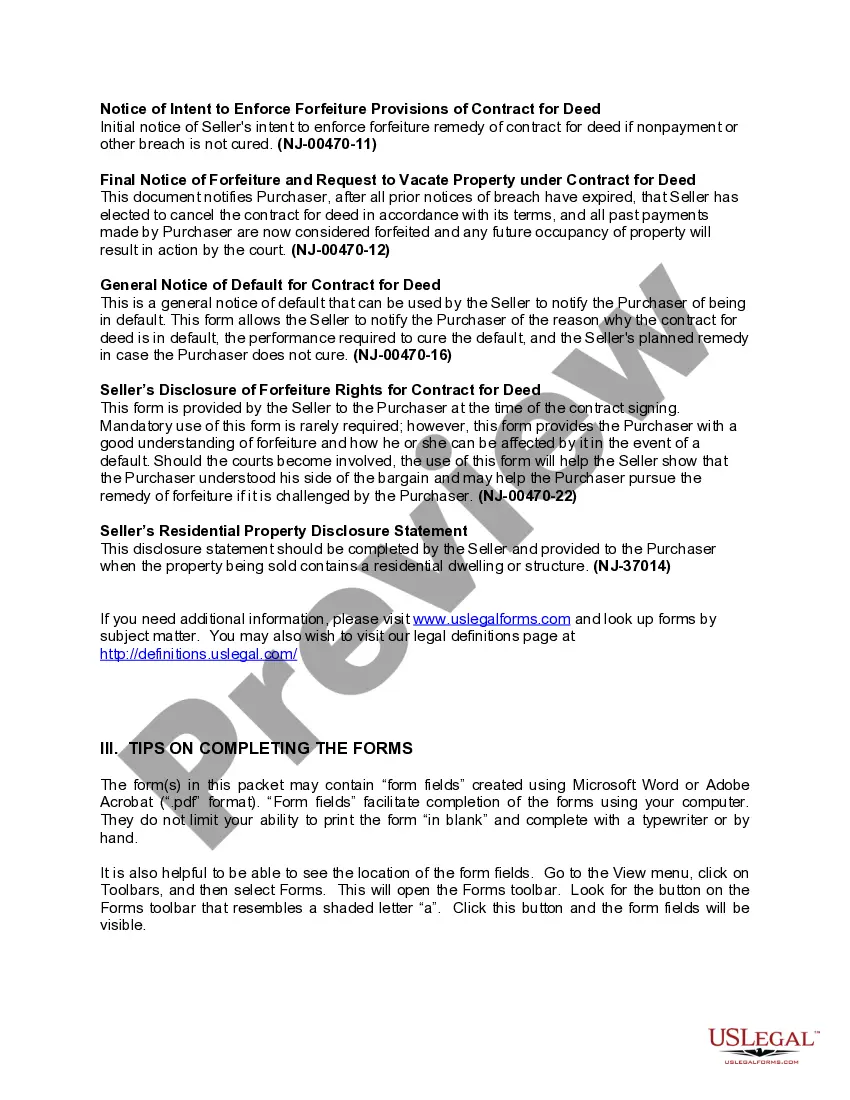
- Notice of Intent to Enforce Forfeiture Provisions of Contact for Deed
- Final Notice of Forfeiture and Request to Vacate Property under Contract for Deed
- General Notice of Default for Contract for Deed
- Seller's Disclosure of Forfeiture Rights for Contract for Deed
- Seller's Disclosure of Financing Terms for Residential Property in connection with Contract or Agreement for Deed a/k/a Land Contract
- Contract for Deed Seller's Annual Accounting Statement
- Notice of Default for Past Due Payments in connection with Contract for Deed
- Final Notice of Default for Past Due Payments in connection with Contract for Deed
- Assignment of Contract for Deed by Seller
- Notice of Assignment of Contract for Deed
When to use this document
This form package is ideal for situations where a seller wishes to provide financing directly to a buyer, allowing the buyer to purchase property without obtaining traditional mortgage financing. It's commonly used in cases where:
- A seller is looking to sell property but may not want to deal with banks or financial institutions.
- A buyer may have difficulties securing a conventional loan.
- A real estate investor intends to manage properties through owner financing.
- A seller wishes to protect their interests and rights throughout the contract for deed process.
Intended users of this form package
- Property sellers offering owner financing.
- Buyers seeking to purchase property through a contract for deed arrangement.
- Real estate investors involved in owner-financed transactions.
- Individuals unfamiliar with legal document drafting who need an easy-to-follow package.
Instructions for completing these forms
- Review all included forms to understand their purpose and requirements.
- Identify the parties involved in the transaction, including the seller and buyer.
- Fill in relevant information such as property details, payment terms, and personal data.
- Ensure all signatures are properly executed where required.
- Keep copies of all completed forms for your records.
Notarization requirements for forms in this package
Some forms in this package require notarization to be legally valid. US Legal Forms provides secure online notarization powered by Notarize, allowing you to complete the process through a verified video call, available 24/7.
Get your form ready online
Our built-in tools help you complete, sign, share, and store your documents in one place.
Make edits, fill in missing information, and update formatting in US Legal Forms—just like you would in MS Word.
Download a copy, print it, send it by email, or mail it via USPS—whatever works best for your next step.
Sign and collect signatures with our SignNow integration. Send to multiple recipients, set reminders, and more. Go Premium to unlock E-Sign.
If this form requires notarization, complete it online through a secure video call—no need to meet a notary in person or wait for an appointment.
We protect your documents and personal data by following strict security and privacy standards.

Make edits, fill in missing information, and update formatting in US Legal Forms—just like you would in MS Word.

Download a copy, print it, send it by email, or mail it via USPS—whatever works best for your next step.

Sign and collect signatures with our SignNow integration. Send to multiple recipients, set reminders, and more. Go Premium to unlock E-Sign.

If this form requires notarization, complete it online through a secure video call—no need to meet a notary in person or wait for an appointment.

We protect your documents and personal data by following strict security and privacy standards.
Common mistakes
- Failing to complete all required form fields, which can render the document void.
- Not providing necessary disclosures, especially regarding financing terms.
- Incorrectly calculating payment schedules, leading to defaults.
- Neglecting to sign forms where signatures are essential.
Why complete this package online
- Convenience of downloading instantly from your home or office.
- Editability of forms allows for customization to specific needs.
- Reliability of documents crafted by licensed attorneys familiar with New Jersey laws.
Looking for another form?
Form popularity
FAQ
The simplest way to add a spouse to a deed is through a quitclaim deed. This type of deed transfers whatever ownership rights you have so that you and your spouse now become joint owners. No title search or complex transaction is necessary. The deed will list you as the grantor and you and your spouse as grantees.
Retrieve your original deed. Get the appropriate deed form. Draft the deed. Sign the deed before a notary. Record the deed with the county recorder. Obtain the new original deed.
When done properly, a deed is recorded anywhere from two weeks to three months after closing.
The interest rate on a contract for deed loan is typically 3% - 6% higher than the rate on regular mortgage. A higher interest rate means a higher monthly mortgage payment plus you are also responsible for property taxes and insurance even though you do not own the property.
Be in English or include an English translation (N.J.S.A. Identify the grantor / grantee (N.J.S.A. Be signed by the grantor with the name printed underneath (N.J.S.A. Include the name and mailing address of the grantee (N.J.S.A. Be notarized (N.J.S.A.
In New Jersey, the deed must be in English, identify the seller/buyer (grantor/grantee), name the person that prepared the deed, state the consideration (amount paid) for the transfer, contain a legal description of the property (a survey), include the signature of the grantor and be signed before a notary.
In New Jersey, the preparation of legal documents such as a deed is considered the practice of law which may only be undertaken by an Attorney at Law of the State of New Jersey. The only exception to that rule is that an individual representing him/herself may prepare his/her own documents.
Adding someone to your house deed requires the filing of a legal form known as a quitclaim deed. When executed and notarized, the quitclaim deed legally overrides the current deed to your home. By filing the quitclaim deed, you can add someone to the title of your home, in effect transferring a share of ownership.
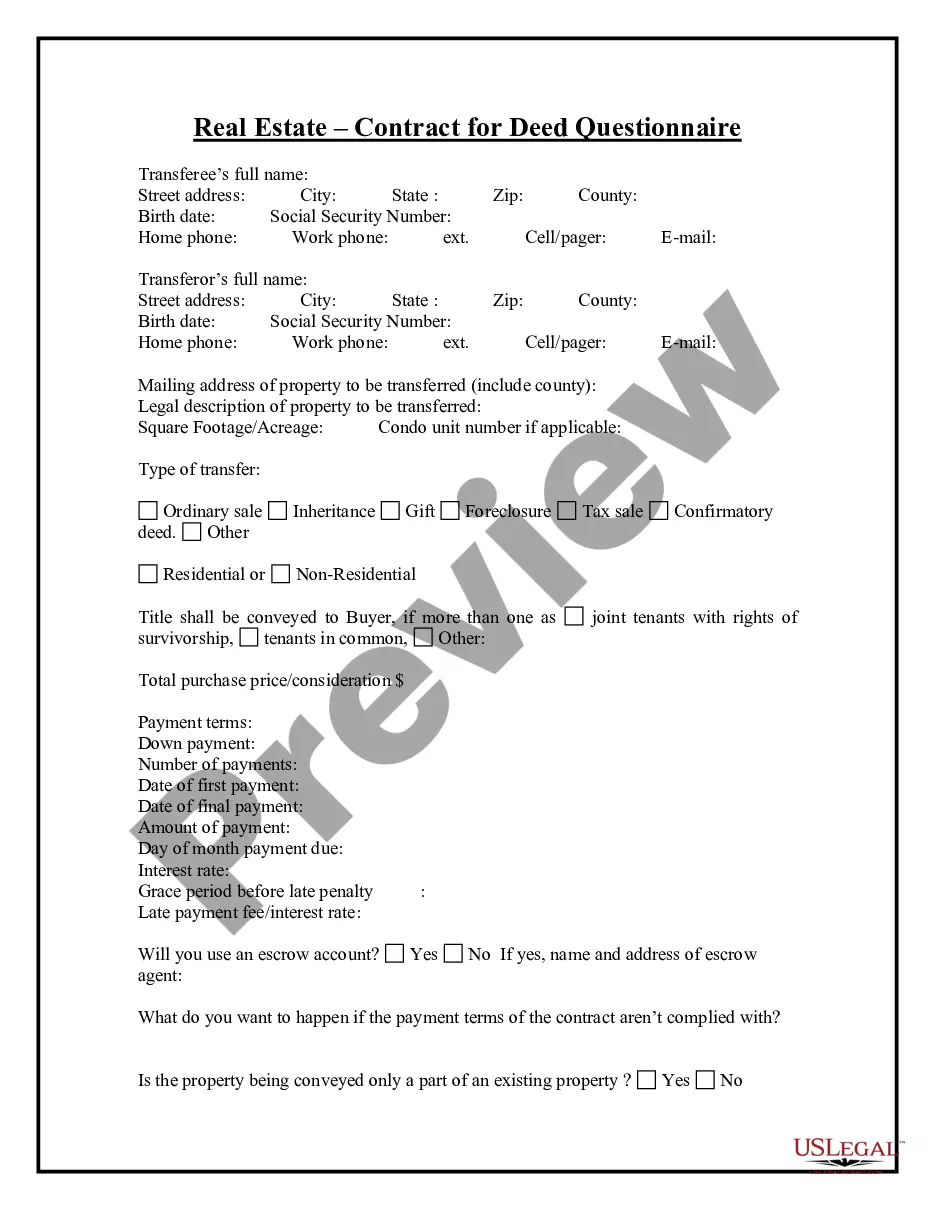
Purchase price. Down payment. Interest rate. Number of monthly installments. Responsibilities of the buyer and seller. Legal remedies for the seller if the buyer does not make payments.