New Hampshire Warning of Default on Residential Lease
What is this form?
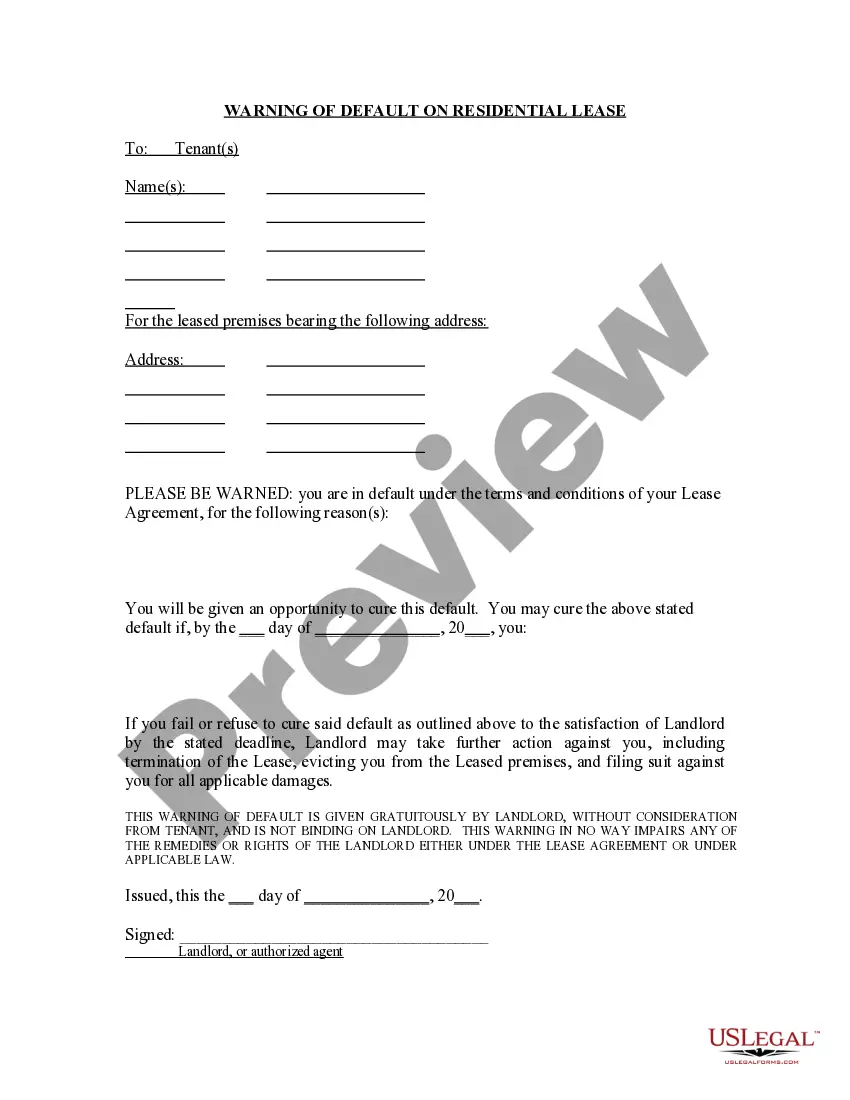
The Warning of Default on Residential Lease is a formal notification from a landlord to a tenant. It expresses concern that the tenant is on the verge of breaching their lease agreement unless specific conditions are addressed promptly. This form serves as an important communication tool that differentiates itself from eviction notices by allowing the tenant an opportunity to rectify the situation before facing legal consequences.
What’s included in this form
- Statement indicating that the warning is provided without any obligation on the landlord's part.
- Notice that this warning does not limit the landlord's legal rights or remedies under the lease.
- Spaces designated for the date of issuance and the landlord's signature.



When this form is needed
This form is used when a landlord notices that a tenant is not complying with the terms of the residential lease. Common situations include late rent payments, unauthorized alterations to the property, or failure to maintain the premises. The form acts as a preliminary step before further legal action is considered, giving the tenant a chance to correct their behavior.
Who this form is for
- Landlords who have tenants under a residential lease agreement.
- Property managers acting on behalf of the landlord.
- Real estate professionals facilitating lease agreements.
How to prepare this document
- Identify the parties involved, including the landlord and tenant's names.
- Specify the date when the warning is issued.
- Enter details regarding the lease and the specific default conditions, if applicable.
- Provide a signature from the landlord or an authorized agent.
Notarization guidance
This form usually doesn’t need to be notarized. However, local laws or specific transactions may require it. Our online notarization service, powered by Notarize, lets you complete it remotely through a secure video session, available 24/7.
Get your form ready online
Our built-in tools help you complete, sign, share, and store your documents in one place.
Make edits, fill in missing information, and update formatting in US Legal Forms—just like you would in MS Word.
Download a copy, print it, send it by email, or mail it via USPS—whatever works best for your next step.
Sign and collect signatures with our SignNow integration. Send to multiple recipients, set reminders, and more. Go Premium to unlock E-Sign.
If this form requires notarization, complete it online through a secure video call—no need to meet a notary in person or wait for an appointment.
We protect your documents and personal data by following strict security and privacy standards.

Make edits, fill in missing information, and update formatting in US Legal Forms—just like you would in MS Word.

Download a copy, print it, send it by email, or mail it via USPS—whatever works best for your next step.

Sign and collect signatures with our SignNow integration. Send to multiple recipients, set reminders, and more. Go Premium to unlock E-Sign.

If this form requires notarization, complete it online through a secure video call—no need to meet a notary in person or wait for an appointment.

We protect your documents and personal data by following strict security and privacy standards.
Typical mistakes to avoid
- Failing to provide specific details about the default conditions.
- Not dating the warning when it is issued.
- Using improper language that might confuse the tenant about their obligations.
Why use this form online
- Convenience of downloading and editing the form to fit specific needs.
- Availability of templates drafted by licensed attorneys.
- Quick access without the need for in-person legal consultations.
Looking for another form?
Form popularity
FAQ
Protect your rental income. Even the most reliable tenants sometimes struggle to pay their rent.Tenant default insurance from Simply Business provides vital back-up for landlords it can cover your rental income if your tenant fails to pay rent.
Unless your lease says otherwise simply breaking it is not an option. This is known as "unilateral breach" and typical penalties can include: Paying the rent - One way or another, if you walk away from your lease and no one else rents the apartment then you will owe the landlord this money.
Can I break my lease? You are always able to break a lease; there is little a landlord can do to actually stop you from leaving before the full term specified in the lease. You are violating no law by vacating early, but you are violating the terms of the contract between you and the landlord.
If you find out that your tenant lied to you after the lease has been signed, it can be grounds for an eviction. The best way to determine whether or not your applicant is lying to you is to cross check the rental application with their background report.
In some circumstances, a tenant can break a fixed-term agreement early without penalty. A tenant can give 14 days' written notice to end an agreement early without penalty if: they have accepted an offer of social housing (e.g. from DCJ Housing)
In landlord-tenant law, default refers to the failure of a tenant to timely pay rent due.In general, the landlord is required to give the tenant notice of the default before bringing eviction proceedings or applying security deposit proceeds to the payment in default.
Tenant default occurs when a Tenant breaches one of the tenant's covenants in its lease. Tenant default can arise in a number of different ways but will typically be for one of the following: Non-payment of rent or other sums reserved under the lease.
Default by landlord The most common form of landlord default is failure to provide services and maintain the property condition. When a landlord defaults on the terms of the lease, tenants may sue for damages.
Step 1: Speak to your tenant. Step 2: Provide notice of contract breach. Step 3: Decide between an interdict or cancellation. Step 4: Eviction process. Step 5: Eviction notice. Final advice.