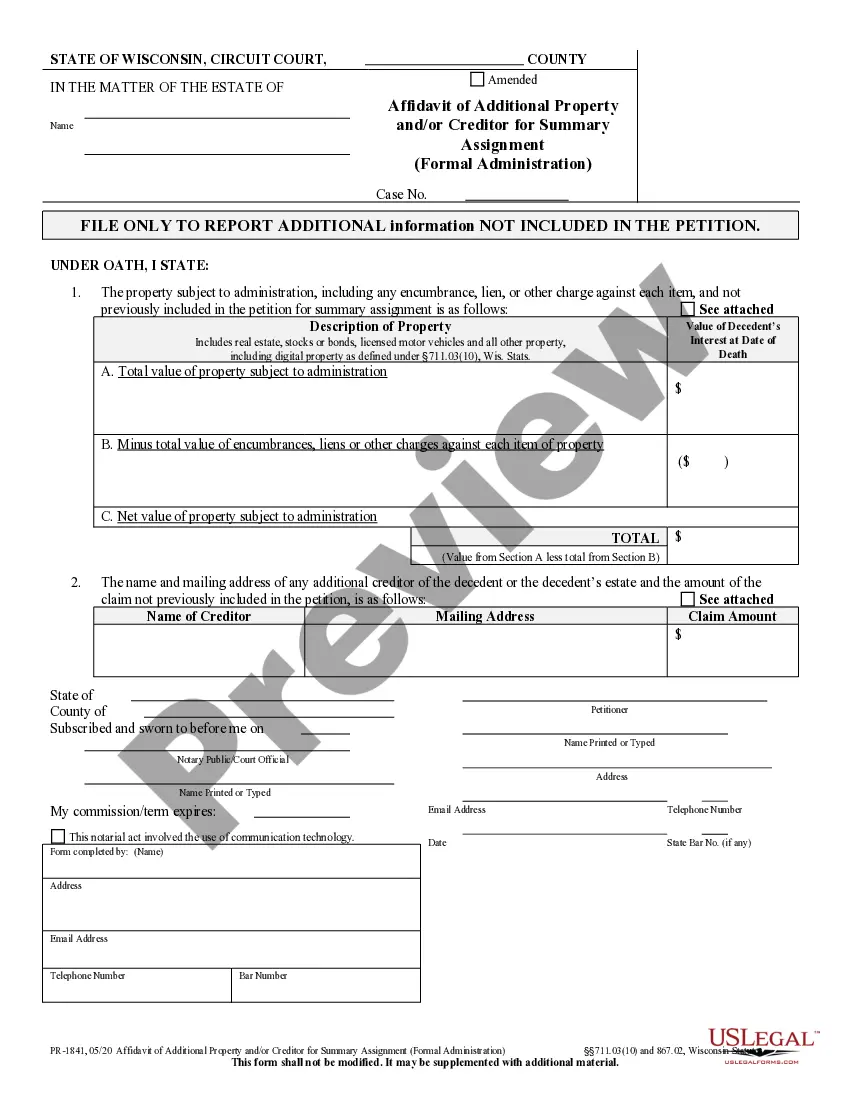
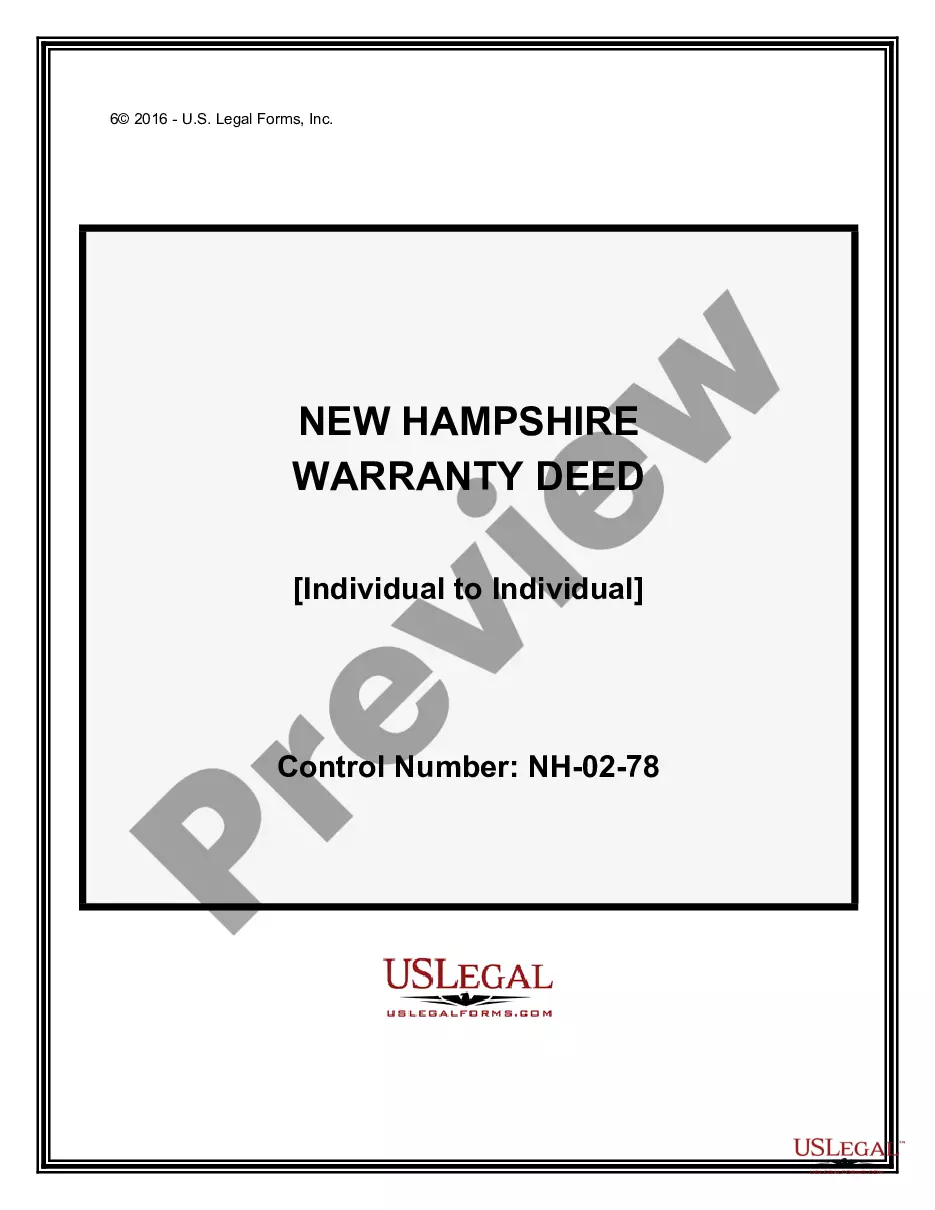
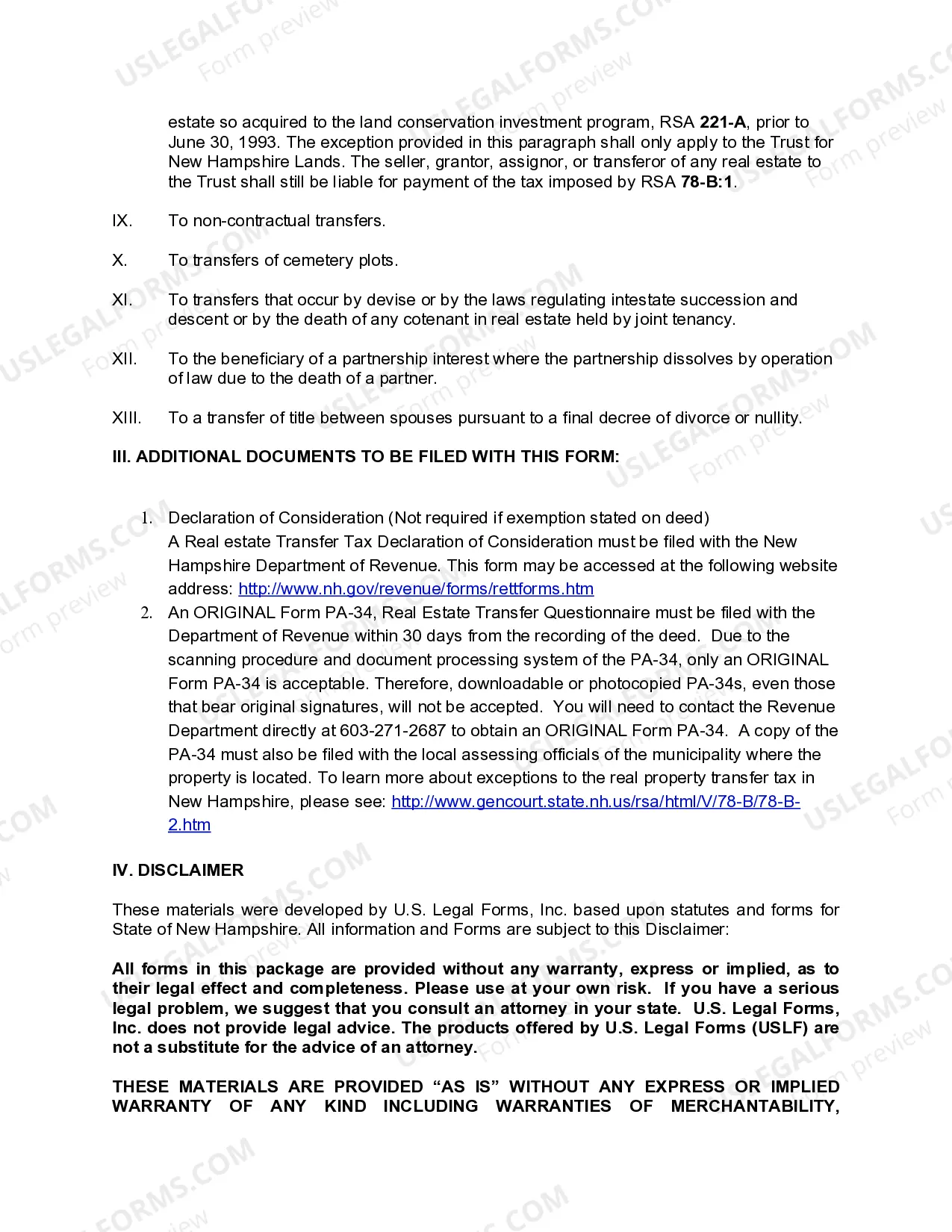
New Hampshire Warranty Deed from Individual to Individual

Overview of this form
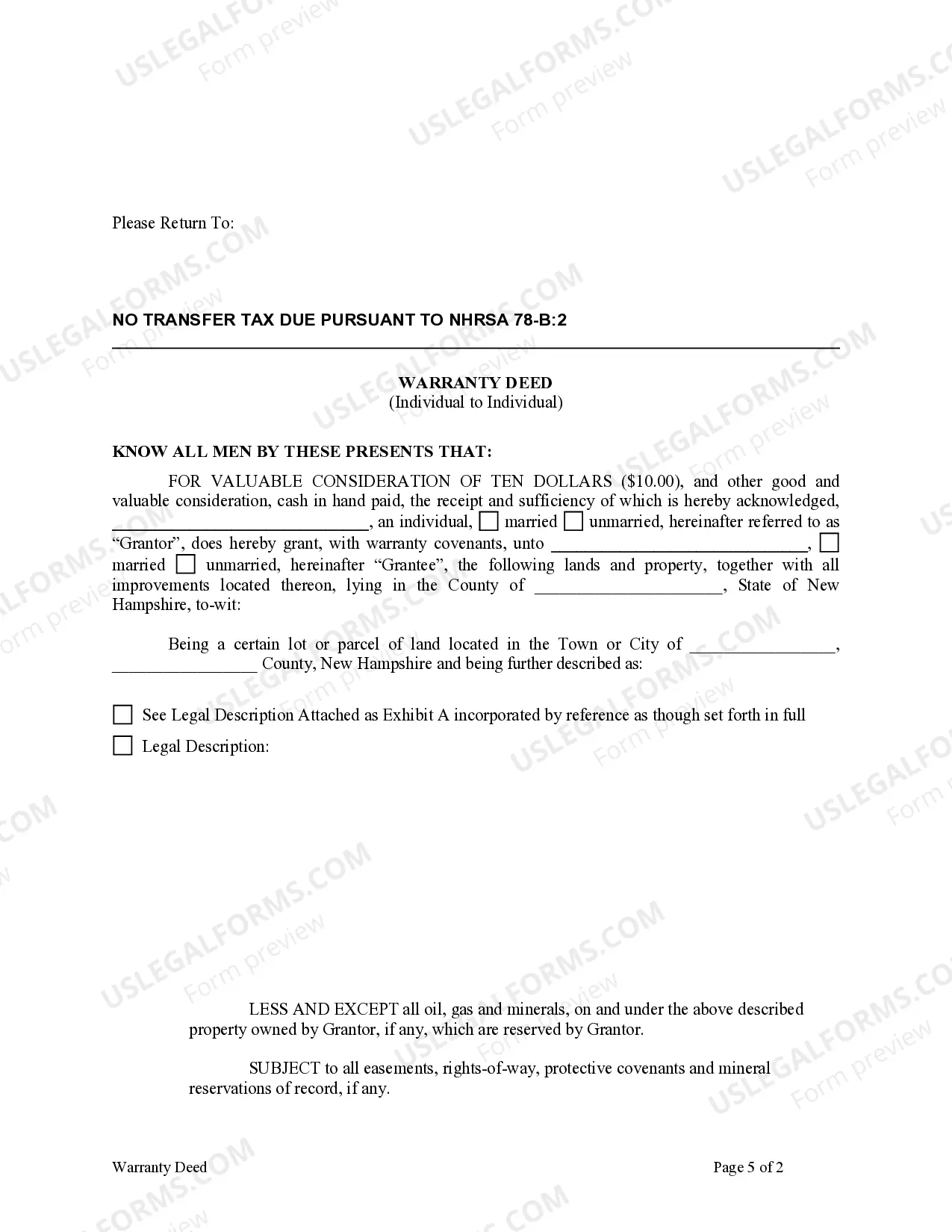
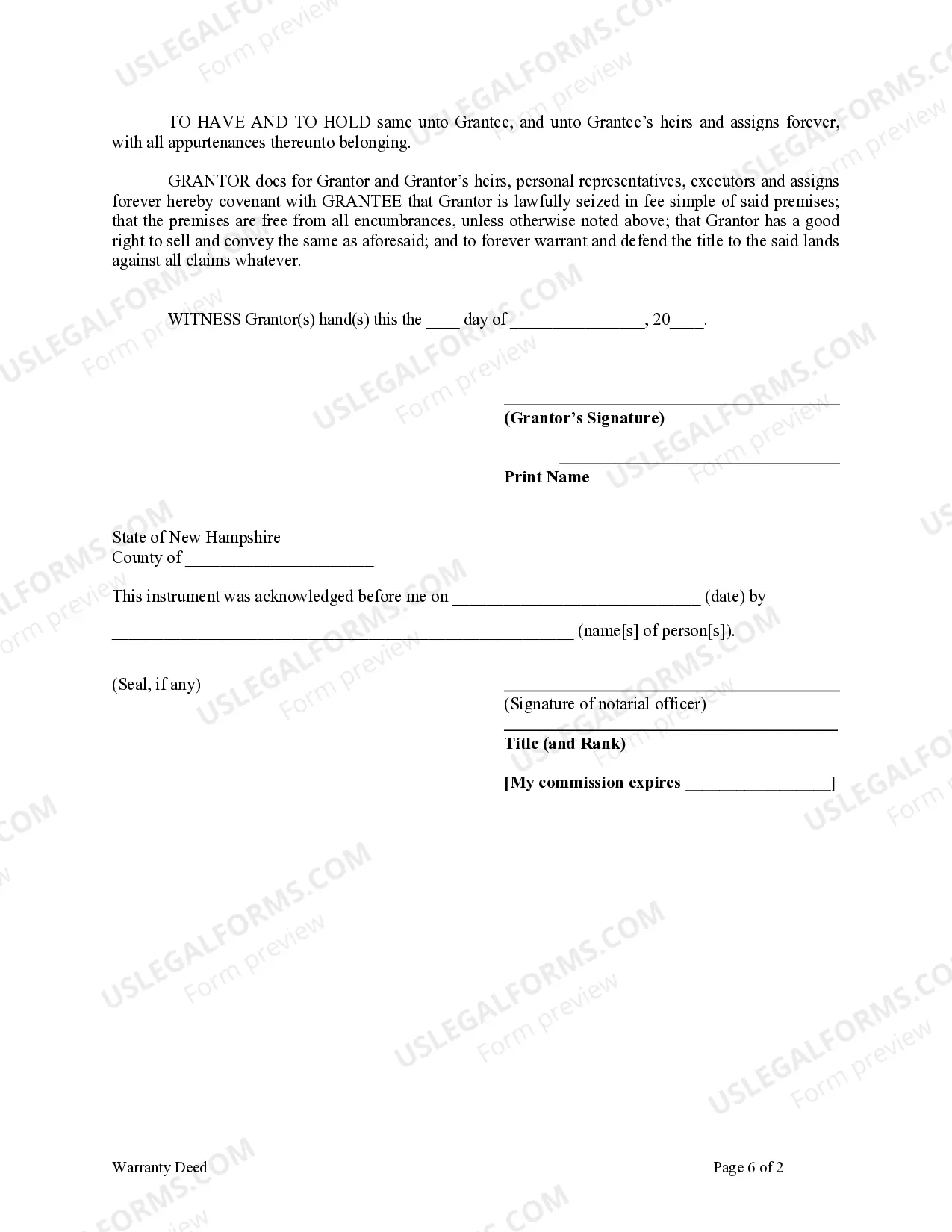
The Warranty Deed from Individual to Individual is a legal document that transfers property ownership from one individual (the Grantor) to another (the Grantee). This form ensures that the Grantor conveys clear title to the property, barring the reservation of any oil, gas, and minerals that may exist under the land. Unlike other deeds, this warranty deed provides a guarantee that the Grantor has the right to sell the property, offering more security to the Grantee.
Main sections of this form
- Grantor's information: Name and address of the individual selling the property.
- Grantee's information: Name and address of the individual purchasing the property.
- Description of the property: A detailed legal description of the land being transferred.
- Reservation clause: Notation regarding the reservation of oil, gas, and minerals.
- Signatures: Required signatures of the Grantor to validate the transfer.
- Date of execution: When the deed is signed and executed.





When to use this form
This form is useful when an individual wants to sell or transfer ownership of real estate to another individual. It is commonly used in private property transactions, ensuring both parties have clarity regarding the terms of the transfer and the rights associated with the property.
Who this form is for
- Individuals looking to transfer ownership of their property to another individual.
- Buyers who require assurance of clear title upon purchasing a property.
- Individuals who prefer an uncomplicated transfer process without involving a real estate agent.
How to prepare this document
- Identify the Grantor and Grantee by clearly entering their full names and addresses.
- Provide a detailed legal description of the property being transferred.
- Include any necessary reservation clauses, specifically noting any oil, gas, or mineral rights that are retained by the Grantor.
- Sign and date the document where indicated to confirm the transfer.
- Ensure that documentation is filed with the appropriate local authorities as required in New Hampshire.
Notarization requirements for this form
Notarization is required for this form to take effect. Our online notarization service, powered by Notarize, lets you verify and sign documents remotely through an encrypted video session, available 24/7.
Get your form ready online
Our built-in tools help you complete, sign, share, and store your documents in one place.
Make edits, fill in missing information, and update formatting in US Legal Forms—just like you would in MS Word.
Download a copy, print it, send it by email, or mail it via USPS—whatever works best for your next step.
Sign and collect signatures with our SignNow integration. Send to multiple recipients, set reminders, and more. Go Premium to unlock E-Sign.
If this form requires notarization, complete it online through a secure video call—no need to meet a notary in person or wait for an appointment.
We protect your documents and personal data by following strict security and privacy standards.

Make edits, fill in missing information, and update formatting in US Legal Forms—just like you would in MS Word.

Download a copy, print it, send it by email, or mail it via USPS—whatever works best for your next step.

Sign and collect signatures with our SignNow integration. Send to multiple recipients, set reminders, and more. Go Premium to unlock E-Sign.

If this form requires notarization, complete it online through a secure video call—no need to meet a notary in person or wait for an appointment.

We protect your documents and personal data by following strict security and privacy standards.
Avoid these common issues
- Failing to provide a complete and accurate legal property description.
- Not including the reservation clause for oil, gas, and minerals when applicable.
- Neglecting to have the Grantor sign and date the deed, which is crucial for validity.
Benefits of using this form online
- Convenience: Easily access and fill out the form from any location.
- Editability: Adjust your information quickly without the need for physical copies.
- Compliance: Ensure that you have a form that is tailored to meet state-specific laws and requirements.
Key takeaways
- The Warranty Deed from Individual to Individual is essential for proper property transfer between individuals.
- Ensure accuracy in the property description and reservation clauses to avoid issues.
- File completed documents with local authorities to maintain record integrity.
Looking for another form?
Form popularity
FAQ
A personal representative deed and warranty deed are the same only in that they both convey ownership of land. The types of title assurance that the different deeds provide to the new owner are very different.
Used to transfer property rights from a deceased person's estate. Involves Probate Court. Like a Quit Claim deed, there are no warranties. Generally, the Personal Representative is unwilling to warrant or promise anything relating to property that he/she has never personally owned.
A deed, of course, is a legal document representing property ownership. But you might be wondering if an owner can transfer a deed to another person without a real estate lawyer. The answer is yes. Parties to a transaction are always free to prepare their own deeds.
Special warranties allow the transfer of property title between seller and buyer. The purchase of title insurance can mitigate the risk of prior claims to the special warranty deed.
It will not protect against title issues that arose prior to the time the seller took occupancy. Consequently, it offers less protection to buyers, and more protection to sellers, than a general warranty deed, which is the most common option for selling or buying a property.
A warranty deed guarantees that: The grantor is the rightful owner of the property and has the legal right to transfer the title.The title would withstand third-party claims to ownership of the property. The grantor will do anything to ensure the grantee's title to the property.
A special warranty deed to real estate offers protection to the buyer through the seller's guarantee that the title has been free and clear of encumbrances during their ownership of the property. It does not guarantee clear title beyond their ownership.
It's important to note that a warranty deed does not actually prove the grantor has ownership (a title search is the best way to prove that), but it is a promise by the grantor that they are transferring ownership and if it turns out they don't actually own the property, the grantor will be responsible for compensating