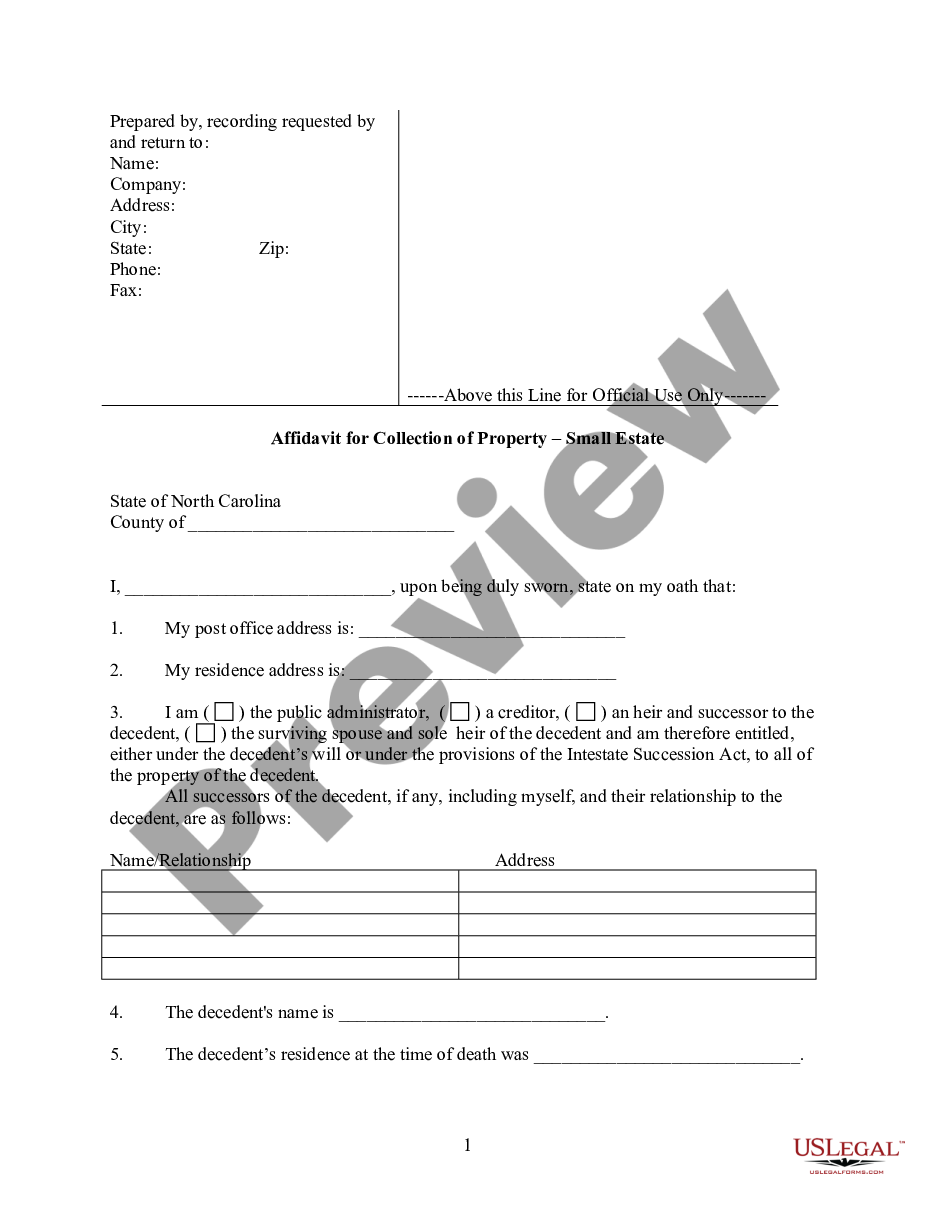
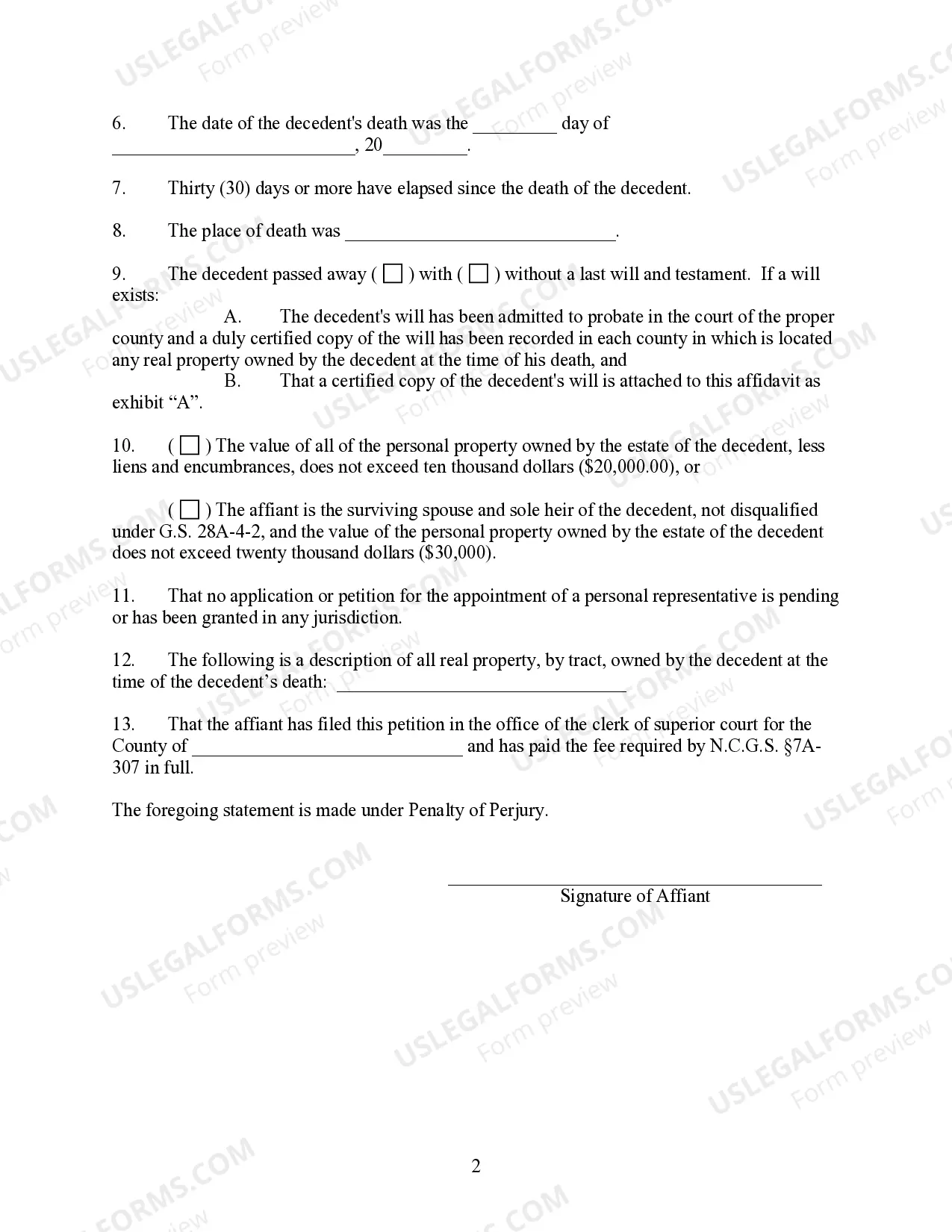
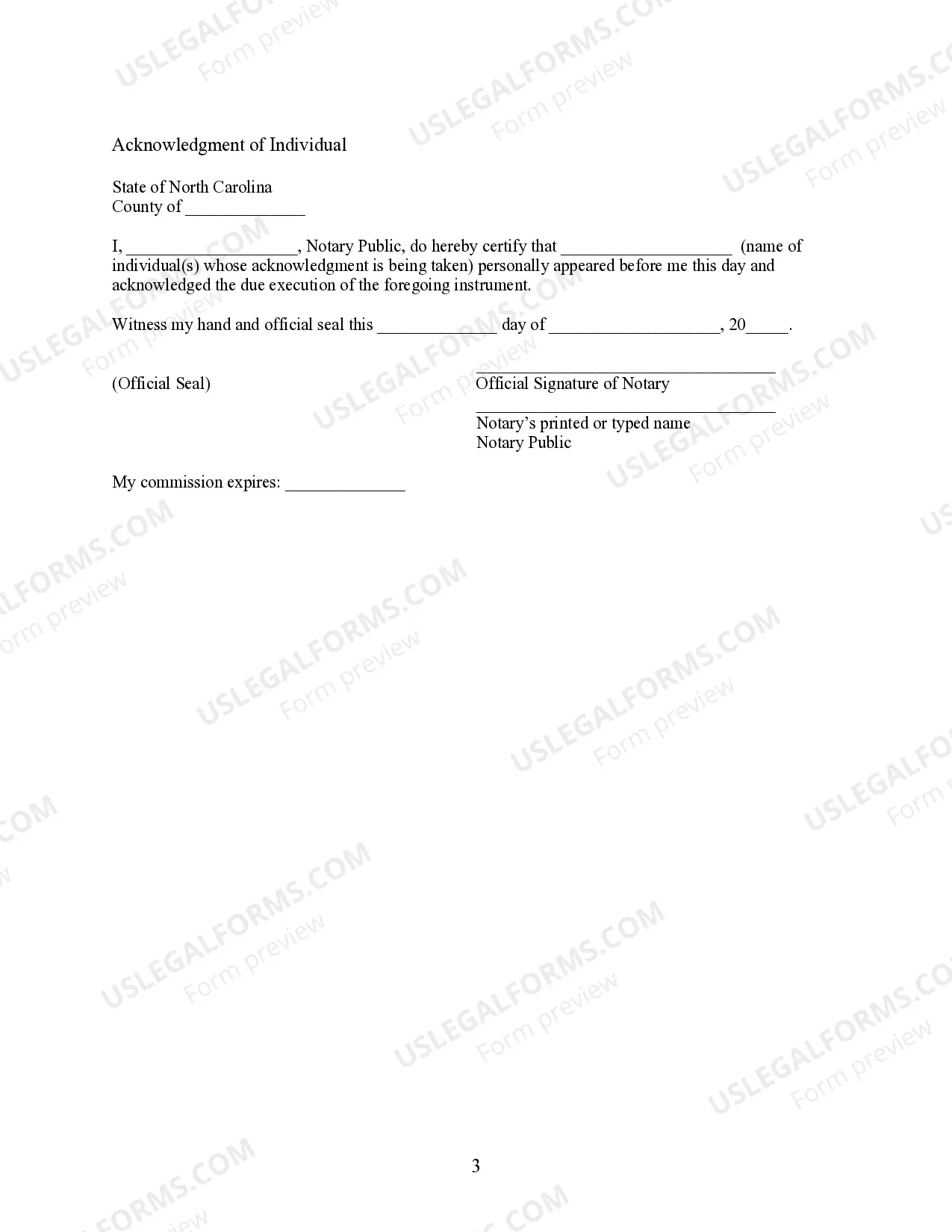
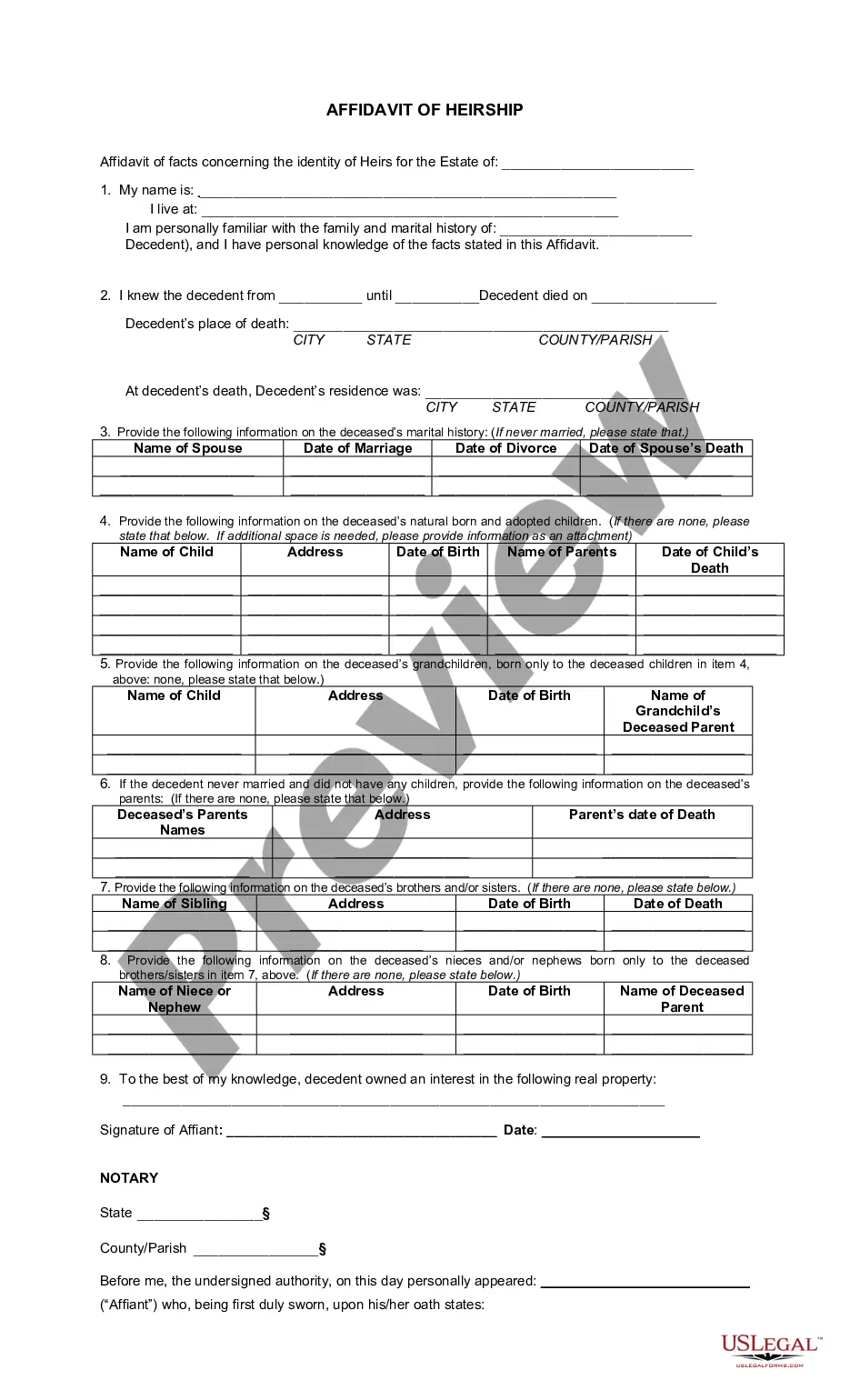
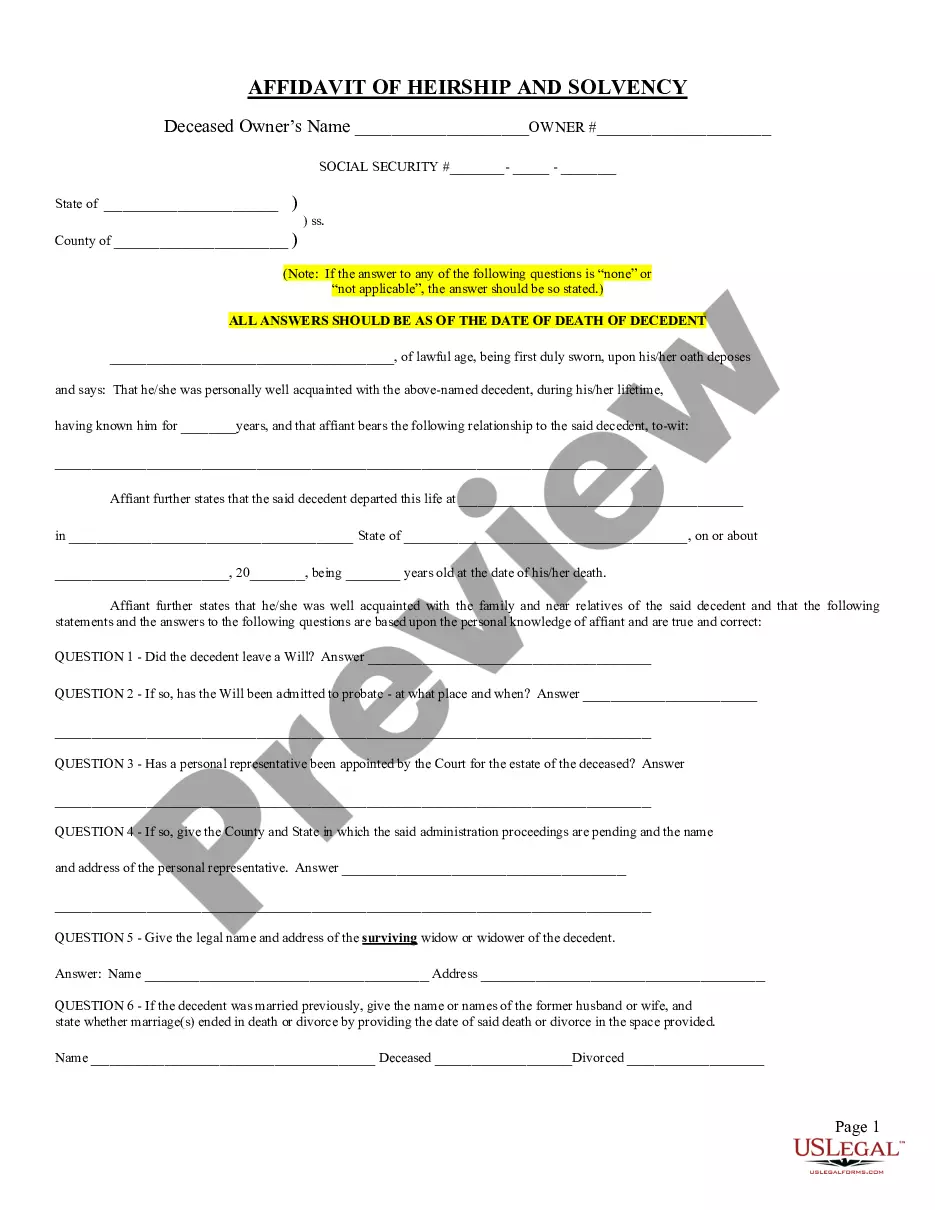
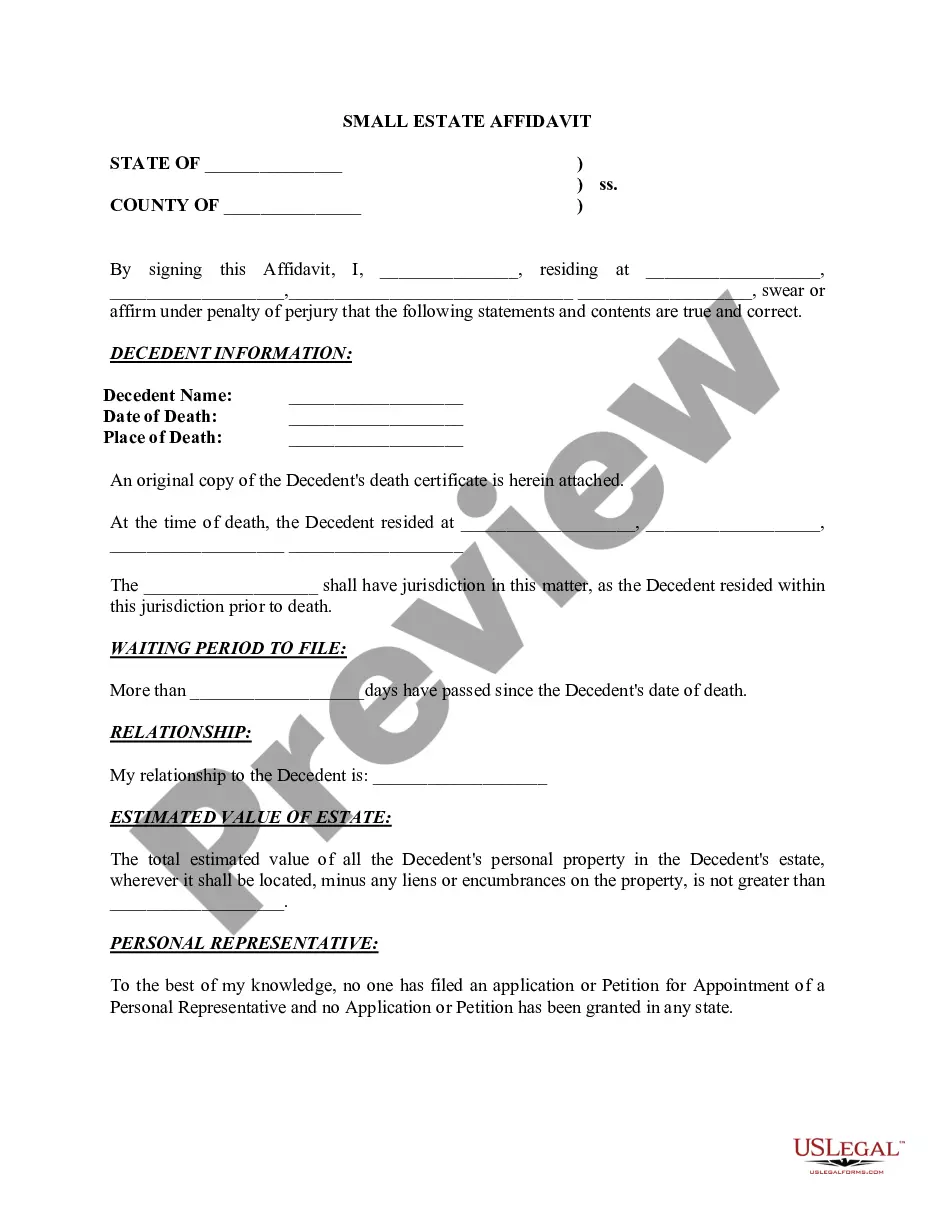
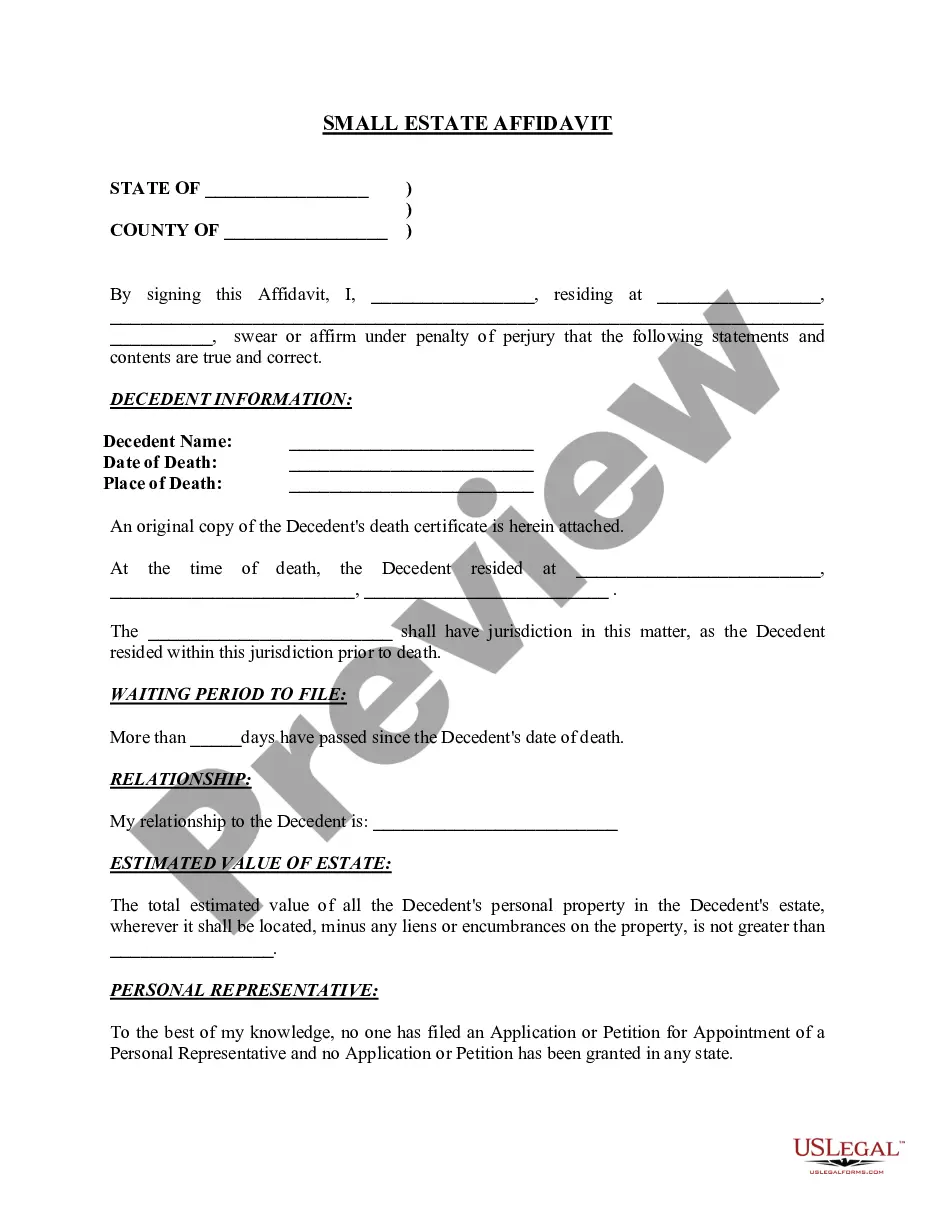
Small Estate Affidavit for North Carolina for estates not more than $20,000 - $30,000
Small Estates General Summary:
Small Estate laws were enacted in order to enable heirs to obtain property
of the deceased without probate, or with shortened probate proceedings,
provided certain conditions are met. Small estates can be administered
with less time and cost. If the deceased had conveyed most property
to a trust but there remains some property, small estate laws may also
be available. Small Estate procedures may generally be used regardless
of whether there was a Will. In general, two forms of small estate
procedures are recognized:
1.
Small Estate Affidavit -Some States allow an affidavit
to be executed by the spouse and/or heirs of the deceased and present the
affidavit to the holder of property such as a bank to obtain property of
the deceased. Other states require that the affidavit be filed with the
Court. The main requirement before you may use an affidavit is that
the value of the personal and/or real property of the estate not exceed
a certain value.
2.
Summary Administration -Some states allow a Summary
administration. Some States recognize both the Small Estate affidavit and
Summary Administration, basing the requirement of which one to use on the
value of the estate. Example: If the estate value is 10,000 or less an
affidavit is allowed but if the value is between 10,000 to 20,000 a summary
administration is allowed.
North Carolina Summary:
Under North Carolina statutes, where an
estate is valued at not more than $20,000, an interested party may, thirty
(30) days after the death of the decedent, issue a small estate affidavit
to collect any debts owed to the decedent. Prior to the recovery
of any assets of the decedent, a copy of the affidavit shall be filed in
the office of the clerk of superior court of the county where the decedent
had his domicile at the time of his death.
North Carolina Requirements:
North Carolina requirements are set forth in the statutes below.
ARTICLE 25. Small Estates.
§ 28A-25-1. Collection of property by affidavit when
decedent dies intestate.
(a) When a decedent dies intestate leaving personal
property, less liens and encumbrances thereon, not exceeding twenty thousand
dollars ($20,000) in value, at any time after 30 days from the date of
death, any person indebted to the decedent or having possession of tangible
personal property or an instrument evidencing a debt, obligation, stock
or chose in action belonging to the decedent shall make payment of the
indebtedness or deliver the tangible personal property or an instrument
evidencing a debt, obligation, stock or chose in action to a person claiming
to be the public administrator appointed pursuant to G.S. 28A-12-1, or
an heir or creditor of the decedent, not disqualified under G.S. 28A-4-2,
upon being presented a certified copy of an affidavit filed in accordance
with subsection (b) and made by or on behalf of the heir or creditor or
the public administrator stating:
(1) The name and address of the
affiant and the fact that he or she is the public administrator or an heir
or creditor of the decedent;
(5) That the value of all the personal property
owned by the estate of the decedent, less liens and encumbrances thereon,
does not exceed twenty thousand dollars ($20,000);
(6) That no application or petition for
appointment of a personal representative is pending or has been granted
in any jurisdiction;
(7) The names and addresses of those persons
who are entitled, under the provisions of the Intestate Succession Act,
to the personal property of the decedent and their relationship, if any,
to the decedent; and
(8) A description sufficient to identify
each tract of real property owned by the decedent at the time of his death.
In those cases in which the affiant is the surviving spouse and sole heir
of the decedent, not disqualified under G.S. 28A-4-2, the property described
in this subsection that may be collected pursuant to this section may exceed
twenty thousand dollars ($20,000) in value but shall not exceed thiry thousand
dollars ($30,000) in value. In such cases, the affidavit shall state:
(i) the name and address of the affiant and
the fact that he or she is the surviving spouse and is entitled, under
the provisions of the Intestate Succession Act, to all of the property
of the decedent;
(ii) that the value of all of the personal property owned by the
estate of the decedent, less liens and encumbrances thereon, does not exceed
thirty thousand dollars ($30,000); and
(iii) the information required under
subdivisions (2), (3), (4), (6), and (8) of this subsection.
(b) Prior to the recovery of any assets of the decedent, a copy
of the affidavit described in subsection (a) shall be filed in the office
of the clerk of superior court of the county where the decedent had his
domicile at the time of his death. The affidavit shall be filed by the
clerk upon payment of the fee provided in G.S. 7A-307, shall be indexed
in the index to estates, and a copy thereof shall be mailed by the clerk
to the persons shown in the affidavit as entitled to the personal property.
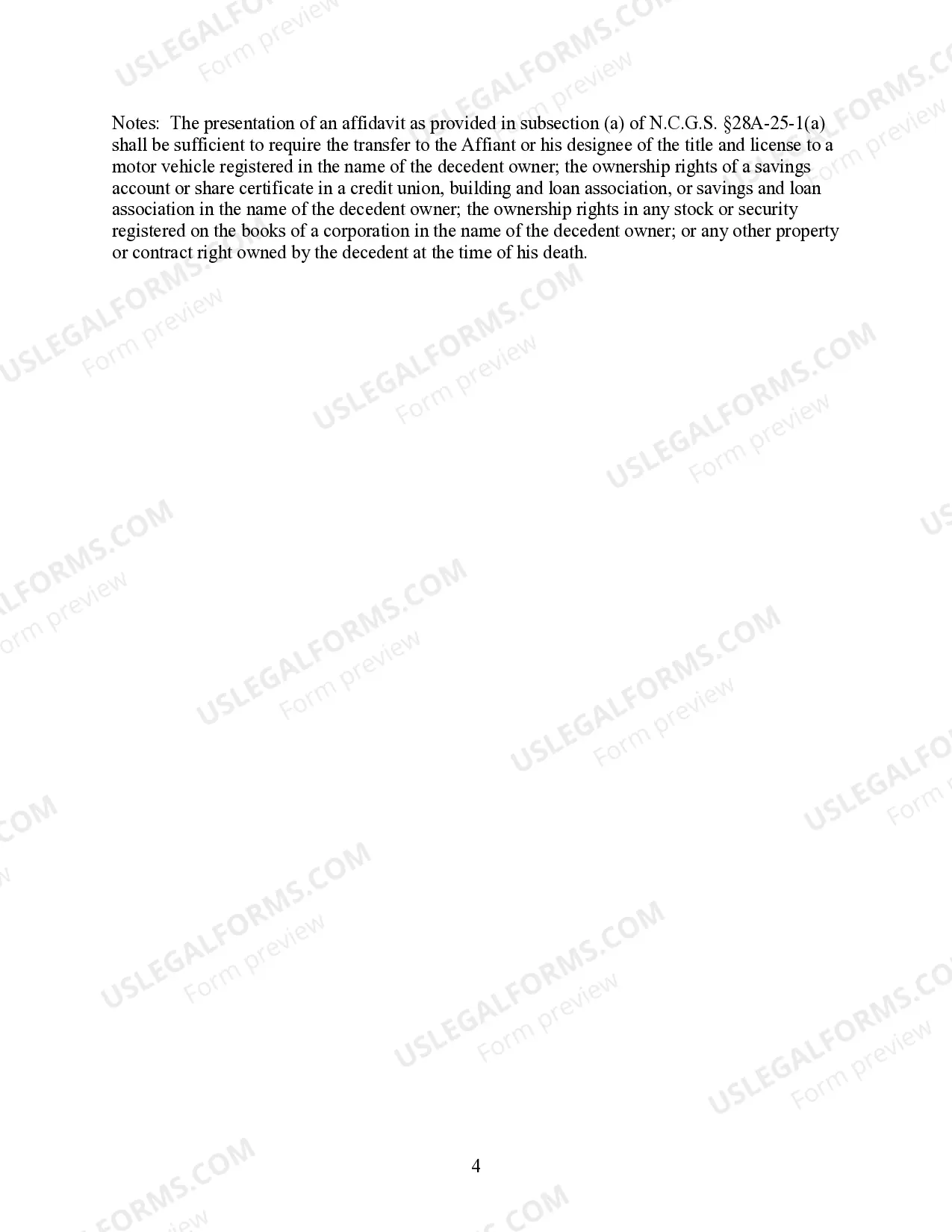
(c) The presentation of an affidavit as provided in subsection
(a) shall be sufficient to require the transfer to the affiant or his designee
of the title and license to a motor vehicle registered in the name of the
decedent owner; the ownership rights of a savings account or checking account
in a bank in the name of the decedent owner; the ownership rights of a
savings account or share certificate in a credit union, building and loan
association, or savings and loan association in the name of the decedent
owner; the ownership rights in any stock or security registered on the
books of a corporation in the name of a decedent owner; or any other property
or contract right owned by decedent at the time of his death.
§ 28A-25-1.1. Collection of property by affidavit when
decedent dies testate.
(a) When a decedent dies testate leaving personal
property, less liens and encumbrances thereon, not exceeding twenty thousand
dollars ($20,000) in value, at any time after 30 days from the date of
death, any person indebted to the decedent or having possession of tangible
personal property or an instrument evidencing a debt, obligation, stock
or chose in action belonging to the decedent shall make payment of the
indebtedness or deliver the tangible personal property or an instrument
evidencing a debt, obligation, stock or chose in action to a person claiming
to be the public administrator appointed pursuant to G.S. 28A-12-1, a person
named or designated as executor in the will, devisee, heir or creditor,
of the decedent, not disqualified under G.S. 28A-4-2, upon being presented
a certified copy of an affidavit filed in accordance with subsection (b)
and made by or on behalf of the heir, the person named or designated as
executor in the will of the decedent, the creditor, the public administrator,
or the devisee, stating:
(1) The name and address of the
affiant and the fact that he is the public administrator, a person named
or designated as executor in the will, devisee, heir or creditor, of the
decedent;
(5) That the decedent died testate leaving
personal property, less liens and encumbrances thereon, not exceeding twenty
thousand dollars ($20,000) in value;
(6) That the decedent's will has been admitted
to probate in the court of the proper county and a duly certified copy
of the will has been recorded in each county in which is located any real
property owned by the decedent at the time of his death;
(8) That no application or petition for
appointment of a personal representative is pending or has been granted
in any jurisdiction;
(9) The names and addresses of those persons
who are entitled, under the provisions of the will, or if applicable, of
the Intestate Succession Act, to the property of the decedent; and their
relationship, if any, to the decedent; and
(10) A description sufficient to identify
each tract of real property owned by the decedent at the time of his death.
In those cases in which the affiant is the surviving spouse, is entitled
to all of the property of the decedent, and is not disqualified under G.S.
28A-4-2, the property described in this subsection that may be collected
pursuant to this section may exceed twenty thousand dollars ($20,000) in value
but shall not exceed thirty thousand dollars ($30,000) in value. In such
cases, the affidavit shall state:
(i) the name and address of the affiant and the fact that
he or she is the surviving spouse and is entitled, under the provisions
of the decedent's will, or if applicable, of the Intestate Succession Act,
to all of the property of the decedent;
(ii) that the decedent died testate leaving personal property, less
liens and encumbrances thereon, not exceeding twenty thousand dollars ($30,000);
and
(iii) the information required under subdivisions (2), (3), (4),
(6), (7), (8), and (10) of this subsection.
(b) Prior to the recovery of any assets of the decedent, a copy
of the affidavit described in subsection (a) shall be filed in the office
of the clerk of superior court of the county where the decedent had his
domicile at the time of his death. The affidavit shall be filed by the
clerk upon payment of the fee provided in G.S. 7A-307, shall be indexed
in the index to estates, and a copy shall be mailed by the clerk to the
persons shown in the affidavit as entitled to the property.
(c) The presentation of an affidavit as provided in subsection
(a) shall be sufficient to require the transfer to the affiant or his designee
of the title and license to a motor vehicle registered in the name of the
decedent owner; the ownership rights of a savings account or checking account
in a bank in the name of the decedent owner; the ownership rights of a
savings account or share certificate in a credit union, building and loan
association, or savings and loan association in the name of the decedent
owner; the ownership rights in any stock or security registered on the
books of a corporation in the name of a decedent owner; or any other property
or contract right owned by decedent at the time of his death.
§ 28A-25-2. Effect of affidavit.
The person paying, delivering, transferring, or issuing personal
property or the evidence thereof pursuant to an affidavit meeting the requirements
of G.S. 28A-25-1(a) or 28A-25-1.1(a) is discharged and released to the
same extent as if he dealt with a duly qualified personal representative
of the decedent. He is not required to see to the application of the personal
property or evidence thereof or to inquire into the truth of any statement
in the affidavit. If any person to whom an affidavit is delivered refuses
to pay, deliver, transfer, or issue any personal property or evidence thereof,
it may be recovered or its payment, delivery, transfer, or issuance compelled
upon proof of their right in an action brought for that purpose by or on
behalf of the persons entitled thereto. The court costs and attorney's
fee incident to the action shall be taxed against the person whose refusal
to comply with the provisions of G.S. 28A-25-1(a) or 28A-25-1.1(a) made
the action necessary. The heir or creditor to whom payment, delivery, transfer
or issuance is made is answerable and accountable therefor to any duly
qualified personal representative or collector of the decedent's estate
or to any other person having an interest in the estate.
§ 28A-25-3. Disbursement and distribution of property collected
by affidavit.
(a) If there has been no personal representative or collector
appointed by the clerk of superior court, the affiant who has collected
personal property of the decedent by affidavit pursuant to G.S. 28A-25-1
or G.S. 28A-25-1.1 shall:
(2) File an affidavit with the clerk
of superior court that he has collected the personal property of the decedent
and the manner in which he has disbursed and distributed the same. This
final affidavit shall be filed within 90 days of the date of filing of
the qualifying affidavit provided for in G.S. 28A-25-1 or G.S. 28A-25-1.1.
If the affiant cannot file the final affidavit within 90 days, he
shall file a report with the clerk within that time period stating his
reasons. Upon determining that the affiant has good reason not to
file the final affidavit within 90 days, the clerk may extend the time
for filing up to one year from the date of filing the qualifying affidavit.
(b) Nothing in this section shall be construed as changing
the rule of G.S. 28A-15-1 and G.S. 28A-15-5 rendering both real and personal
property, without preference or priority, available for the discharge of
debts and other claims against the estate of the decedent. If it appears
that it may be in the best interest of the estate to sell, lease, or mortgage
any real property to obtain money for the payment of debts or other claims
against the decedent's estate, the affiant shall petition the clerk of
superior court for the appointment of a personal representative to conclude
the administration of the decedent's estate pursuant to G.S. 28A-25-5.
§ 28A-25-4. Clerk may compel compliance.
If any affiant who has collected personal property of the decedent
by affidavit pursuant to G.S. 28A-25-1 or G.S. 28A-25-1.1 shall fail to
make distribution or file affidavit as required by G.S. 28A-25-3, the clerk
of superior court may, upon his own motion or at the request of any interested
person, issue an attachment against him for a contempt and commit him until
he makes proper distribution and files the affidavit. In addition
to or in lieu of filing this attachment, the clerk may require the affiant
to post a bond conditioned as provided in G.S. 28A-8-2.
§ 28A-25-5. Subsequently appointed personal representative
or collector.
Nothing in this Article shall preclude any interested person, including
the affiant, from petitioning the clerk of superior court for the appointment
of a personal representative or collector to conclude the administration
of the decedent's estate. If such is done, the affiant who has been collecting
personal property by affidavit shall cease to do so, shall deliver all
assets in his possession to the personal representative, and shall render
a proper accounting to the personal representative or collector. A copy
of the accounting shall also be filed with the clerk having jurisdiction
over the personal representative or collector.
§ 28A-25-6. Payment to clerk of money owed decedent.
(a) As an alternative to the small estate settlement procedures
of this Article, any person indebted to a decedent may satisfy such indebtedness
by paying the amount of the debt to the clerk of the superior court of
the county of the domicile of the decedent:
(1) If no administrator has been
appointed, and
(2) If the amount owed by such person does
not exceed five thousand dollars ($5,000), and
(3) If the sum tendered to the clerk would
not make the aggregate sum which has come into the clerk's hands belonging
to the decedent exceed five thousand dollars ($5,000).
(b) Such payments may not be made to the clerk if the
total amount paid or tendered with respect to any one decedent would exceed
five thousand dollars ($5,000), even though disbursements have been made
so that the aggregate amount in the clerk's hands at any one time would
not exceed five thousand dollars ($5,000).
(c) If the sum tendered pursuant to this section would make
the aggregate sum coming into the clerk's hands with respect to any one
decedent exceed five thousand dollars ($5,000) the clerk shall appoint
an administrator, or the sum may be administered under the preceding sections
of this Article.
(d) If it appears to the clerk after making a preliminary
survey that disbursements pursuant to this section would not exhaust funds
received pursuant to this section, he may, in his discretion, appoint an
administrator, or the funds may be administered under the preceding sections
of this Article.
(e) The receipt from the clerk of the superior court of a
payment purporting to be made pursuant to this section is a full release
to the debtor for the payment so made.
(f) If no administrator has been appointed, the clerk of superior
court shall disburse the money received under this section for the following
purposes and in the following order:
(1) To pay the surviving spouse's
year's allowance and children's year's allowance assigned in accordance
with law;
(2), (3) Repealed by Session Laws 1981, c. 383, s. 3.
Notwithstanding the foregoing provisions of this subsection, the
clerk shall pay, out of funds provided the deceased pursuant to G.S. 111-18
and Part 3 of Article 2 of Chapter 108A of the General Statutes of North
Carolina, any lawful claims for care provided by an adult care home to
the deceased, incurred not more than 90 days prior to his death. After
the death of a spouse who died intestate and after the disbursements have
been made in accordance with this subsection, the balance in the clerk's
hands belonging to the estate of the decedent shall be paid to the surviving
spouse, and if there is no surviving spouse, the clerk shall pay it to
the heirs in proportion to their respective interests.
(g) The clerk shall not be required to publish notice to creditors.
(h) Whenever an administrator is appointed after a clerk of
superior court has received any money pursuant to this section, the clerk
shall pay to the administrator all funds which have not been disbursed.
The clerk shall receive no commissions for payments made to the administrator,
and the administrator shall receive no commissions for receiving such payments.