Minnesota Seller's Disclosure of Financing Terms for Residential Property in connection with Contract or Agreement for Deed a/k/a Land Contract
About this form
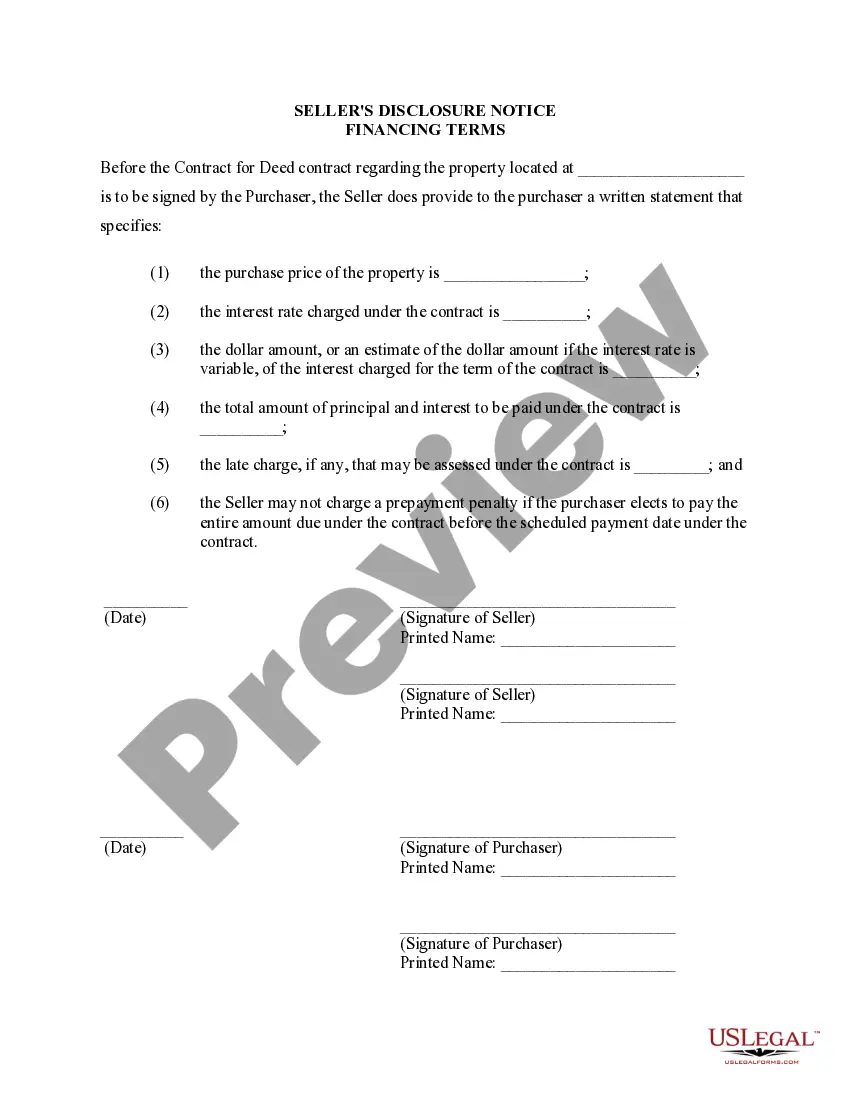
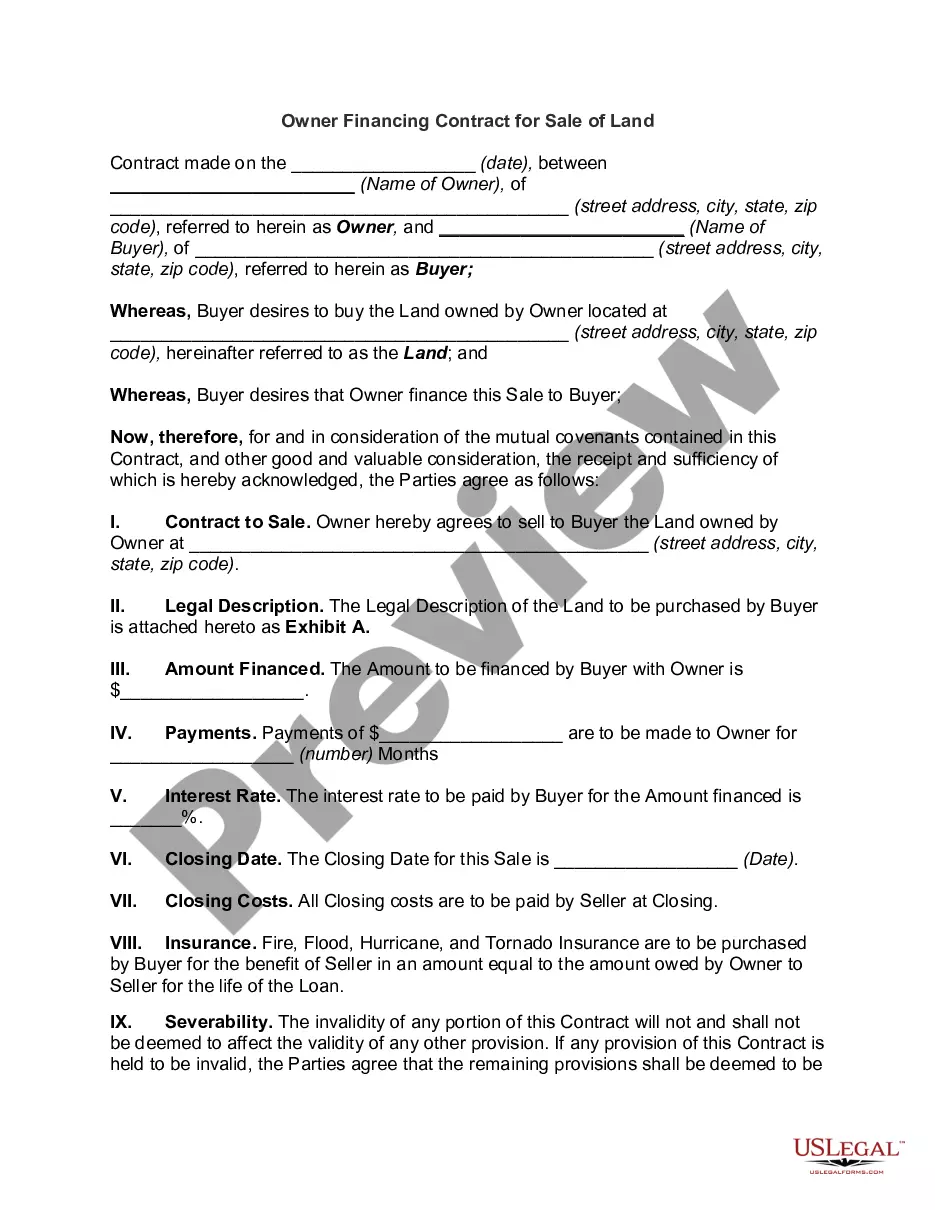
The Seller's Disclosure of Financing Terms for Residential Property is a crucial document for real estate transactions involving a contract for deed, also known as a land contract. This form informs the purchaser about key financing details, including the purchase price, payment structure, interest rates, and any applicable late charges. It helps facilitate a transparent agreement between the seller and buyer, ensuring that both parties understand the financial obligations before finalizing the deal.
Key parts of this document
- Purchase price of the property.
- Details regarding the payment schedule.
- Interest rates applicable to the financing.
- Information on late charges if payments are not timely.
- Signature fields for both seller and purchaser.
When to use this document
This form should be used in situations where a seller is financing a property sale through a contract for deed. It is particularly relevant when the seller intends to offer flexible payment terms to the buyer, thus requiring a clear disclosure of all financing terms. This document must be provided at or before the signing of the contract for deed to ensure that the purchaser is fully informed about their financial responsibilities.
Intended users of this form
This form is intended for:
- Home sellers offering financing options to buyers.
- Potential buyers of residential property who will enter into a contract for deed.
- Real estate agents assisting in the sale of properties using land contracts.
- Investors seeking to understand financing terms before a property purchase.
Completing this form step by step
Follow these steps to complete the Seller's Disclosure of Financing Terms:
- Identify the seller and the purchaser by entering their full names.
- Specify the purchase price of the property clearly.
- Outline the payment terms, including any installment amounts and due dates.
- Clearly state the interest rate applicable to the financing provided.
- Indicate any late charge provisions for delayed payments.
- Ensure both parties sign and date the form before the contract for deed is finalized.
Notarization requirements for this form
This form does not typically require notarization unless specified by local law. It is advisable to check your state's regulations regarding notarization of financing documents.
Get your form ready online
Our built-in tools help you complete, sign, share, and store your documents in one place.
Make edits, fill in missing information, and update formatting in US Legal Forms—just like you would in MS Word.
Download a copy, print it, send it by email, or mail it via USPS—whatever works best for your next step.
Sign and collect signatures with our SignNow integration. Send to multiple recipients, set reminders, and more. Go Premium to unlock E-Sign.
If this form requires notarization, complete it online through a secure video call—no need to meet a notary in person or wait for an appointment.
We protect your documents and personal data by following strict security and privacy standards.

Make edits, fill in missing information, and update formatting in US Legal Forms—just like you would in MS Word.

Download a copy, print it, send it by email, or mail it via USPS—whatever works best for your next step.

Sign and collect signatures with our SignNow integration. Send to multiple recipients, set reminders, and more. Go Premium to unlock E-Sign.

If this form requires notarization, complete it online through a secure video call—no need to meet a notary in person or wait for an appointment.

We protect your documents and personal data by following strict security and privacy standards.
Common mistakes
- Failing to disclose all relevant financial terms clearly.
- Not providing the form before signing the contract for deed.
- Incorrectly entering the interest rate or payment terms.
- Leaving out required signatures or dates.
Why use this form online
- Convenient access to legal forms from any location.
- Ability to download and edit the form as needed.
- Ensures that the form is drafted following legal standards.
- Reduces the risk of errors with guided instructions.
Main things to remember
- The Seller's Disclosure of Financing Terms ensures clarity in real estate transactions involving seller financing.
- Properly completed forms help avoid misunderstandings regarding payment obligations.
- Understanding and following local regulations is essential for the effectiveness of this document.
Looking for another form?
Form popularity
FAQ
A contract for deed, also called a land contract or contract for sale, is a financing option for buyers who do not qualify for a mortgage loan to purchase property. In a contract for deed, the seller finances the purchase of the property, much like a mortgage company in a more traditional mortgage situation.
A: No, they are not. The Contract to Sell comes before a Deed of Sale, as the former serves as the basis for the latter. There is an act of finality when it comes to the Deed of Sale. On the other hand, the Contract to Sell requires that the parties first complete the conditions they agreed to.
Usually the contract requires the buyer to make payments over time with interest payable on the unpaid balance. Once a buyer pays all of the payments called for under the contract, the owner transfers to the buyer a deed to the property.
One of the biggest negatives that can occur with a land contract is when a buyer purchases a property on which the seller is still making mortgage payments.
A disadvantage to the seller is that a contract for deed is frequently characterized by a low down payment and the purchase price is paid in installments instead of one lump sum.The legal fees and time frame for this process will be more extensive than a standard Power of Sale foreclosure.
A contract for deed is a legal agreement for the sale of property in which a buyer takes possession and makes payments directly to the seller, but the seller holds the title until the full payment is made.
In the first instance, if your deed is not recorded, there is nothing in the public record to stop the seller from conveying the property to another person.The second situation could happen if your seller fails to pay his or her debts and the seller's creditors file liens or judgments against your property.
A contract for deed is an agreement for buying property without going to a mortgage lender. The buyer agrees to pay the seller monthly payments, and the deed is turned over to the buyer when all payments have been made.
A contract for deed, also known as a "bond for deed," "land contract," or "installment land contract," is a transaction in which the seller finances the sale of his or her own property. In a contract for deed sale, the buyer agrees to pay the purchase price of the property in monthly installments.