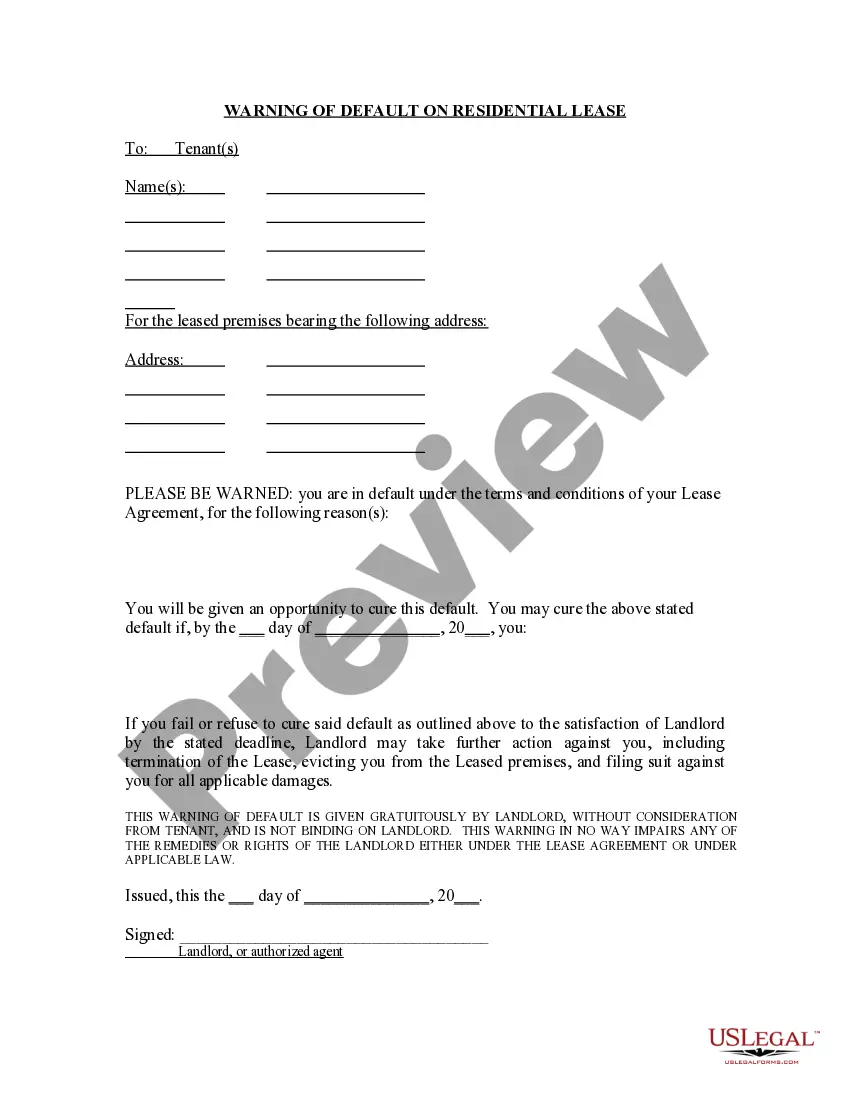
Maine Warning of Default on Residential Lease
Understanding this form
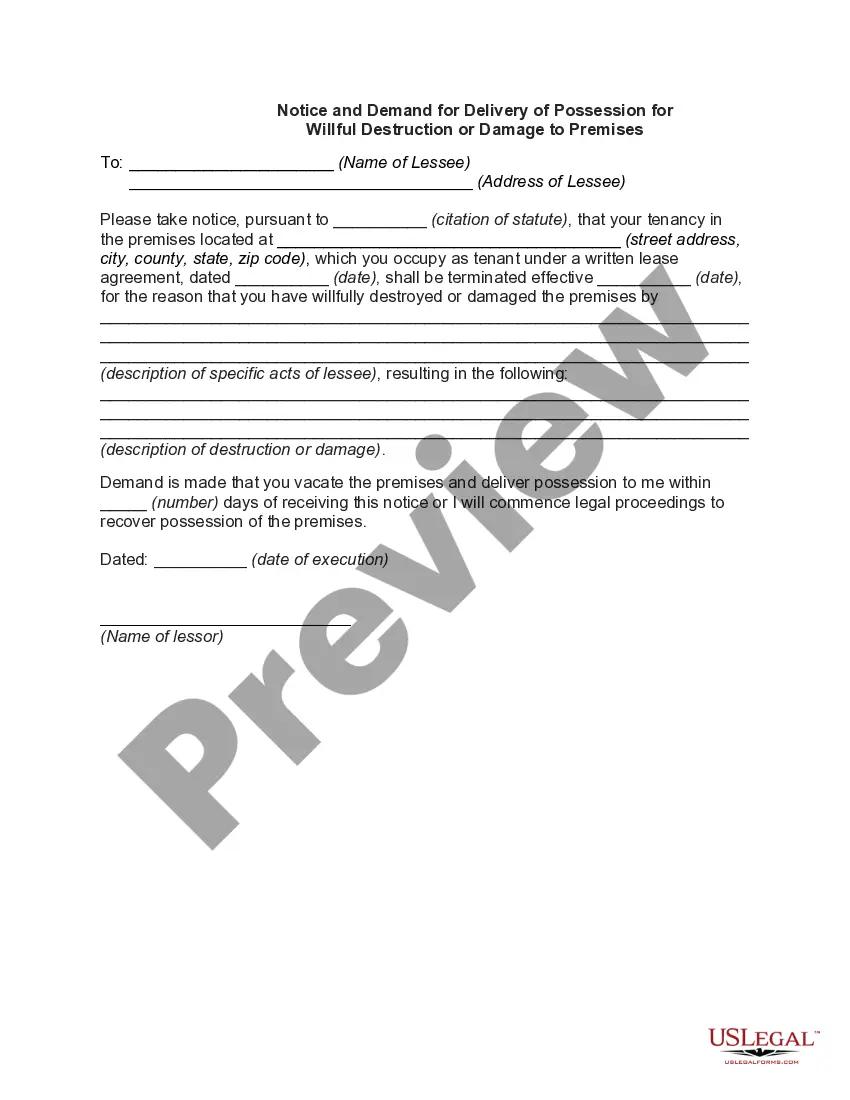
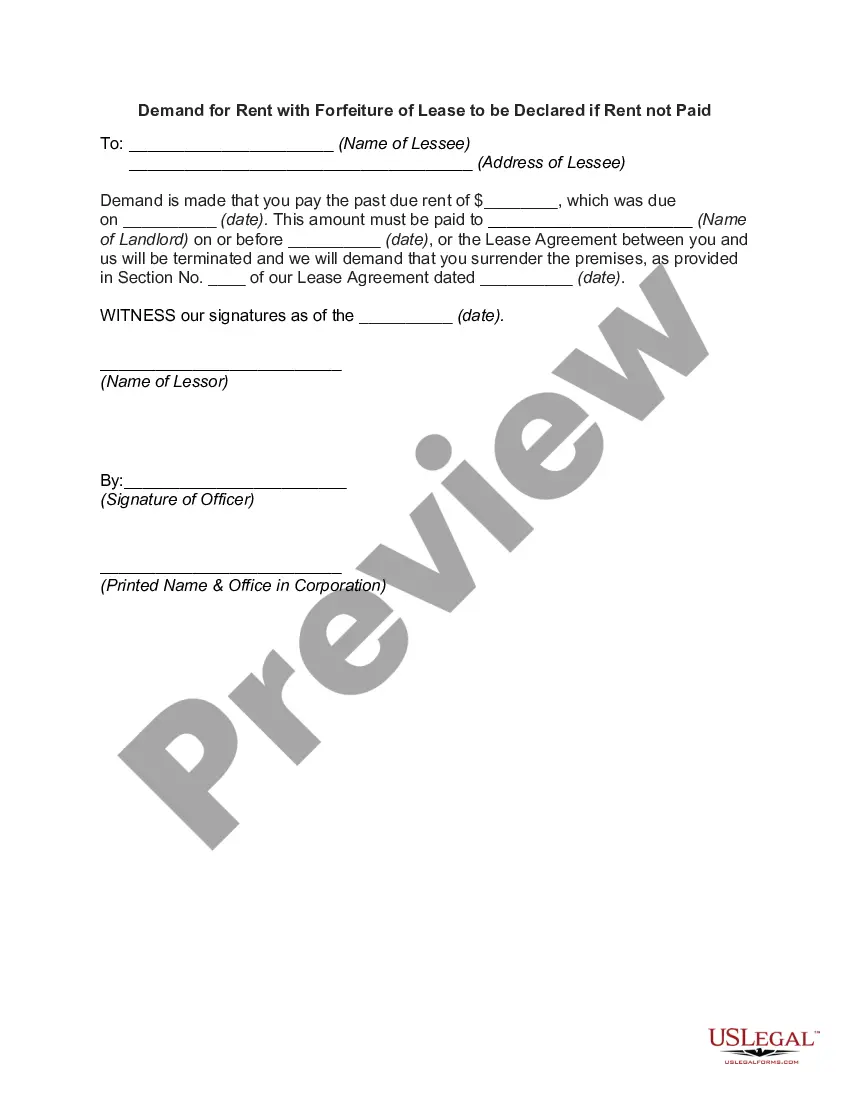
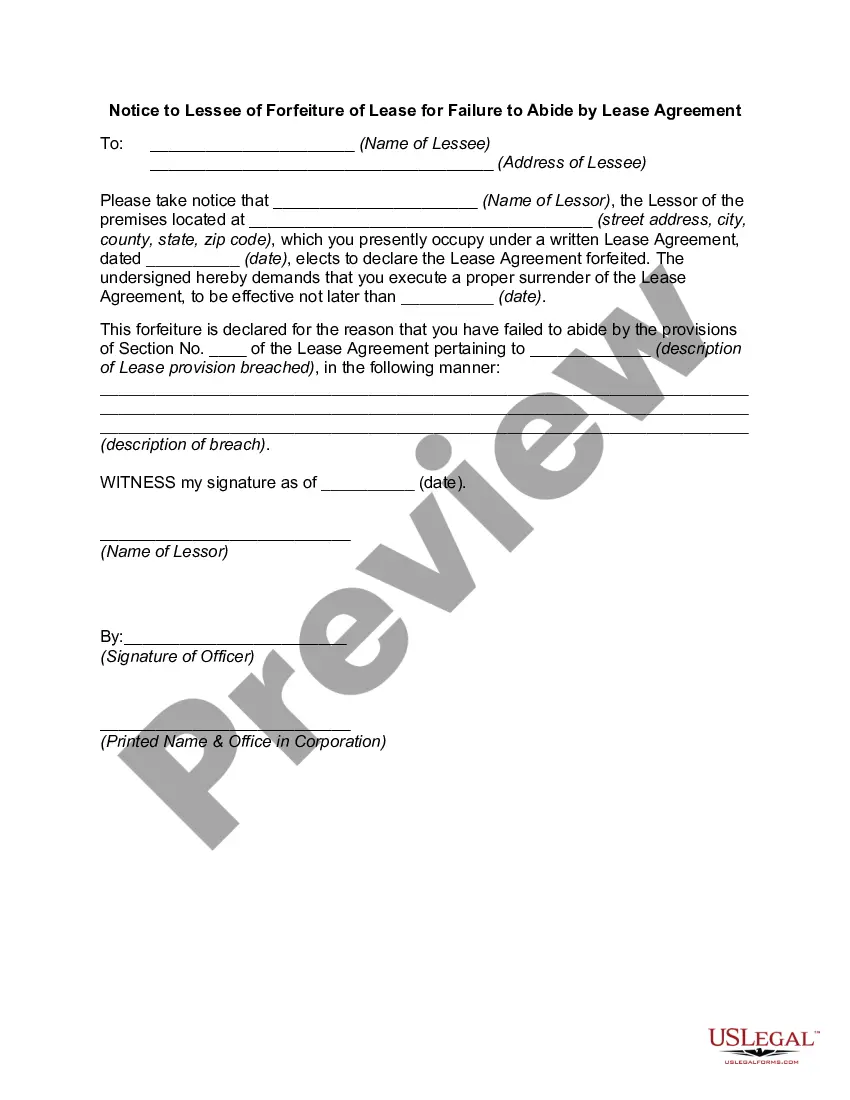
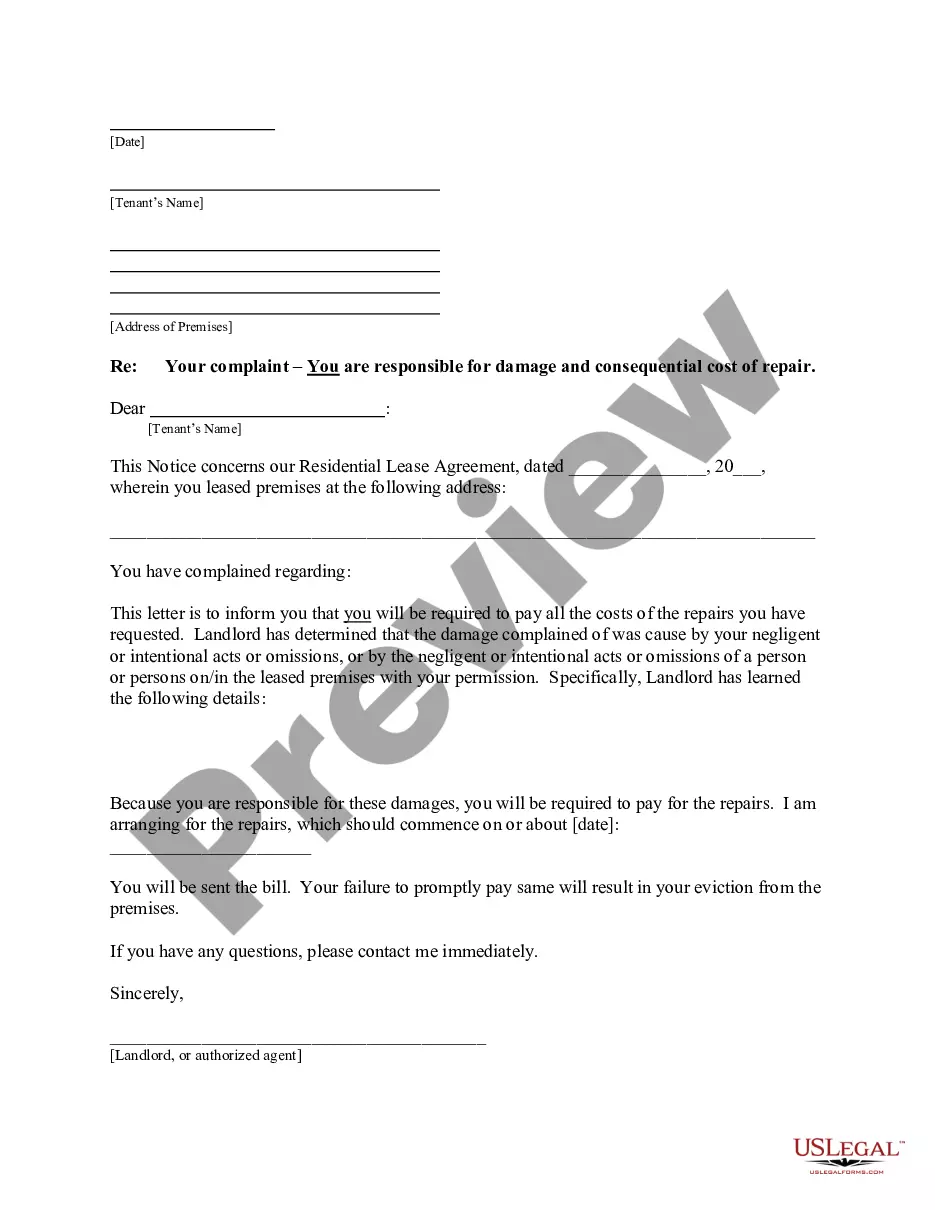
The Warning of Default on Residential Lease is a formal communication from a landlord to a tenant. It serves to alert the tenant that they are potentially in breach of their lease agreement. This warning specifies issues that need to be addressed to avoid being declared in default. Unlike other lease forms, this document is specifically focused on notifying tenants about their obligations and the consequences of failing to meet them.
What’s included in this form
- Date of issuance.
- Landlordâs signature and contact information.
- Description of the default issues that need to be remedied.
- Clear statement regarding the non-binding nature of the warning.


When to use this form
This form should be used when a landlord identifies that a tenant has not complied with the terms of their lease. It serves as an official warning that gives the tenant an opportunity to correct their behavior or fulfill their obligations before any further action is taken, such as eviction. Common scenarios include late rent payments, failure to maintain the property, or unauthorized occupants.
Who can use this document
- Landlords who need to formally notify tenants of potential lease violations.
- Property managers acting on behalf of the landlord.
- Real estate professionals advising landlords about tenant compliance issues.
Completing this form step by step
- Fill in the date you are issuing the warning.
- Clearly state the issues that are causing concern for the tenant.
- Provide your name and contact information as the landlord.
- Sign the document to validate the warning.
Notarization guidance
This form does not typically require notarization unless specified by local law. However, notarization can add an extra layer of validity to the warning if desired.
Get your form ready online
Our built-in tools help you complete, sign, share, and store your documents in one place.
Make edits, fill in missing information, and update formatting in US Legal Forms—just like you would in MS Word.
Download a copy, print it, send it by email, or mail it via USPS—whatever works best for your next step.
Sign and collect signatures with our SignNow integration. Send to multiple recipients, set reminders, and more. Go Premium to unlock E-Sign.
If this form requires notarization, complete it online through a secure video call—no need to meet a notary in person or wait for an appointment.
We protect your documents and personal data by following strict security and privacy standards.

Make edits, fill in missing information, and update formatting in US Legal Forms—just like you would in MS Word.

Download a copy, print it, send it by email, or mail it via USPS—whatever works best for your next step.

Sign and collect signatures with our SignNow integration. Send to multiple recipients, set reminders, and more. Go Premium to unlock E-Sign.

If this form requires notarization, complete it online through a secure video call—no need to meet a notary in person or wait for an appointment.

We protect your documents and personal data by following strict security and privacy standards.
Common mistakes
- Failing to specify clear details about the default issues.
- Not signing the form before giving it to the tenant.
- Using informal language instead of the proper legal terms.
Why use this form online
- Convenient access to a legally vetted template that saves time.
- Editability allows you to customize the form to your specific situation.
- Reliable formatting ensures that all necessary legal components are included.
Legal use & context
- The form provides a warning rather than an eviction notice, which is more severe.
- It is advisable to issue this form before taking any further legal action to demonstrate that the tenant was informed of their defaults.
- Consulting local laws can provide insights into additional rights or obligations under lease agreements.
Main things to remember
- The Warning of Default on Residential Lease is a crucial first step in addressing lease compliance issues.
- It is important to communicate clearly with tenants about any defaults to allow for resolution.
- This form is used widely across states and can be customized for specific situations.
Looking for another form?
Form popularity
FAQ
In the context of a lease, 'default' refers to a failure to meet the obligations set forth in the lease agreement. This could involve not paying rent on time or violating other terms of the lease. A Maine Warning of Default on Residential Lease serves as a formal notification that a tenant has not adhered to these obligations. Understanding the specifics of default can help you address issues promptly.
Many people believe that landlords cannot evict tenants in the winter months (usually between October and March). This is false! According to the law, a landlord can evict a tenant if the reasons for the eviction fall under the Residential Tenancies Act and by following the eviction procedures as set out in the Act.
The Tenant Doesn't Make Enough Income. The Tenant Smokes. The Tenant Has a Pet. The Tenant's Income Isn't Verified. The Tenant Has Been Convicted of a Crime. The Tenant Does Not Have Rental History. The Tenant Has a History of Damaging Property and Not Paying Rent. The Tenant Provides False Information.
Your landlord can evict you with 30 days notice for almost any reason or no reason. Exceptions: You may be able to stop the eviction if your landlord is evicting you because of "retaliation" or "illegal discrimination." Read Retaliation defense and Discrimination defense.
Every habitable room, except rooms used primarily for sleeping purposes, shall be provided with a minimum heating of (68) degrees Fahrenheit, as required by prevailing weather conditions from September 15 through May 15 of each year. Does my landlord need to provide waste receptacles?
Call Pine Tree Legal Assistance if you are being evicted. There are common myths that people with disabilities or children cannot be evicted during Maine's cold months. These myths are not true. You can be evicted at any time of year even if you have a disability or children.
Generally, tenants cannot unilaterally break or terminate their leases in Maine. They must provide their landlords with a written termination notice before termination. Landlords are required to provide their tenants with habitable premises.
Maine Eviction Process Timeline Initial Notice Period between 7 and 30 days, depending on the notice type and reason for eviction. Issuance/Service of Summons and Complaint 7 days prior to the eviction hearing. Court Hearing and Ruling on the Eviction within 10 days of the return date listed on the summons.
State law regulates several rent-related issues, including late fees, the amount of notice (at least 45 days in Maine) landlords must give tenants to raise the rent, and how much time (seven days in Maine) a tenant has to pay rent or move before a landlord can file for eviction.