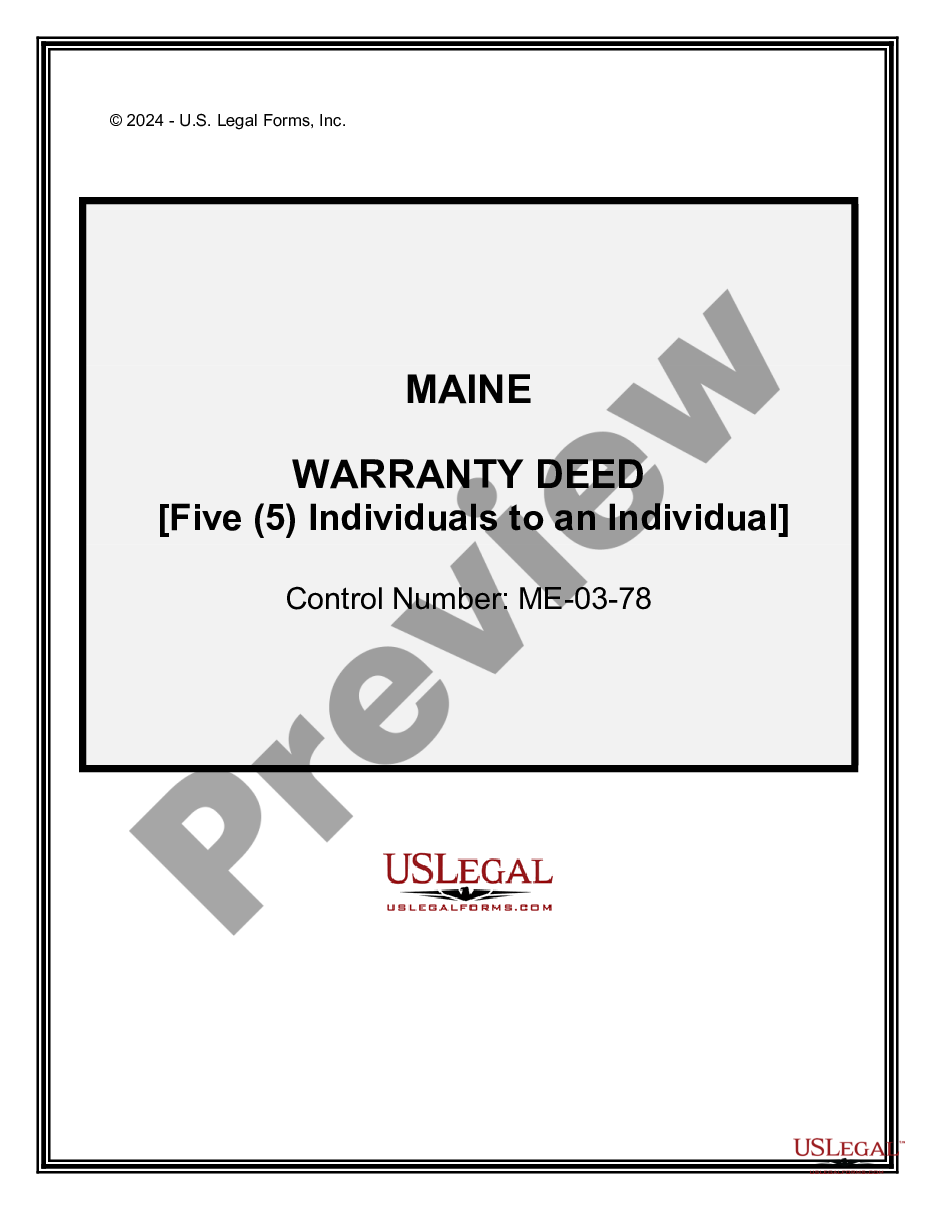
Maine Warranty Deed from Five Individuals to an Individual
What this document covers
This Warranty Deed from Five Individuals to an Individual is a legal document that allows five Grantors to convey and warrant ownership of a property to a single Grantee. This deed ensures that the property is free from claims or liens, providing legal assurance to the Grantee. Unlike other types of deeds, the warranty deed explicitly guarantees the title is clear and provides protections against future claims against the property.
Main sections of this form
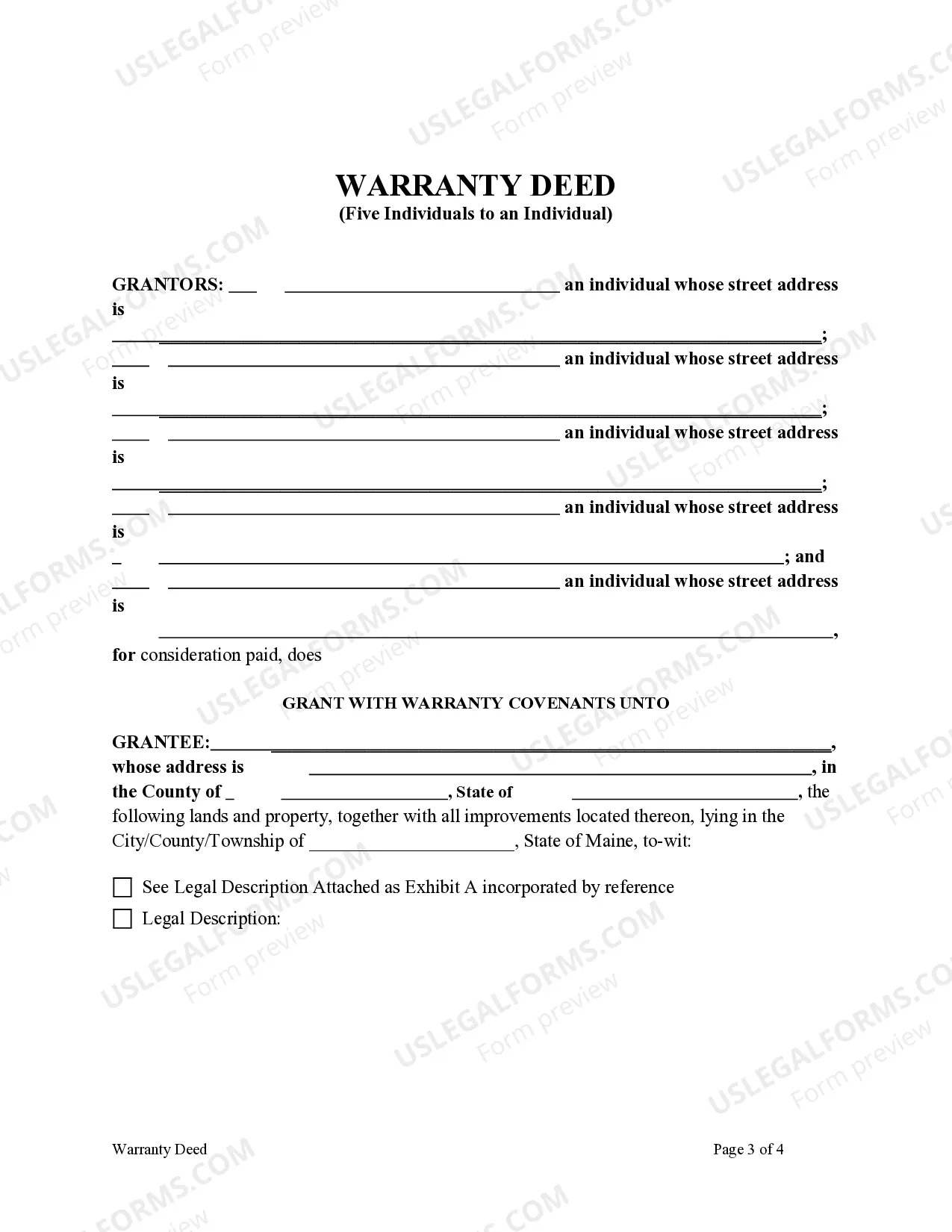
- Identification of Grantors: Names and details of the five individuals transferring property rights.
- Identification of Grantee: Name and details of the individual receiving property rights.
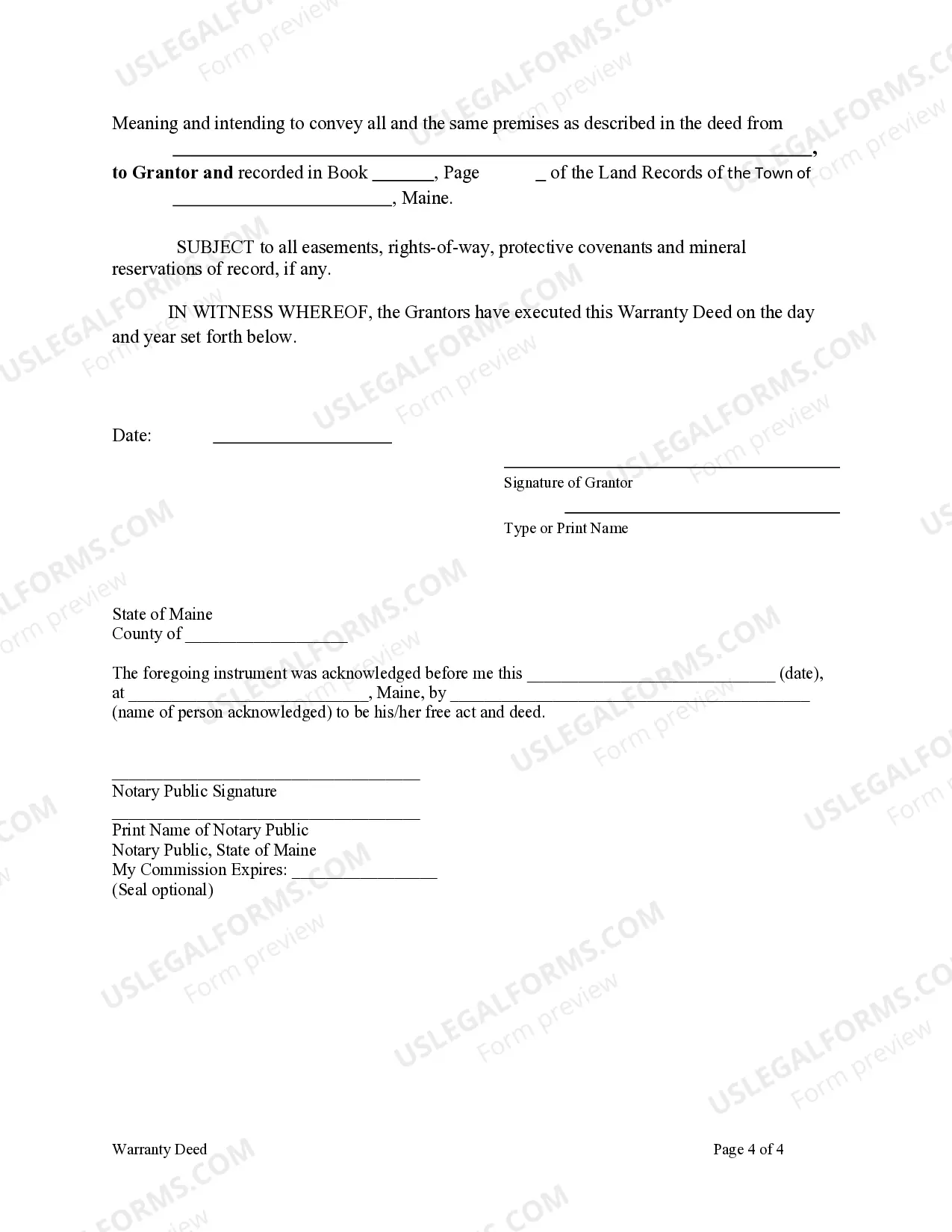
- Description of Property: A detailed description of the property being transferred, including legal description.
- Warranties and Covenants: Clauses ensuring the title is clear and free from encumbrances.
- Date and Signatures: Sections for signing and dating by all Grantors and the Grantee.






Common use cases
This Warranty Deed should be used when five individuals collectively own a property and wish to transfer their interests to one individual. This situation may arise in estate planning, real estate transactions, or in instances where a partnership dissolves and assets need to be reallocated.
Intended users of this form
This form is intended for:
- Individuals acting as Grantors who need to formally transfer property to an individual.
- A single Grantee receiving property from multiple owners.
- Anyone involved in property transactions requiring a warranty deed for clarity of title.
Completing this form step by step
- Identify the parties by entering the names and addresses of the five Grantors and the Grantee.
- Specify the property by providing the legal description and physical address of the property being transferred.
- State any warranties and covenants, ensuring clarity on the title's condition.
- Sign and date the deed in the appropriate sections by all Grantors and the Grantee.
- Consider notarizing the completed form to enhance its legal enforceability in certain jurisdictions.
Notarization requirements for this form
Notarization is required for this form to take effect. Our online notarization service, powered by Notarize, lets you verify and sign documents remotely through an encrypted video session, available 24/7.
Get your form ready online
Our built-in tools help you complete, sign, share, and store your documents in one place.
Make edits, fill in missing information, and update formatting in US Legal Forms—just like you would in MS Word.
Download a copy, print it, send it by email, or mail it via USPS—whatever works best for your next step.
Sign and collect signatures with our SignNow integration. Send to multiple recipients, set reminders, and more. Go Premium to unlock E-Sign.
If this form requires notarization, complete it online through a secure video call—no need to meet a notary in person or wait for an appointment.
We protect your documents and personal data by following strict security and privacy standards.

Make edits, fill in missing information, and update formatting in US Legal Forms—just like you would in MS Word.

Download a copy, print it, send it by email, or mail it via USPS—whatever works best for your next step.

Sign and collect signatures with our SignNow integration. Send to multiple recipients, set reminders, and more. Go Premium to unlock E-Sign.

If this form requires notarization, complete it online through a secure video call—no need to meet a notary in person or wait for an appointment.

We protect your documents and personal data by following strict security and privacy standards.
Common mistakes
- Failing to provide complete legal descriptions of the property.
- Not including all Grantors' signatures, which may invalidate the deed.
- Rounding or inaccurately calculating the transfer details, leading to potential disputes.
- Neglecting to verify if notarization is required in your jurisdiction.
Benefits of using this form online
- Convenient access: Download and complete the form from anywhere at any time.
- Editability: Fill in the form fields electronically, ensuring legibility and accuracy.
- Reliability: Utilize a form drafted by licensed attorneys to meet legal standards.
Looking for another form?
Form popularity
FAQ
A warranty deed guarantees that: The grantor is the rightful owner of the property and has the legal right to transfer the title. The property is free and clear of all liens and outstanding claims. The title would withstand third-party claims to ownership of the property.
A warranty deed can include six traditional forms of Covenants for Title, sometimes known as the English covenants of title. Those six traditional forms of covenants can be broken down into two categories: present covenants and future covenants.
Misconceptions and Realities. It is a misconception that someone can be removed from the deed. Nor can a co-owner simply take away another party's interest in a property by executing a new deed without that other party. In short, no one can be passively removed from a title.
The General Warranty Deed A general warranty deed provides the highest level of protection for the buyer because it includes significant covenants or warranties conveyed by the grantor to the grantee.
A general warranty deed must include the following to be valid: The name and address of the seller (called the grantor) The name and address of the buyer (called the grantee) A legal description of the property (found on the previous deed)
Contrary to normal expectations, the Deed DOES NOT have to be recorded to be effective or to show delivery, and because of that, the Deed DOES NOT have to be signed in front of a Notary Public. However, if you plan to record it, then it does have to be notarized as that is a County Recorder requirement.
Quitclaim Deeds are used when the transfer of ownership in the property does not occur as the result of a traditional sale.Under a warranty deed, if it turns out that the property is not what the seller promised or there's an uncleared lien or other block to the title, the buyer can sue the seller and recover damages.
They are (1) covenant for seisin; (2) covenant of the right to convey; (3) covenant against encumbrances; (4) covenant for QUIET ENJOYMENT; (5) covenant of general WARRANTY; and (6) covenant for further assurances.
12. Who benefits the most from recording a warranty deed? D. Explanation: The grantee is the one who has acquired an interest in the land, and she is the one who benefits the most from recording the deed to provide constructive (legal) notice of that interest.