Maryland Written Revocation of Will
Overview of this form
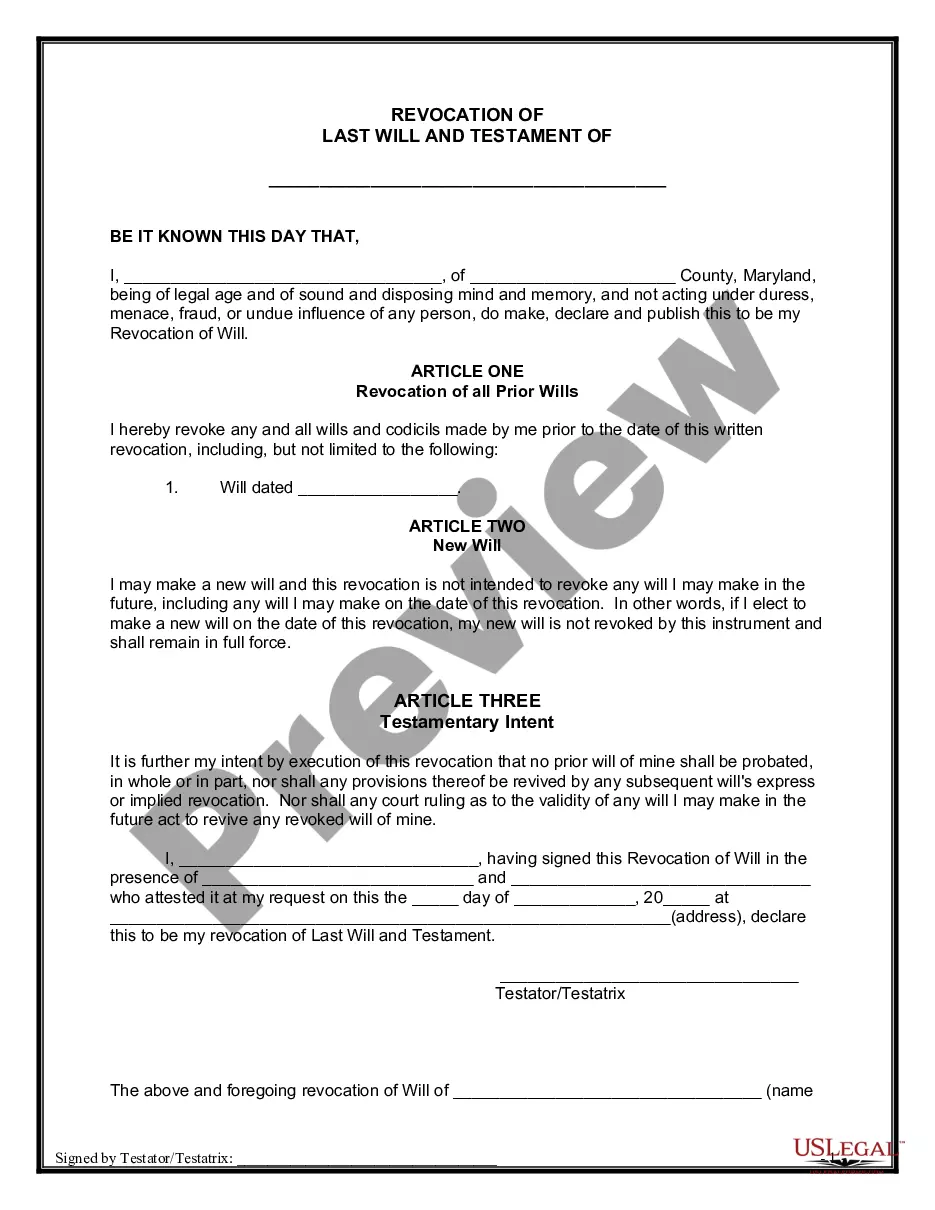
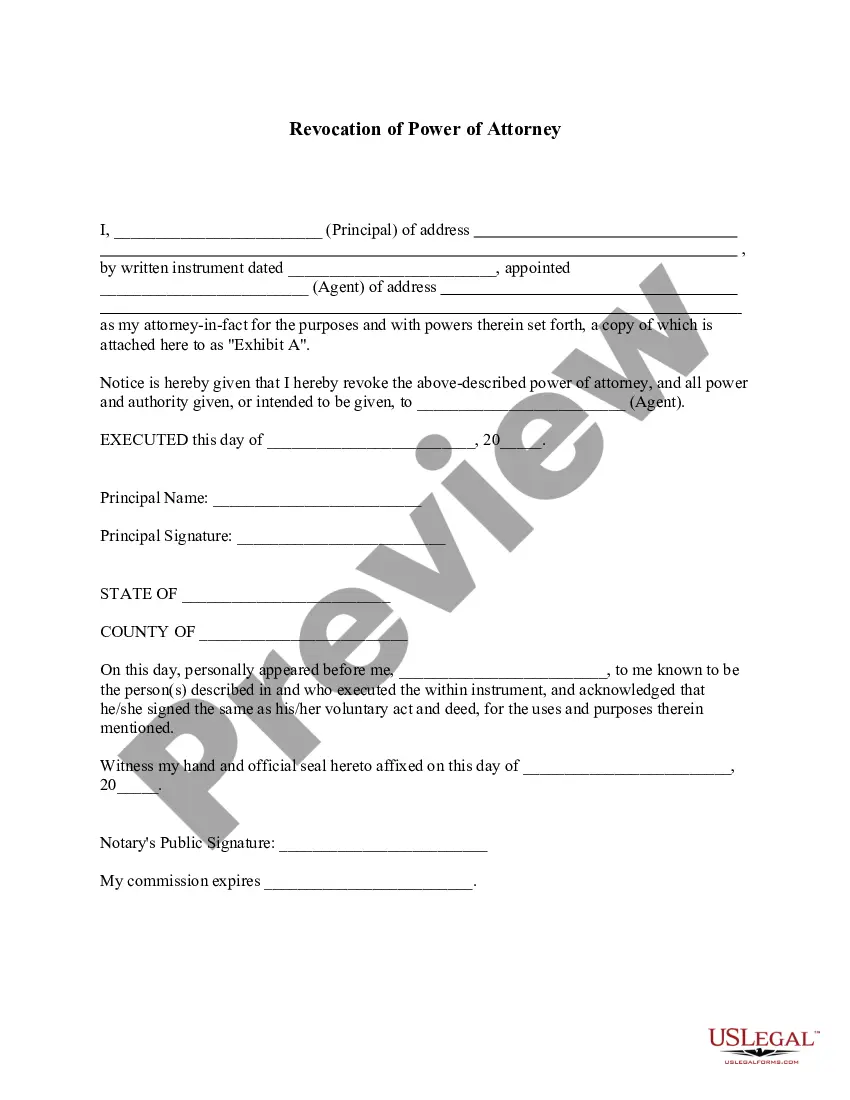
The Written Revocation of Will is a legal document used to officially revoke any existing wills. This form is essential when a person wants to make it clear that previous wills should no longer be honored, particularly if a new will does not contain an explicit revocation clause. This ensures that heirs cannot claim any benefits from an older will that is not in line with the individual's current wishes.
Main sections of this form
- Testator/Testatrix information: Includes full name and county of residence.
- Revocation clause: A clear statement revoking all prior wills and codicils.
- Future wills: A clause specifying that the revocation does not affect any future wills made by the testator.
- Intent declaration: Ensures there is no ambiguity regarding the revocation of prior wills.
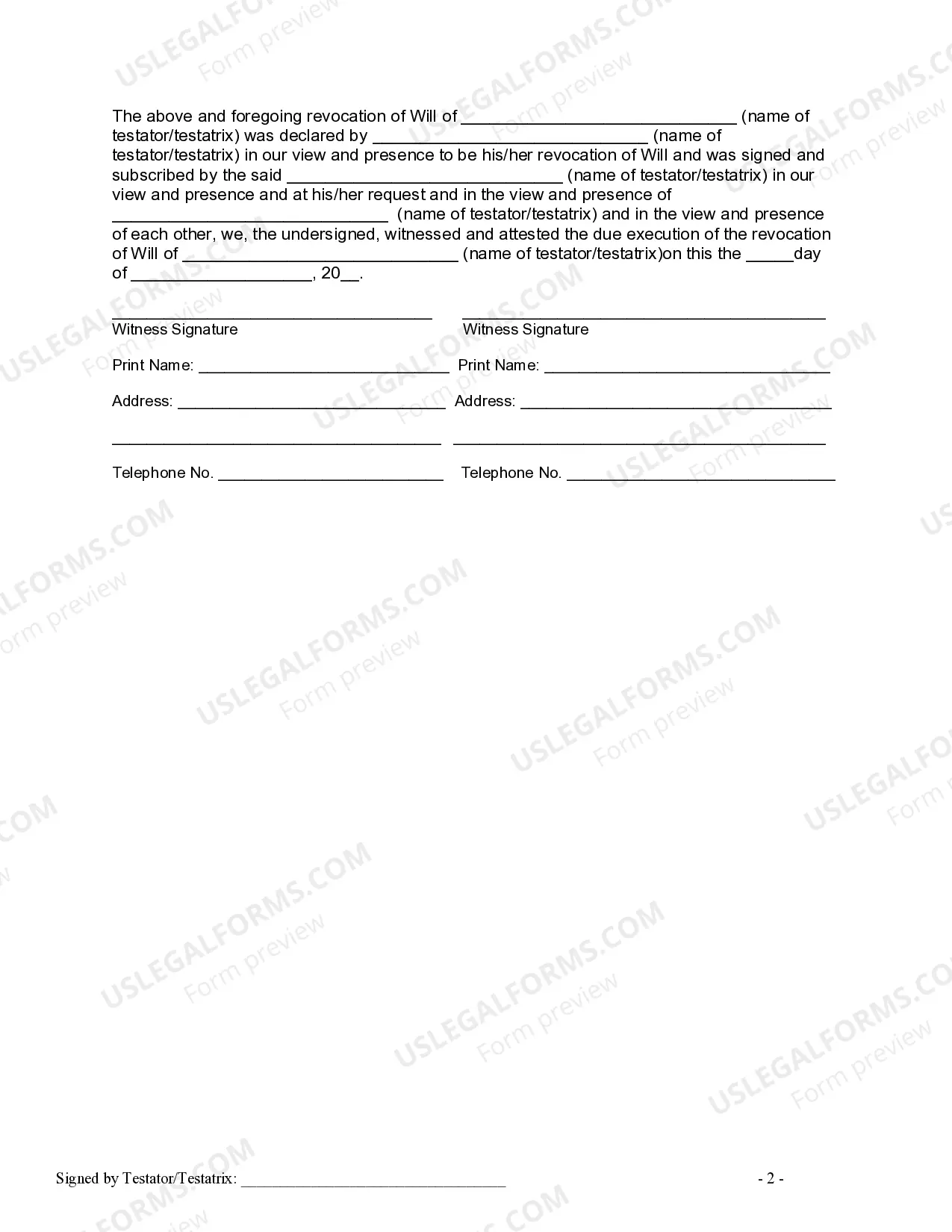
- Witnesses: Requires signatures from two witnesses to validate the revocation.


When to use this document
This form should be used when an individual wants to revoke a previous will due to various reasons, such as changing personal circumstances, relationships, or preferences regarding the distribution of their estate. It can also be helpful if there is a desire to avoid confusion among heirs about which will is in effect, particularly if a new will lacks a revocation clause.
Who needs this form
- Individuals who have previously created a will and wish to revoke it.
- People who are updating their estate plans and need to clarify their intentions regarding previous wills.
- Those looking to ensure that their heirs cannot probate an older, undesired will.
Instructions for completing this form
- Provide your full name and county of residence in the designated fields.
- Clearly state the date of any prior wills you wish to revoke.
- Include a declaration that you revoke all previous wills and codicils.
- Ensure to include a statement that this revocation does not affect any future wills.
- Sign the document in front of two witnesses who will also sign the declaration.
Notarization guidance
This form usually doesn’t need to be notarized. However, local laws or specific transactions may require it. Our online notarization service, powered by Notarize, lets you complete it remotely through a secure video session, available 24/7.
Get your form ready online
Our built-in tools help you complete, sign, share, and store your documents in one place.
Make edits, fill in missing information, and update formatting in US Legal Forms—just like you would in MS Word.
Download a copy, print it, send it by email, or mail it via USPS—whatever works best for your next step.
Sign and collect signatures with our SignNow integration. Send to multiple recipients, set reminders, and more. Go Premium to unlock E-Sign.
If this form requires notarization, complete it online through a secure video call—no need to meet a notary in person or wait for an appointment.
We protect your documents and personal data by following strict security and privacy standards.

Make edits, fill in missing information, and update formatting in US Legal Forms—just like you would in MS Word.

Download a copy, print it, send it by email, or mail it via USPS—whatever works best for your next step.

Sign and collect signatures with our SignNow integration. Send to multiple recipients, set reminders, and more. Go Premium to unlock E-Sign.

If this form requires notarization, complete it online through a secure video call—no need to meet a notary in person or wait for an appointment.

We protect your documents and personal data by following strict security and privacy standards.
Common mistakes
- Failing to sign the document in front of witnesses, which may render it invalid.
- Not clearly identifying all previous wills being revoked.
- Not including a statement about future wills, leading to potential confusion.
Benefits of using this form online
- Convenient access to downloadable forms that can be filled out at your own pace.
- Reliable legal templates drafted by licensed attorneys, ensuring compliance with legal requirements.
- Editability allows you to customize the document to fit your specific circumstances before finalizing it.
Looking for another form?


Form popularity
FAQ
Can You Revoke a Will After the Death of the Testator? A will can only be canceled by the testator. A power of attorney does not grant the right to revoke a will. Therefore, no one else can cancel a will after the death of the testator.
Your will is revoked automatically in certain situations: If you marry or enter into a civil partnership, your will is revoked, unless your will was unless the later will was made with the marriage or civil partnership clearly in mind If you make another will, the first will you made is revoked.
Alberta Wills can be changed at any time simply by visiting your lawyer.In some situations, wills are automatically revoked, such as when you get married. Consider making an entirely new will when you need to make major changes and using a codicil for small changes.
No, in Maryland, you do not need to notarize your will to make it legal. Maryland does allow you to make your will "self-proving," which speeds up probate because the court can accept the will without contacting the witnesses who signed it.
Most people revoke one will by making another, which supersedes the old one. That's why most wills begin with a sentence like "I hereby revoke all previous wills and codicils." (A codicil is an addition to a will; they aren't very common these days.)
Generally, you can revoke a will by (1) destroying the old will, (2) creating a new will or (3) making changes to an existing will. In some circumstances, simply giving away all or your property and assets before you die can have the effect of revoking a will (subject to estate tax penalties).
Is a holographic (handwritten) Will legal in Maryland ? Yes, if it complies with Maryland Law.
A Will can either be destroyed directly by the Testator or by the Testator giving directions to a third party in their presence.Wills are also revoked by marriage or civil partnership, but interestingly a Will is not revoked by divorce.
For a codicil to be valid in Maryland, it must be in writing, signed by the testator, and the testator's signature must be witnessed by two independent witnesses. In addition, the testator must have the requisite testamentary capacity to execute a codicil.