Maryland Notice of Default on Residential Lease
About this form
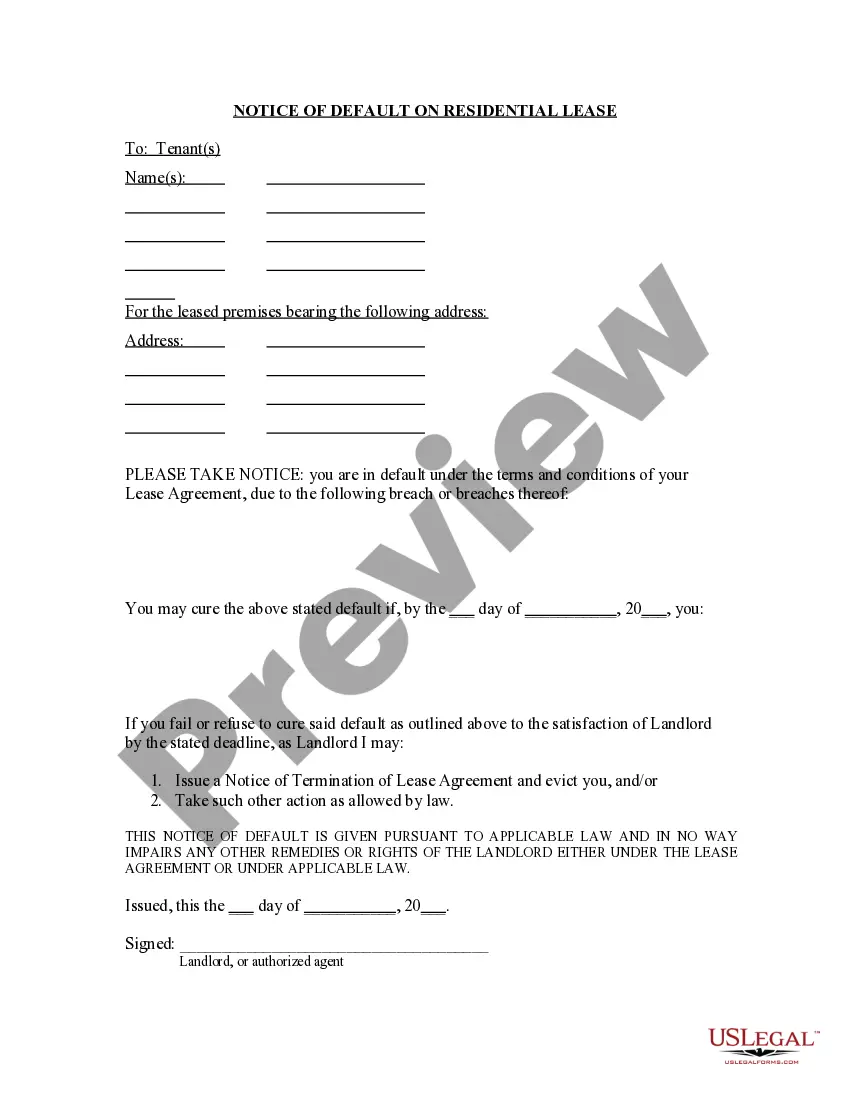
The Notice of Default on Residential Lease is a formal notification from a landlord to a tenant indicating that the tenant has failed to fulfill certain obligations under the lease agreement, typically related to rent payments. This notice serves to inform the tenant of the default and specifies a deadline for remedying the situation. Unlike other lease notifications, this form focuses specifically on defaults, which may lead to potential eviction if not resolved.
Key parts of this document
- Identification of the tenant and landlord.
- Specific reasons for the default, typically related to unpaid rent.
- A deadline date for the tenant to cure the default.
- Statement of potential follow-up actions, including eviction.
- The date the notice is issued and spaces for signatures.



When this form is needed
This form should be used when a tenant is behind on rent payments or has failed to meet other monetary obligations as outlined in the rental agreement. It is an essential step for landlords who seek to formally notify tenants of their default before initiating eviction proceedings or applying security deposits to cover unpaid rent. Issuing a Notice of Default is both a legal requirement and a best business practice to ensure compliance with landlord-tenant laws.
Who this form is for
- Landlords seeking to notify tenants of a lease default.
- Property managers responsible for handling tenant communications.
- Real estate professionals assisting landlords with lease management.
How to complete this form
- Identify the parties by entering the landlord's and tenant's names and contact information.
- Specify the reasons for default clearly, focusing on the monetary obligations that have not been met.
- Enter the deadline date by which the tenant must remedy the default.
- State any potential actions that may follow if the tenant does not respond, such as eviction.
- Complete the date of issuance and provide the landlord's signature or that of an authorized agent.
Notarization guidance
This form does not typically require notarization unless specified by local law. However, it is advisable to check state-specific rules regarding any necessary witness signatures or notarization requirements that may apply.
Get your form ready online
Our built-in tools help you complete, sign, share, and store your documents in one place.
Make edits, fill in missing information, and update formatting in US Legal Forms—just like you would in MS Word.
Download a copy, print it, send it by email, or mail it via USPS—whatever works best for your next step.
Sign and collect signatures with our SignNow integration. Send to multiple recipients, set reminders, and more. Go Premium to unlock E-Sign.
If this form requires notarization, complete it online through a secure video call—no need to meet a notary in person or wait for an appointment.
We protect your documents and personal data by following strict security and privacy standards.

Make edits, fill in missing information, and update formatting in US Legal Forms—just like you would in MS Word.

Download a copy, print it, send it by email, or mail it via USPS—whatever works best for your next step.

Sign and collect signatures with our SignNow integration. Send to multiple recipients, set reminders, and more. Go Premium to unlock E-Sign.

If this form requires notarization, complete it online through a secure video call—no need to meet a notary in person or wait for an appointment.

We protect your documents and personal data by following strict security and privacy standards.
Common mistakes to avoid
- Failing to specify the exact reasons for the default can lead to confusion for the tenant.
- Not providing a clear deadline for the tenant to cure the default may complicate legal proceedings later.
- Omitting the landlord's or authorized agent's signature might render the notice invalid.
Why complete this form online
- Convenience of instant access to legally vetted forms anytime and anywhere.
- Editable templates allow landlords to customize details specific to their situation.
- Reliable legal language ensures compliance with applicable laws without needing legal expertise.
Legal use & context
- This notice serves as a legal requirement in many jurisdictions before proceeding with eviction.
- Proper use of this form helps protect landlords' rights under relevant landlord-tenant laws.
- Failure to provide this notice could hinder eviction proceedings and impact landlord's legal rights.
What to keep in mind
- The Notice of Default on Residential Lease is essential for legally addressing tenant defaults.
- It provides tenants an opportunity to cure the default before eviction proceedings.
- Complete the form accurately and keep a copy for your records.
- Compliance with state laws is important for effective execution of this notice.
Looking for another form?
Form popularity
FAQ
Gives the landlord 30 days' written notice either hand-delivered or by first-class mail prior to ending the lease, along with a copy of the court order.
To evict you, a landlord must go to District Court to get a judgment against you.A notice to vacate from your landlord is not a court order. This is the written notice that a landlord must give you at least one month before your lease ends, if they want you to move out at the end of the lease.
In landlord-tenant law, default refers to the failure of a tenant to timely pay rent due.In general, the landlord is required to give the tenant notice of the default before bringing eviction proceedings or applying security deposit proceeds to the payment in default.
Your lease agreement will state what constitutes a default of the lease as well as if there is any grace period in making lease payments. Not making a contractually required monthly payment will normally be a breach of the lease and the lessor can then repossess the vehicle from you.
You can help the situation a lot by providing as much notice as possible and writing a sincere letter to your landlord explaining why you need to leave early. Ideally you can offer your landlord a qualified replacement tenant, someone with good credit and excellent references, to sign a new lease with your landlord.
Under Maryland law, tenants have a right to freedom from housing discrimination, a right to certain security deposit protections, the right to freedom from landlord retaliation, and the right to be protected after domestic violence.
In Colorado, evictions are sometimes referred to as forcible entry & detainer (FED). Before you can file for eviction, you must generally provide 10 days' notice (increased from 3 days prior) for tenants to correct a deficiency or leave the property, except in certain circumstances.
Evicting a tenant in Maryland can take around 3 weeks to 5 months, depending on the reason for the eviction. If tenants request a continuance or file an appeal, the process can take longer (read more).
A default is a failure to comply with a provision in the lease. Curing or remedying the default means correcting the failure or omission. A common example is a failure to pay the rent on time.Typically a lease will give the parties adequate notice and time to fix the problem before more drastic action is taken.