Maryland Notice to Owner or Owner's Agent of Intention to Claim a Lien by Individual
Understanding this form
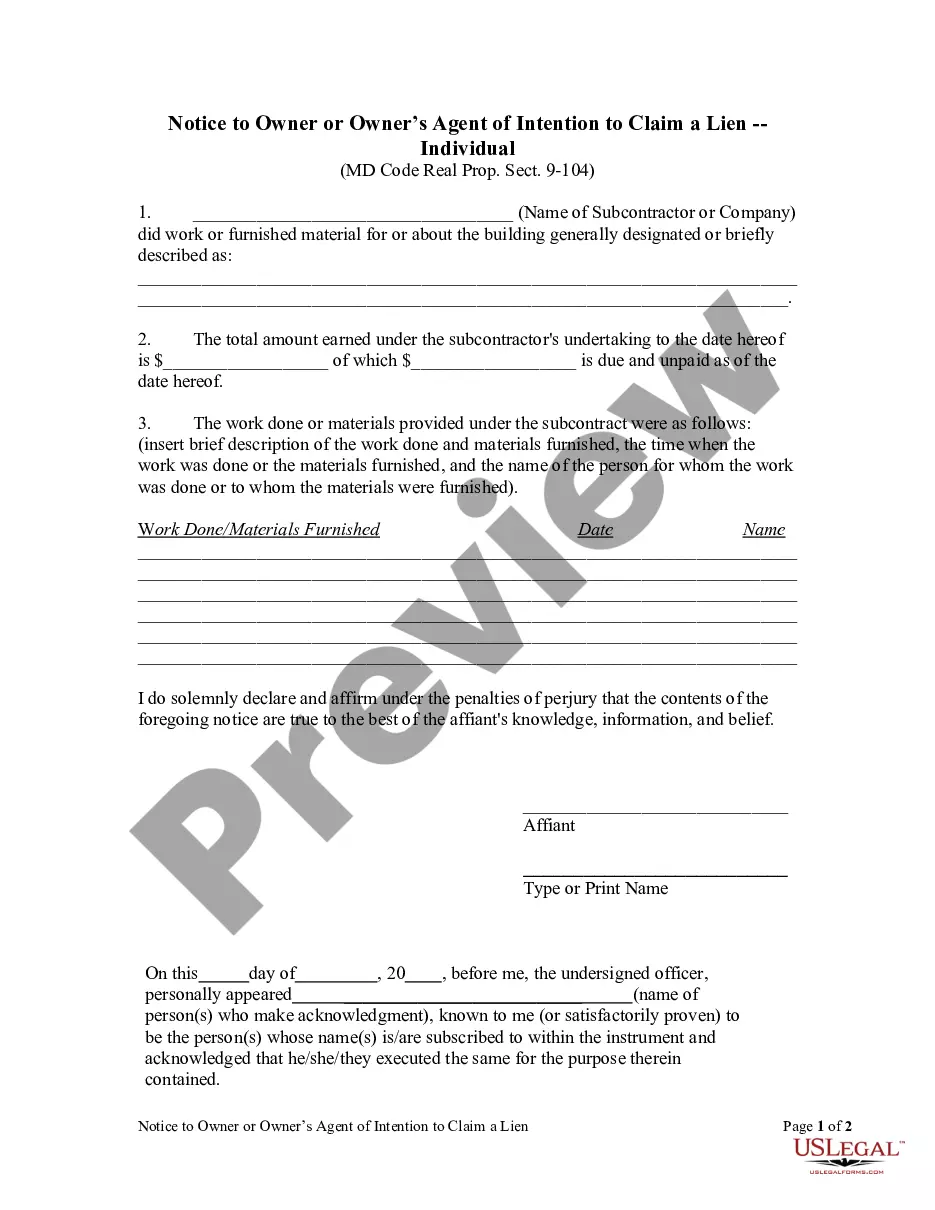
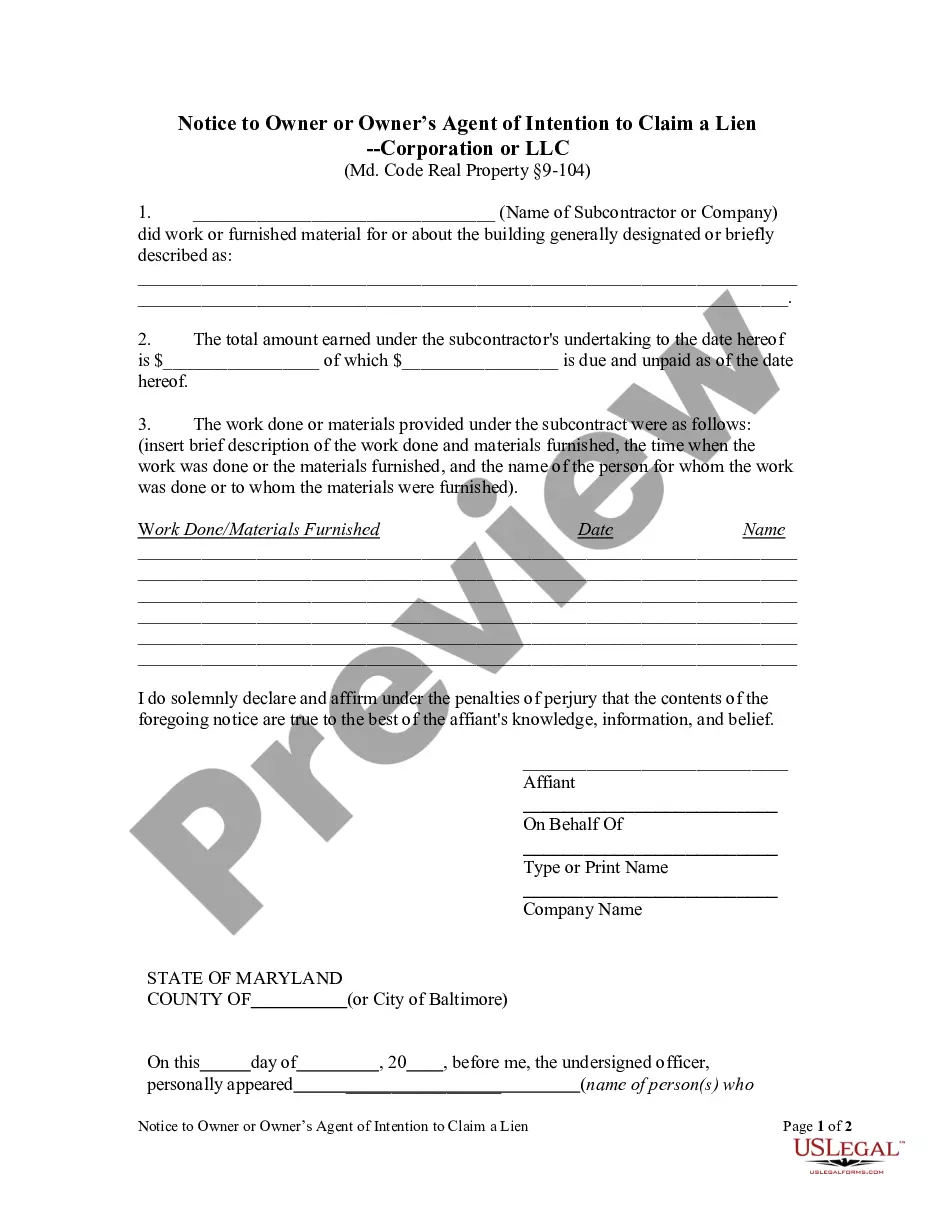
The Notice to Owner or Owner's Agent of Intention to Claim a Lien by Individual is a legal document required in Maryland for individuals who wish to assert a lien on a property for unpaid work or materials. This form serves as a preliminary notice to the property owner, informing them of the intention to claim a lien and must be filed prior to submitting a Petition to Establish a Lien in court. Unlike similar forms, this notice is vital for protecting the rights of subcontractors and suppliers in the construction industry.
Form components explained
- Name of the subcontractor or company claiming the lien.
- Description of the building where work was completed or materials were provided.
- Total amount earned and amount due for unpaid work or materials.
- Description of the work done or materials furnished, including dates and recipient details.
- A declaration of truthfulness signed by the affiant.
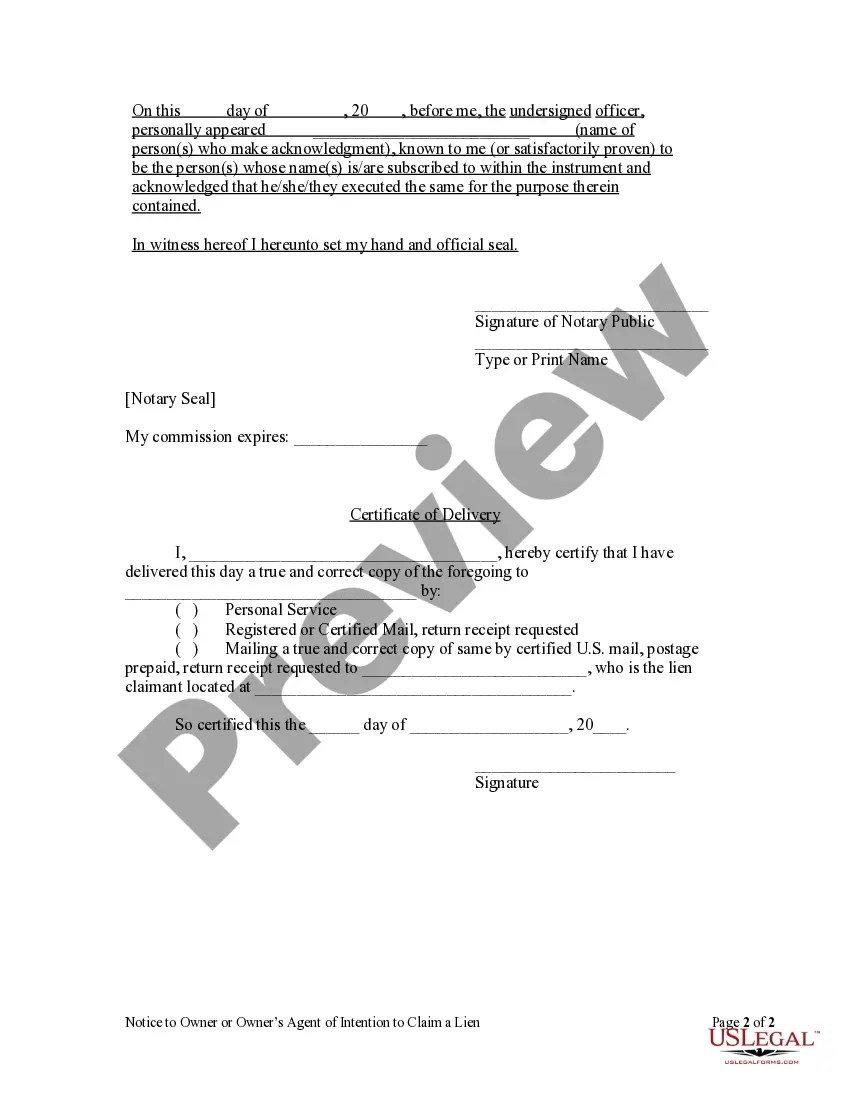
- Notary acknowledgment for legal validation.
- Certificate of delivery confirming how the notice was served.
Common use cases
This form should be used when a contractor, subcontractor, or supplier wants to formally notify the property owner or their agent of their intention to file a lien due to unpaid work or materials provided within a timeframe of 120 days from the completion of the work or delivery of materials. It is an important first step in ensuring that lien rights are preserved under Maryland law.
Who can use this document
This form is intended for:
- Contractors and subcontractors who have not been paid for their services.
- Suppliers of materials used in construction who require payment.
- Individuals or entities who wish to secure a lien on property in Maryland.
Instructions for completing this form
- Identify and enter the name of the subcontractor or company at the top of the form.
- Clearly describe the building or property where work was done or materials were supplied.
- Specify the total amount earned and detail the unpaid amount.
- Provide a brief description of the work done and materials furnished, including dates and names of recipients.
- Sign the declaration section before a notary public to validate the document.
- Complete the certificate of delivery section to confirm how the notice was served.
Notarization requirements for this form
Yes, this form must be notarized to be legally valid. Completing the notarization process provides an additional layer of authenticity and security. US Legal Forms offers integrated online notarization services, making it convenient to get this step done securely via video call without the need to travel.
Get your form ready online
Our built-in tools help you complete, sign, share, and store your documents in one place.
Make edits, fill in missing information, and update formatting in US Legal Forms—just like you would in MS Word.
Download a copy, print it, send it by email, or mail it via USPS—whatever works best for your next step.
Sign and collect signatures with our SignNow integration. Send to multiple recipients, set reminders, and more. Go Premium to unlock E-Sign.
If this form requires notarization, complete it online through a secure video call—no need to meet a notary in person or wait for an appointment.
We protect your documents and personal data by following strict security and privacy standards.

Make edits, fill in missing information, and update formatting in US Legal Forms—just like you would in MS Word.

Download a copy, print it, send it by email, or mail it via USPS—whatever works best for your next step.

Sign and collect signatures with our SignNow integration. Send to multiple recipients, set reminders, and more. Go Premium to unlock E-Sign.

If this form requires notarization, complete it online through a secure video call—no need to meet a notary in person or wait for an appointment.

We protect your documents and personal data by following strict security and privacy standards.
Typical mistakes to avoid
- Failing to serve the notice within the 120-day time frame.
- Not including all necessary details about the work done or materials provided.
- Neglecting to have the notice notarized if required.
- Not properly documenting the method of delivery to the property owner.
- Using vague or unclear descriptions that may not adequately inform the recipient.
Benefits of completing this form online
- Easy access to templates created by licensed attorneys, ensuring legal accuracy.
- Convenient digital download that allows for quick completion and submission.
- Editability to customize the form according to specific needs.
- Hassle-free filing process that eliminates the need for physical trip to a lawyerâs office or court.
Summary of main points
- This Notice is crucial for establishing a lien under Maryland law.
- Timely delivery to the property owner is essential to maintain your rights.
- Proper completion, including notarization, ensures the validity of the claim.
Looking for another form?





Form popularity
FAQ
What Is a Fraudulent Lien?the claimant is owed money on another job by the same general contractor or property owner, but didn't file a lien on that project before time expired; or. the claimant wants to file a lien because of personal reasons generally related to the identity of the property owner.
Even in states like California, which prohibits creditors explicitly from placing liens on joint tenancy property, spouses are not covered.Nevada, Arizona, Washington, Idaho, California, New Mexico, Texas, Puerto Rico, Wisconsin, and Louisiana are currently community property states.
To establish a lien, a contractor or subcontractor must file a petition in the circuit court for the county where the property is located within 180 days after completing work on the property or providing materials. It can be difficult to determine the work completion date.
Yes, a lien may be placed on property that is jointly owned. However, the effects of that lien depend on the type of ownership that the property is under.
The people who can file mechanic's liens are identified by state law. A subcontractor or supplier to a subcontractor may not be able to file a lien. Also, unlicensed contractors are often barred from filing a mechanic's lien.
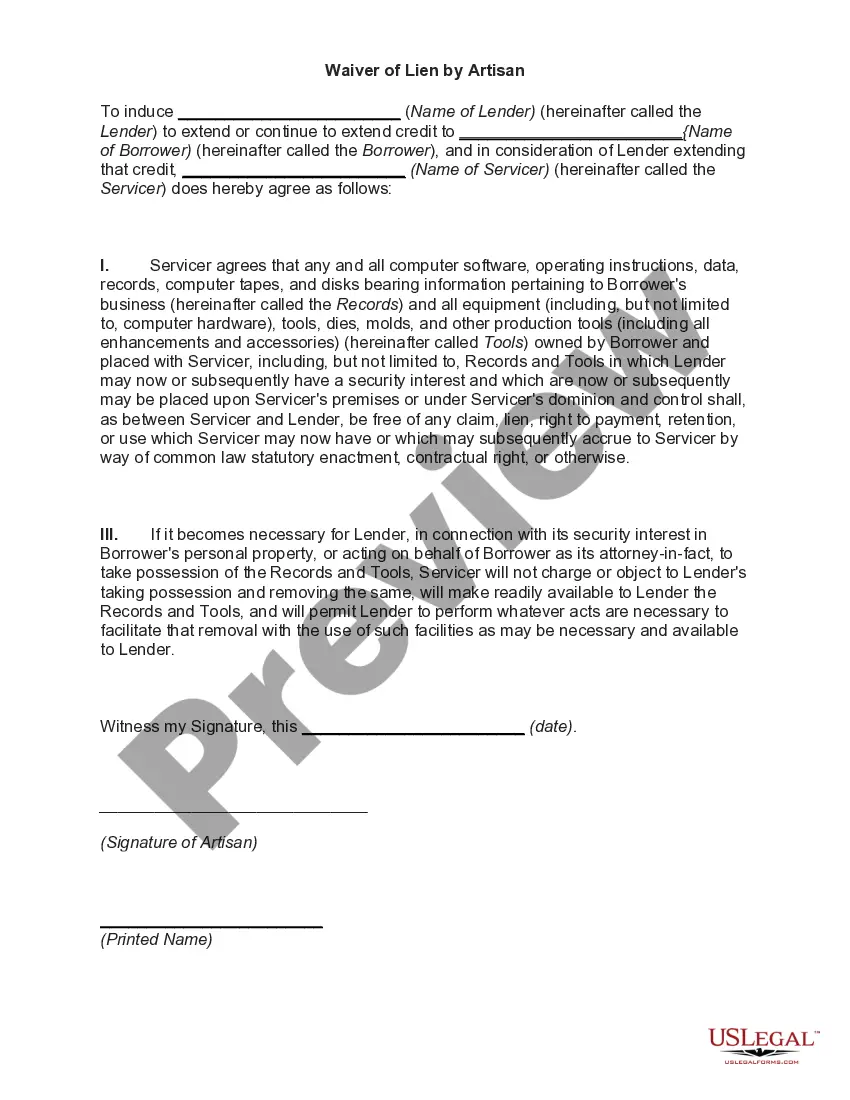
The most common way to reduce or even eliminate mechanic's lien risk is through the use of lien waivers. A lien waiver is a private agreement in which a party surrenders the right to file a lien in exchange for payment.
The simplest way to prevent liens and ensure that subcontractors and suppliers are paid is to pay with joint checks. This is when both parties endorse the check. Compare the contractor's materials or labor bill to the schedule of payments in your contract and the Preliminary Notices.
If contractors or suppliers aren't paid on a construction project in Maryland, they can file a mechanics lien to secure payment.