Massachusetts Quitclaim Deed from Husband and Wife to LLC
Understanding this form
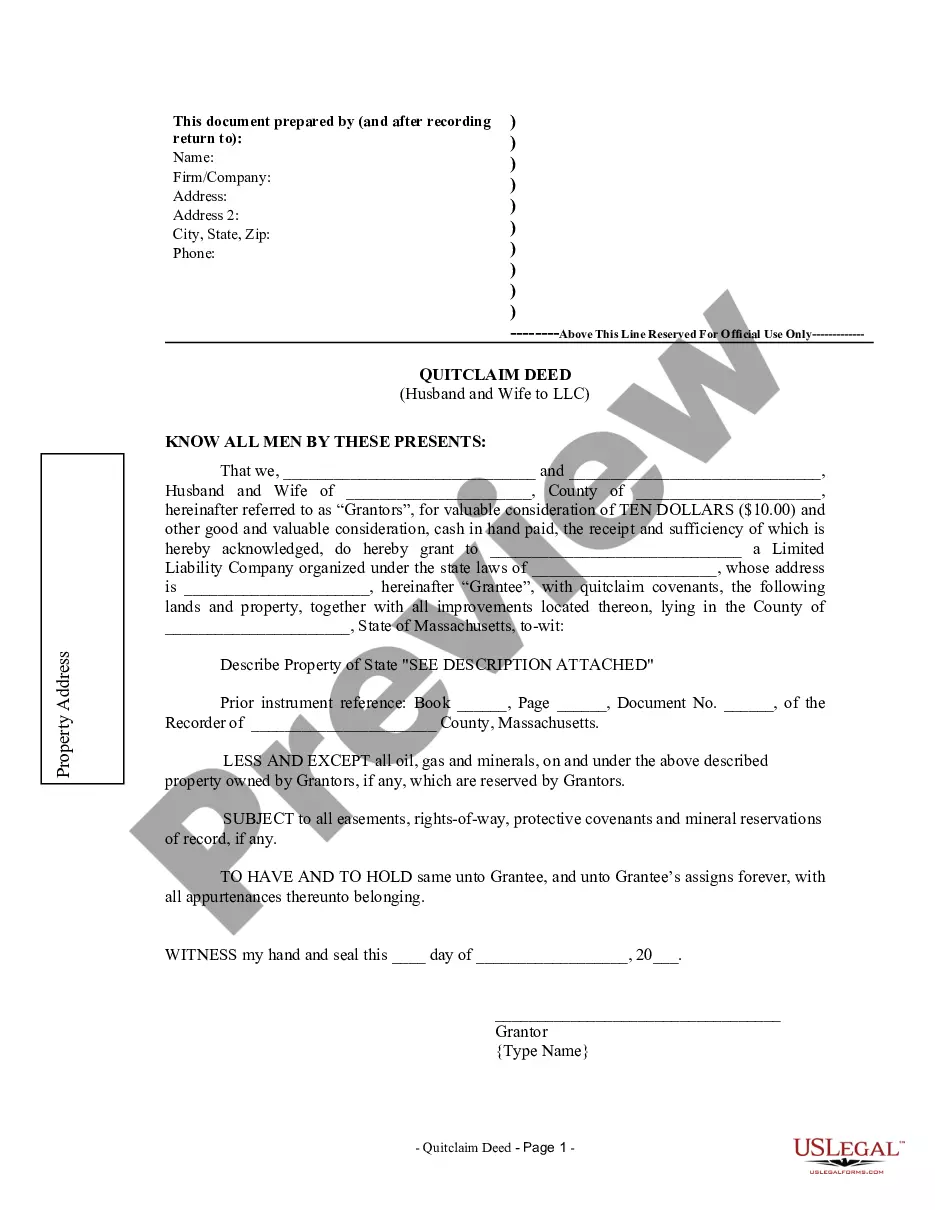
The Quitclaim Deed from Husband and Wife to LLC is a legal document used to transfer property ownership from a married couple to a limited liability company. Unlike a warranty deed, which provides guarantees about the title, a quitclaim deed transfers any interest the grantors have in the property without such assurances. This form is particularly useful for couples who wish to simplify their property holdings by transferring ownership to a business entity for legal or tax purposes.
Key parts of this document
- Identification of the grantors: Names of the husband and wife transferring property.
- Identification of the grantee: The limited liability company receiving the property.
- Property description: Clear details about the property being transferred.
- Reservation of rights: Grantors retain rights to any oil, gas, or minerals found on the property.
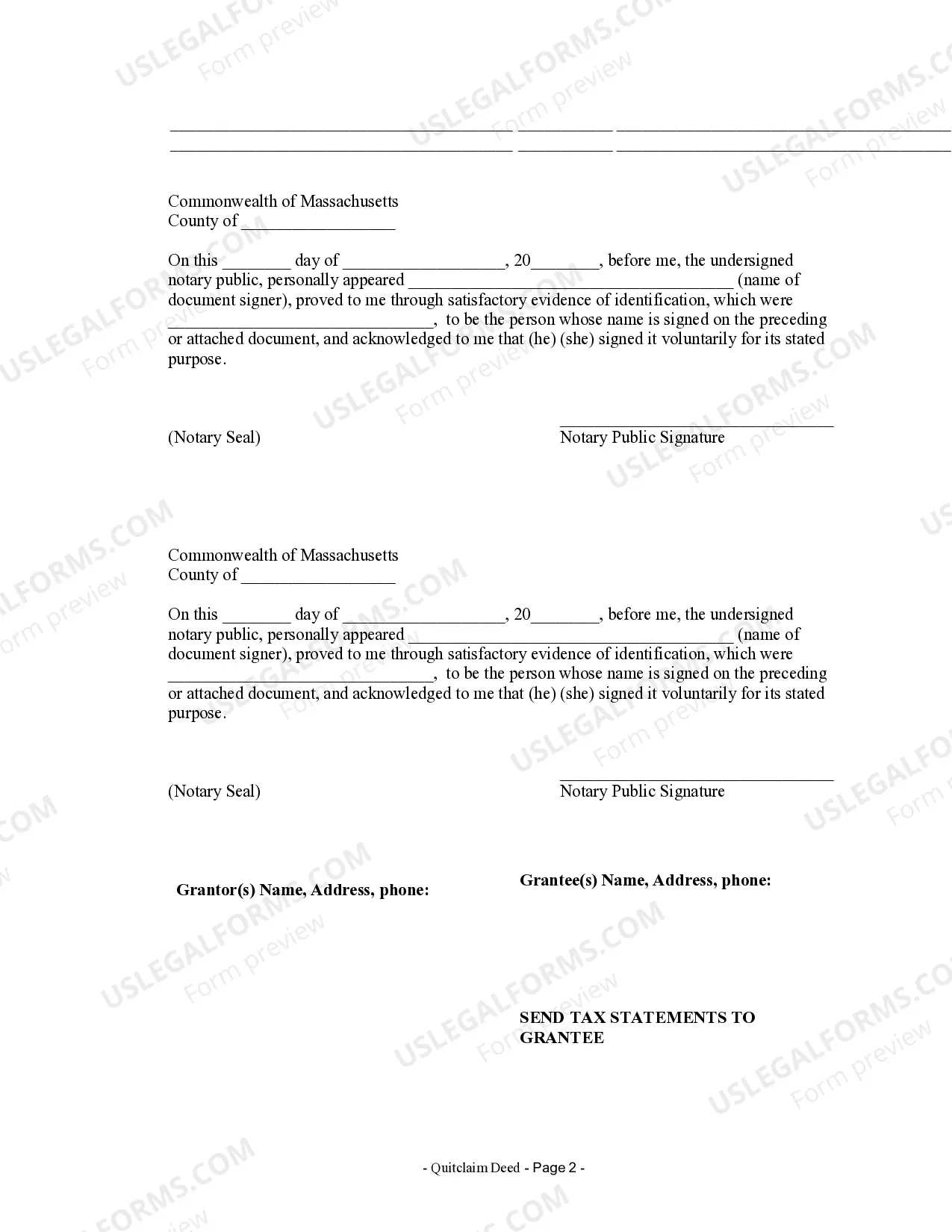
- Notary acknowledgment: A section for notarization to verify the identities of the parties involved.




When this form is needed
This quitclaim deed is appropriate in several scenarios, such as when a couple wishes to transfer their jointly owned property to a limited liability company for business operations, tax benefits, or estate planning. It can also be used when the couple is separating assets or reorganizing property ownership for any reason.
Who can use this document
- Married couples looking to transfer property to a limited liability company.
- Business owners who want to simplify property ownership under their LLC.
- Individuals involved in estate planning who need to clarify asset ownership.
- Couples seeking to manage their property holdings efficiently.
How to prepare this document
- Identify the parties: Fill in the names of both grantors (husband and wife) and the grantee (the LLC).
- Specify the property: Provide a detailed description of the property being transferred, including any identifying information.
- Enter prior references: Include the previous instrument reference including Book and Page numbers if applicable.
- Sign the document: Both grantors must sign the deed in the presence of a notary public.
- Notarization: Ensure the notary completes their section to verify the identities of the grantors.
Does this form need to be notarized?
Yes, this form must be notarized to be legally valid. This ensures that the identities of the grantors are verified, preventing fraud. US Legal Forms offers integrated online notarization, allowing you to complete the process securely via video call at your convenience.
Get your form ready online
Our built-in tools help you complete, sign, share, and store your documents in one place.
Make edits, fill in missing information, and update formatting in US Legal Forms—just like you would in MS Word.
Download a copy, print it, send it by email, or mail it via USPS—whatever works best for your next step.
Sign and collect signatures with our SignNow integration. Send to multiple recipients, set reminders, and more. Go Premium to unlock E-Sign.
If this form requires notarization, complete it online through a secure video call—no need to meet a notary in person or wait for an appointment.
We protect your documents and personal data by following strict security and privacy standards.

Make edits, fill in missing information, and update formatting in US Legal Forms—just like you would in MS Word.

Download a copy, print it, send it by email, or mail it via USPS—whatever works best for your next step.

Sign and collect signatures with our SignNow integration. Send to multiple recipients, set reminders, and more. Go Premium to unlock E-Sign.

If this form requires notarization, complete it online through a secure video call—no need to meet a notary in person or wait for an appointment.

We protect your documents and personal data by following strict security and privacy standards.
Common mistakes
- Failing to properly describe the property may lead to confusion or disputes later.
- Omitting the notary section can render the deed invalid in some jurisdictions.
- Not including the reservation of mineral rights could affect ownership of resources on the property.
- Incorrectly filling out the prior instrument reference may complicate property records.
Benefits of using this form online
- Convenience: Easily fill out and download the form from anywhere without needing to visit a lawyer.
- Editability: Make necessary changes quickly and efficiently before finalizing the document.
- Reliability: Access a professionally drafted form that complies with state laws.
Main things to remember
- The Quitclaim Deed from Husband and Wife to LLC is a vital document for property transfers between married couples and an LLC.
- It allows for the retention of rights over potential natural resources.
- Proper completion and notarization of the form is crucial for legal enforceability.
Looking for another form?
Form popularity
FAQ
The main difference between a warranty deed and a quitclaim deed in Massachusetts lies in the level of protection they provide. A warranty deed guarantees that the grantor holds clear title to the property and will defend the title against any claims. In contrast, a quitclaim deed transfers whatever interest the grantor has without any guarantees. Thus, when using a Massachusetts Quitclaim Deed from Husband and Wife to LLC, it's essential to understand the implications of this type of transfer.
A Quitclaim Deed must be notarized by a notary public or attorney in order to be valid.Consideration in a Quitclaim Deed is what the Grantee will pay to the Grantor for the interest in the property.
Recording: Massachusetts quitclaim deeds must be filed with the Registry of Deeds Office. Choose the office in the county where the property is. Filing Fee: Each Registry of Deeds Office charges a filing fee, which must be filed along with the deed.
A quitclaim deed is a deed (proof of ownership) that is passed from a grantor (the existing property owner) to a grantee (the new property owner) that does not have a warranty.A quitclaim deed has no guarantees for the grantor or grantee.
If the quitclaim deed requires the signature of all co-owners, the deed is invalid unless all co-owners have signed it and the deed is then delivered to the grantee.If one individual owns real estate and desires to add a co-owner such as a spouse, a quitclaim deed might be used.
A quitclaim deed transfers title but makes no promises at all about the owner's title.A person who signs a quitclaim deed to transfer property they do not own results in no title at all being transferred since there is no actual ownership interest. The quitclaim deed only transfers the type of title you own.
A quitclaim deed affects ownership and the name on the deed, not the mortgage. Because quitclaim deeds expose the grantee to certain risks, they are most often used between family members and where there is no exchange of money.Quitclaim deeds transfer title but do not affect mortgages.
They are commonly used to add/remove someone to/from real estate title or deed (divorce, name changes, family and trust transfers). The quitclaim deed is a legal document (deed) used to transfer interest in real estate from one person or entity (grantor) to another (grantee).
But you might be wondering if an owner can transfer a deed to another person without a real estate lawyer. The answer is yes. Parties to a transaction are always free to prepare their own deeds.A quitclaim deed, for example, is far simpler than a warranty deed.