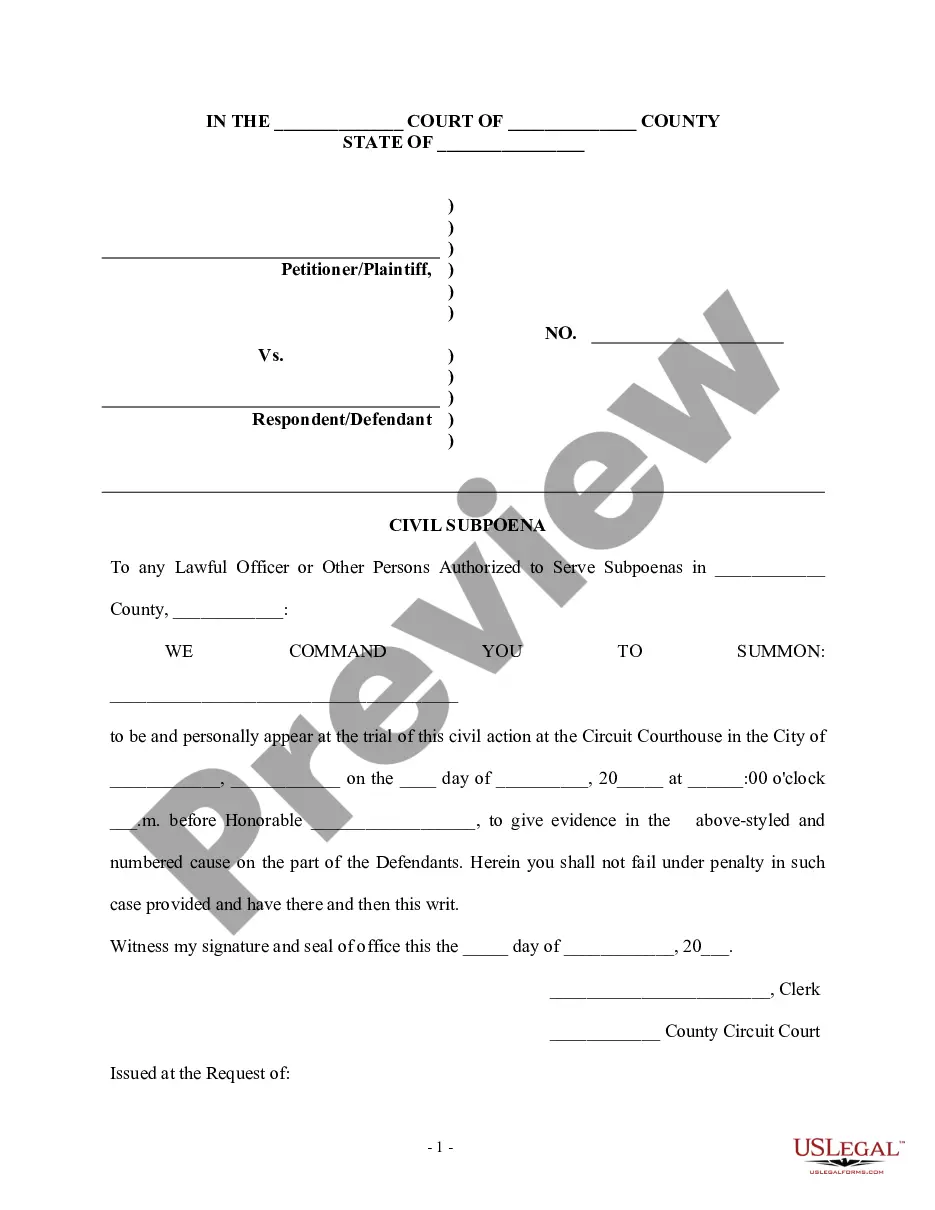
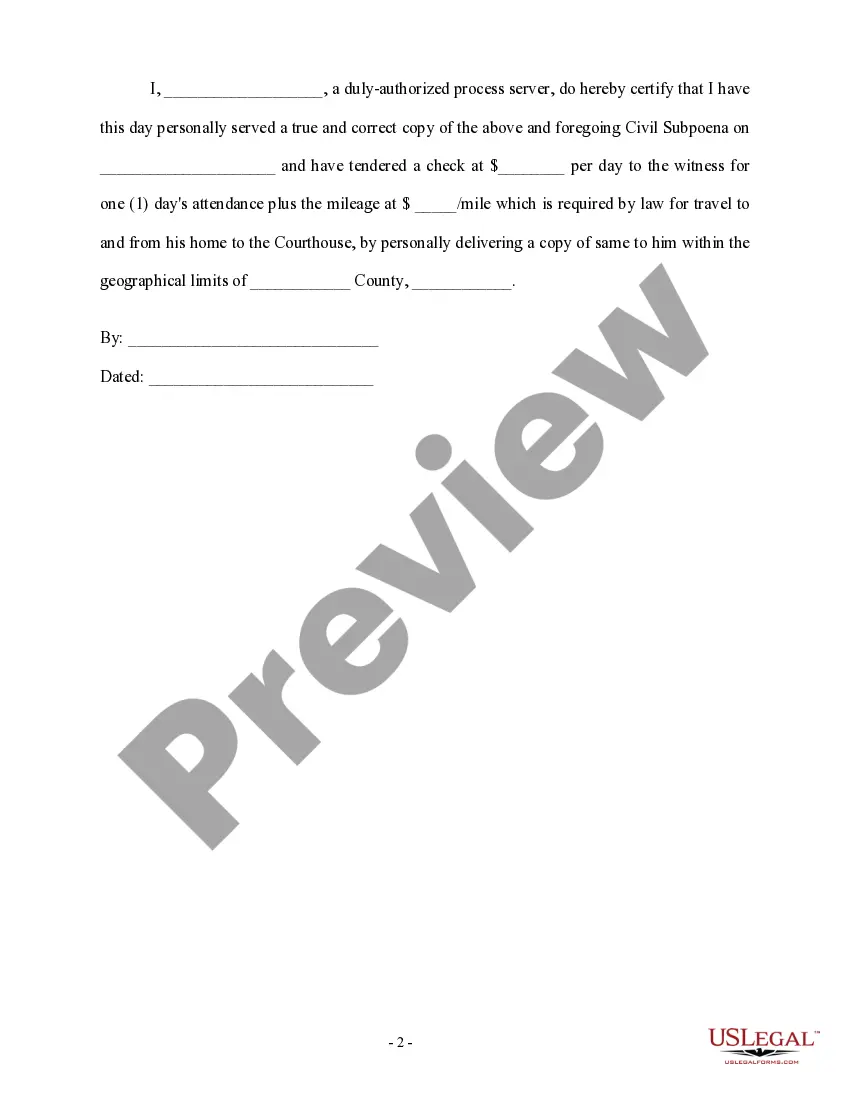
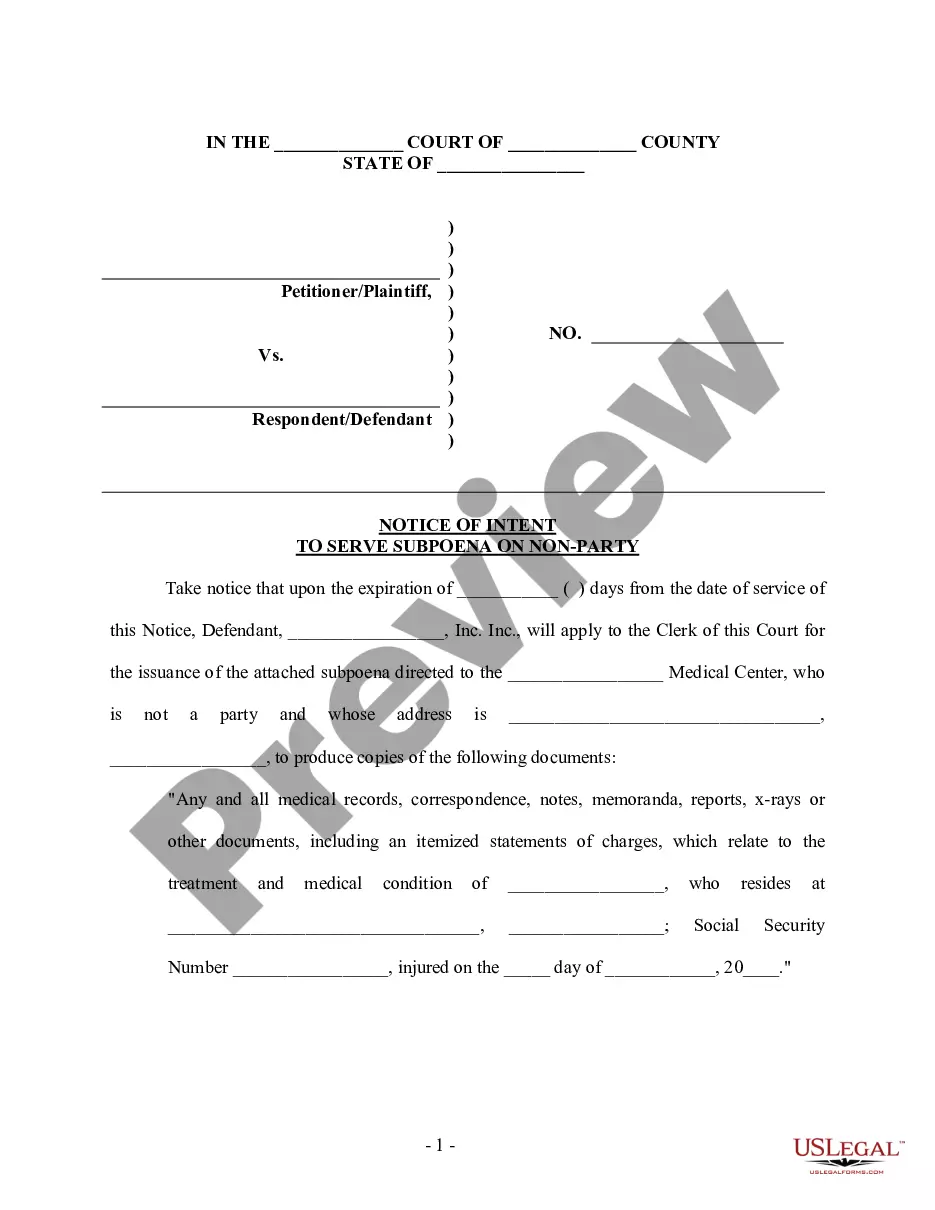
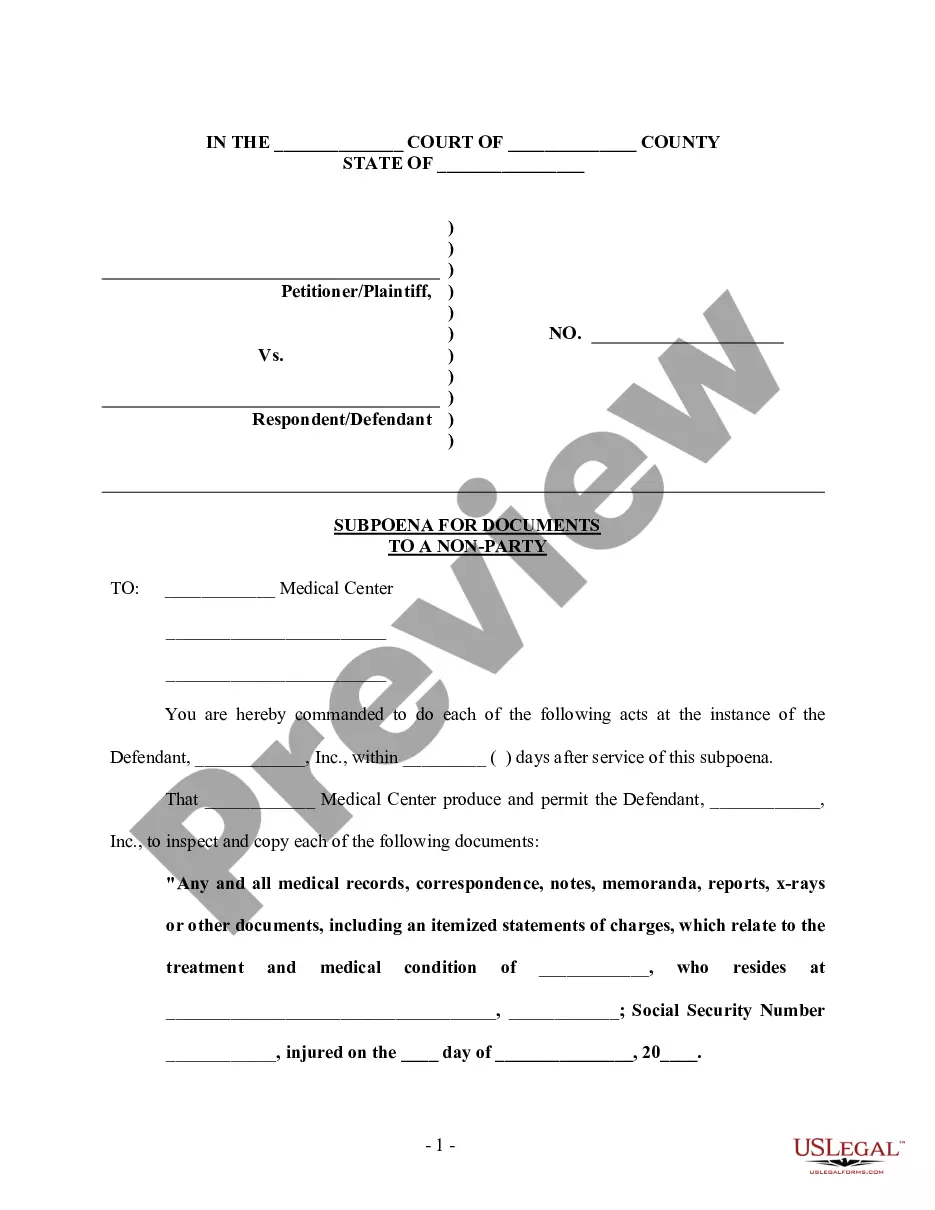
This form is a sample civil subpoena for use in personal injury action.
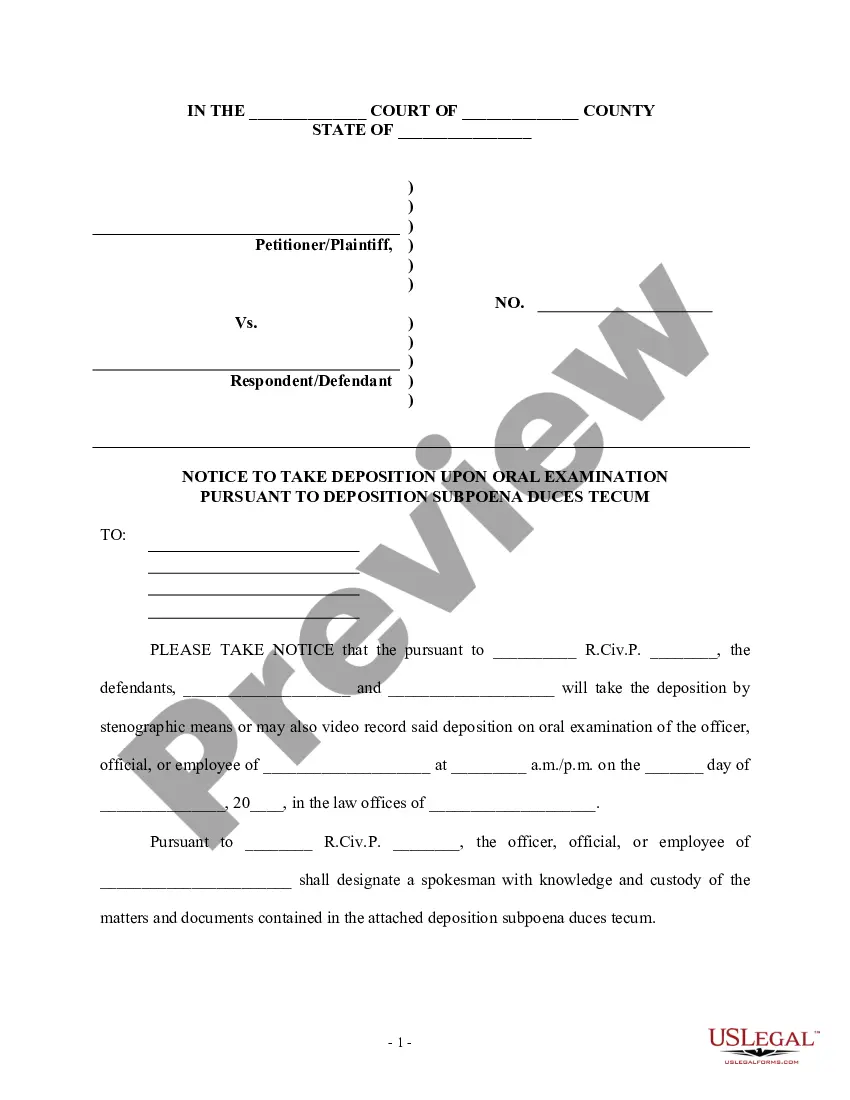
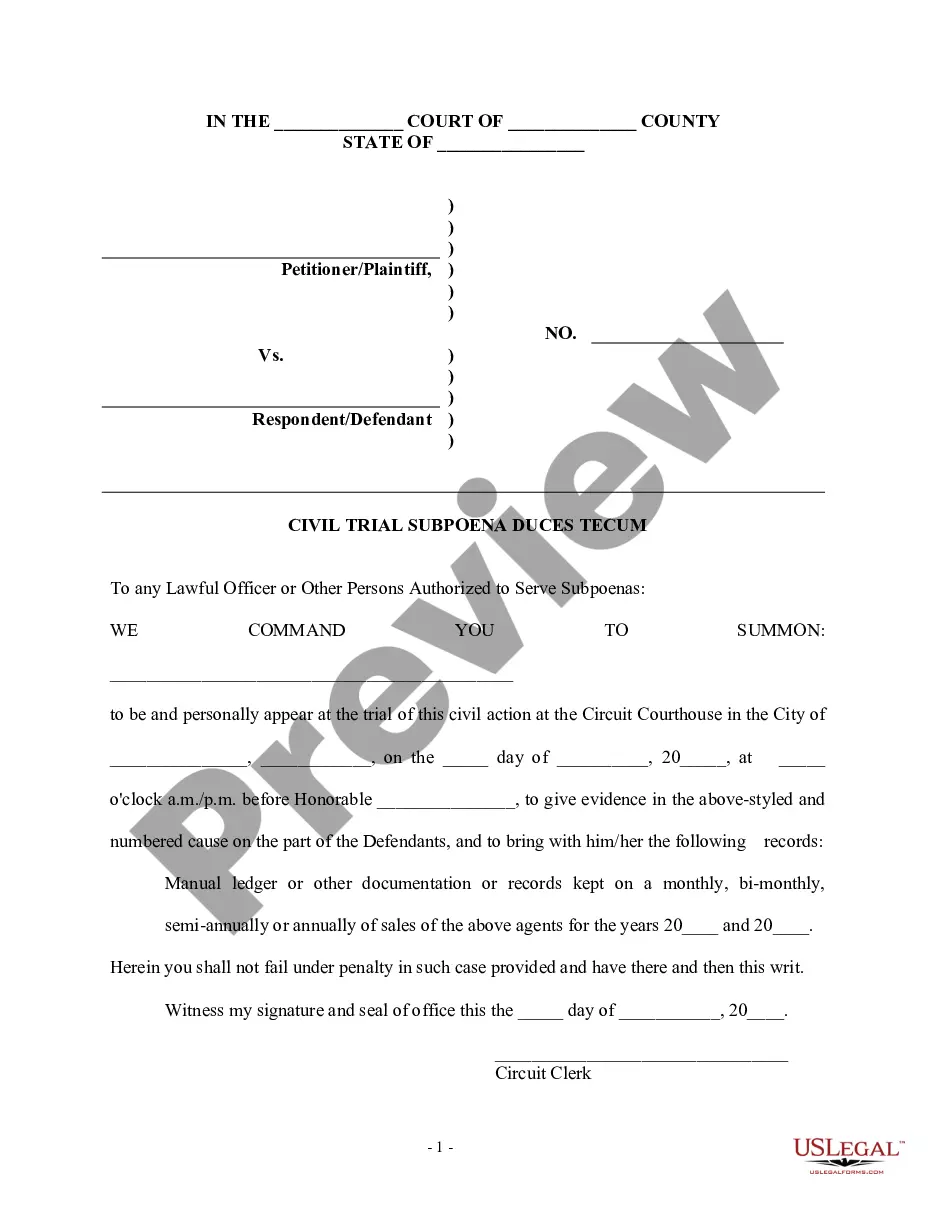
Tarrant Texas Civil Subpoena - Personal Injury
State:
Multi-State
County:
Tarrant
Control #:
US-PI-0047
Format:
Word;
Rich Text
84 downloads
Description
Free preview
Get your form ready online
Our built-in tools help you complete, sign, share, and store your documents in one place.
Built-in online Word editor
Make edits, fill in missing information, and update formatting in US Legal Forms—just like you would in MS Word.
Export easily
Download a copy, print it, send it by email, or mail it via USPS—whatever works best for your next step.
E-sign your document
Sign and collect signatures with our SignNow integration. Send to multiple recipients, set reminders, and more. Go Premium to unlock E-Sign.
Notarize online 24/7
If this form requires notarization, complete it online through a secure video call—no need to meet a notary in person or wait for an appointment.
Store your document securely
We protect your documents and personal data by following strict security and privacy standards.

Make edits, fill in missing information, and update formatting in US Legal Forms—just like you would in MS Word.

Download a copy, print it, send it by email, or mail it via USPS—whatever works best for your next step.

Sign and collect signatures with our SignNow integration. Send to multiple recipients, set reminders, and more. Go Premium to unlock E-Sign.

If this form requires notarization, complete it online through a secure video call—no need to meet a notary in person or wait for an appointment.

We protect your documents and personal data by following strict security and privacy standards.
Looking for another form?



How to fill out Civil Subpoena - Personal Injury?
Drafting legal documents is essential in the contemporary environment.
However, you do not always have to seek expert assistance to create some of them from the beginning, such as the Tarrant Civil Subpoena - Personal Injury, using a service like US Legal Forms.
US Legal Forms offers over 85,000 documents to select from across various categories, ranging from living wills to real estate contracts to divorce forms.
- Review the document's preview and description (if available) to understand what you’ll receive after obtaining the document.
- Confirm that the template you select is tailored to your state/county/region as local laws can affect the legality of certain documents.
- Inspect related document templates or restart the search to find the appropriate file.
- Click Buy now and create your account. If you already have an account, opt to Log In.
- Select the pricing {plan, then choose a payment method to purchase the Tarrant Civil Subpoena - Personal Injury.
- Opt to save the document template in any available file format.
- Navigate to the My documents section to re-download the document.
Form popularity
FAQ
Divorce cases, rent matters and sale of land cases are decided under Civil Law.
A business or agency can also file a case in civil court or be sued in civil court. If someone loses a case in civil court, that person may be ordered to pay money to the other side or return property, but that person does not go to jail just for losing the case.
Steps in the Texas Civil Litigation Process. Research. File Suit. Give Legal Notice. Gather Information. Before Trial. Motions and Requests. Ending Your Case Before Trial.
If the case you need help with does not involve jail time or a criminal fine, then it is probably a civil case. Some examples of civil cases are cases about family issues, such as divorce, child support, child custody, and name changes.
Every subpoena must: (1) be issued in the name of the State of Texas; (2) state the style of the suit and its cause number; (3) state the court in which the suit is pending; (4) state the date on which the subpoena is issued; (5) identify the person to whom the subpoena is directed; (6) state the time, place, and
Civil law deals with behavior that constitutes an injury to an individual or other private party, such as a corporation. Examples are defamation (including libel and slander), breach of contract, negligence resulting in injury or death, and property damage.
45(a)(1)(A)(iii). B. Geographical Limitations In state court, a subpoena can commend a witness to appear or produce documents in any county within 150 miles of where the witness resides or was served.
Court cases that involve disputes between people or businesses over money or some injury to personal rights are called civil cases. A civil case usually begins when one person or business (called the "plaintiff") claims to have been harmed by the actions of another person or business (called the "defendant").
(b) A subpoena must be served at least five days before the hearing. (c) After a subpoena is served upon a witness, the return of service of the subpoena must be filed at SOAH at least three days prior to the hearing.
Texas courts mandate that depositions cannot last more than six hours in one day. Federal courts allow up to seven hours. Importantly, these time limits do not include breaks.