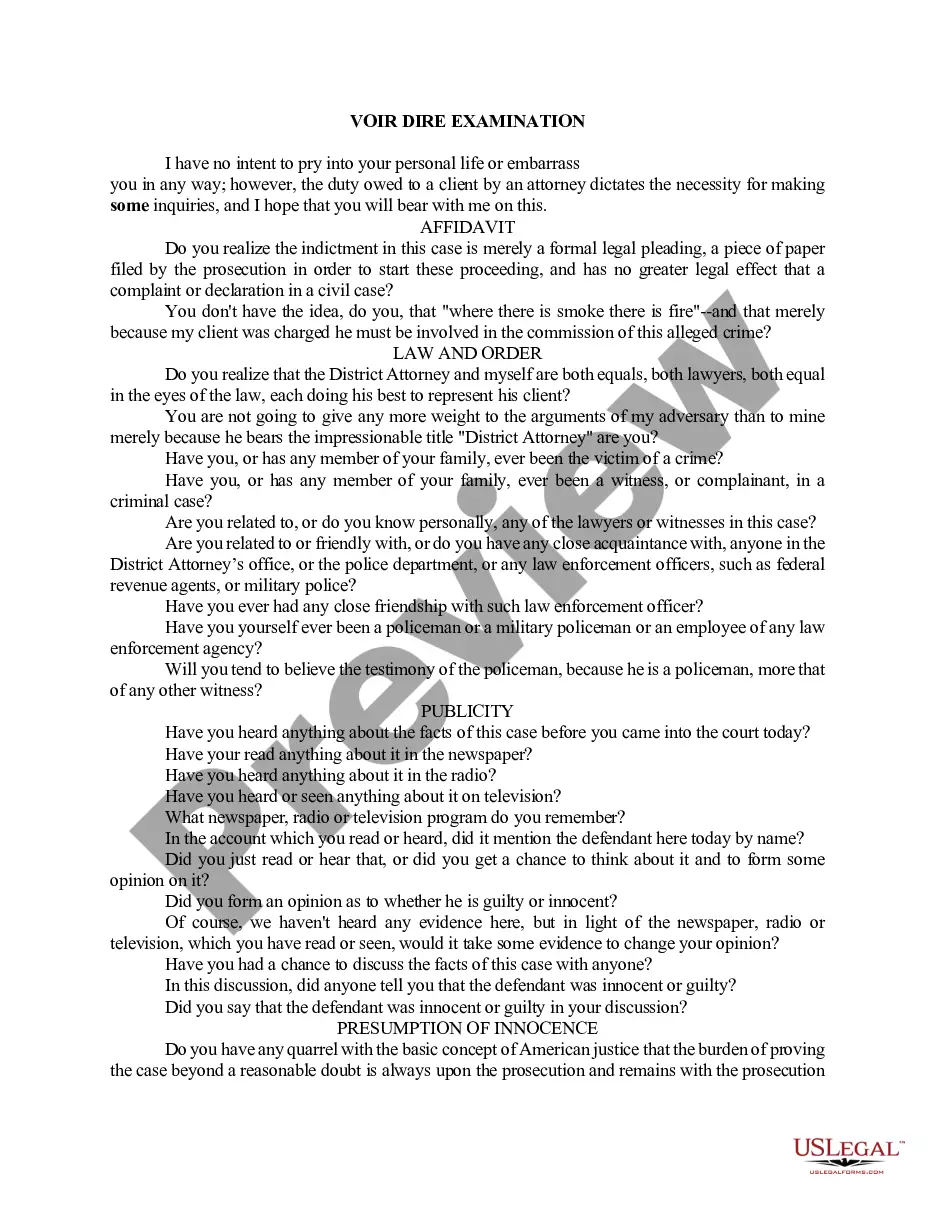
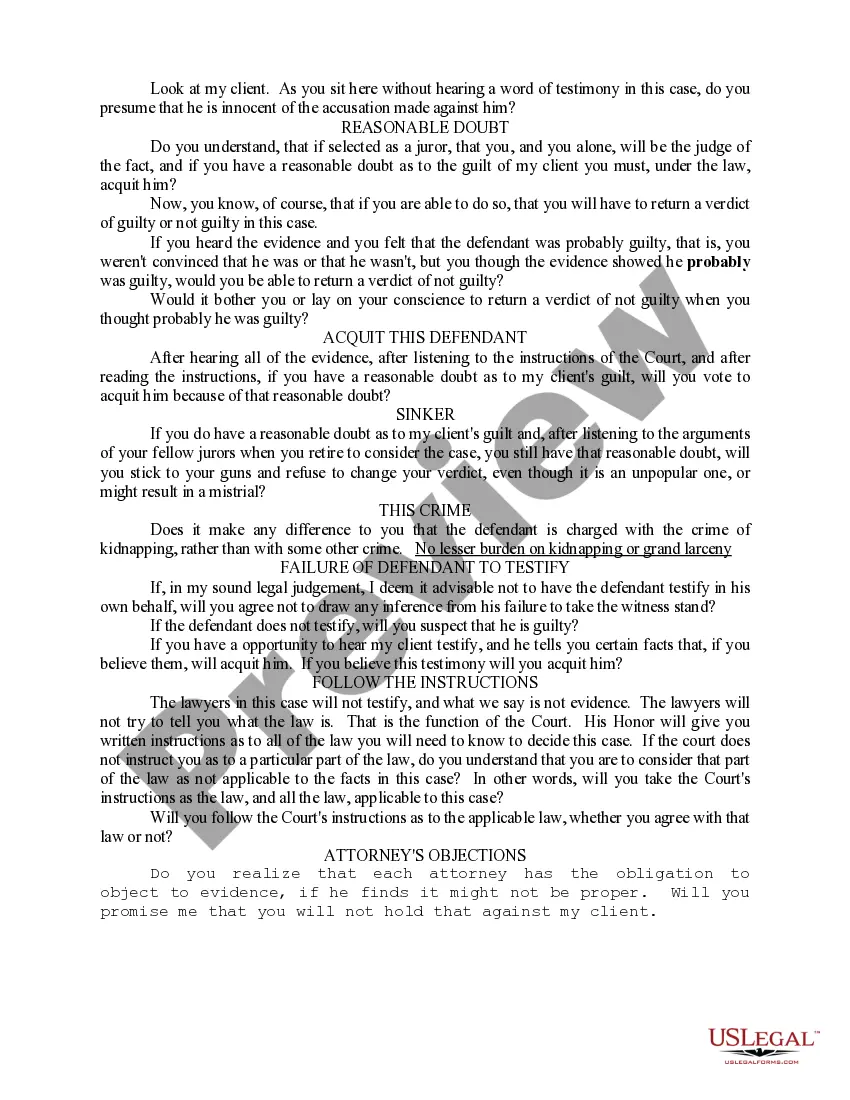
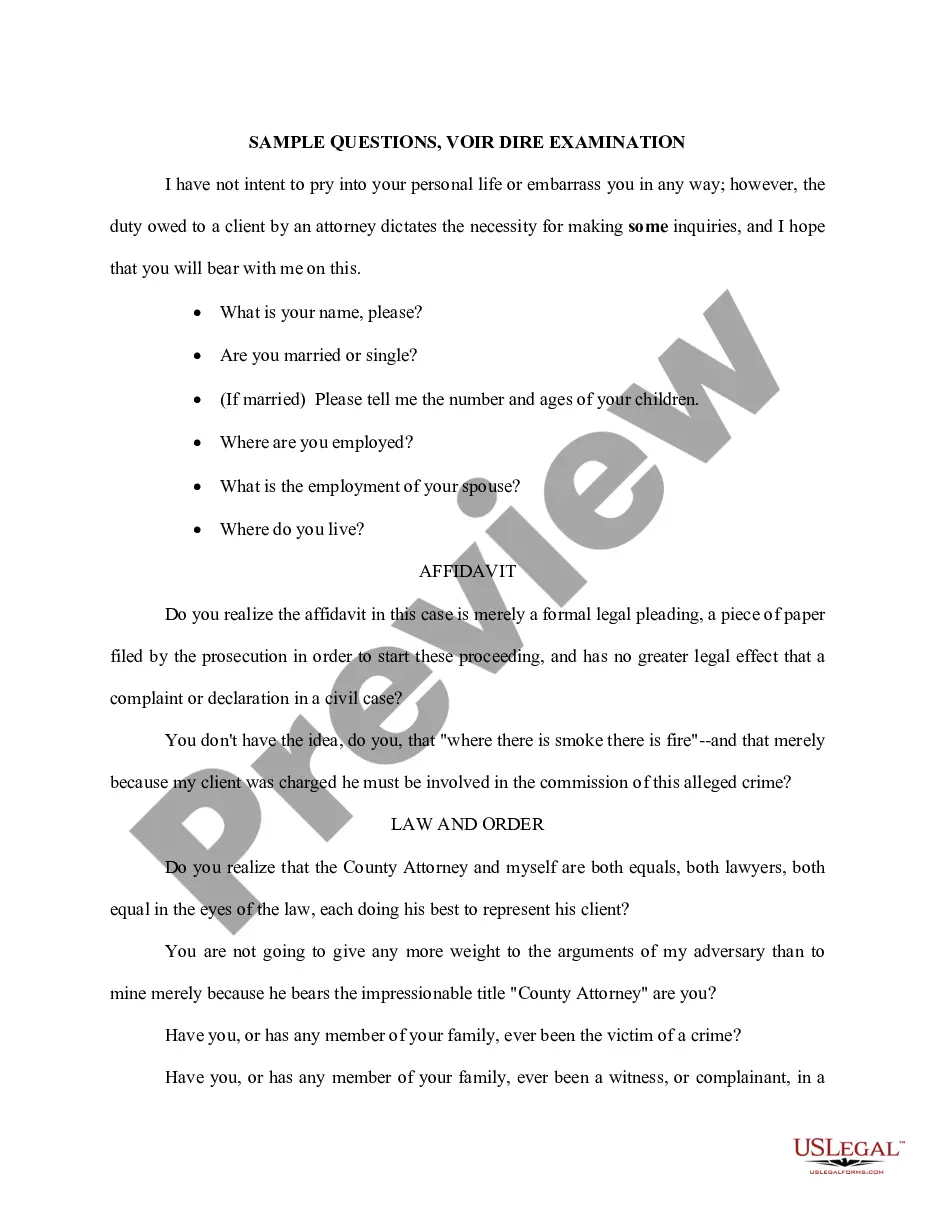
Sacramento California Voir Dire Examination
Description
Get your form ready online
Our built-in tools help you complete, sign, share, and store your documents in one place.
Make edits, fill in missing information, and update formatting in US Legal Forms—just like you would in MS Word.
Download a copy, print it, send it by email, or mail it via USPS—whatever works best for your next step.
Sign and collect signatures with our SignNow integration. Send to multiple recipients, set reminders, and more. Go Premium to unlock E-Sign.
If this form requires notarization, complete it online through a secure video call—no need to meet a notary in person or wait for an appointment.
We protect your documents and personal data by following strict security and privacy standards.

Make edits, fill in missing information, and update formatting in US Legal Forms—just like you would in MS Word.

Download a copy, print it, send it by email, or mail it via USPS—whatever works best for your next step.

Sign and collect signatures with our SignNow integration. Send to multiple recipients, set reminders, and more. Go Premium to unlock E-Sign.

If this form requires notarization, complete it online through a secure video call—no need to meet a notary in person or wait for an appointment.

We protect your documents and personal data by following strict security and privacy standards.
Looking for another form?

How to fill out Voir Dire Examination?
A document process consistently accompanies any legal action you undertake.
Establishing a business, applying for or accepting a job offer, transferring ownership, and various other life instances require you to prepare formal documentation that varies across the nation.
This is why gathering everything in one location is so advantageous.
US Legal Forms is the largest online repository of current federal and state-specific legal documents.
Utilize it as needed: print it or fill it out digitally, sign it, and send it where required. This is the easiest and most reliable method to obtain legal documents. All the templates available in our library are professionally crafted and validated for compliance with local laws and regulations. Prepare your documentation and manage your legal matters appropriately with US Legal Forms!
- On this platform, you can easily find and obtain a document for any personal or commercial purpose employed in your area, including the Sacramento Voir Dire Examination.
- Finding templates on the platform is incredibly easy.
- If you already have a membership to our service, Log In to your account, search for the sample using the search bar, and click Download to save it on your device.
- After that, the Sacramento Voir Dire Examination will be available for subsequent use in the My documents section of your profile.
- If you are using US Legal Forms for the initial time, follow this brief guideline to acquire the Sacramento Voir Dire Examination.
- Ensure you have opened the correct page with your regional form.
- Use the Preview mode (if available) and scroll through the template.
- Review the description (if any) to make sure the template suits your requirements.
- Look for another document through the search tab if the sample does not meet your criteria.
- Click Buy Now once you find the necessary template.
- Choose the appropriate subscription plan, then Log In or create an account.
- Select the preferred payment option (using credit card or PayPal) to proceed.
- Choose file format and download the Sacramento Voir Dire Examination onto your device.
Form popularity
FAQ
(c) Process for requesting permanent medical excuse (1) An applicant must submit to the jury commissioner a written request for permanent medical excuse with a supporting letter, memo, or note from a treating health care provider.
(1) No class or category of persons may be automatically excluded from jury duty except as provided by law. (2) A statutory exemption from jury service must be granted only when the eligible person claims it. (3) Deferring jury service is preferred to excusing a prospective juror for a temporary or marginal hardship.
Avoiding it, however, is ill advised: you cannot simply refuse and it is a criminal offence to not answer a jury summons without reasonable cause. You may, however, be able to defer (or possibly be excused) if you've served in the last two years or have a good reason.
Primary tabs. French for "to speak the truth." The process through which potential jurors from the venire are questioned by either the judge or a lawyer to determine their suitability for jury service. Also the preliminary questioning of witnesses (especially experts) to determine their competence to testify.
Rather than issue a bench warrant immediately, a judge might also send a notice to the person, ordering him to appear at court and address his failure to appear for jury duty. If the judge uses these alternatives and you ignore them, the court ultimately may file criminal charges, issue a bench warrant, or both.
Finally, jurors may feel uncomfortable discussing their inability to be fair or impartial in the presence of other prospective jurors. Even when jurors are aware of their biases, it may be difficult to detect their prejudices if they lie about them during voir dire.
Source and Scope of the Right to Adequate Voir Dire An effective voir dire protects the litigant's right to trial by fair and impartial jurors as guaranteed in criminal and civil cases by Article I, sections 11 and 17 of the Oregon Constitution.
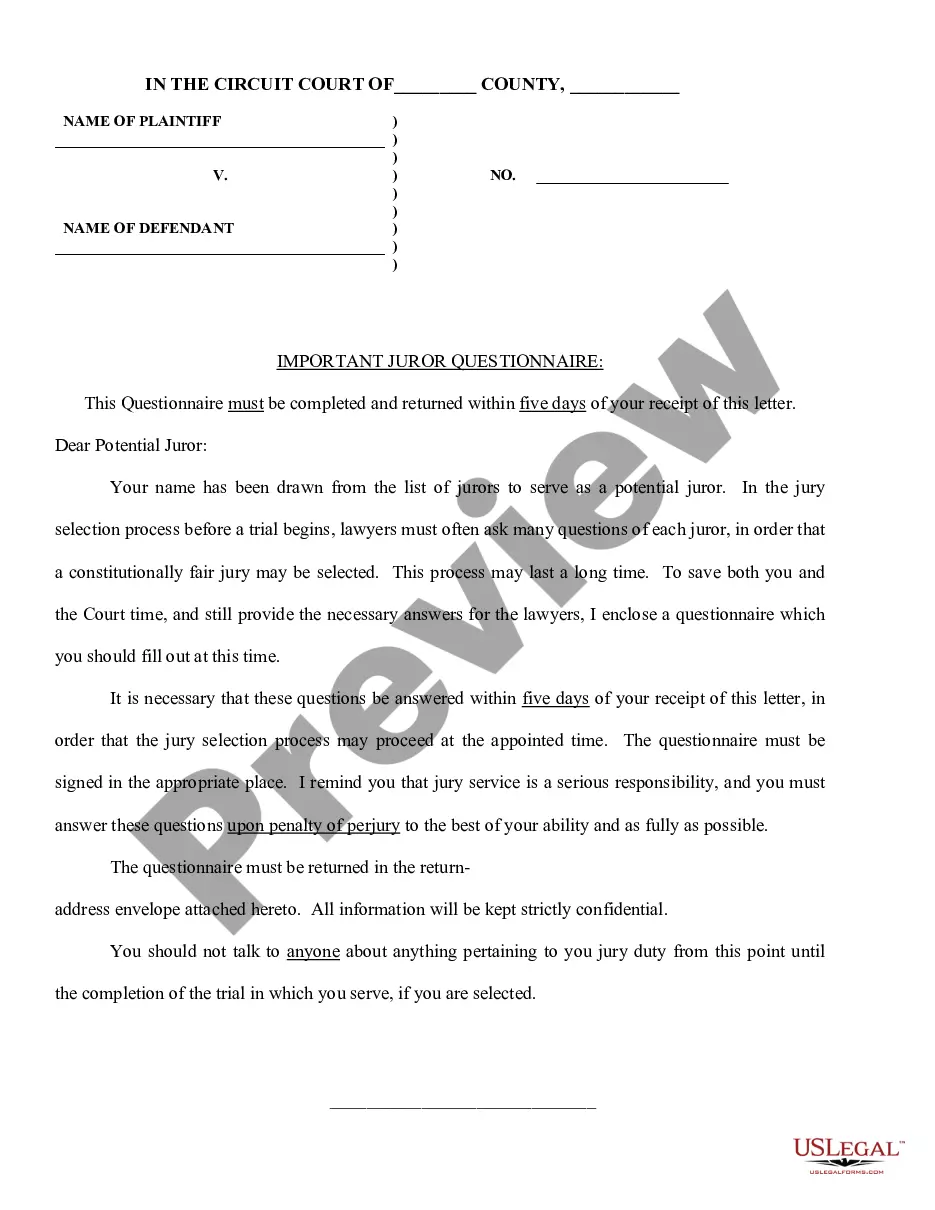
In terms of the Jury Amendment Act 2010, you may have 'good cause' to be excused if: jury service would cause undue hardship or serious inconvenience to you or your family. you have a disability that makes you unsuitable or incapable of effectively serving as a juror, without reasonable accommodation.
You may postpone your service for up to six months from your reporting date.
Frederick provided 11 tips on how to effectively conduct voir dire: Adopt the proper orientation.Set the stage for jurors.Get them talking.Ask open-ended questions.Avoid the Socially Desirable Response Bias.Focus on difficulty vs.Use alternative route to uncover bias.Design questions using bad answers.