Tennessee Declaration under Uniform Chld Custody Jurisdiction and Enforcement Act (UCCJEA)
Understanding this form
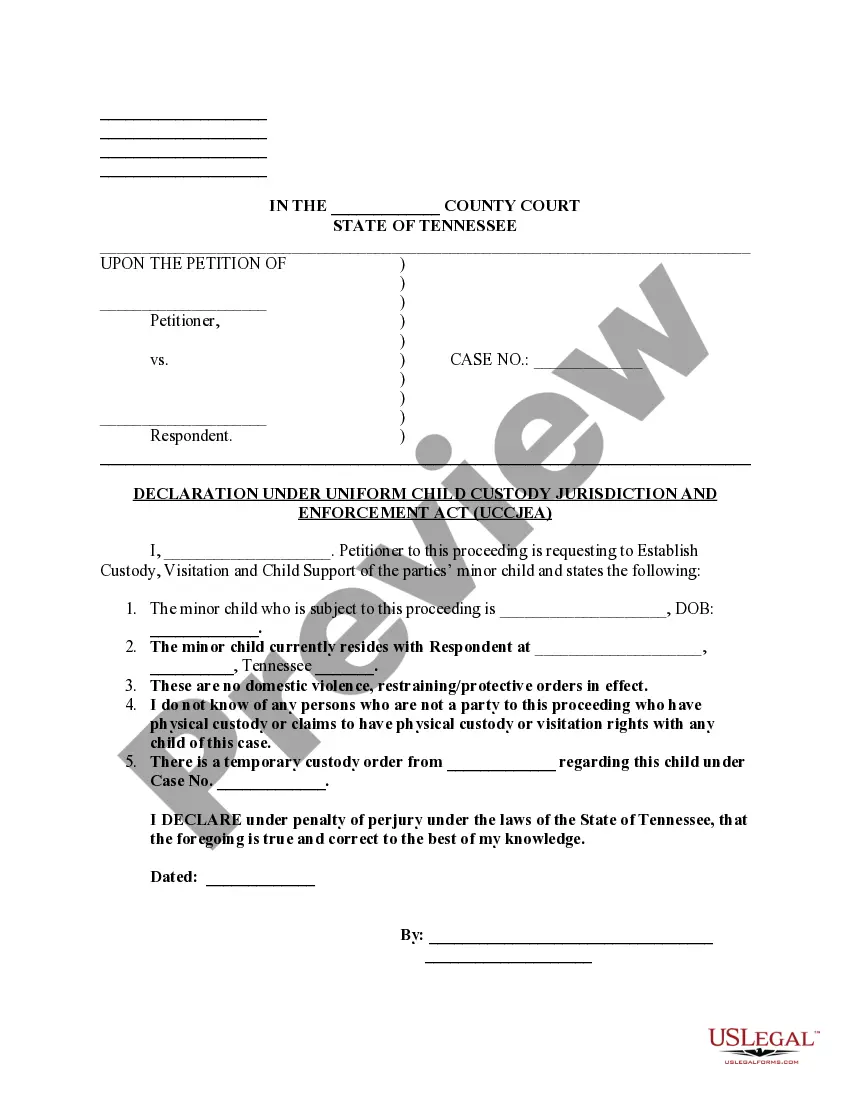
The Declaration under Uniform Child Custody Jurisdiction and Enforcement Act (UCCJEA) is a legal document used to establish custody, visitation, and child support for a minor child. This form is specifically important in situations where legal custody arrangements need to be recognized and enforced across state lines. It differs from other custody forms by ensuring compliance with the UCCJEA, which addresses jurisdictional issues related to child custody matters.
What’s included in this form
- Petitioner and Respondent details: Identification of the parties involved in the custody case.
- Minor child details: Information about the child including name and date of birth.
- Current residence: Address where the minor child resides with the Respondent.
- Domestic violence declaration: Confirmation that there are no existing protective orders.
- Knowledge of custody claims: A statement regarding other individuals claiming custody or visitation rights.
- Temporary custody orders: A section for noting any existing custody orders related to the child.
- Declaration of truth: An affirmation that the provided information is accurate.

When to use this form
This form should be used when a parent wishes to establish legal custody arrangements or visitation rights for their child, particularly when such arrangements arise in Tennessee, the child's home state. It may also be used when a previous custody order exists, or in situations where custody enforcement is needed across state lines due to relocations or disputes.
Who can use this document
- Parents seeking to establish custody and visitation agreements for their minor child.
- Parents who have relocated and need to enforce existing custody orders from another state.
- Parents who need to clarify child support obligations in conjunction with custody arrangements.
Steps to complete this form
- Start by entering the names and addresses of the Petitioner and Respondent.
- Provide the minor child's full name and date of birth.
- Fill in the current address where the child resides with the Respondent.
- Indicate whether there are any existing domestic violence or protective orders.
- Declare any awareness of other individuals with custody claims or visitation rights.
- Sign and date the document to affirm the honesty of the information provided.
Is notarization required?
This form does not typically require notarization unless specified by local law. However, verifying the identity of the signers may be necessary in certain jurisdictions, so it's advisable to check local requirements before submitting the form.
Get your form ready online
Our built-in tools help you complete, sign, share, and store your documents in one place.
Make edits, fill in missing information, and update formatting in US Legal Forms—just like you would in MS Word.
Download a copy, print it, send it by email, or mail it via USPS—whatever works best for your next step.
Sign and collect signatures with our SignNow integration. Send to multiple recipients, set reminders, and more. Go Premium to unlock E-Sign.
If this form requires notarization, complete it online through a secure video call—no need to meet a notary in person or wait for an appointment.
We protect your documents and personal data by following strict security and privacy standards.

Make edits, fill in missing information, and update formatting in US Legal Forms—just like you would in MS Word.

Download a copy, print it, send it by email, or mail it via USPS—whatever works best for your next step.

Sign and collect signatures with our SignNow integration. Send to multiple recipients, set reminders, and more. Go Premium to unlock E-Sign.

If this form requires notarization, complete it online through a secure video call—no need to meet a notary in person or wait for an appointment.

We protect your documents and personal data by following strict security and privacy standards.
Avoid these common issues
- Incorrectly identifying the parties involved in the custody case.
- Failing to provide complete and accurate addresses for the child and parents.
- Omitting any existing custody orders related to the child.
- Not signing the declaration, which is essential for validation.
Advantages of online completion
- Convenience of downloading the form immediately for personal use.
- Editable format that allows parents to fill out details accurately and quickly.
- Access to templates drafted by licensed attorneys for enhanced reliability.
Looking for another form?
Form popularity
FAQ
Under Section 204 of the UCCJEA, a court has ?temporary jurisdiction if the child is present in this State and it is necessary in an emergency to protect the child because the child is subjected to or threatened with mistreatment or abuse.? Section 204 of the UCCJEA was specifically enacted to protect victims fleeing
Declaration Under Uniform Child Custody Jurisdiction and Enforcement Act (UCCJEA) (FL-105) Give the court important information about the children you have with your spouse or domestic partner. The court considers this information before making child custody and visitation orders.
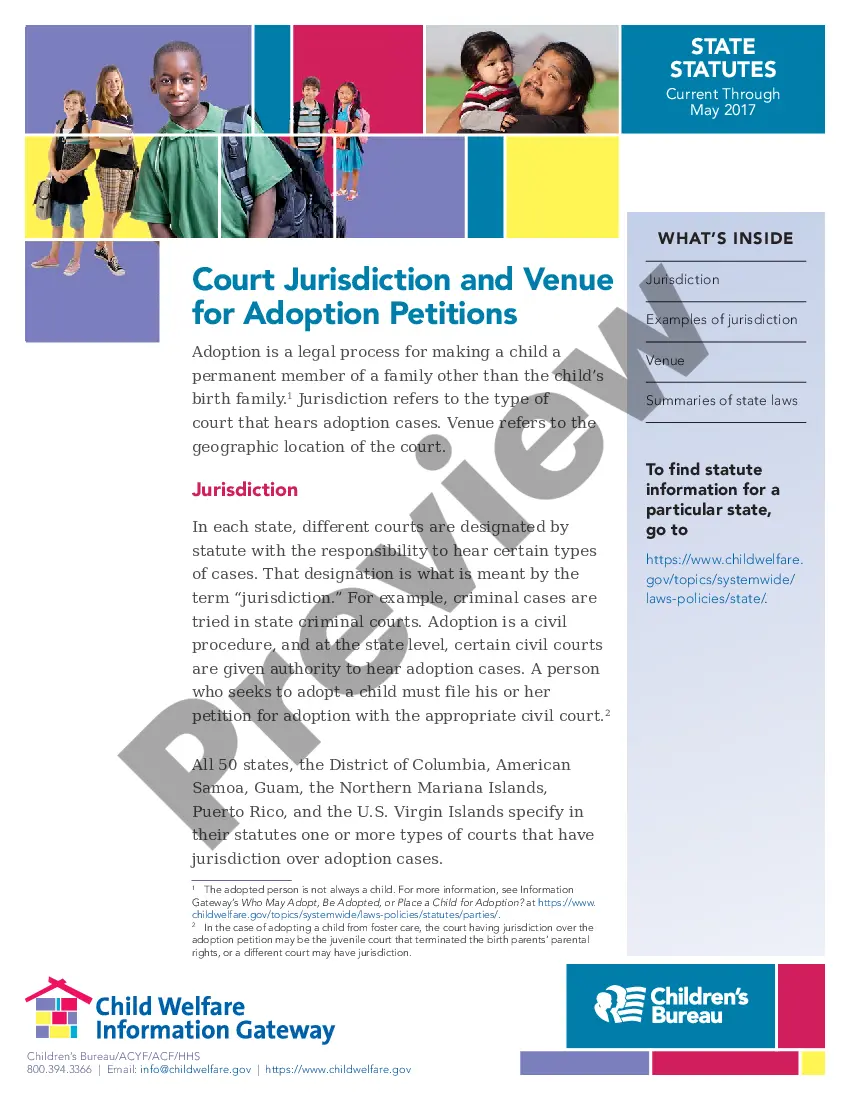
Scope of UCCJEA Jurisdiction The UCCJEA does not apply in adoption, juvenile delinquency, contractual emancipation, or emergency medical care proceeding. However, under the UCCJEA a child custody determination made by a foreign country must be recognized and enforced by a U.S. court.
The Uniform Child Custody Jurisdiction and Enforcement Act (UCCJEA) was enacted to create uniformity in determining which court in which state is the appropriate one to make decisions regarding child custody and child visitation, and has been codified into California law as Sections 3400-3465 of the California Family
The Uniform Child Custody Jurisdiction and Enforcement Act (UCCJEA) is a multi-state compact that helps to ensure separated parents cannot move their children across state lines simply in order to avoid a child custody order or child visitation order.
A court must decline to exercise jurisdiction if a party has engaged in unjustifiable misconduct that resulted in the court's jurisdiction over the case. UCCJEA, §208.
Tennessee has home state jurisdiction if it was the child's home state within the six months before the proceeding commenced, the child is absent, and a parent or someone acting as a parent continues to live in Tennessee.