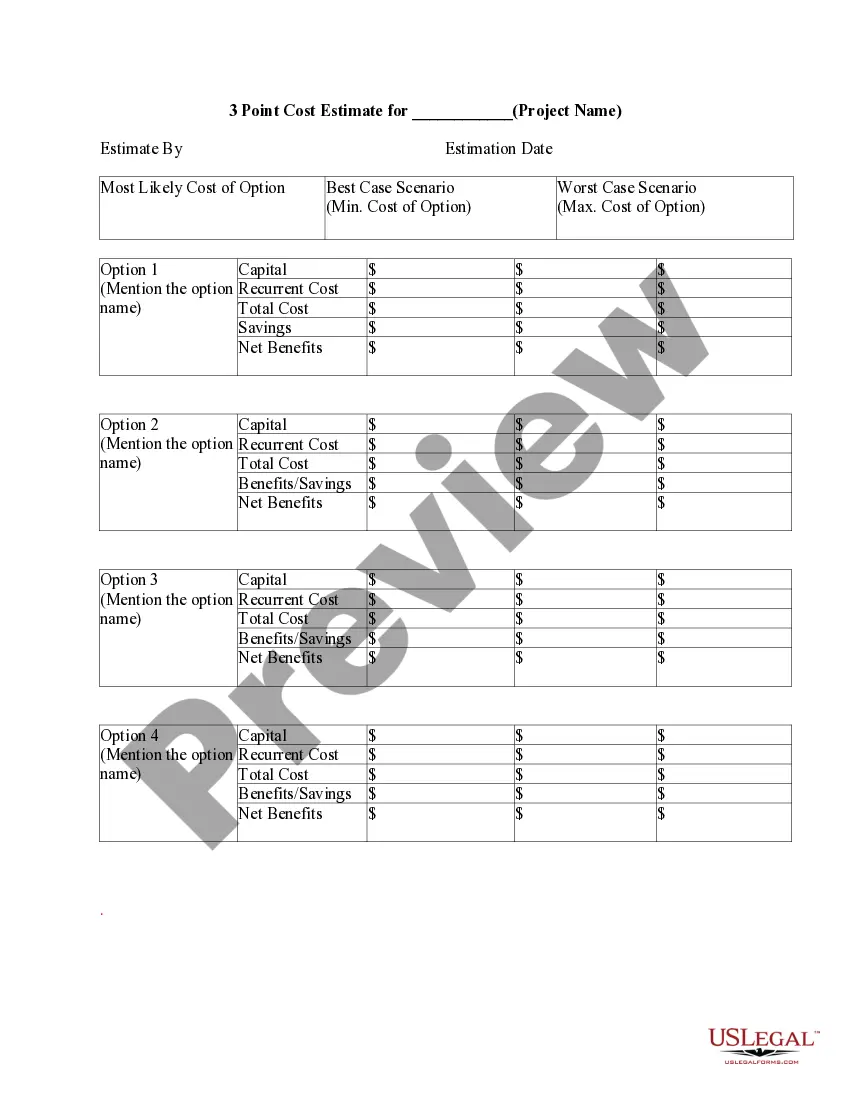
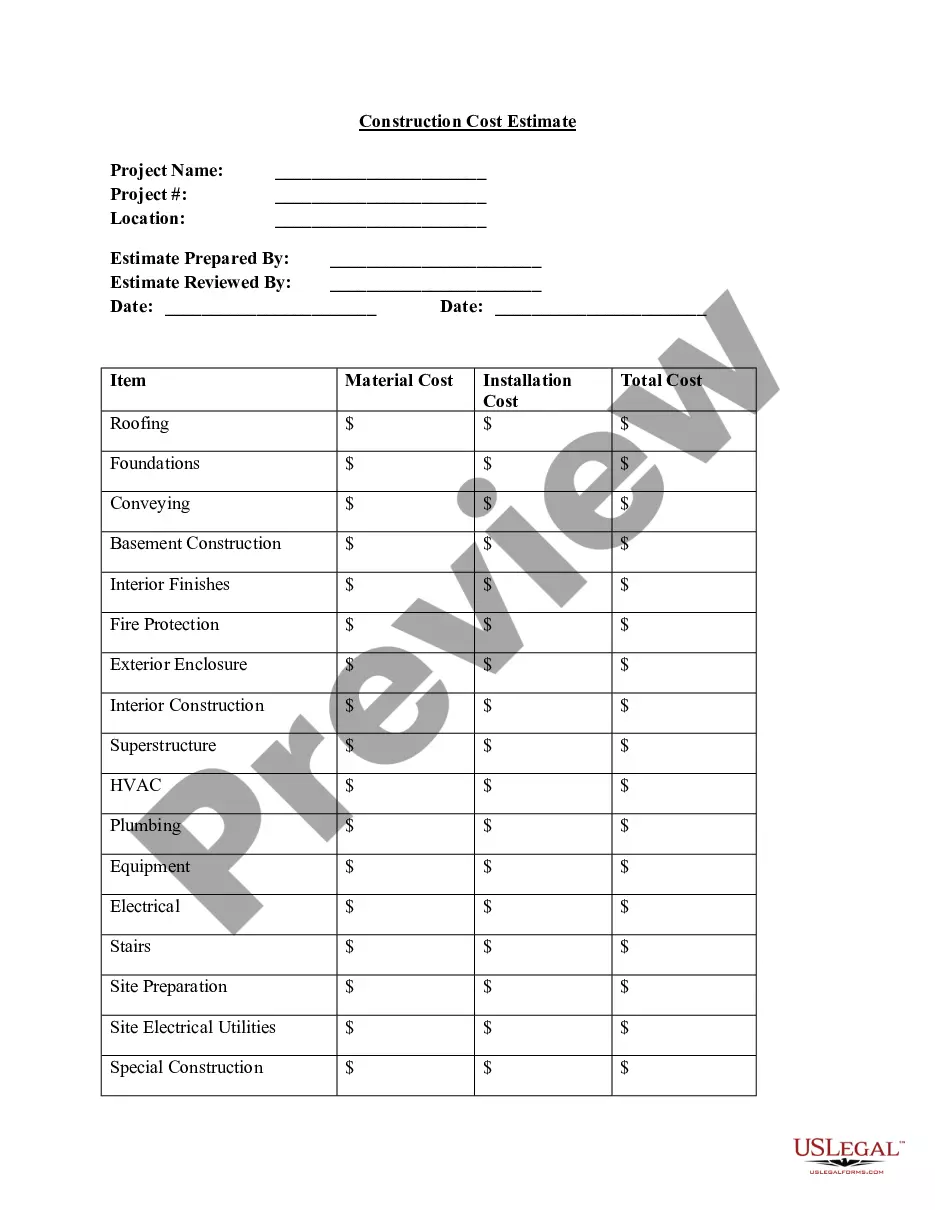
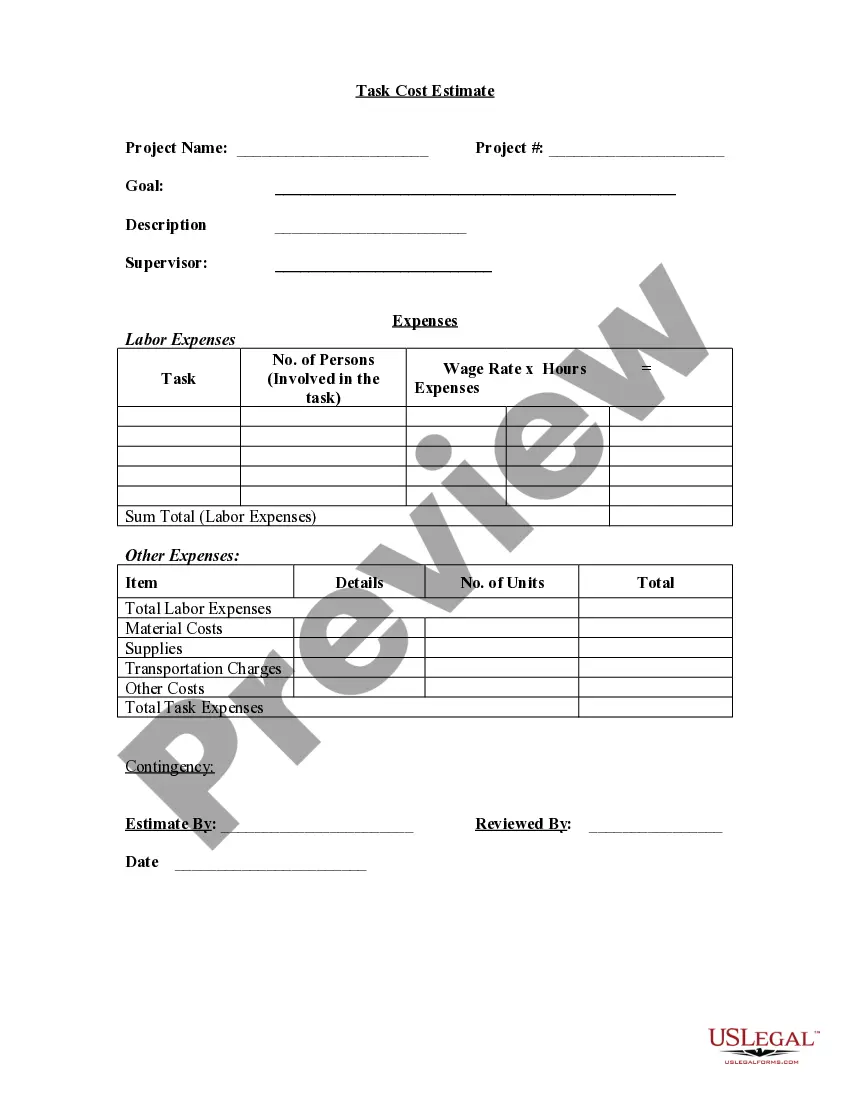
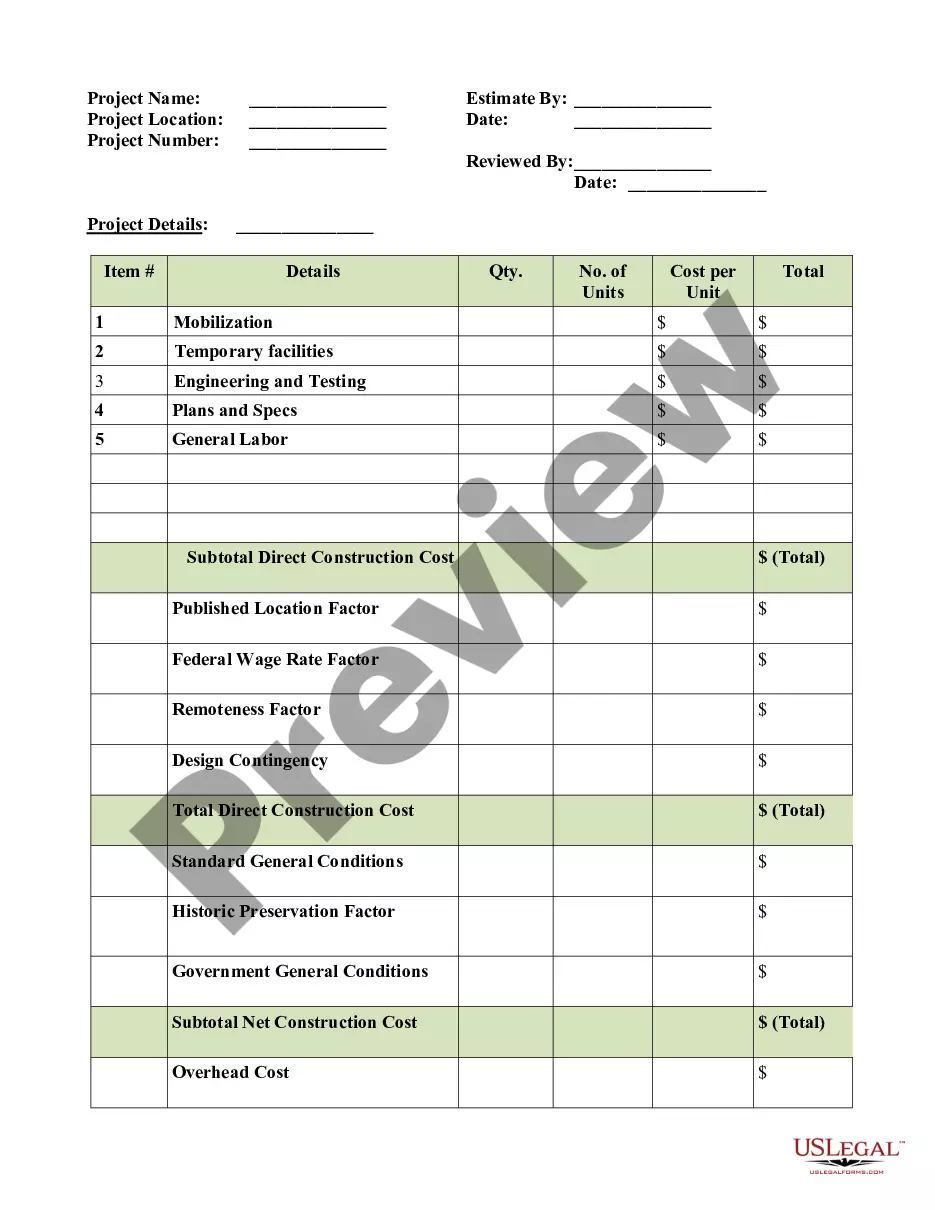
Santa Ana California 3-Point Cost Estimate Comparisons
Description
Form popularity
FAQ
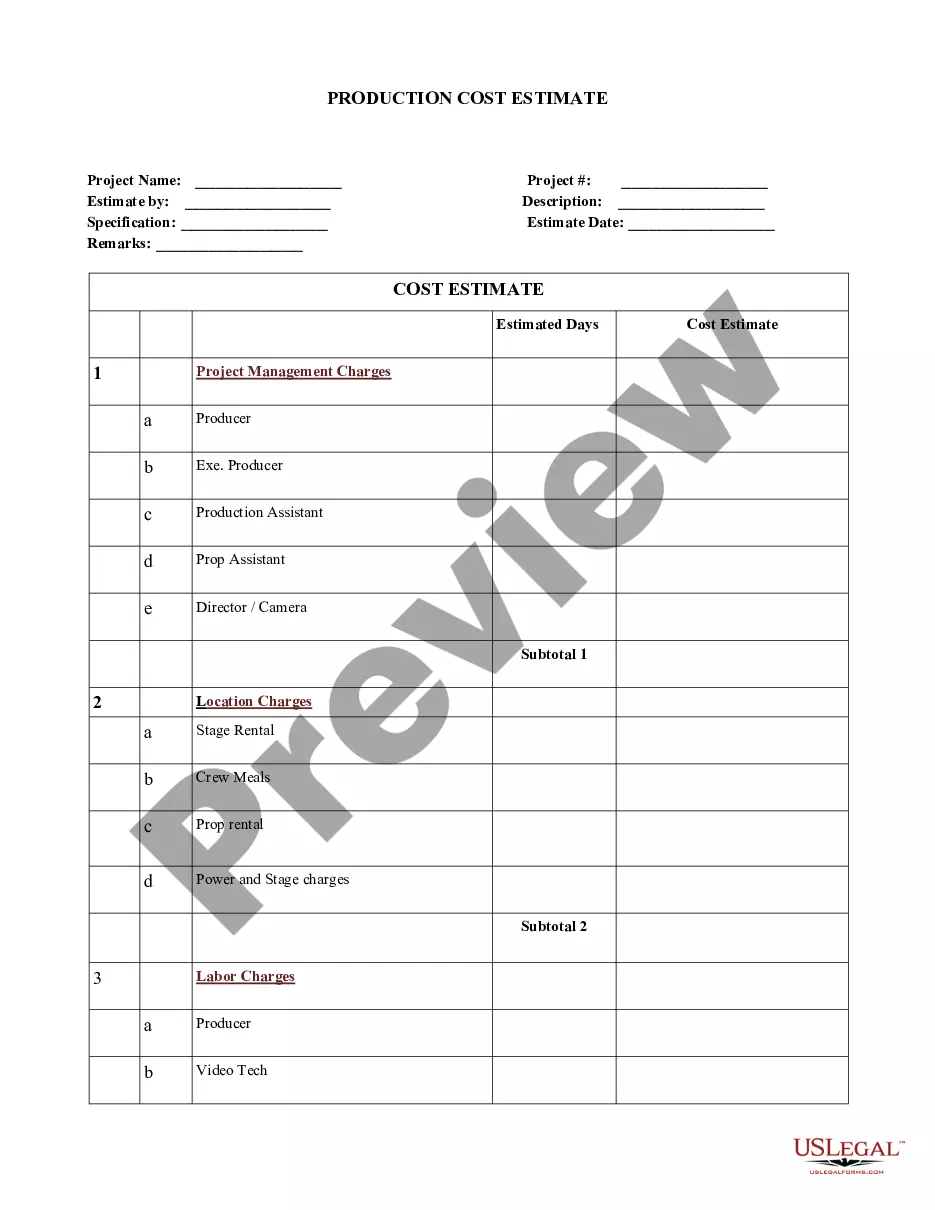
To calculate a point estimate, you typically select one value that represents the expected outcome of your project. This could be the most likely estimate derived from your 3-point analysis. In the framework of Santa Ana California 3-point cost estimate comparisons, having a solid point estimate can enable you to set realistic budgetary expectations.
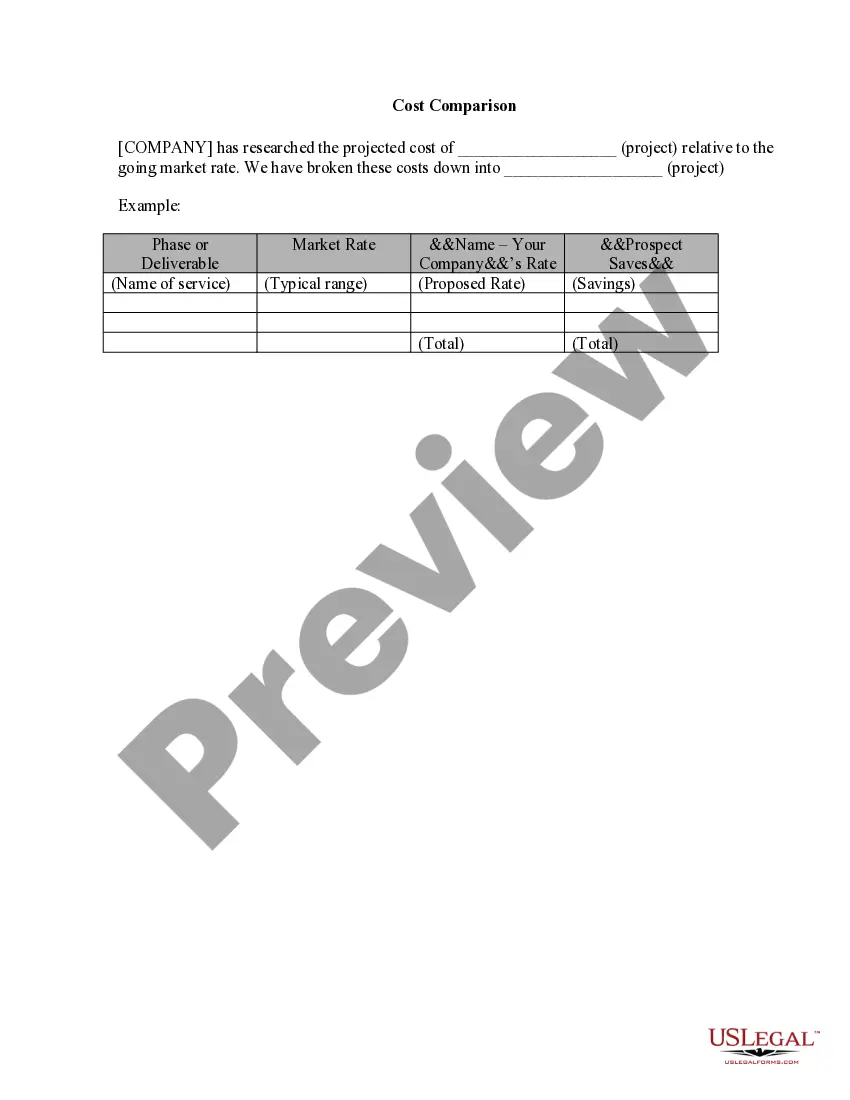
When applying three-point estimating, include a range of estimates such as optimistic, pessimistic, and most likely figures. These diverse inputs assist in creating a well-rounded view of potential risks and costs. Utilizing Santa Ana California 3-point cost estimate comparisons allows you to visualize these factors in context and make informed projections.
To calculate a 3-point average, you need to gather the optimistic, pessimistic, and most likely estimates. The formula is (Optimistic + 4 Most Likely + Pessimistic) / 6, which gives more weight to the most likely estimate. Incorporating this method into your Santa Ana California 3-point cost estimate comparisons enhances your decision-making process.
The formula for the three-time estimate involves using optimistic, pessimistic, and most likely completion times. The equation is similar to the one for cost, as it combines these three factors to create a weighted average. Using Santa Ana California 3-point cost estimate comparisons, you can better assess time frames for project tasks.
To perform a 3-point estimate, gather input from team members on the optimistic, pessimistic, and most likely estimates regarding your project. Next, apply the formula: (Optimistic + 4 Most Likely + Pessimistic) / 6 for a weighted average. In the context of Santa Ana California, 3-point cost estimate comparisons can refine your budgeting process and prepare you for uncertainties.
The 3-point formula for Project Management Professional (PMP) estimates involves three key values: the optimistic estimate, the pessimistic estimate, and the most likely estimate. By combining these values, you can create a more comprehensive view of your project timeline and costs. Specifically, in Santa Ana California, 3-point cost estimate comparisons help you understand potential variations, allowing for better budgeting and resource allocation.
Calculating a 3-point estimate involves using a simple formula that combines your three estimates: optimistic, pessimistic, and most likely. Specifically, you can calculate it with (Optimistic + 4 x Most Likely + Pessimistic) / 6. This structured approach helps to mitigate risk and prepare for variable costs. For accurate Santa Ana California 3-Point Cost Estimate Comparisons, consider using US Legal Forms to obtain detailed breakdowns.
To calculate a 3-point estimate, you first gather your optimistic, pessimistic, and most likely estimates. Then, you use the formula: (Optimistic + 4 x Most Likely + Pessimistic) / 6. This calculation gives you a weighted average that incorporates differing outcomes. Understanding this method is particularly useful when reviewing Santa Ana California 3-Point Cost Estimate Comparisons to make informed decisions.
Three-point estimating relies on three distinct estimates: the optimistic, pessimistic, and most likely estimates. The optimistic estimate reflects the best-case scenario, while the pessimistic estimate considers the worst-case scenario. The most likely estimate is, as the name suggests, the most probable outcome. When you explore Santa Ana California 3-Point Cost Estimate Comparisons, these estimates help provide a clearer understanding of potential project costs.
The three-point average formula calculates an average from three distinct values, which commonly includes the best, worst, and most realistic scenarios. You can achieve this by summing these three estimates and dividing the total by three. This method aids in creating a balanced view of potential costs, particularly useful for Santa Ana California 3-Point Cost Estimate Comparisons. Consider using uslegalforms to simplify this process with accessible resources and templates.