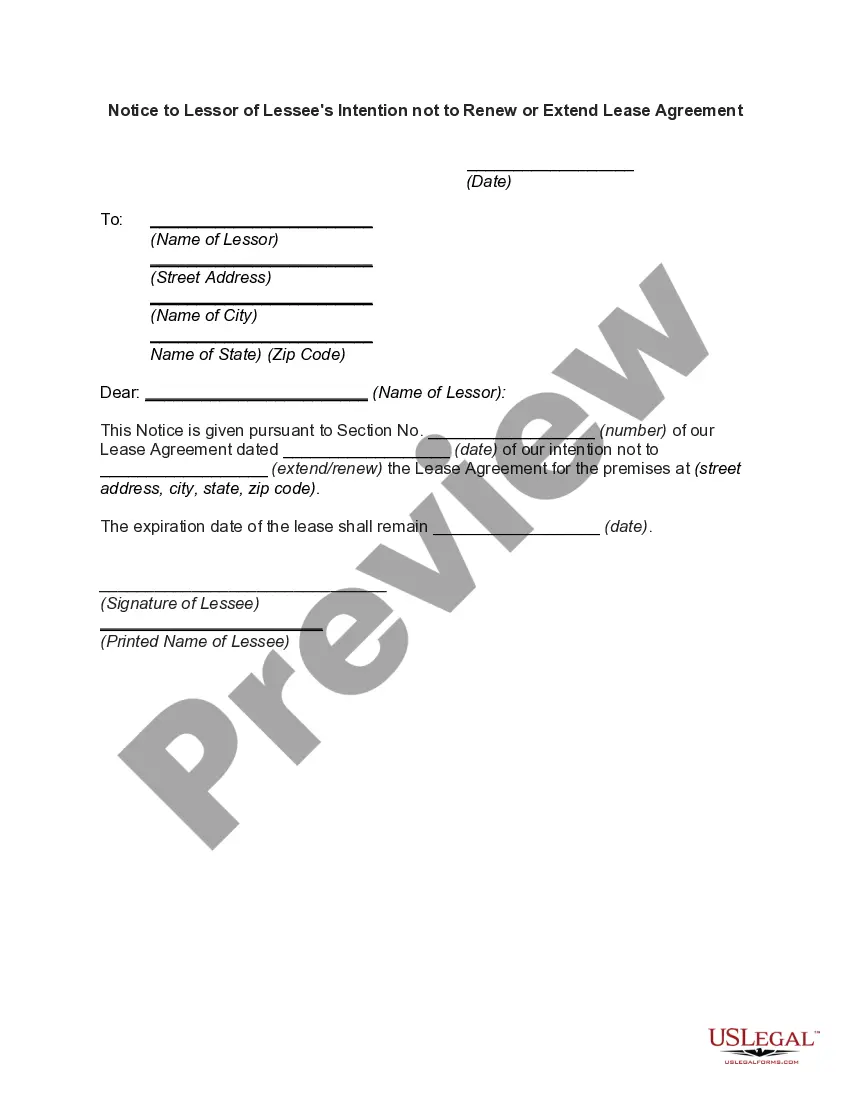
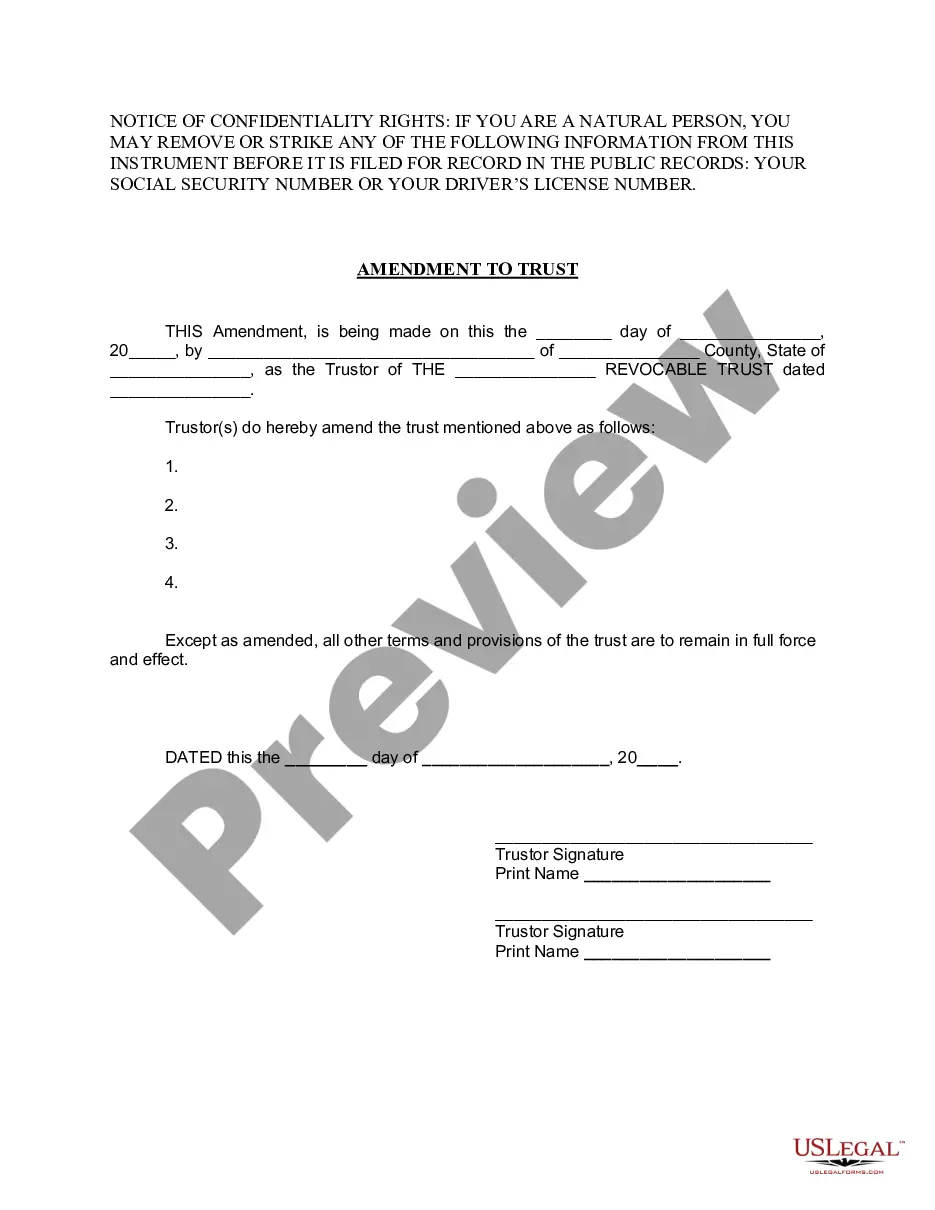
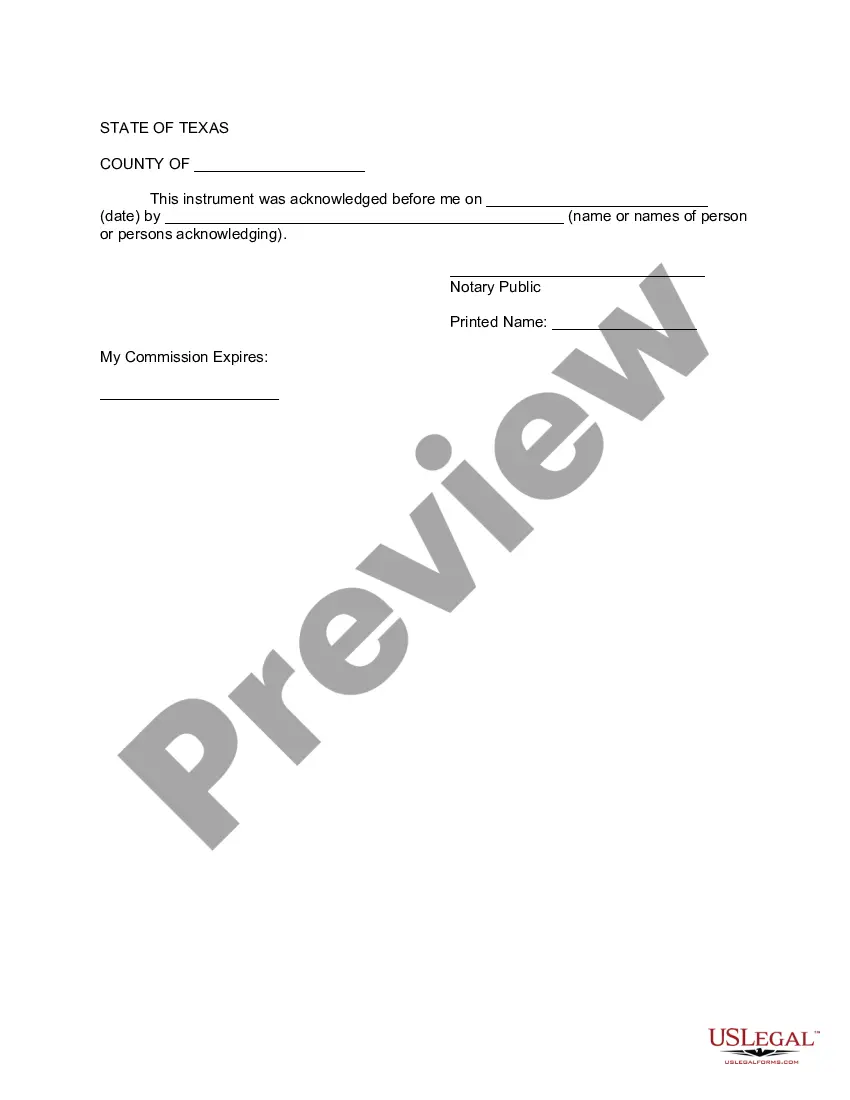
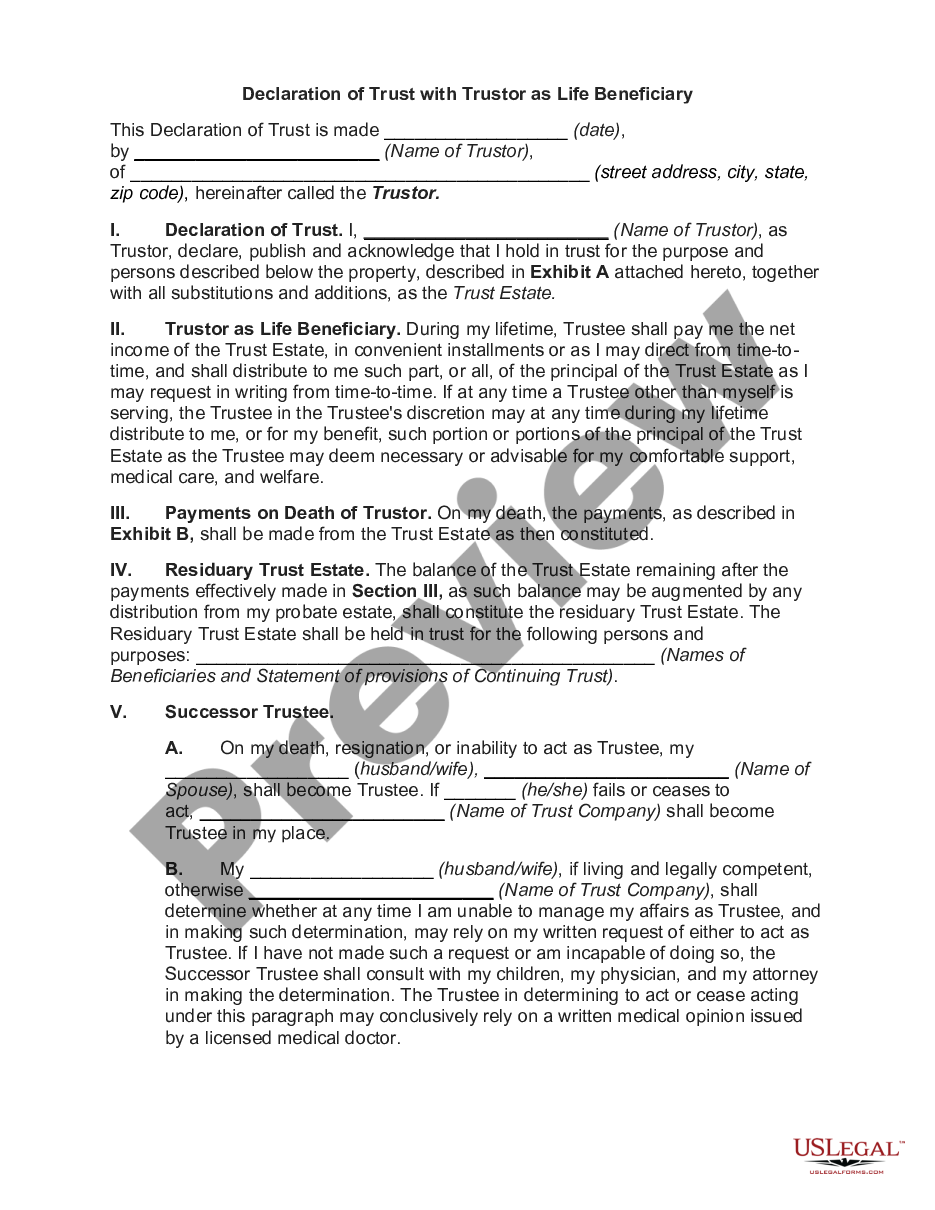
This form is for amending a living trust. A living trust is a trust established during a person's lifetime in which a person's assets and property are placed within the trust, usually for the purpose of estate planning. This form permits the Trustor to amend certain properties of the trust without changing the purpose or nature of the trust. Except for the amended provisions, all other parts of the trust will remain in full force and effect. The Trustor(s) signature(s) is needed, and it must be signed in front of a notary public.
Fort Worth Texas Amendment to Living Trust
Category:
State:
Texas
City:
Fort Worth
Control #:
TX-E0178A
Format:
Word;
Rich Text
Instant download
Description
Free preview





How to fill out Texas Amendment To Living Trust?
Obtaining verified templates specific to your local regulations can be difficult unless you access the US Legal Forms library.
This online repository contains over 85,000 legal forms catering to personal and professional needs as well as various real-life scenarios.
All documents are properly organized by category and jurisdiction, making it as simple as ABC to find the Fort Worth Texas Amendment to Living Trust.
Enter your credit card information or use your PayPal account to pay for the subscription. Download the Fort Worth Texas Amendment to Living Trust to your device for further completion, and access it anytime from the My documents menu in your profile. Keeping paperwork organized and compliant with legal requirements is crucial. Utilize the US Legal Forms library to have essential document templates readily available for any needs!
- Review the Preview mode and form description.
- Ensure you’ve selected the correct one that fulfills your needs and aligns with your local jurisdiction stipulations.
- Look for another template if necessary.
- If you notice any discrepancies, use the Search tab above to find the correct one. If it meets your requirements, proceed to the next step.
- Purchase the document.
Form popularity
FAQ
Fortunately, California law allows for the amendment, modification or termination of an otherwise irrevocable trust--under the proper circumstances and using the proper procedures.
To make a living trust in Texas, you: Choose whether to make an individual or shared trust. Decide what property to include in the trust. Choose a successor trustee. Decide who will be the trust's beneficiaries?that is, who will get the trust property. Create the trust document.
The Cons. While there are many benefits to putting your home in a trust, there are also a few disadvantages. For one, establishing a trust is time-consuming and can be expensive. The person establishing the trust must file additional legal paperwork and pay corresponding legal fees.
The beneficiary can (where there is one beneficiary or if there are several beneficiaries and all of them agree) direct the trustee to transfer the trust property to him (if there are several beneficiaries to all of them) or to such other person as the beneficiary (or the beneficiaries may desire).
The common law rule on amending trust deeds was confirmed in Potgieter v Potgieter 2012 1 SA 637 (SCA) that trust deeds can be amended by the founder and trustees alone.
A revocable trust can be modified while the Grantor is alive. Revising the terms of a trust is known as ?amending? the trust. An amendment is generally appropriate when there are only a few minor changes to make, like rewording a certain paragraph, changing the successor trustee, or modifying beneficiaries.
You could end up paying more than $1,000 to create a living trust. While these costs are a definite downside, you'll dodge the potential dangers of DIY estate planning by getting an expert's input.
To transfer real property into your Trust, a new deed reflecting the name of the Trust must be executed, notarized and recorded with the County Recorder in the County where the property is located. Care must be taken that the exact legal description in the existing deed appears on the new deed.
A trust cannot own, manage, or sell real estate or other property. However, the trustee administering the trust may hold legal title to the property on behalf of the individual or individuals that the trust benefits. This means that the trustee may lease, sell, or otherwise manage the property.
In scenarios where the founder of the trust deed is still alive, then it can be amended through the powers afforded to the trustee in terms of the deed itself or in terms of the law of contract by which a later agreement between the founder and trustees amend substitute an earlier agreement between the same parties.