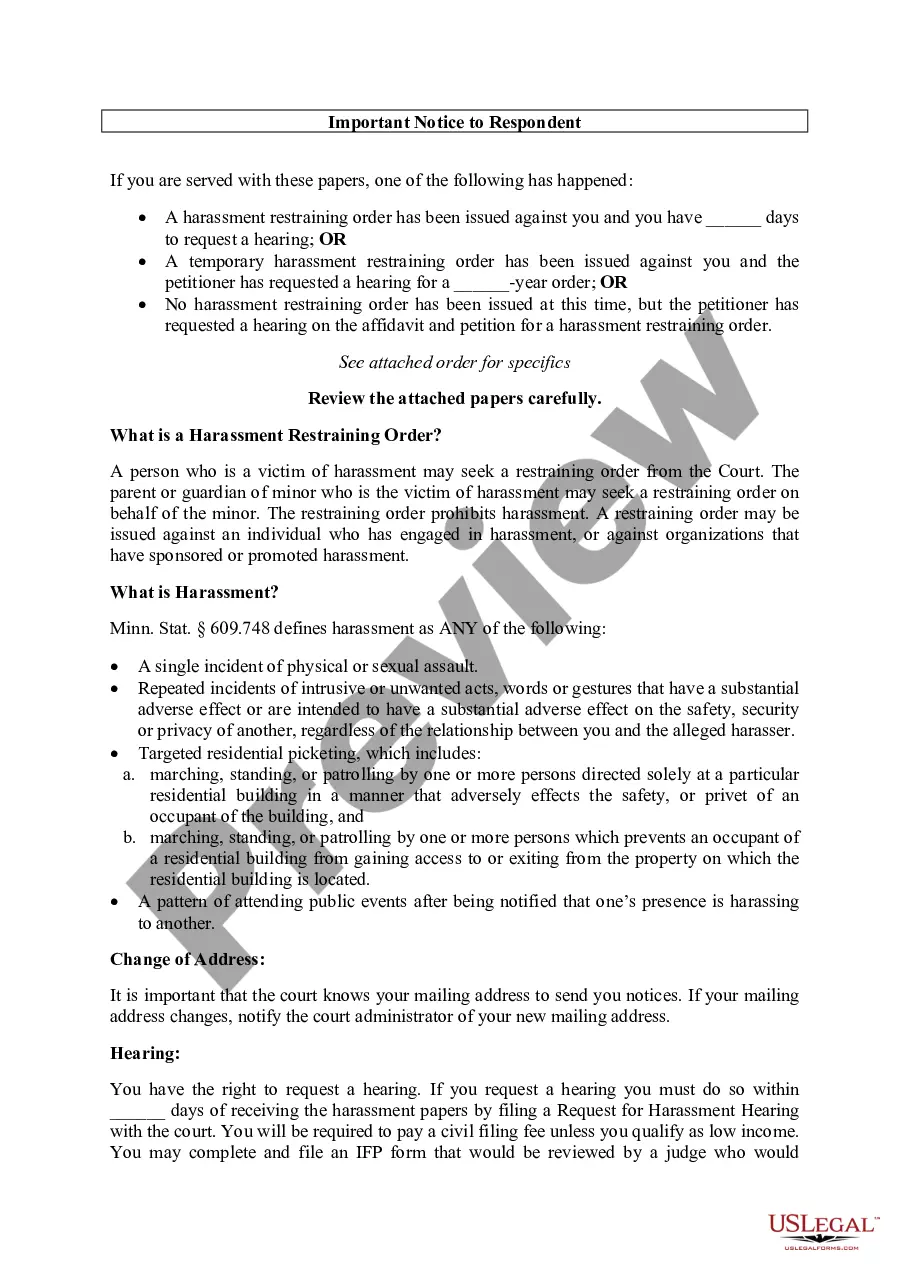
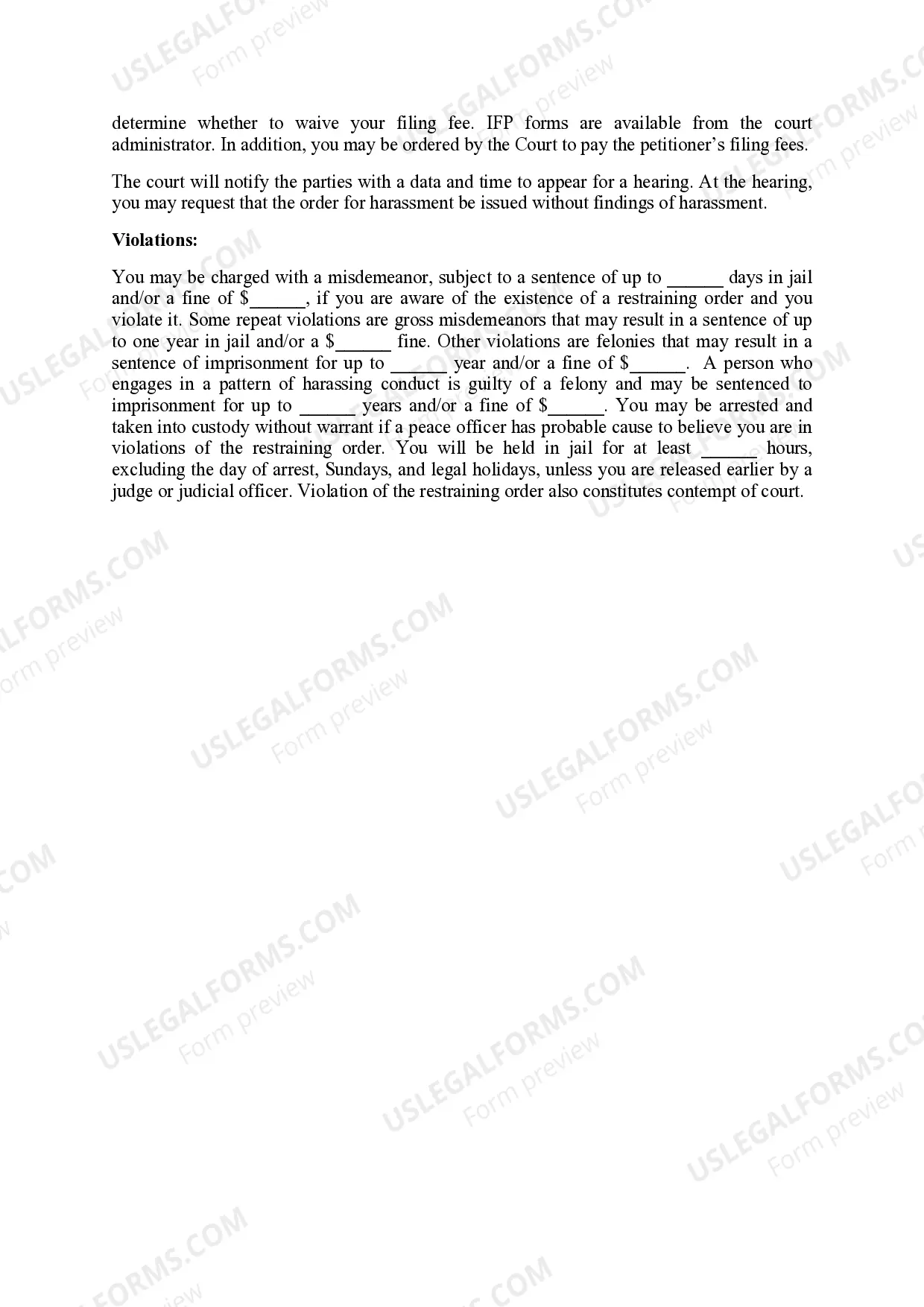
Minneapolis Minnesota Important Notice to Respondent Regarding Restraining Order
Description
Get your form ready online
Our built-in tools help you complete, sign, share, and store your documents in one place.
Make edits, fill in missing information, and update formatting in US Legal Forms—just like you would in MS Word.
Download a copy, print it, send it by email, or mail it via USPS—whatever works best for your next step.
Sign and collect signatures with our SignNow integration. Send to multiple recipients, set reminders, and more. Go Premium to unlock E-Sign.
If this form requires notarization, complete it online through a secure video call—no need to meet a notary in person or wait for an appointment.
We protect your documents and personal data by following strict security and privacy standards.

Make edits, fill in missing information, and update formatting in US Legal Forms—just like you would in MS Word.

Download a copy, print it, send it by email, or mail it via USPS—whatever works best for your next step.

Sign and collect signatures with our SignNow integration. Send to multiple recipients, set reminders, and more. Go Premium to unlock E-Sign.

If this form requires notarization, complete it online through a secure video call—no need to meet a notary in person or wait for an appointment.

We protect your documents and personal data by following strict security and privacy standards.
Looking for another form?

How to fill out Minnesota Important Notice To Respondent Regarding Restraining Order?
If you are looking for a legitimate form template, it’s unattainable to select a more suitable service than the US Legal Forms site – likely the most extensive collections online.
With this collection, you can locate thousands of form examples for professional and personal use by categories, regions, or keywords.
With the enhanced search capability, obtaining the latest Minneapolis Minnesota Important Notice to Respondent Regarding Restraining Order is as simple as 1-2-3.
Obtain the template. Specify the format and save it to your device.
Make modifications. Complete, edit, print, and sign the acquired Minneapolis Minnesota Important Notice to Respondent Regarding Restraining Order.
- If you are already familiar with our system and have an account, all you need to acquire the Minneapolis Minnesota Important Notice to Respondent Regarding Restraining Order is to Log In to your profile and click the Download button.
- If you are using US Legal Forms for the first time, just follow the instructions below.
- Ensure you have found the form you require. Review its details and utilize the Preview feature to examine its content. If it doesn’t satisfy your needs, use the Search field at the top of the page to find the appropriate document.
- Confirm your choice. Click the Buy now button. Next, select your preferred subscription plan and enter your information to create an account.
- Complete the transaction. Use your credit card or PayPal account to finish the registration process.
Form popularity
FAQ
How do I contest an order for protection? The respondent can contest an OFP by requesting a hearing before the judge who issued a temporary or ex-parte OFP. At the hearing, both parties can present evidence, including witness testimony, in order to establish whether an OFP is necessary.
They are public. A conviction record shows that a jury or judge accepted the allegation as true beyond a reasonable doubt. Criminal case restraining orders, though public, are still less damaging than a record of conviction.
In Minnesota, victims of domestic abuse can go to civil court to petition (request) an order for protection (OFP). An OFP directs the alleged abuser to not harm or have any contact with the victim. Violating the order can result in criminal penalties.
They are public. A conviction record shows that a jury or judge accepted the allegation as true beyond a reasonable doubt. Criminal case restraining orders, though public, are still less damaging than a record of conviction.
A peace officer shall arrest without a warrant and take into custody a person whom the peace officer has probable cause to believe has violated a domestic abuse no contact order, even if the violation of the order did not take place in the presence of the peace officer, if the existence of the order can be verified by
How do I contest an order for protection? The respondent can contest an OFP by requesting a hearing before the judge who issued a temporary or ex-parte OFP. At the hearing, both parties can present evidence, including witness testimony, in order to establish whether an OFP is necessary.
A Harassment Restraining Order (HRO) is an order signed by a judicial officer (judge or referee) that orders someone to stop harassing you and have no contact, unless allowed in the court order. It is not a criminal proceeding and takes place in civil court.
What is the punishment for violating the order? In Minnesota, if a person is guilty of a misdemeanor violation, s/he could be imprisoned for up to 90 days, fined up to $1,000, or both. If s/he is found guilty of a gross misdemeanor violation, s/he could be imprisoned for up to one year, fined up to $3,000, or both.
Typically, either the victim or the defendant can ask the court to lift the restraining order. This is usually completed by filing a motion with the court, such as a Motion to Modify Conditions of Pretrial Release or a Motion to Lift Restraining Order. This legal motion must usually identify the parties.