Louisiana Judgment on Visitation Schedule, Custody, Child Support
Overview of this form
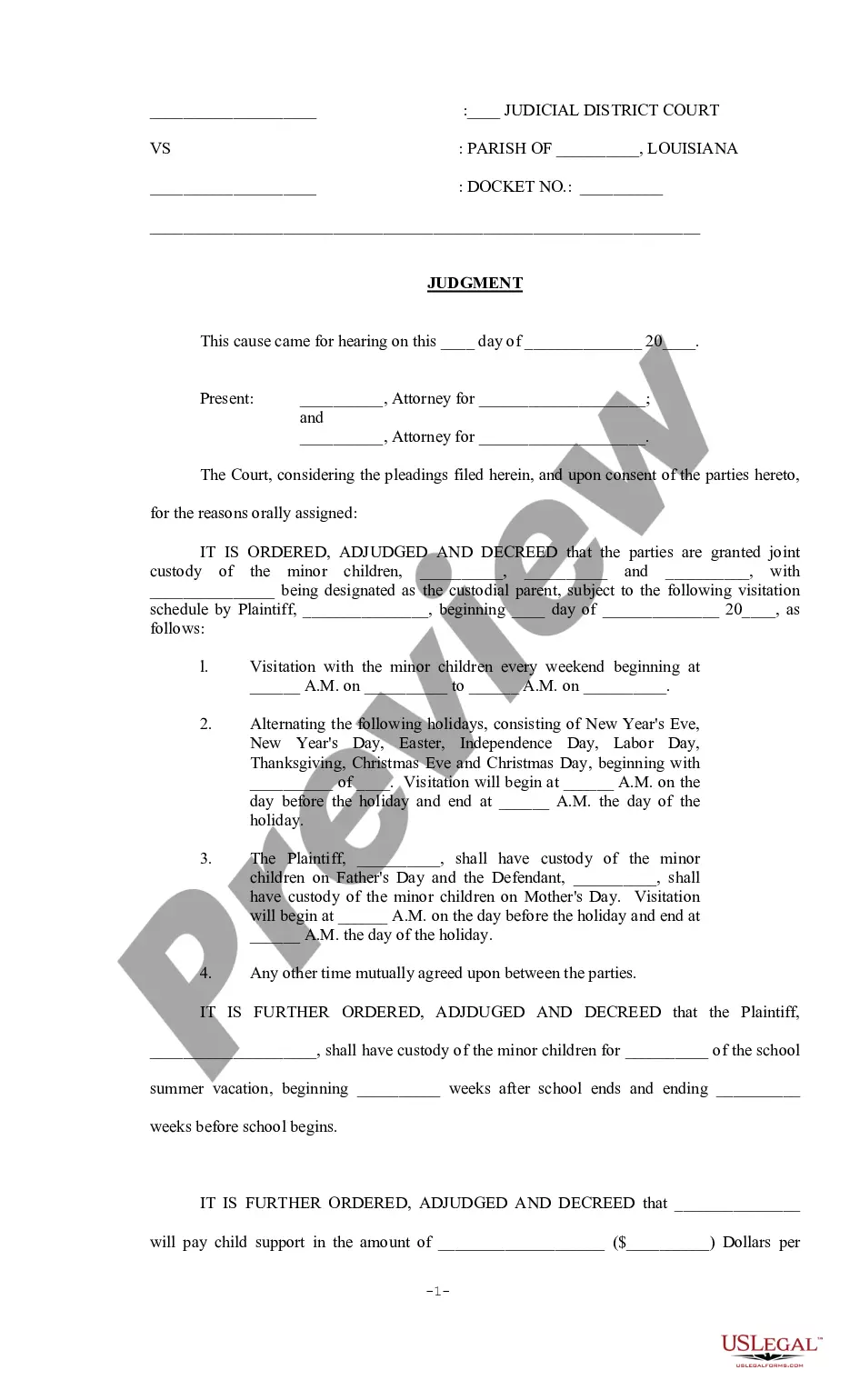
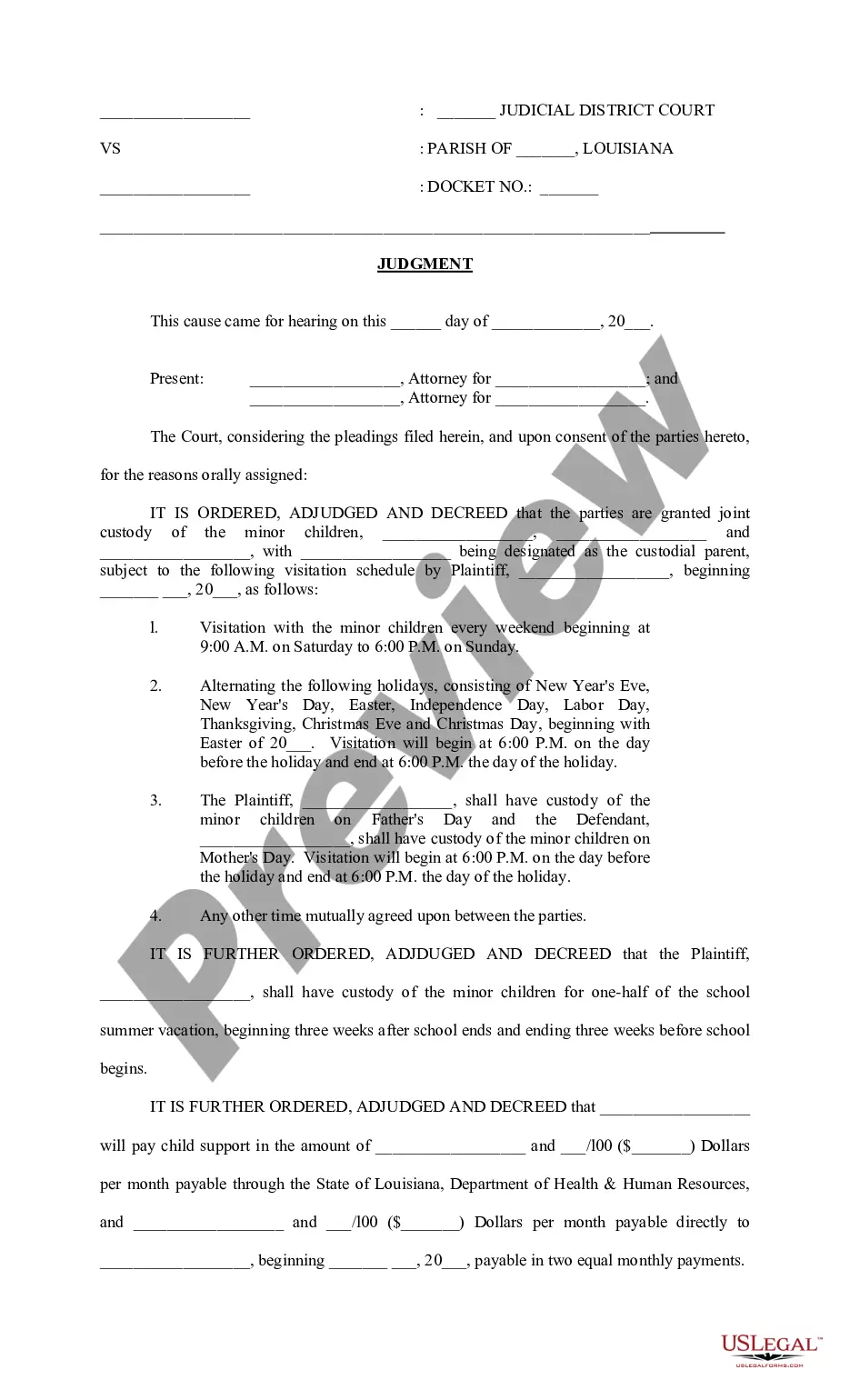
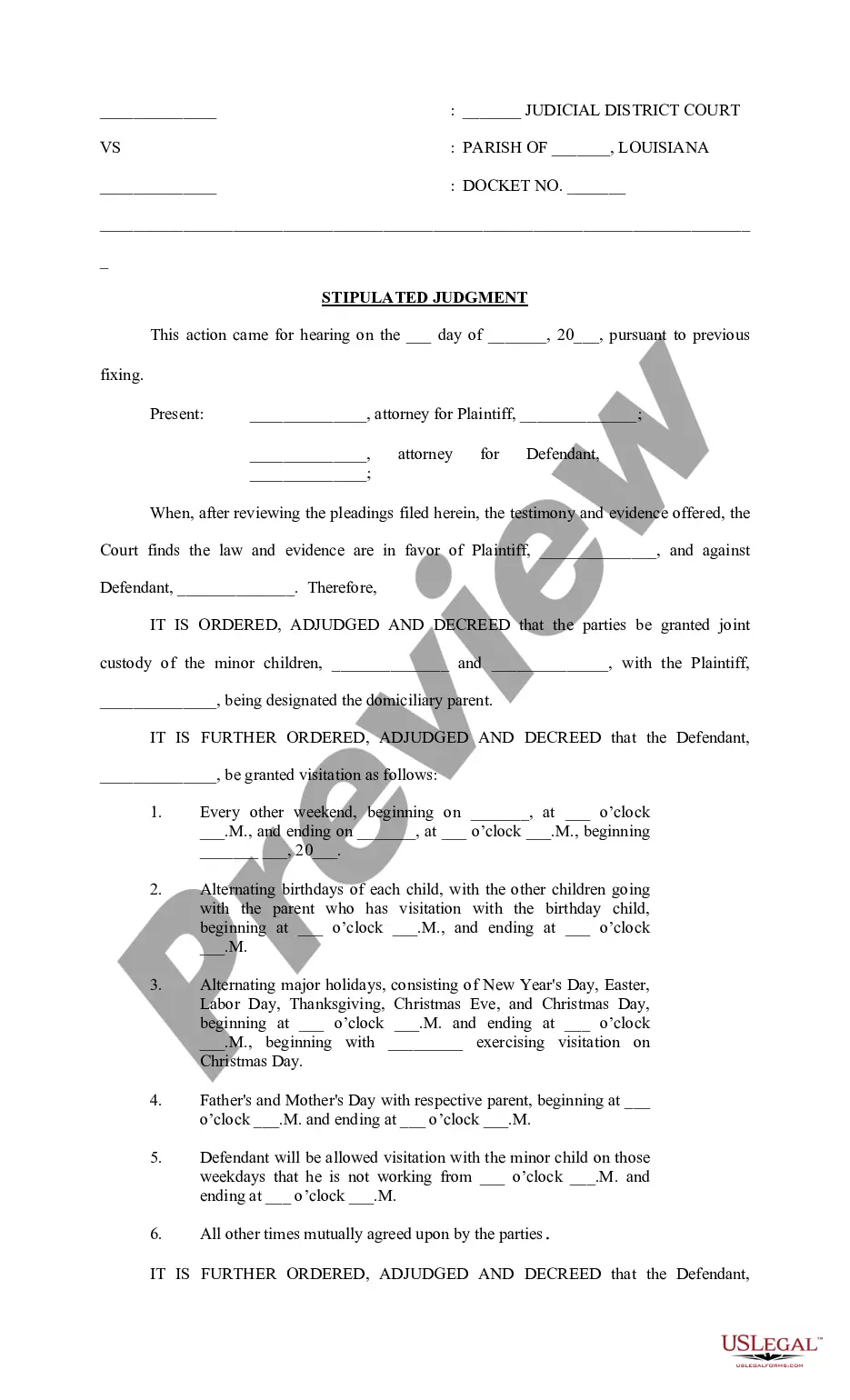
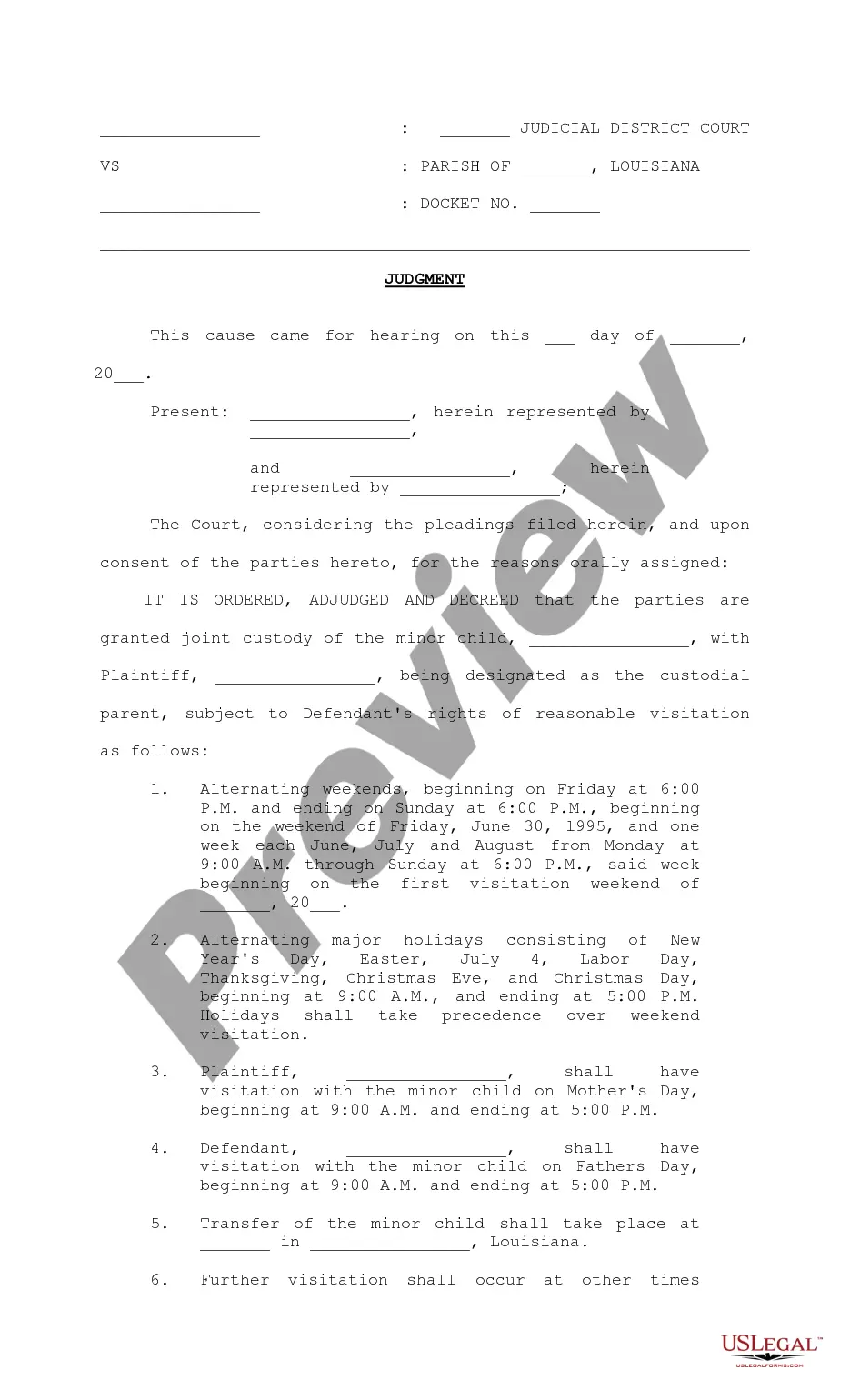
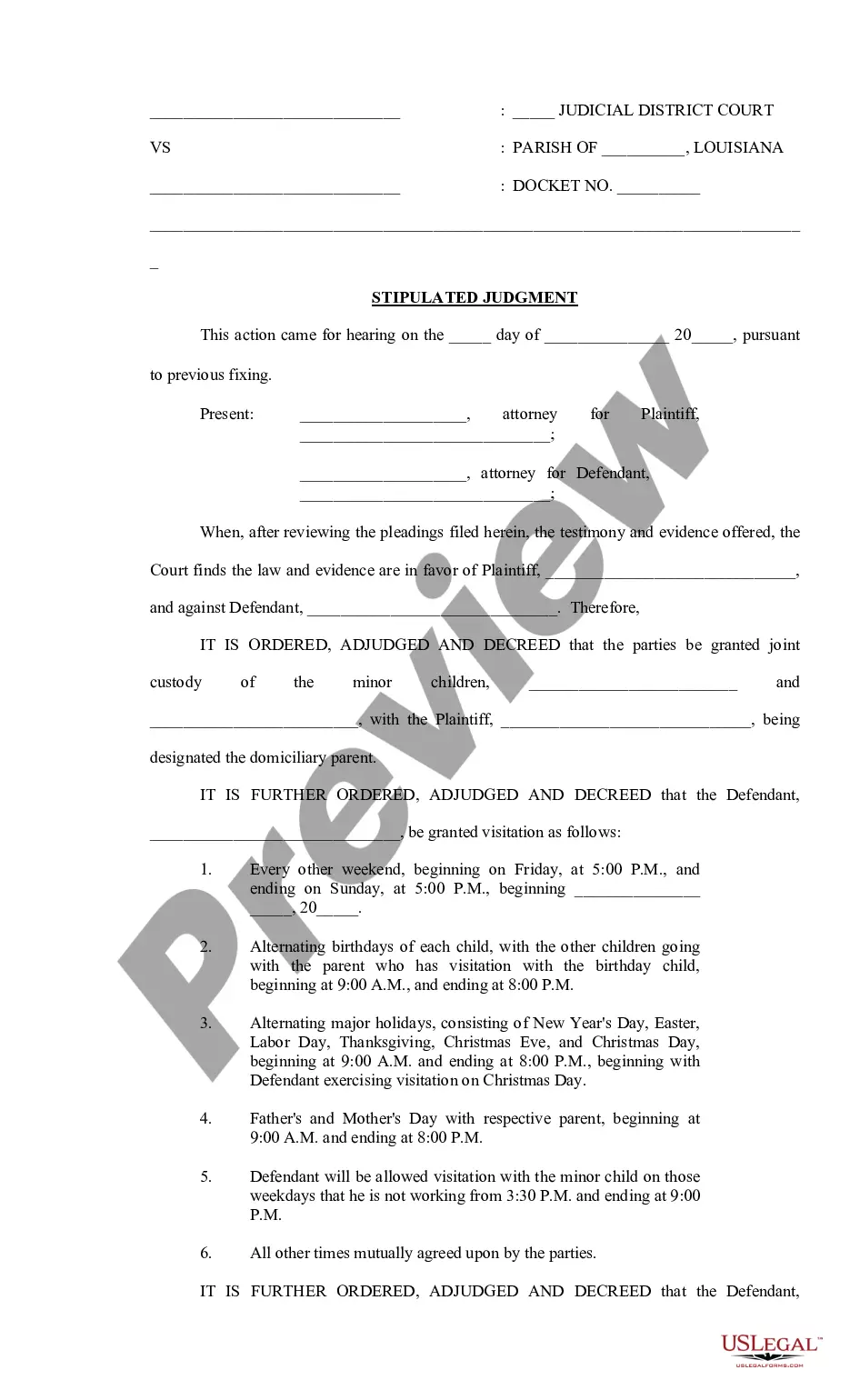
The Judgment on Visitation Schedule, Custody, and Child Support is a legal document that formalizes the terms of custody and support in a child custody case. This form is a consent judgment, meaning it is based on an agreement between the parties involved. It details joint custody arrangements, visitation rights, and financial obligations for child support. Unlike other custody forms, this judgment is enforceable by law, providing clarity and structure for parenting arrangements.
Key parts of this document
- Joint custody award to both parties with designated domiciliary parent.
- Detailed visitation schedule for the non-custodial parent.
- Specific periods of custody during summer vacation for the custodial parent.
- Monthly child support payments specified, including direct payments to the non-custodial parent.
- Distribution of court costs between the parties.

Common use cases
This form should be used in situations where parents have reached an agreement regarding custody and child support terms after an initial custody dispute. It is useful when both parties are willing to cooperate and seek court approval to formalize their parenting plan. Scenarios may include divorces involving children, modifications in existing custody arrangements, or when establishing custody in paternity cases.
Who this form is for
This form is intended for:
- Parents involved in a child custody dispute who have reached a mutual agreement.
- Individuals seeking to establish or modify child custody and support terms.
- Custodial or non-custodial parents looking for clarity in visitation rights and obligations.
Steps to complete this form
Follow these steps to complete the form:
- Identify the parties involved, including names and addresses of both parents.
- Specify the custody arrangement, clearly stating who will be the domiciliary parent.
- Outline the visitation schedule, including dates and times for regular visits and holidays.
- Enter the agreed-upon child support amount and how payments will be made.
- Sign the document in the presence of legal representatives to ensure enforceability.
Does this form need to be notarized?
This form does not typically require notarization unless specified by local law. It is important to verify the requirements within your jurisdiction to ensure compliance.
Get your form ready online
Our built-in tools help you complete, sign, share, and store your documents in one place.
Make edits, fill in missing information, and update formatting in US Legal Forms—just like you would in MS Word.
Download a copy, print it, send it by email, or mail it via USPS—whatever works best for your next step.
Sign and collect signatures with our SignNow integration. Send to multiple recipients, set reminders, and more. Go Premium to unlock E-Sign.
If this form requires notarization, complete it online through a secure video call—no need to meet a notary in person or wait for an appointment.
We protect your documents and personal data by following strict security and privacy standards.

Make edits, fill in missing information, and update formatting in US Legal Forms—just like you would in MS Word.

Download a copy, print it, send it by email, or mail it via USPS—whatever works best for your next step.

Sign and collect signatures with our SignNow integration. Send to multiple recipients, set reminders, and more. Go Premium to unlock E-Sign.

If this form requires notarization, complete it online through a secure video call—no need to meet a notary in person or wait for an appointment.

We protect your documents and personal data by following strict security and privacy standards.
Common mistakes
- Failing to specify clear visitation times, leading to confusion.
- Not including all children in the custody agreement.
- Forgetting to detail how child support will be allocated between state and direct payments.
- Neglecting to have both parties sign the document.
Advantages of online completion
- Convenient online access to a legally vetted form.
- Editable templates allow for customization to individual circumstances.
- Quick download and printing options make the process efficient.
- Provides a clear framework to avoid future disputes.
Legal use & context
- This judgment serves as a legally binding agreement, enforceable in court.
- Parents must comply with all outlined provisions for the judgment to remain valid.
- The document facilitates clarity and reduces the potential for future disputes.
What to keep in mind
- The Judgment on Visitation Schedule, Custody, and Child Support is essential for formalizing custody arrangements.
- Clear specifications regarding visitation and financial responsibilities prevent future conflicts.
- Online availability simplifies the process of obtaining necessary legal forms.
Looking for another form?
Form popularity
FAQ
In cases where parents can't agree, a judge will decide visitation and custody based on the child's best interests.Both parents are bound by the terms of a custody order. If your child refuses to go to visits with the other parent, you could still be on the hook for failing to comply with a custody order.
File a Motion: If the custodial parent is consistently denying you visitation, you can file a motion requesting updated orders from the court.In contempt proceedings, the court may issue sanctions (fines) or require that the violator serve jail time.
When a noncustodial parent is repeatedly denied his or her rights to visit their child, it is important that the parent document each denial.A custodial parent who denies the noncustodial parent his or her visitation rights may be held in contempt of court, and be fined and/or jailed.
If the child is at least 12 years old, courts will usually give the child's preference some weight. Courts don't have to follow a child's custodial preference.
In the case of a 50/50 split, the higher earner usually pays child support to the lower earner to ensure the children's standard of living is the same in both locations.
Child maintenance payments It all depends on the child maintenance rate being paid and the number of shared care nights there are. If the day-to-day care of a child is shared equally between the paying parent and the receiving parent the paying parent will not have to pay any child maintenance for that child.
If one parent does not follow the custody and visitation court order.File an action for contempt with the court. In contempt actions, you ask the court to enforce the order and make a finding that the other parent willfully disobeyed the court order. This is very complicated and can have serious consequences.
Child support is still paid when parents have joint custody in Texas in most situations.Generally, in most joint managing conservatorship cases one parent is named the primary conservator who has the right to determine the primary residence of the child, and the other parent has visitation.
Paying child support obligations alone is not enough of a factor for access or visitation to be given, if it is not deemed to be in the best interests of the child.