Alabama Objection to Document Request
Understanding this form
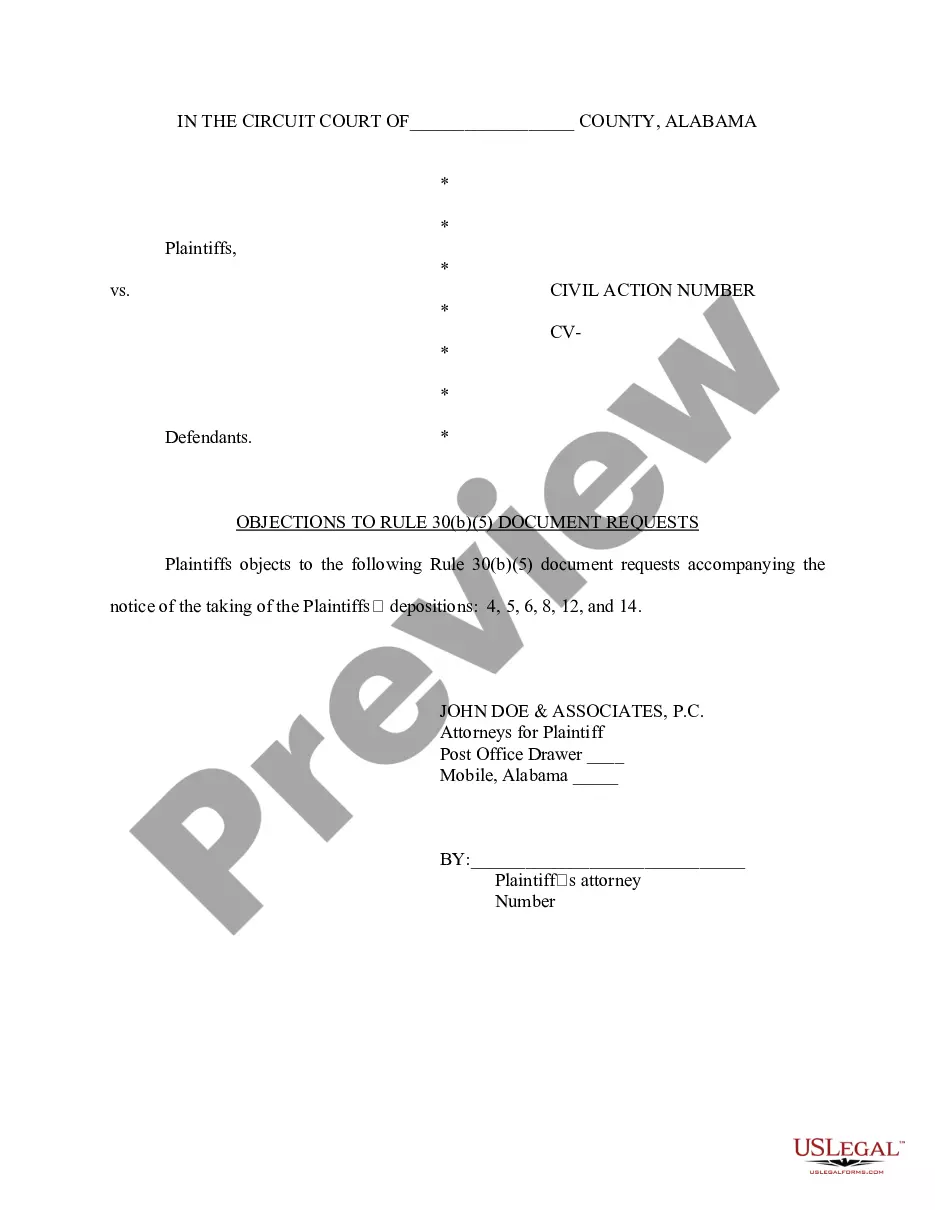
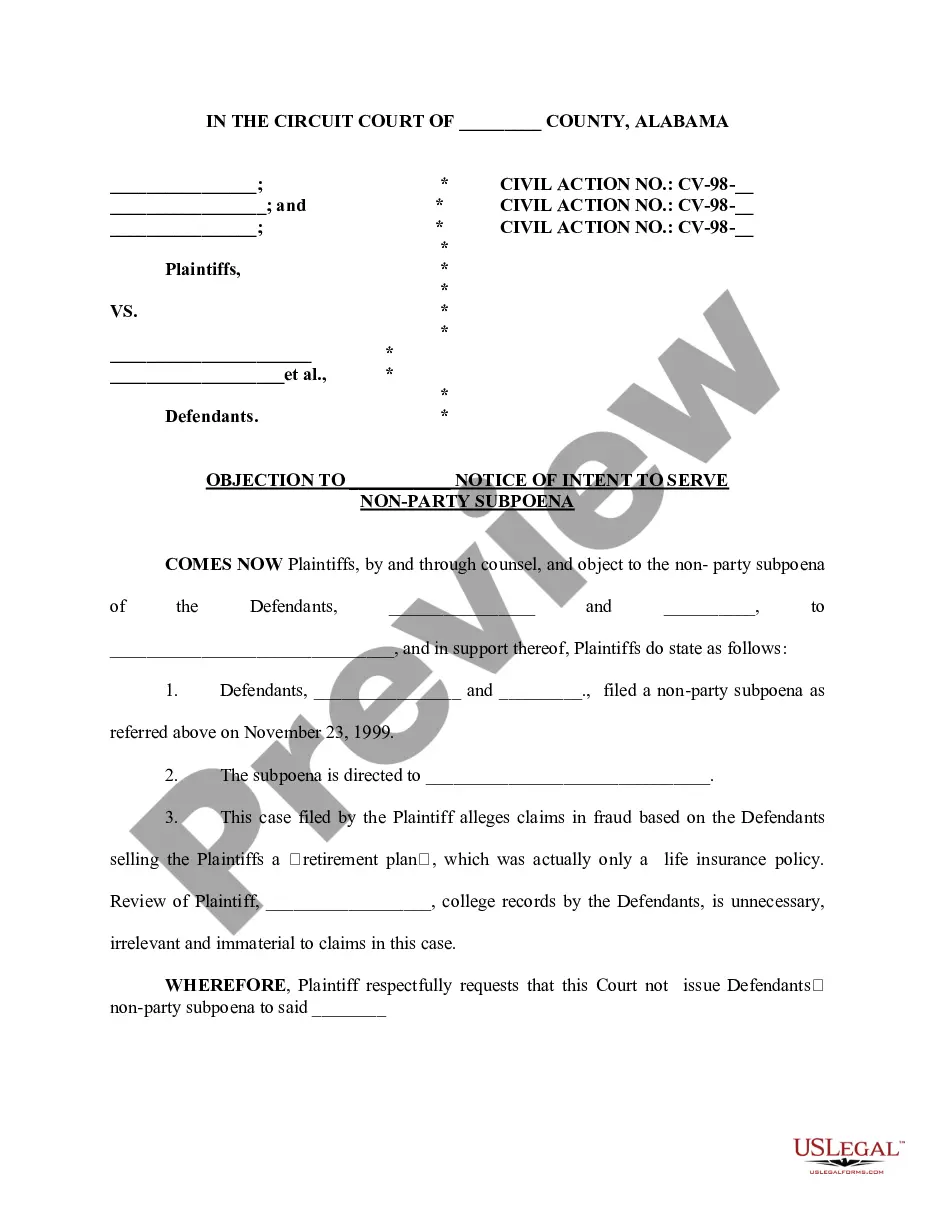
The Objection to Document Request is a legal document used by plaintiffs to formally object to specific document requests made by the opposing party during litigation. This form is crucial for protecting a plaintiff's rights and ensuring that only relevant and proper documents are requested in depositions. It differs from other forms used in discovery by specifically addressing the objections to Rule 30(b)(5) document requests, which pertain to the documents that must be produced during depositions.
Key parts of this document
- Court information, including the case number and parties involved.
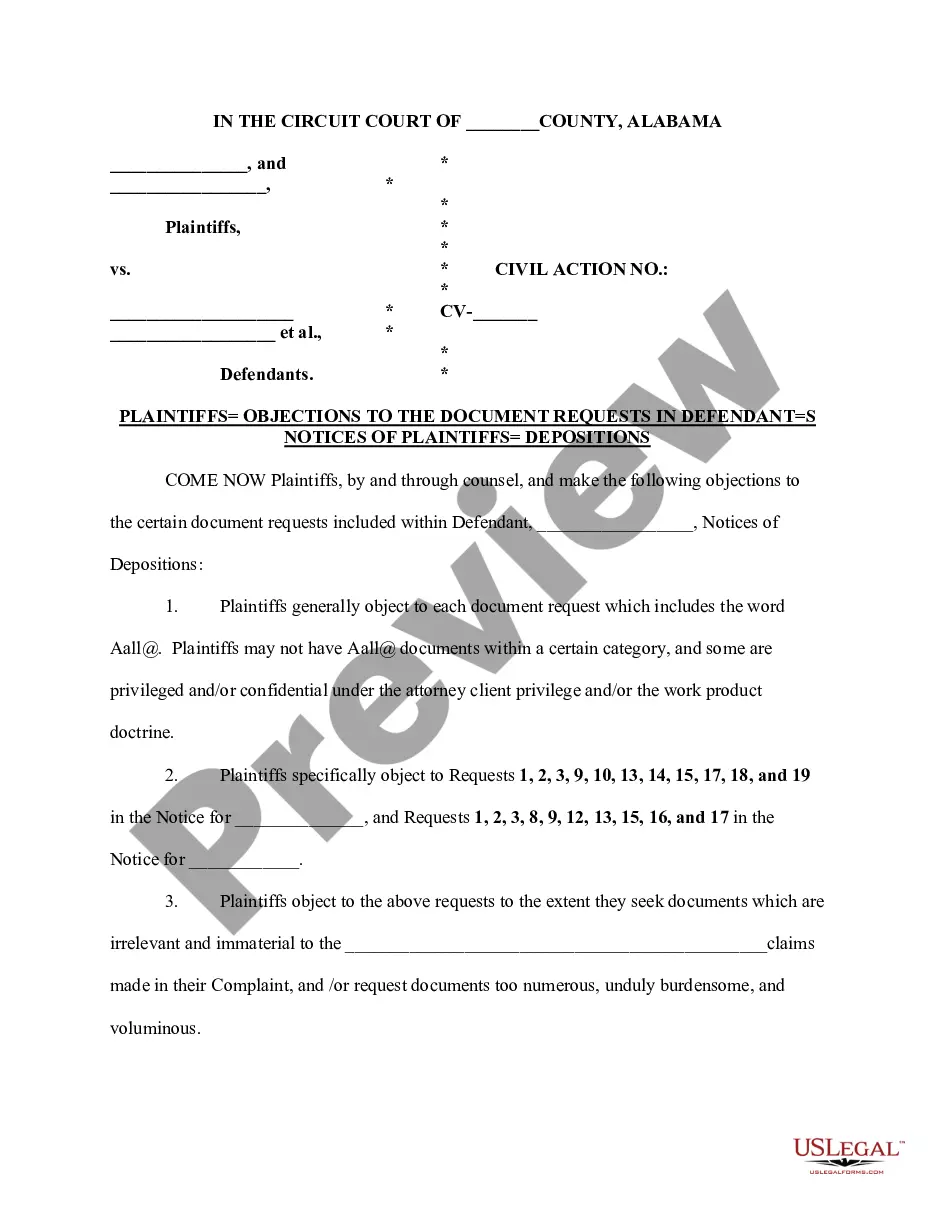
- A list of specific document requests the plaintiff is objecting to.
- A section for the signature of the plaintiff's attorney.
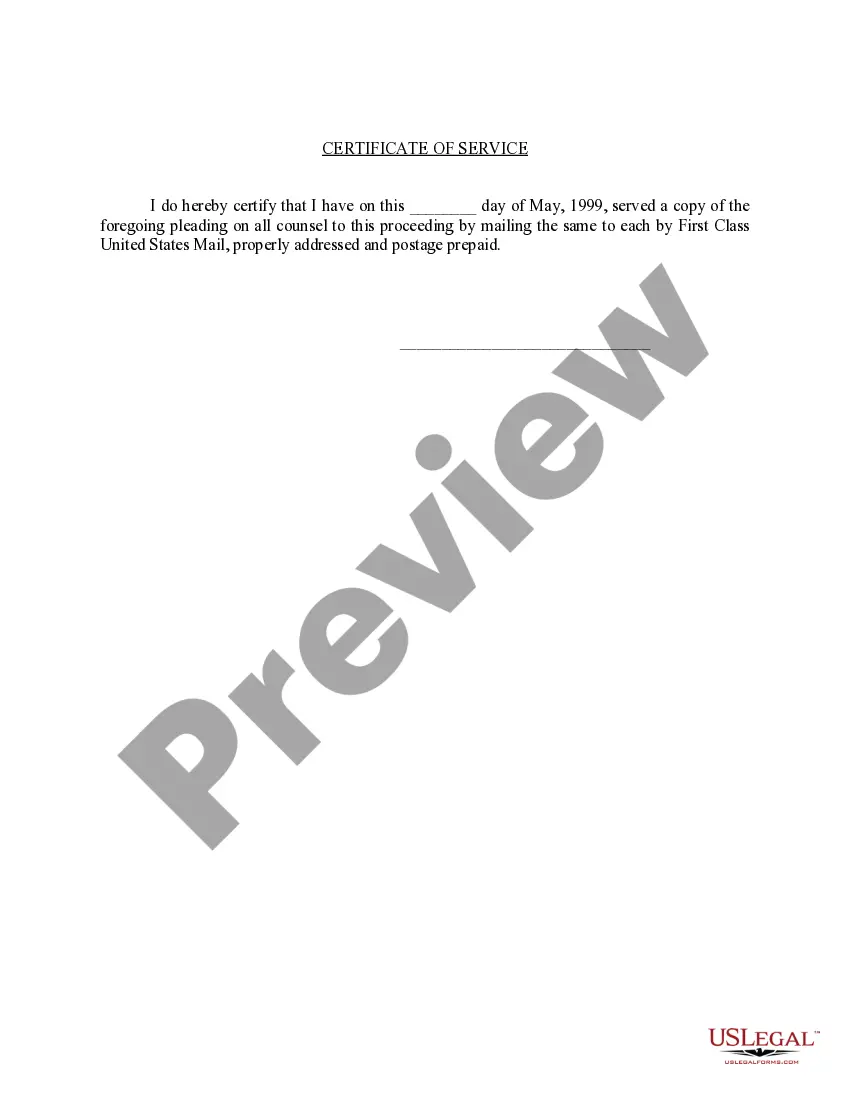
- Certificate of service to confirm that the form has been served to all relevant parties.
Situations where this form applies
This form should be used when a plaintiff believes that certain document requests posed by the defendants are unreasonable, irrelevant, or overly burdensome. For example, if the requests demand production of documents not related to the case or those that are confidential, this form serves to formally submit objections in a legal context.
Who should use this form
- Plaintiffs involved in a civil action in Circuit Court.
- Attorneys representing plaintiffs in litigation.
- Individuals seeking to protect their rights during the discovery phase of a lawsuit.
Completing this form step by step
- Begin by filling in the court name, case number, and the names of the parties involved in the lawsuit.
- List each specific document request you are objecting to, citing the relevant rule number.
- Have the plaintiff's attorney sign the document to validate the objections.
- Fill out the certificate of service section to indicate when and how the document was served to involved parties.
- Review the completed form for accuracy and compliance with local court rules.
Notarization guidance
This form does not typically require notarization to be legally valid. However, some jurisdictions or document types may still require it. US Legal Forms provides secure online notarization powered by Notarize, available 24/7 for added convenience.
Get your form ready online
Our built-in tools help you complete, sign, share, and store your documents in one place.
Make edits, fill in missing information, and update formatting in US Legal Forms—just like you would in MS Word.
Download a copy, print it, send it by email, or mail it via USPS—whatever works best for your next step.
Sign and collect signatures with our SignNow integration. Send to multiple recipients, set reminders, and more. Go Premium to unlock E-Sign.
If this form requires notarization, complete it online through a secure video call—no need to meet a notary in person or wait for an appointment.
We protect your documents and personal data by following strict security and privacy standards.

Make edits, fill in missing information, and update formatting in US Legal Forms—just like you would in MS Word.

Download a copy, print it, send it by email, or mail it via USPS—whatever works best for your next step.

Sign and collect signatures with our SignNow integration. Send to multiple recipients, set reminders, and more. Go Premium to unlock E-Sign.

If this form requires notarization, complete it online through a secure video call—no need to meet a notary in person or wait for an appointment.

We protect your documents and personal data by following strict security and privacy standards.
Common mistakes to avoid
- Failing to specifically identify all the document requests being objected to.
- Not signing the form or having it signed by an authorized representative.
- Neglecting to serve the objections to all parties involved in the case.
Benefits of using this form online
- Convenience of filling out the form from anywhere with easy access to legal templates.
- Editable format allows users to customize the document as needed.
- Provides reliable and professionally drafted content tailored to legal requirements.
Quick recap
- The Objection to Document Request is vital for plaintiffs to protect their rights during litigation.
- Ensure all objections are clearly outlined and served to the appropriate parties.
- Familiarize yourself with local court rules regarding document requests and objections.
Looking for another form?
Form popularity
FAQ
To request documents from opposing counsel in Alabama, you should draft a formal request for production of documents. Make sure to specify the documents you seek with detail, ensuring they are relevant to your case. Always send your request in writing and allow sufficient time for a response, typically within 30 days. For assistance, consider using USLegalForms, which provides templates and guidance for effective document requests.
To object to an interrogatory in Alabama, you must provide a written response within the specified time frame. Clearly state your objection, citing the reason why the interrogatory is improper, such as being overly broad or irrelevant. It is important to be concise and precise to strengthen your position. Utilizing resources like USLegalForms can guide you through the objection process and ensure your rights are protected.
Common objections to Requests for Admission (RFAs) include ambiguity, irrelevance, and the assertion of privilege. Each of these objections is critical in protecting your interests during legal proceedings. Understanding these common objections helps you respond effectively, and leveraging uslegalforms can empower you to construct well-founded objections in the context of Alabama objection to document request.
An effective response to a request for production of documents could state, 'We object to the request on the grounds of relevance and privilege, and we will produce all responsive documents that are not protected.' This response should clearly outline your position while also demonstrating a willingness to cooperate. Using a legal platform like uslegalforms can assist in drafting precise responses and ensuring compliance with Alabama rules.
Evidence objections to documents arise when the relevance or admissibility of documents is questioned. In the context of Alabama objection to document request, you may argue that certain documents contain irrelevant information or should remain confidential. By highlighting these evidence objections, you help maintain the integrity of the information shared in the legal process.
When you encounter a request for production of documents, several objections may be appropriate. Common Alabama objections to document request include relevance, privilege, and overbroad requests. By identifying these objections, you can protect your rights and ensure that only necessary documents are disclosed.
To properly address a request for production of documents, start by reviewing the request thoroughly. Ensure you understand what documents are being asked for and determine if any Alabama objections to document request apply. You should gather the requested documents or present valid reasons for not producing them. Be clear and concise in your response to avoid misunderstandings.
Examples of objections to a request for production of documents include claiming the request is overly burdensome, seeks irrelevant documents, or invades the privacy of individuals. Other objections may relate to the confidentiality of trade secrets or protected attorney-client communications. Effectively communicating these objections can greatly enhance your legal strategy using the Alabama Objection to Document Request.
An argumentative objection occurs when a party argues that the interrogatory questions are leading or require the responding party to make legal conclusions. This type of objection is often aimed at preserving the integrity of the legal process and preventing misuse of answers. Utilizing strategic objections is an essential aspect of the Alabama Objection to Document Request.
The basis for objecting to interrogatories includes arguing that the questions are overly broad, seek irrelevant information, or intrude on protected communications. Such objections serve to streamline the discovery process and focus on material facts. Knowing these grounds strengthens your position in the context of the Alabama Objection to Document Request.