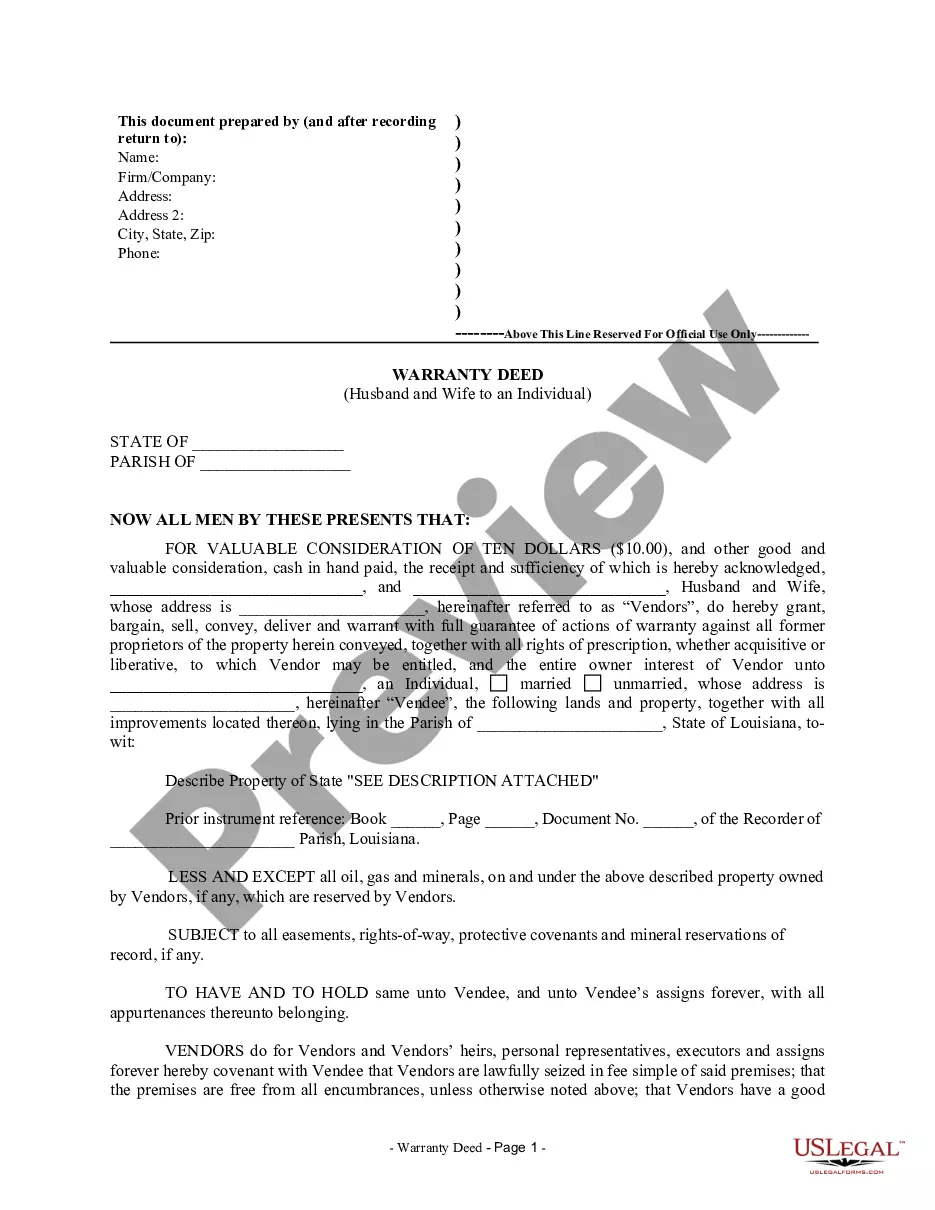
Louisiana Warranty Deed from Individual to Individual
Understanding this form
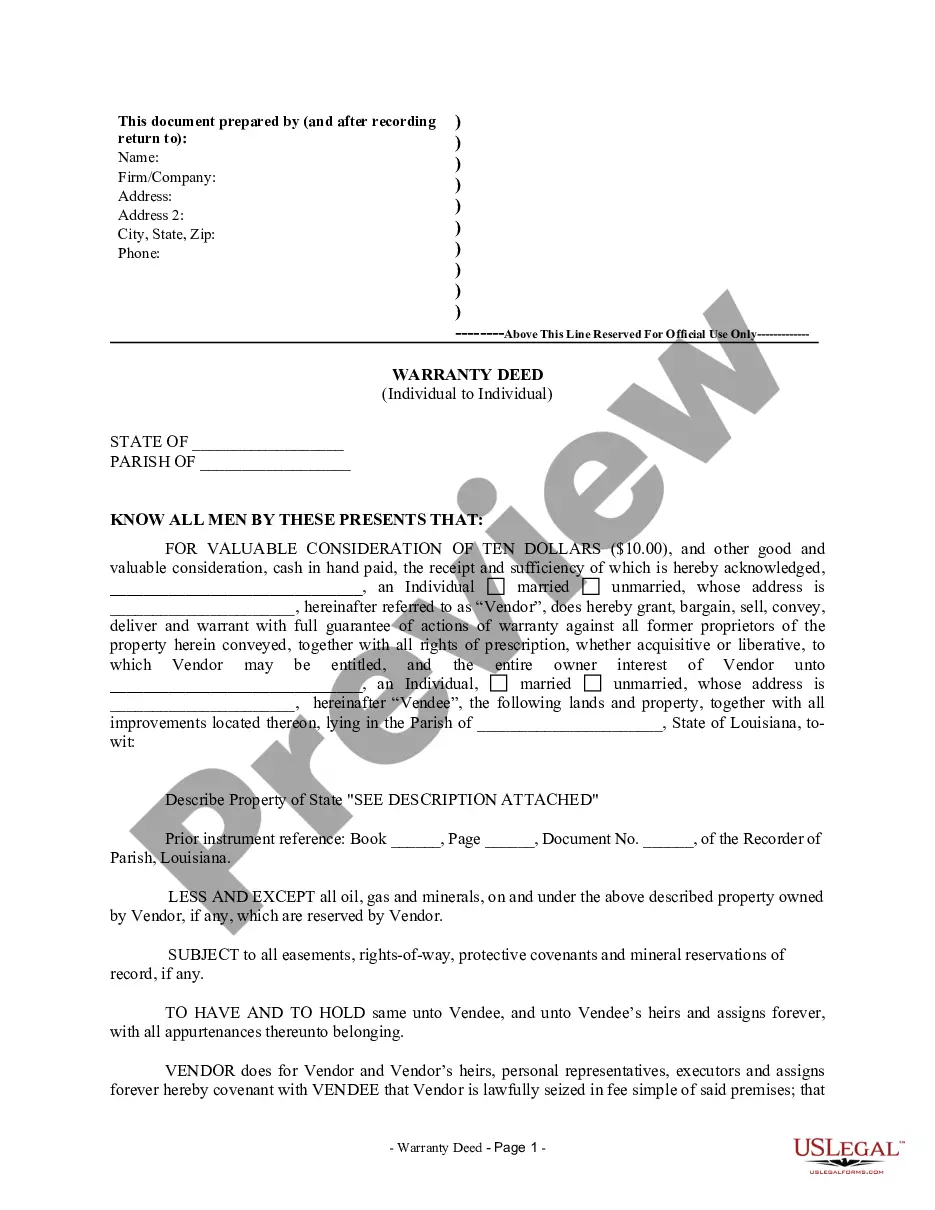
This Warranty Deed from Individual to Individual is a legal document that formally transfers ownership of real property from one individual (the Grantor) to another (the Grantee). Unlike other deeds, this warranty deed guarantees that the property is free from any encumbrances, unless specified, ensuring the buyer has clear title. This form is essential for personal sales or transfers of real estate between individuals, providing necessary legal protections for both parties involved in the transaction.
Key parts of this document
- Identification of the Grantor and Grantee, including marital status and addresses.
- Consideration amount, signifying the payment made for the property transfer.
- A detailed description of the property being transferred.
- A reservation clause excluding oil, gas, and mineral rights retained by the Grantor.
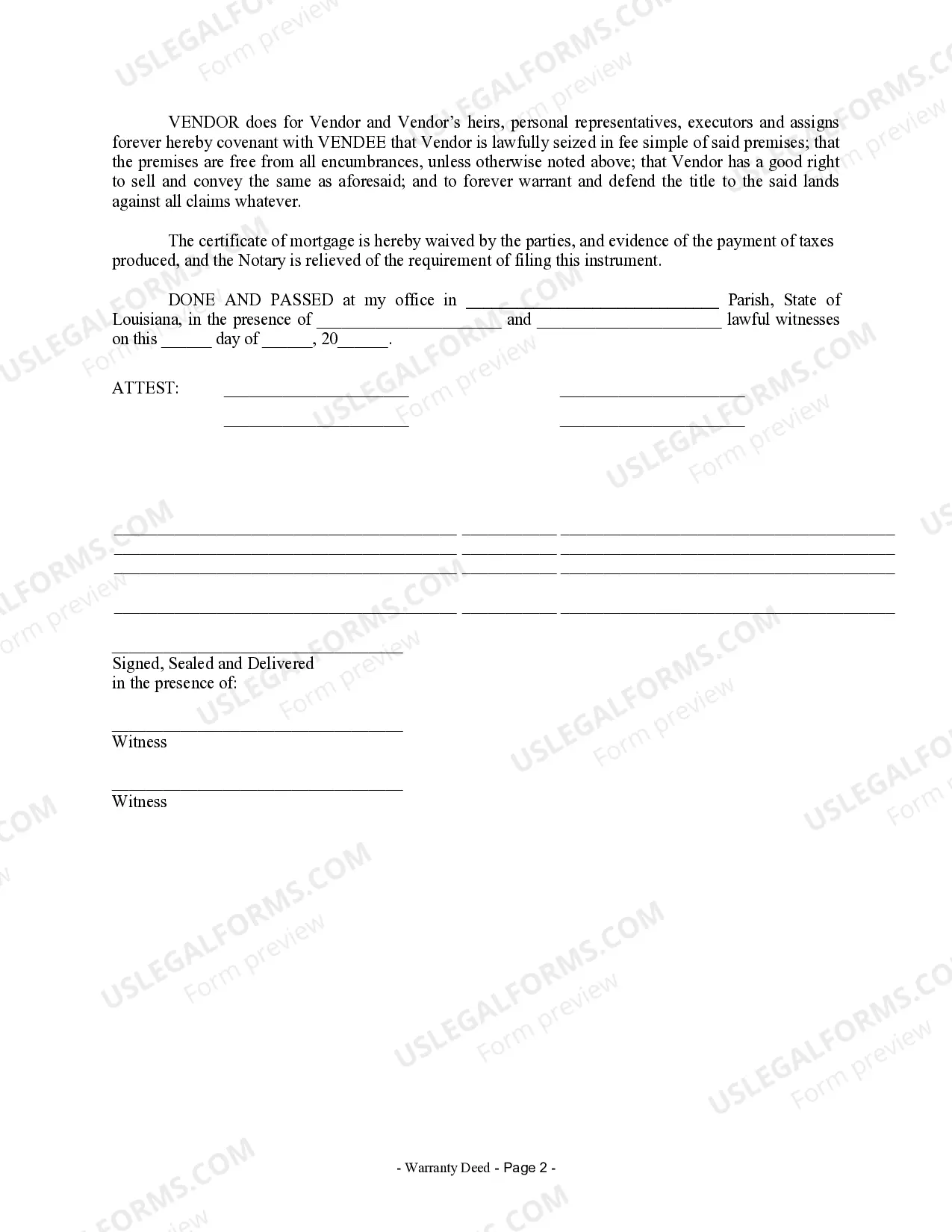
- Covenants that guarantee the Grantor holds clear title to the property.
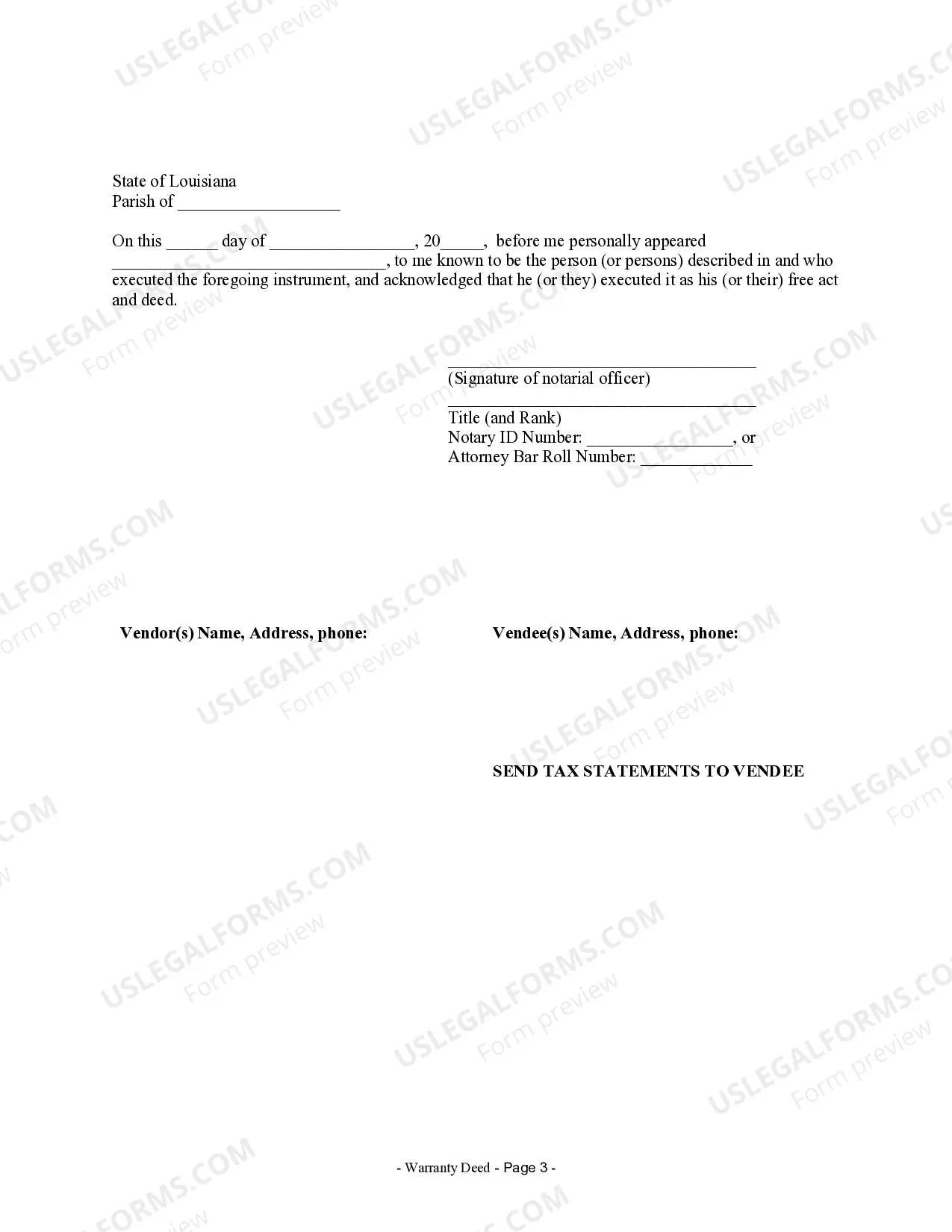
- Signatures of the Grantor and witnesses, followed by notarization details.




Situations where this form applies
This Warranty Deed should be used when an individual wishes to transfer property ownership to another individual. Common scenarios include selling a residential property, gifting property to a family member, or transferring property ownership due to a divorce settlement. It ensures that both parties are legally protected and that the Grantee receives clear title without hidden claims or issues.
Intended users of this form
- Individuals seeking to sell or gift real estate to another individual.
- Property owners wanting to ensure a clear transfer of property title.
- Individuals involved in familial property transfers or business transactions.
Steps to complete this form
- Identify the Grantor and Grantee, including their marital status and addresses.
- Specify the consideration amount for the property transfer.
- Provide a detailed description of the property being conveyed.
- Include any reservations of rights, such as oil and mineral rights.
- Ensure the form is signed by the Grantor and at least two witnesses.
- Complete the notarization section to validate the deed.
Notarization requirements for this form
Notarization is required for this form to take effect. Our online notarization service, powered by Notarize, lets you verify and sign documents remotely through an encrypted video session, available 24/7.
Get your form ready online
Our built-in tools help you complete, sign, share, and store your documents in one place.
Make edits, fill in missing information, and update formatting in US Legal Forms—just like you would in MS Word.
Download a copy, print it, send it by email, or mail it via USPS—whatever works best for your next step.
Sign and collect signatures with our SignNow integration. Send to multiple recipients, set reminders, and more. Go Premium to unlock E-Sign.
If this form requires notarization, complete it online through a secure video call—no need to meet a notary in person or wait for an appointment.
We protect your documents and personal data by following strict security and privacy standards.

Make edits, fill in missing information, and update formatting in US Legal Forms—just like you would in MS Word.

Download a copy, print it, send it by email, or mail it via USPS—whatever works best for your next step.

Sign and collect signatures with our SignNow integration. Send to multiple recipients, set reminders, and more. Go Premium to unlock E-Sign.

If this form requires notarization, complete it online through a secure video call—no need to meet a notary in person or wait for an appointment.

We protect your documents and personal data by following strict security and privacy standards.
Common mistakes
- Failing to include a clear and complete property description.
- Not identifying the marital status of the Grantor and Grantee.
- Neglecting to sign the deed in the presence of witnesses.
- Forgetting to include notarization, which can invalidate the deed.
Why complete this form online
- Convenience of digital access from anywhere without the need for in-person visits.
- Editable templates allow customization based on individual circumstances.
- Forms drafted by licensed attorneys ensure compliance with legal standards.
- Quick delivery via download, saving time compared to traditional methods.
Quick recap
- The Warranty Deed from Individual to Individual provides a legal guarantee of property transfer between individuals.
- Proper completion of the form requires attention to detail, including notarization.
- This form is compliant with Louisiana laws and can be utilized for various personal property transfer scenarios.
Looking for another form?
Form popularity
FAQ
It will not protect against title issues that arose prior to the time the seller took occupancy. Consequently, it offers less protection to buyers, and more protection to sellers, than a general warranty deed, which is the most common option for selling or buying a property.
Let's start with the definition of a deed: DEED: A written instrument by which one party, the Grantor, conveys the title of ownership in property to another party, the Grantee. A Warranty Deed contains promises, called covenants, that the Grantor makes to the Grantee.
Special warranties allow the transfer of property title between seller and buyer. The purchase of title insurance can mitigate the risk of prior claims to the special warranty deed.
A personal representative deed and warranty deed are the same only in that they both convey ownership of land. The types of title assurance that the different deeds provide to the new owner are very different.
A special warranty deed to real estate offers protection to the buyer through the seller's guarantee that the title has been free and clear of encumbrances during their ownership of the property. It does not guarantee clear title beyond their ownership.
Typically, the lender will provide you with a copy of the deed of trust after the closing. The original warranty deeds are often mailed to the grantee after they are recorded. These are your original copies and should be kept in a safe place, such as a fireproof lockbox or a safe deposit box at a financial institution.
Used to transfer property rights from a deceased person's estate. Involves Probate Court. Like a Quit Claim deed, there are no warranties. Generally, the Personal Representative is unwilling to warrant or promise anything relating to property that he/she has never personally owned.
A warranty deed guarantees that: The grantor is the rightful owner of the property and has the legal right to transfer the title.The title would withstand third-party claims to ownership of the property. The grantor will do anything to ensure the grantee's title to the property.