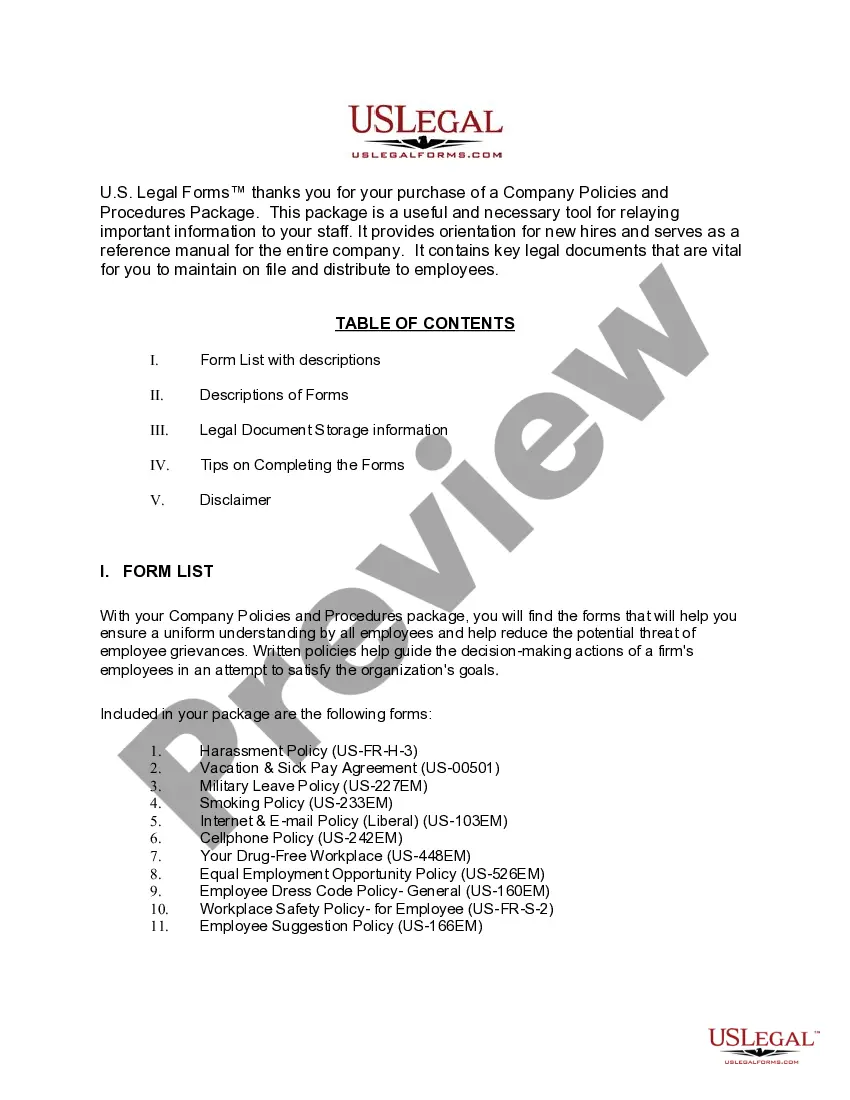
1. Harassment Policy
2. Vacation & Sick Pay Agreement
3. Military Leave Policy
4. Smoking Policy
5. Internet & E-mail Policy (Liberal)
6. Cellphone Policy
7. Your Drug-Free Workplace
8. Equal Employment Opportunity Policy
9. Employee Dress Code Policy- General
10. Workplace Safety Policy- for Employee
11. Employee Suggestion Policy
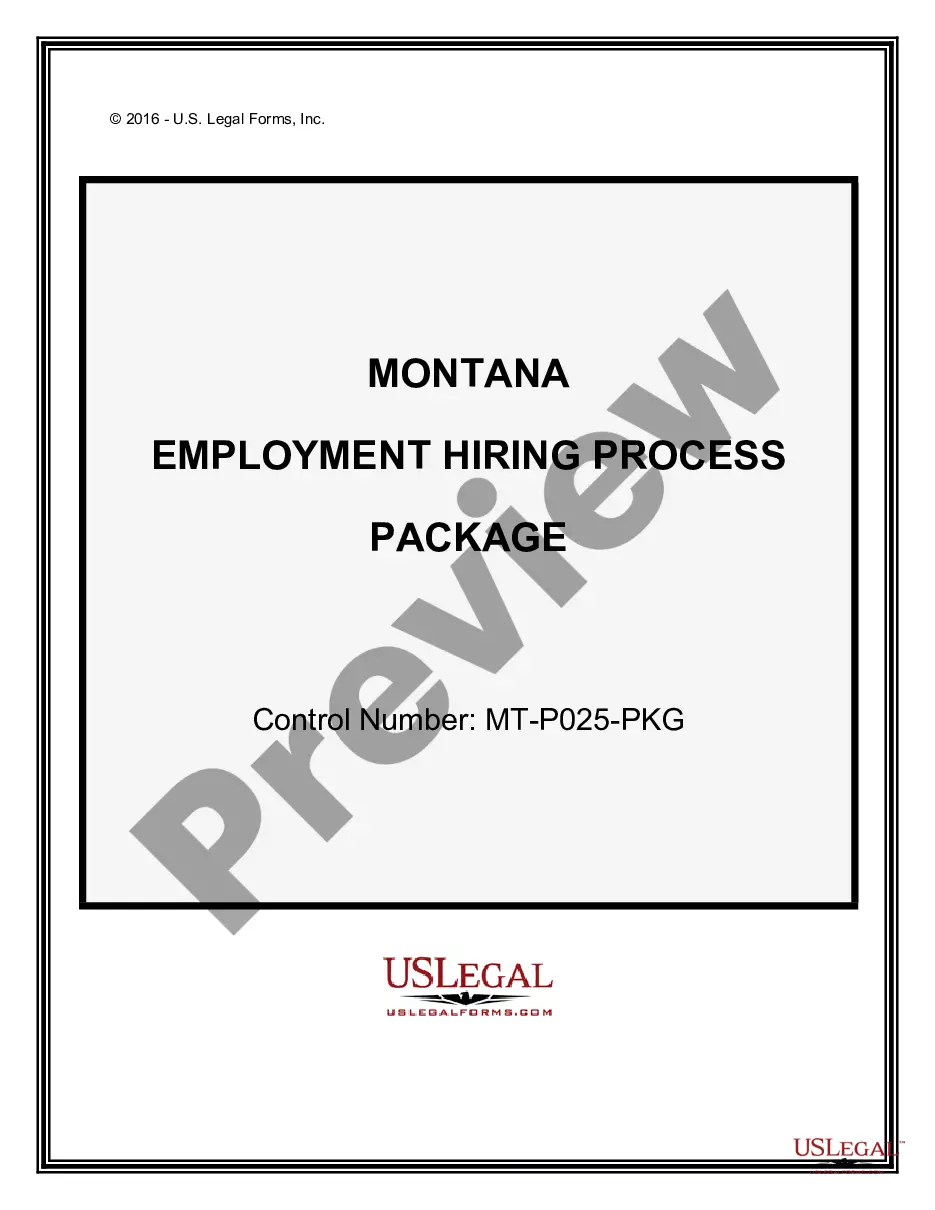
Montana Company Employment Policies and Procedures Package
Category:
State:
Montana
Control #:
MT-P008-PKG
Format:
Word;
Rich Text;
PDF
Instant download
Description
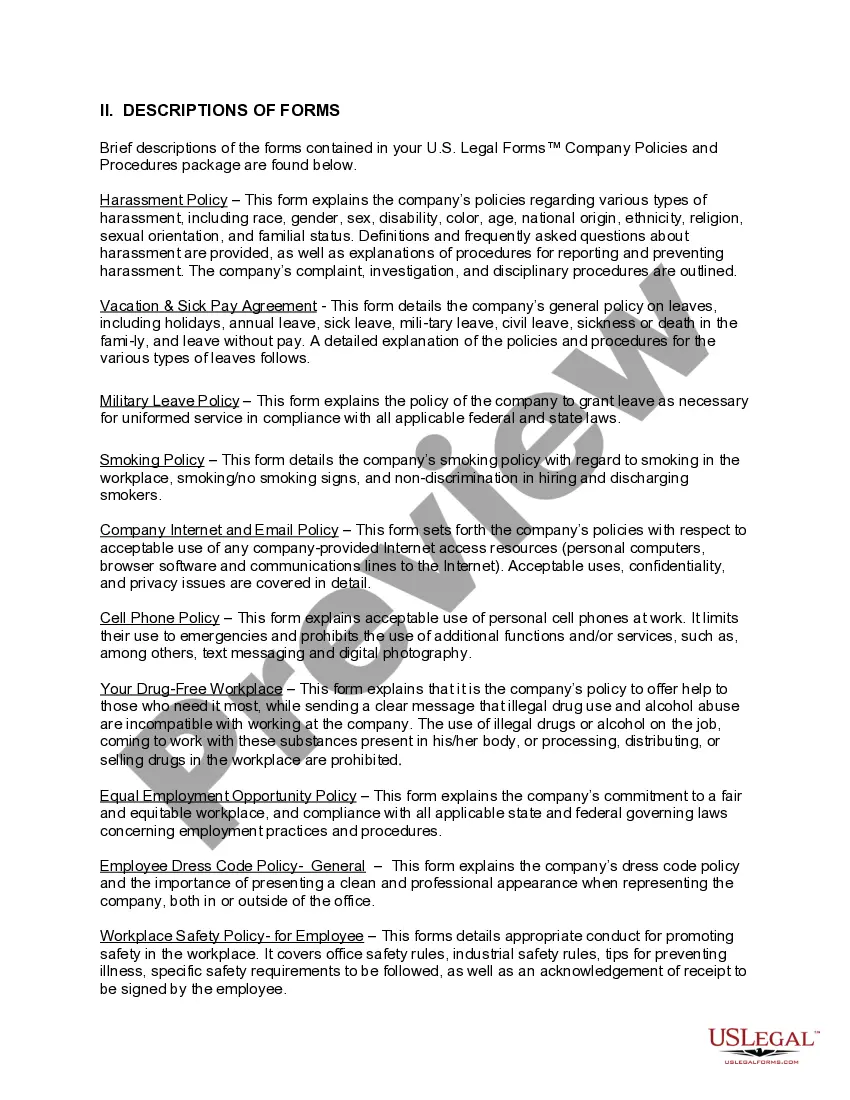
This package contains essential policy and procedures forms to help your company ensure a uniform understanding by all employees and help reduce the potential threat of employee grievances. It provides orientation for new hires and serves as a reference manual for the entire company. The documents in this package include the following:
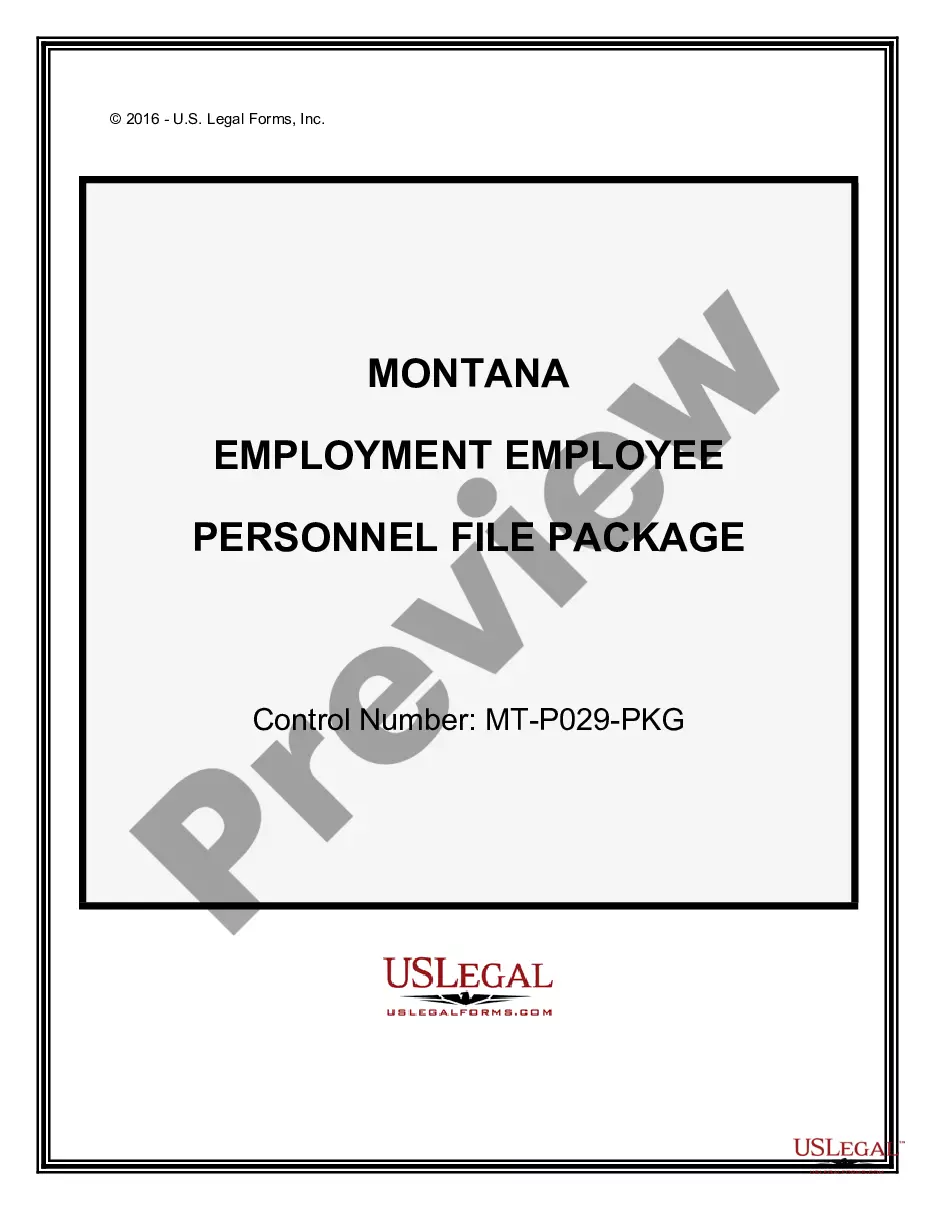
Free preview





How to fill out Montana Company Employment Policies And Procedures Package?
Avoid expensive attorneys and find the Montana Company Employment Policies and Procedures Package you want at a affordable price on the US Legal Forms site. Use our simple categories function to search for and obtain legal and tax documents. Go through their descriptions and preview them prior to downloading. Additionally, US Legal Forms provides users with step-by-step tips on how to download and complete each template.
US Legal Forms clients basically have to log in and get the specific document they need to their My Forms tab. Those, who have not obtained a subscription yet need to stick to the tips listed below:
- Make sure the Montana Company Employment Policies and Procedures Package is eligible for use where you live.
- If available, look through the description and make use of the Preview option well before downloading the templates.
- If you are confident the document fits your needs, click on Buy Now.
- If the template is incorrect, use the search engine to find the right one.
- Next, create your account and select a subscription plan.
- Pay out by card or PayPal.
- Select obtain the document in PDF or DOCX.
- Click Download and find your form in the My Forms tab. Feel free to save the form to the gadget or print it out.
Right after downloading, you are able to complete the Montana Company Employment Policies and Procedures Package manually or by using an editing software. Print it out and reuse the template many times. Do more for less with US Legal Forms!
Form popularity
FAQ
Alabama. Florida. Georgia. Louisiana. Maine. Nebraska. New York. Rhode Island.
24 statesAlaska, Arizona, California, Colorado, Illinois, Indiana, Kentucky, Louisiana, Maine, Maryland, Massachusetts, Minnesota, Nebraska, New Hampshire, New York, North Carolina, North Dakota, Ohio, Oklahoma, Pennsylvania, Rhode Island (after one year of employment), Tennessee, West Virginia, and Wyomingand the
In Montana, employers are not required to provide employees with vacation benefits, either paid or unpaid.If an employer chooses to provide such benefits, it must comply with the terms of its employment contract or established policy.
Yes, you can sue your employer if they wrongfully fired you. But you need to know if your employer actually broke the law, and you need to determine how strong your case is. All too often, people want to sue for being fired when the company had a legitimate reason to fire them. Not every firing is illegal.
In Montana it is unlawful for an employer to fire you in certain circumstances, such as:Good cause means a job related reason such as failure to do your job, disrupting the employer's business, or some other legitimate business reason. Your employer violated its own written personnel policy when it fired you.
To be wrongfully terminated is to be fired for an illegal reason, which may involve violation of federal anti-discrimination laws or a contractual breach.For instance, an employee cannot be fired on the basis of her race, gender, ethnic background, religion, or disability.
California does not require employers to have a handbook.
Q: Is my employer required to give me a reason for firing me? A: Federal law does not require employers to give an employee a reason for his or her termination. However, some states have laws that require employers to provide the reason for termination upon request. This is called a service letter law.
Short answer: Full-time employment is usually considered between 30-40 hours a week, while part-time employment is usually less than 30 hours a week.