Kansas Power of Attorney for Sale of Motor Vehicle
About this form
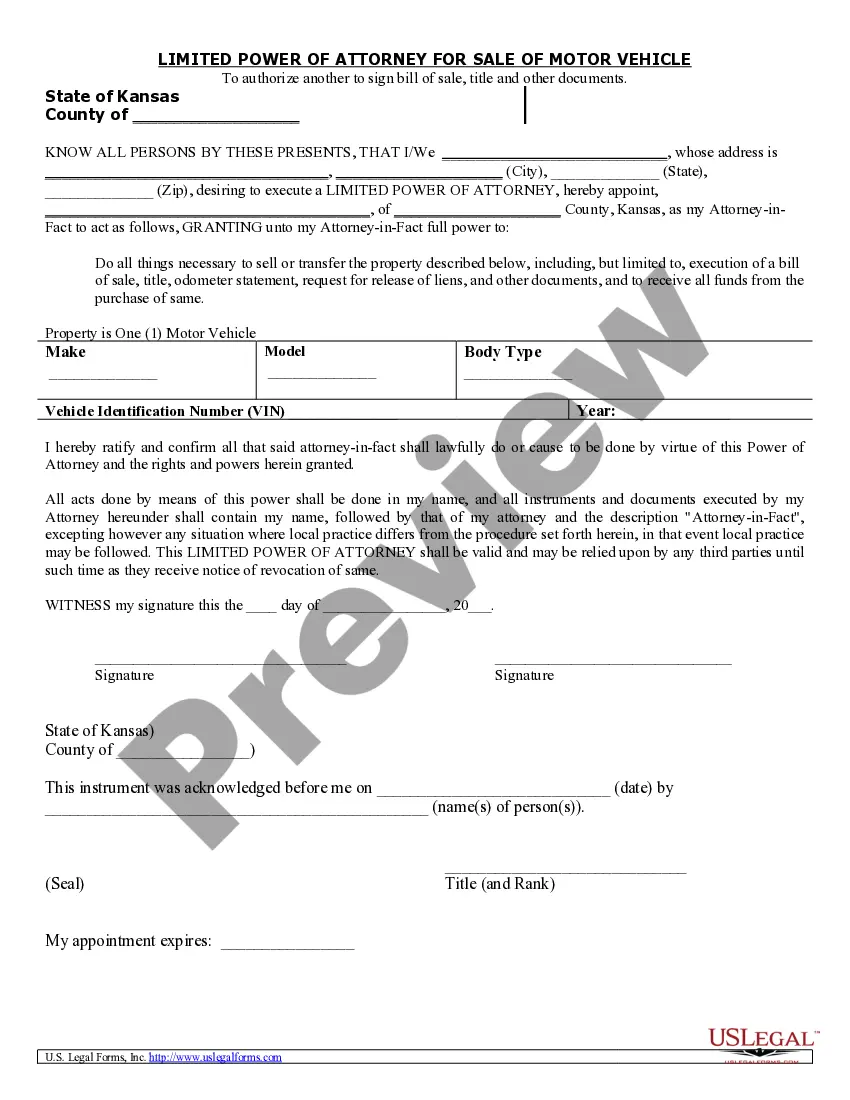
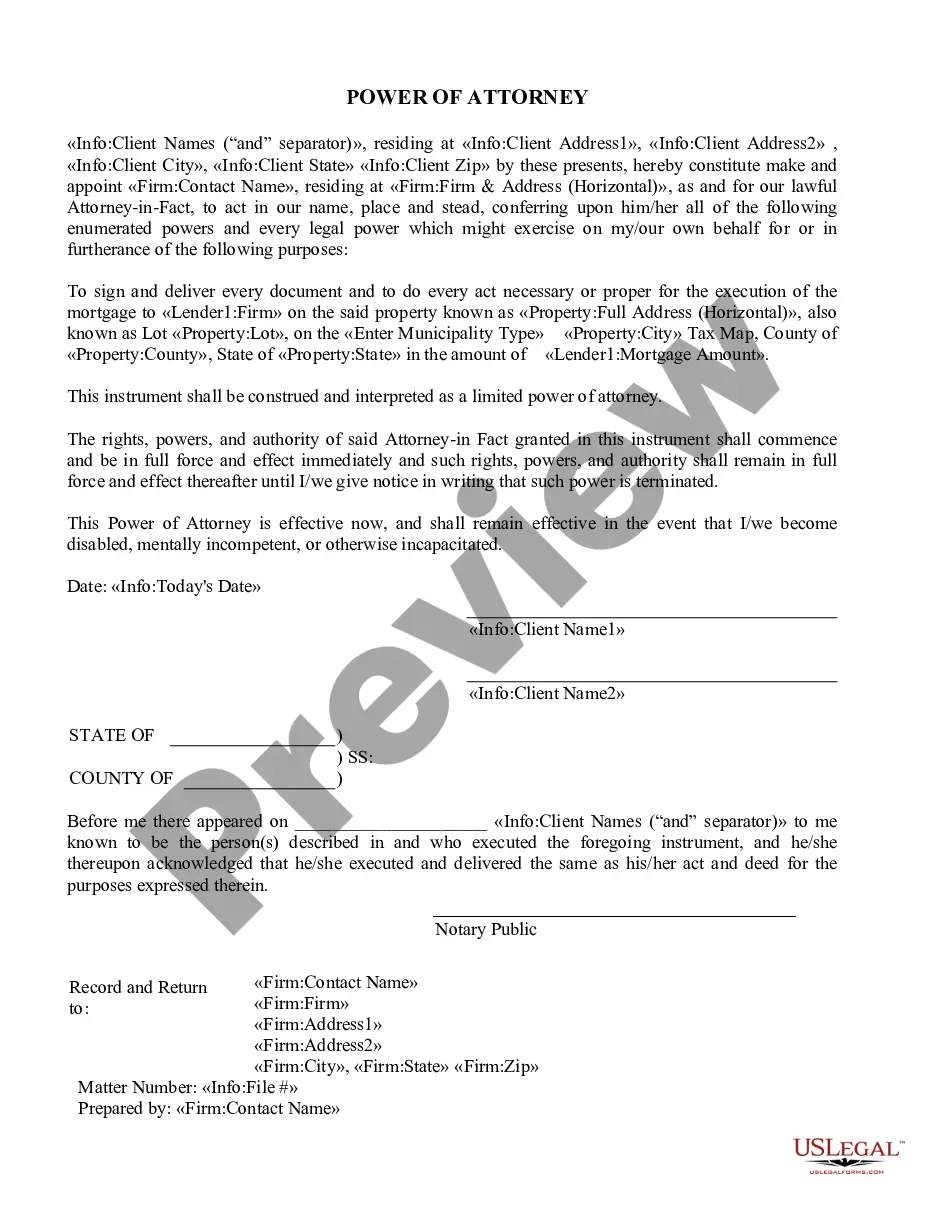
The Power of Attorney for Sale of Motor Vehicle is a legal document that allows you to appoint an agent to manage the sale of your vehicle on your behalf. Unlike a general power of attorney, this form is specifically limited to the selling and transferring of a motor vehicle, ensuring that your agent can execute necessary documents like the bill of sale and title. This form simplifies the process of transferring ownership and protects your interests in the transaction.
Key components of this form
- Identification of the principal who grants the power of attorney.
- Details of the chosen agent or attorney-in-fact who will act on behalf of the principal.
- Specific information about the motor vehicle, including make, model, year, VIN, and body type.
- Authority granted to the agent to execute required documents, including odometer statements and lien release requests.
- A ratification clause confirming the actions of the attorney-in-fact.
When this form is needed
This form is used when a vehicle owner wishes to appoint someone else to sell their motor vehicle. It is particularly useful when the owner cannot be present to complete the transaction in person due to relocation, illness, or scheduling conflicts. The form can also be beneficial for individuals assisting aging parents or family members who may need help with their vehicle sales.
Who this form is for
- Anyone who needs to sell their motor vehicle but cannot be present for the transaction.
- Individuals looking to assist relatives or friends in selling their vehicle.
- Persons who want to legally delegate the authority to manage a vehicle sale.
- Vehicle owners who prefer to ensure the proper documentation is completed by a trusted agent.
Completing this form step by step
- Identify yourself as the principal by filling in your name and address at the top of the form.
- Choose the agent who will act on your behalf and provide their name and address.
- Complete the details of the motor vehicle, including make, model, year, body type, and VIN.
- Sign and date the form to validate the Power of Attorney.
- Ensure that any necessary witnesses or notary requirements are fulfilled, if applicable.
Notarization guidance
This form does not typically require notarization unless specified by local law. It is advisable to check your local regulations to ensure compliance, as some jurisdictions may have specific requirements regarding the execution of a Power of Attorney.
Get your form ready online
Our built-in tools help you complete, sign, share, and store your documents in one place.
Make edits, fill in missing information, and update formatting in US Legal Forms—just like you would in MS Word.
Download a copy, print it, send it by email, or mail it via USPS—whatever works best for your next step.
Sign and collect signatures with our SignNow integration. Send to multiple recipients, set reminders, and more. Go Premium to unlock E-Sign.
If this form requires notarization, complete it online through a secure video call—no need to meet a notary in person or wait for an appointment.
We protect your documents and personal data by following strict security and privacy standards.

Make edits, fill in missing information, and update formatting in US Legal Forms—just like you would in MS Word.

Download a copy, print it, send it by email, or mail it via USPS—whatever works best for your next step.

Sign and collect signatures with our SignNow integration. Send to multiple recipients, set reminders, and more. Go Premium to unlock E-Sign.

If this form requires notarization, complete it online through a secure video call—no need to meet a notary in person or wait for an appointment.

We protect your documents and personal data by following strict security and privacy standards.
Common mistakes to avoid
- Failing to fill in the vehicle details accurately, which may complicate the sale.
- Not signing the document, which renders it invalid.
- Ignoring local notarization requirements, if applicable.
- Choosing an agent who is not trustworthy or reliable.
Why use this form online
- Convenience of downloading and completing the form at your own pace.
- Easily editable to ensure all information is accurate before submission.
- Access to reliable, attorney-drafted templates that comply with state laws.
- Eliminates the need for in-person appointments, saving time and effort.
Looking for another form?
Form popularity
FAQ
Alabama. Arkansas. Colorado. Connecticut. Hawaii. Idaho. Maine. Nebraska.
In general, Kansas does not require bills of sale, title assignments, and applications to be notarized. However, it has the right to request notarization in unusual circumstances, such as if document information is incomplete or questionable.
You'll need to complete the Title and Registration Manual Application. You'll need to bring these documents and payment for the registration and transfer fees to your local DOR office. Title transfer costs $10. Registration costs between $20 and $45 depending on the vehicle.
When selling a car privately in Kansas, the buyer and the seller both need to fill out the relevant sections on the back of the title. This information includes the legal name, address, and signature of the buyer and the seller(s) along with the date of the sale, the odometer reading, and the purchase price.
The Kansas Division of Vehicles does not require most title assignments, title applications and bills of sale completed within Kansas to be notarized. The Division reserves the right to require notarized documentation in unusual circumstances.
In general, Kansas does not require bills of sale, title assignments, and applications to be notarized. However, it has the right to request notarization in unusual circumstances, such as if document information is incomplete or questionable.
In simple situations where you own the vehicle outright and wish to transfer ownership to someone else, all you must do is complete a title certificate. Once you have filled out and signed the certificate, the buyer or recipient can take the title to a local DMV office and officially transfer ownership.
What Do You Need To Transfer A Car Title In Kansas? Title transfer requirements include a signed title, proof of insurance, and a completed motor vehicle examination form. These can be brought to your county treasurer along with a completed title transfer application and payment for the title transfer fee.
The Kansas Division of Vehicles does not require most title assignments, title applications and bills of sale completed within Kansas to be notarized. The Division reserves the right to require notarized documentation in unusual circumstances.