Kansas Letter from Tenant to Landlord about Fair Housing Reduction or Denial of services to Family with Children
What this document covers
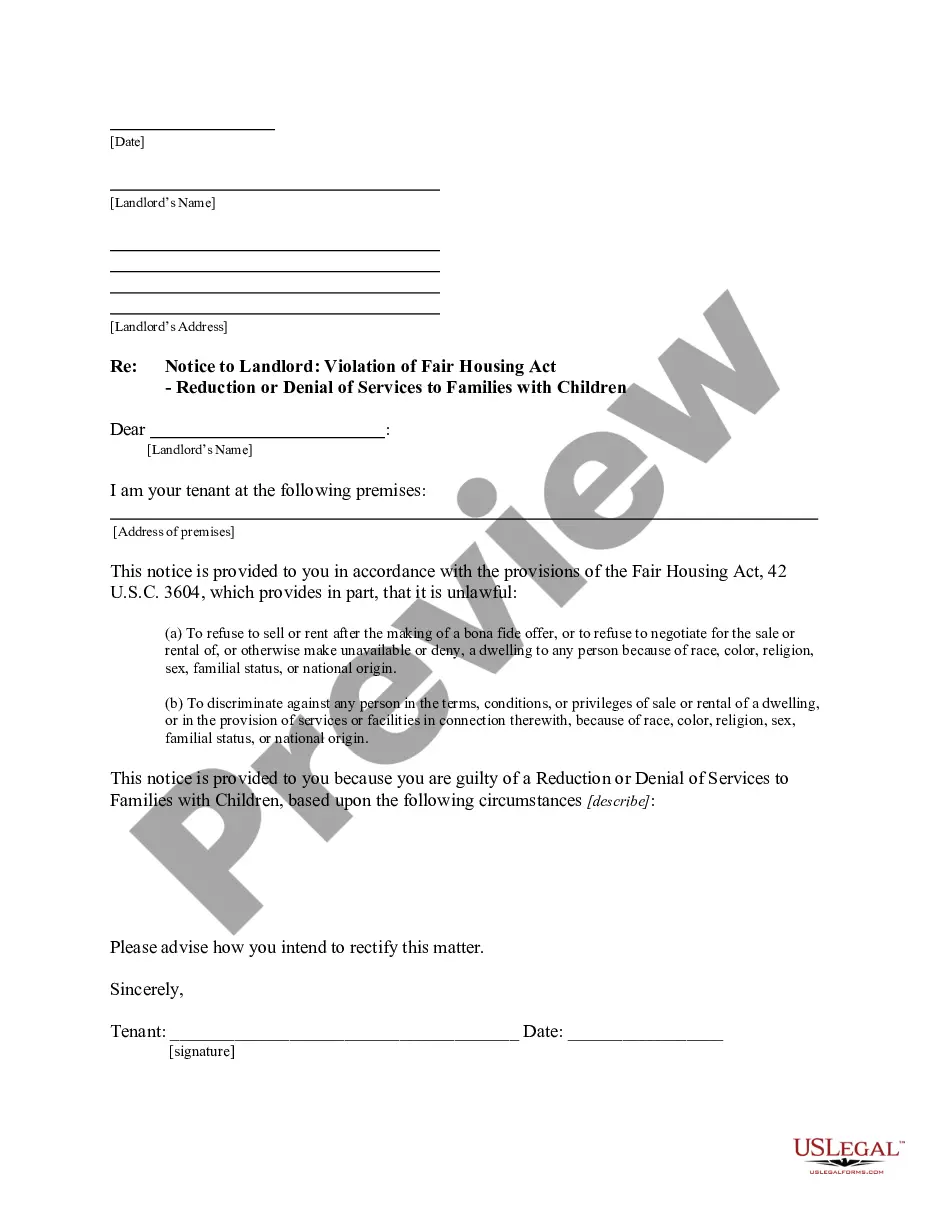
This letter from tenant to landlord addresses violations of the Fair Housing Act regarding denial or reduction of services to families with children. It serves to notify landlords about their unlawful discrimination based on familial status, ensuring tenants can advocate for their rights. This form is particularly distinct from general complaint letters by specifically referencing the legal protections under the Fair Housing Act.
What’s included in this form
- Tenantâs contact information
- Landlordâs contact information
- Statement of violation concerning Fair Housing Act
- Details of the reduction or denial of services
- Date of the incident(s)
- Tenantâs demand for corrective action

Common use cases
This form should be used when a tenant experiences a reduction or denial of services from a landlord specifically due to having children in the household. Situations may include refusal to allow certain amenities, restrictions on common areas, or changes in lease terms that adversely affect families with children. Utilizing this letter notifies the landlord of their obligations under the Fair Housing Act and prompts them to rectify any discriminatory practices.
Who this form is for
This form is intended for:
- Tenants who have children in their household
- Individuals facing discrimination in rental agreements
- Families seeking to ensure they receive equal treatment in housing
Instructions for completing this form
- Identify and enter your contact information, including your name and address.
- Provide the landlord's contact information accurately.
- Clearly describe the violation and the specific services reduced or denied.
- Include any evidence or details about the incident(s) related to the denied services.
- State the actions you would like the landlord to take to correct the situation.
- Sign and date the letter before sending it to your landlord.
Notarization requirements for this form
This form does not typically require notarization unless specified by local law. Make sure to check your local regulations to ensure compliance.
Get your form ready online
Our built-in tools help you complete, sign, share, and store your documents in one place.
Make edits, fill in missing information, and update formatting in US Legal Forms—just like you would in MS Word.
Download a copy, print it, send it by email, or mail it via USPS—whatever works best for your next step.
Sign and collect signatures with our SignNow integration. Send to multiple recipients, set reminders, and more. Go Premium to unlock E-Sign.
If this form requires notarization, complete it online through a secure video call—no need to meet a notary in person or wait for an appointment.
We protect your documents and personal data by following strict security and privacy standards.

Make edits, fill in missing information, and update formatting in US Legal Forms—just like you would in MS Word.

Download a copy, print it, send it by email, or mail it via USPS—whatever works best for your next step.

Sign and collect signatures with our SignNow integration. Send to multiple recipients, set reminders, and more. Go Premium to unlock E-Sign.

If this form requires notarization, complete it online through a secure video call—no need to meet a notary in person or wait for an appointment.

We protect your documents and personal data by following strict security and privacy standards.
Avoid these common issues
- Failing to provide clear and specific details about the discrimination.
- Not including important dates related to the incident(s).
- Ignoring the need for a signed copy when sending the letter.
- Using vague language that does not clearly state the issue.
Why complete this form online
- Convenient access to a legally compliant template.
- Edit the form easily to fit your specific situation.
- Receive updates on legal requirements and best practices.
Legal use & context
This form is based on the Fair Housing Act, which prohibits discrimination in housing based on familial status. Tenants should be aware that legal recourse may be available if landlords do not comply with fair housing laws.
Summary of main points
- This form informs landlords of their legal obligations regarding families with children.
- Using this template helps to formally document discriminatory behavior.
- Proper completion of the form may encourage landlords to rectify issues promptly.
Looking for another form?


Form popularity
FAQ
Examples of familial status discrimination include: Refusing to rent to families with children. Evicting families once a child joins the family through, e.g., birth, adoption, custody. Requiring families with children to live on specific floors or in specific buildings or areas.
It is against Fair Housing guidelines to provide discounts to the elderly.
The Fair Housing Act covers most housing. In some circumstances, the Act exempts owner-occupied buildings with no more than four units, single-family housing sold or rented without the use of a broker and housing operated by organizations and private clubs that limit occupancy to members.
Which would be exempt under the Federal Fair Housing Acts of 1968? An individual selling a personal residence who does not use a broker or discriminatory advertising:Some groups are not covered by the Federal Fair Housing protected classes. These are age, marital status, and occupation.
Race, color, religion, sex, handicap, familial status, national origin. Although some interest groups have tried to lobby to include sexual orientation and marital status, these aren't protected classes under the federal law, but are sometimes protected by certain local state fair housing laws.
The federal Fair Housing Act of 1968 and the federal Fair Housing Act Amendments Act of 1988 prohibit discrimination on the basis of the following criteria (called protected categories): race or color; religion; national origin; familial status or ageincludes families with children under the age of 18 and pregnant
Under the FHA, familial status discrimination occurs when a landlord, property manager, real estate agent, or property owner treats someone differently because they have a family with one or more individuals who are under 18 years of age.
HUD Settles Disability Discrimination Fair Housing Act Case For $80,000.
Under California law, it is unlawful for a landlord, managing agent, real estate broker, or salesperson to discriminate against a person or harass a person because of the person's race, color, religion, sex (including gender and perception of gender), sexual orientation, marital status, national origin, ancestry,