Kansas Warranty Deed from Individual to LLC
Understanding this form
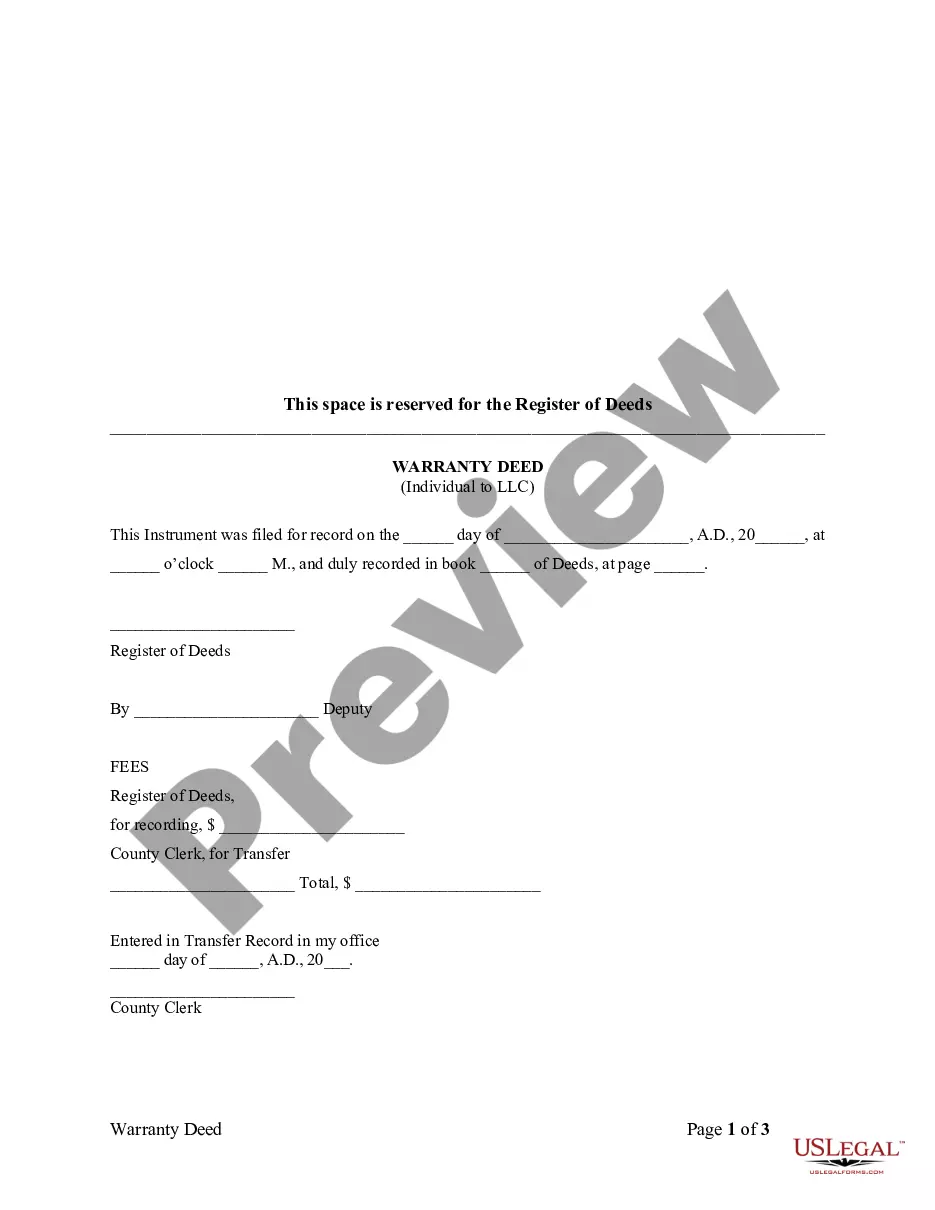
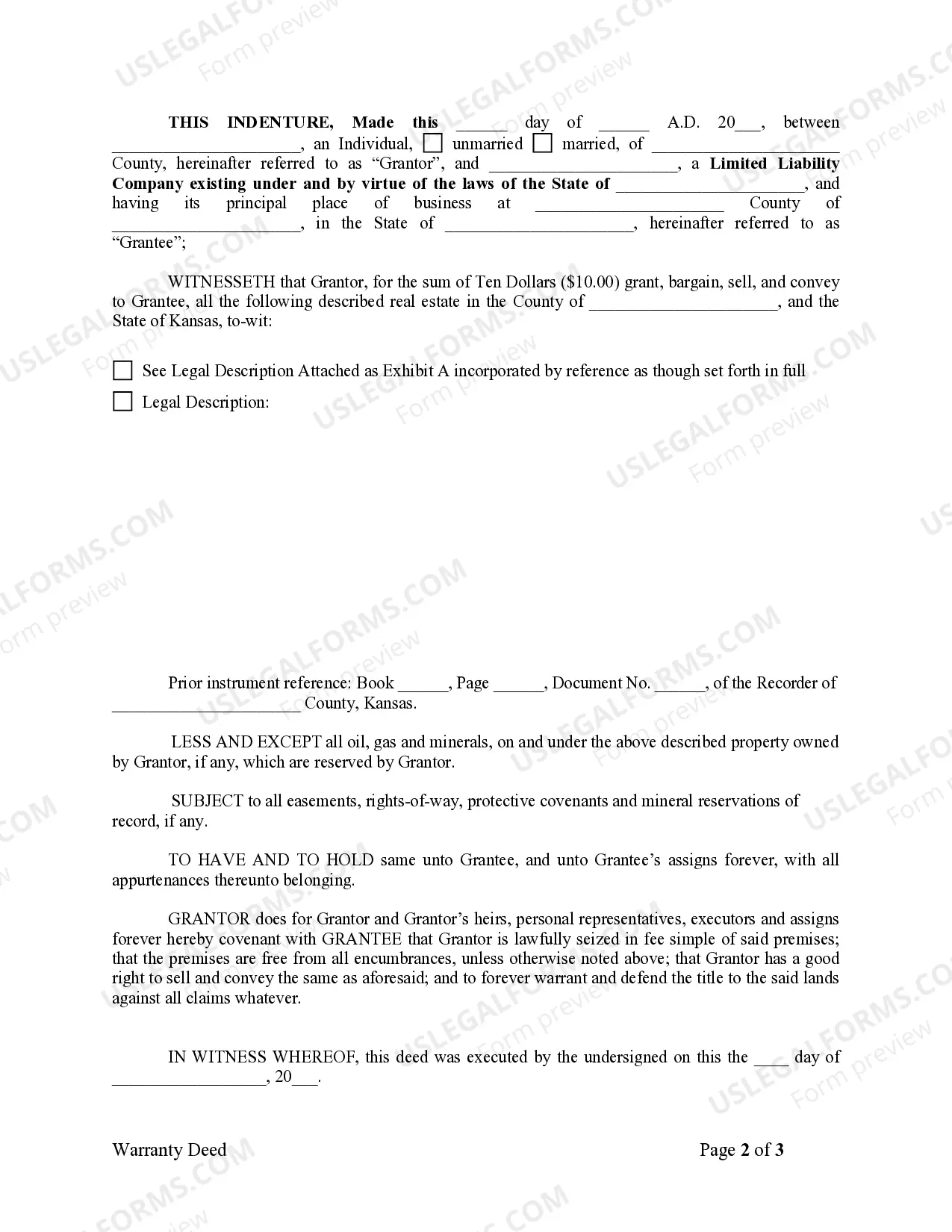
The Warranty Deed from Individual to LLC is a legal document used to transfer ownership of real property from an individual (the grantor) to a limited liability company (the grantee). This deed ensures that the grantor guarantees the title of the property being transferred, which is free from encumbrances unless otherwise stated. Unlike a quitclaim deed, this warranty deed offers a higher level of protection for the grantee, making it clear that the grantor legally owns the property and can convey it.
What’s included in this form
- Identification of the grantor as an individual and the grantee as an LLC.
- Legal description of the property to be transferred.
- Clauses stating the absence of encumbrances on the property.
- Reservation clause for oil, gas, and minerals under the property, if applicable.
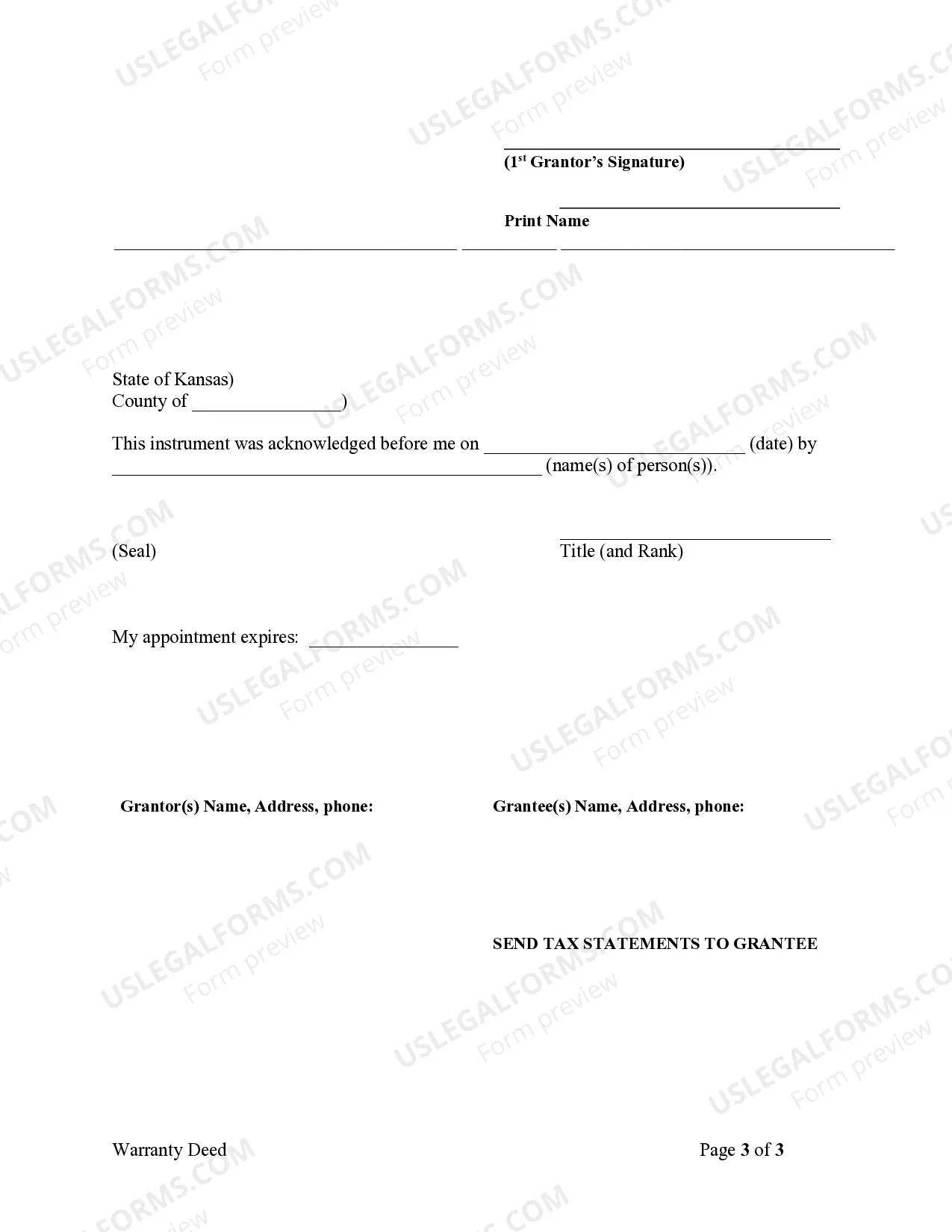
- Signature section for the grantor and a notarization area.






Common use cases
This form should be used when an individual is transferring property ownership to a limited liability company. Scenarios include a property owner who wishes to formally place real estate into their business for asset protection, tax purposes, or business management. It is also applicable when reorganizing assets in a personal or business context.
Who this form is for
- Individuals looking to transfer property to their LLCs.
- Business owners who are formally organizing their assets into a legal structure.
- Real estate professionals assisting clients with property transfers.
How to prepare this document
- Identify and enter the names of the grantor (individual) and grantee (LLC).
- Specify the legal description of the property being transferred.
- Fill in the date of transfer and the consideration amount (usually ten dollars).
- Sign the document in the presence of a notary public.
- Ensure the form is filed with the appropriate Register of Deeds in your county.
Does this form need to be notarized?
Yes, this form must be notarized to be legally valid. This ensures that the identities of the parties are confirmed and that the document is executed properly. US Legal Forms offers integrated online notarization services, allowing you to complete notarization securely via video call 24/7, without any need for travel.
Get your form ready online
Our built-in tools help you complete, sign, share, and store your documents in one place.
Make edits, fill in missing information, and update formatting in US Legal Forms—just like you would in MS Word.
Download a copy, print it, send it by email, or mail it via USPS—whatever works best for your next step.
Sign and collect signatures with our SignNow integration. Send to multiple recipients, set reminders, and more. Go Premium to unlock E-Sign.
If this form requires notarization, complete it online through a secure video call—no need to meet a notary in person or wait for an appointment.
We protect your documents and personal data by following strict security and privacy standards.

Make edits, fill in missing information, and update formatting in US Legal Forms—just like you would in MS Word.

Download a copy, print it, send it by email, or mail it via USPS—whatever works best for your next step.

Sign and collect signatures with our SignNow integration. Send to multiple recipients, set reminders, and more. Go Premium to unlock E-Sign.

If this form requires notarization, complete it online through a secure video call—no need to meet a notary in person or wait for an appointment.

We protect your documents and personal data by following strict security and privacy standards.
Common mistakes
- Failing to provide a complete legal description of the property.
- Not including the required notary signature and seal.
- Inaccuracies in the names of the grantor or grantee.
Advantages of online completion
- Convenient access to templates that ensure legally sound documentation.
- Editable forms allow for customization to fit specific circumstances.
- Reliability from professionally drafted forms designed by licensed attorneys.
Main things to remember
- The Warranty Deed from Individual to LLC is essential for transferring property ownership securely.
- Completing this form accurately prevents future legal complications regarding property ownership.
- Notarization is required for the deed to hold legal weight.
Looking for another form?

Form popularity
FAQ
Contrary to normal expectations, the Deed DOES NOT have to be recorded to be effective or to show delivery, and because of that, the Deed DOES NOT have to be signed in front of a Notary Public. However, if you plan to record it, then it does have to be notarized as that is a County Recorder requirement.
A warranty deed is a legal document used to transfer, or convey, rights in real property from a grantor (seller) to a grantee (buyer). For Kansas residential property, the primary methods for holding title in co-ownership are tenancy in common and joint tenancy.
It's important to note that a warranty deed does not actually prove the grantor has ownership (a title search is the best way to prove that), but it is a promise by the grantor that they are transferring ownership and if it turns out they don't actually own the property, the grantor will be responsible for compensating
The mortgage company usually prepares this deed as part of the loan package and delivers it to the title company for you to sign at closing. The title company is commonly the trustee to the deed and holds legal title to the property until the loan gets fully repaid.
Typically, the lender will provide you with a copy of the deed of trust after the closing. The original warranty deeds are often mailed to the grantee after they are recorded. These are your original copies and should be kept in a safe place, such as a fireproof lockbox or a safe deposit box at a financial institution.
The original deed is returned to the owner of the property from the office of the recorder after proper entry. The office of the Recorder of Deeds maintains a set of indexes about each deed recorded, for an easy search. Almost all states have a grantor-grantee index including a reference to all documents recorded.
A warranty deed, also known as a general warranty deed, is a legal real estate document between the seller (grantor) and the buyer (grantee). The deed protects the buyer by pledging that the seller holds clear title to the property and there are no encumbrances, outstanding liens, or mortgages against it.
A warranty deed guarantees that: The grantor is the rightful owner of the property and has the legal right to transfer the title.The title would withstand third-party claims to ownership of the property. The grantor will do anything to ensure the grantee's title to the property.
After your Warranty Deed has been recorded at the County Clerk's Office, it can be sent to the grantee. However, any person or corporation can be designated as the recipient of the recorded Warranty Deed.