Kansas Quitclaim Deed from Husband and Wife to an Individual

What this document covers
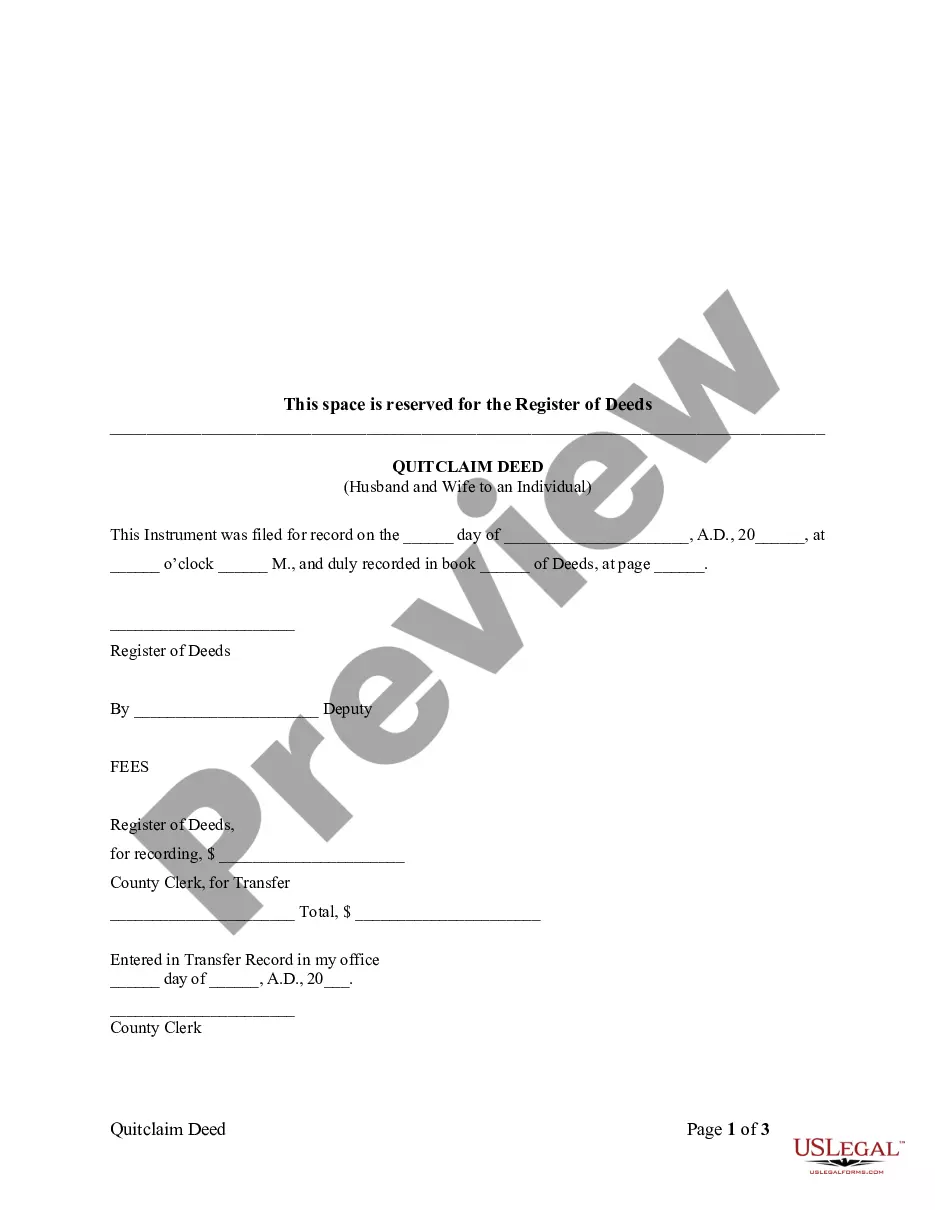
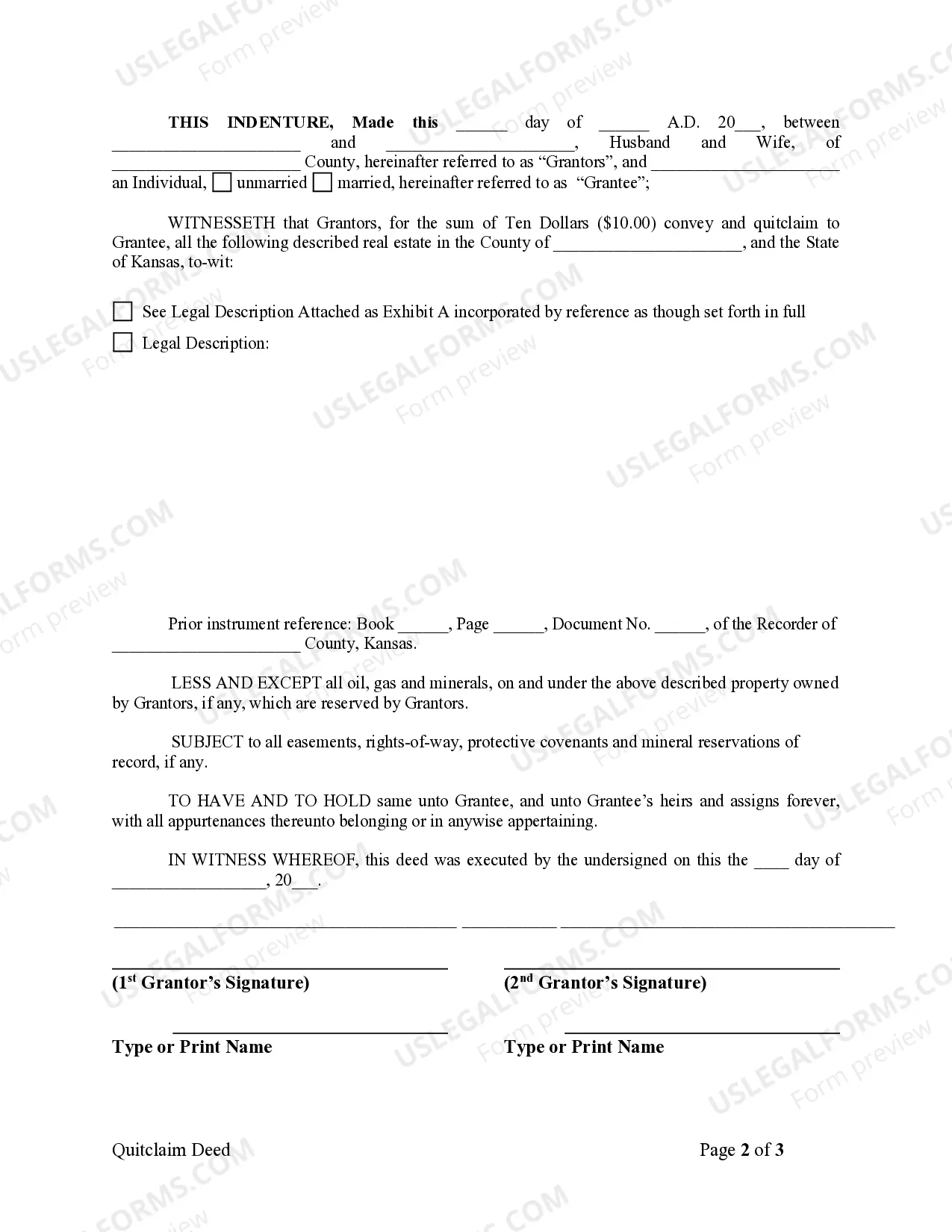
A Quitclaim Deed from Husband and Wife to an Individual is a legal document used to transfer ownership of real property from a married couple (the grantors) to a single individual (the grantee). This type of deed conveys whatever interest the grantors have in the property without guaranteeing its title, which is different from a warranty deed that provides such guarantees. This deed specifically excludes oil, gas, and mineral rights retained by the grantors, making it essential for proper property transfer and clarity regarding ownership rights.
What’s included in this form
- The names and addresses of the grantors (husband and wife).
- The name and address of the grantee (the individual receiving the property).
- The legal description of the property being transferred.
- Clauses regarding reserved mineral rights and any existing easements.
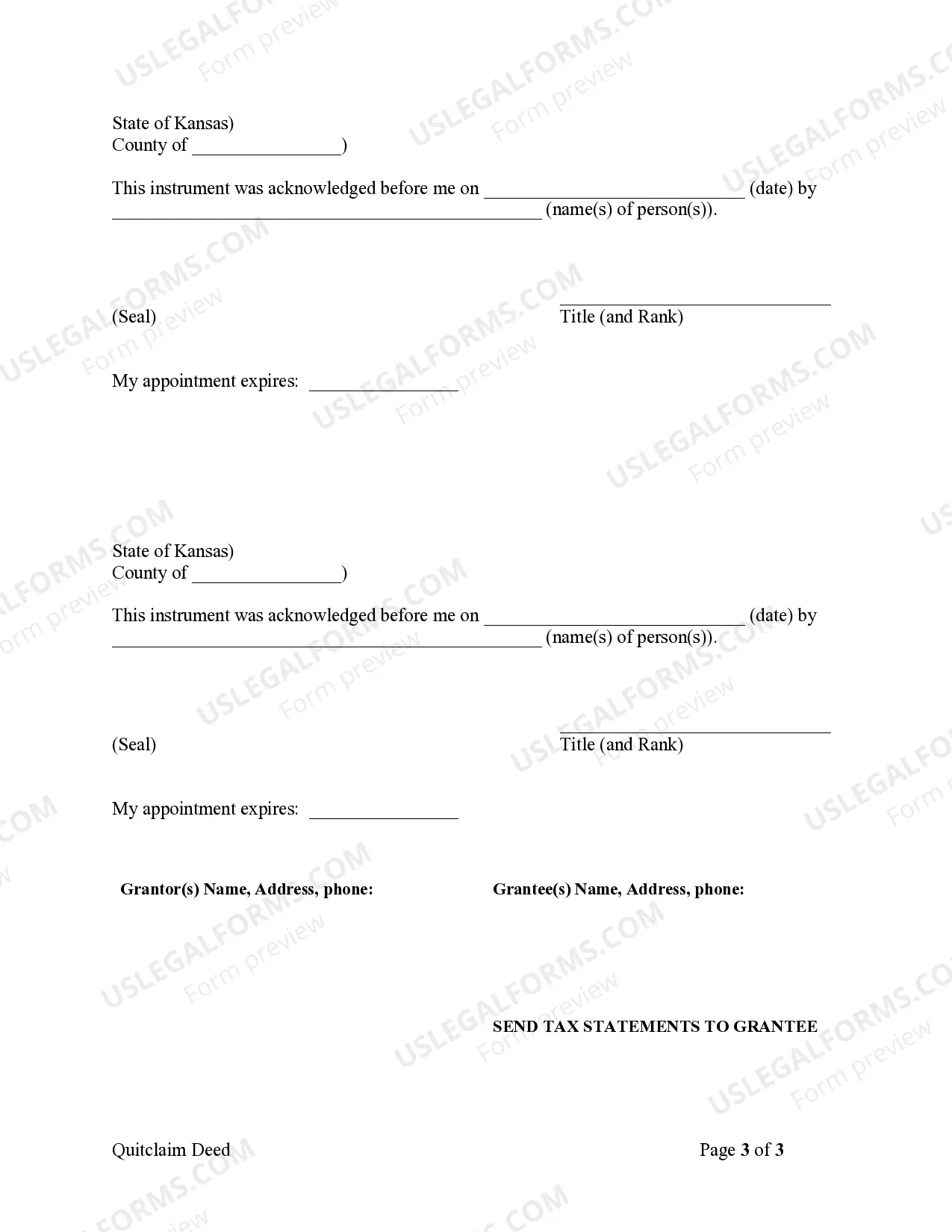
- Signature lines for both grantors and acknowledgment by a notary public.




When this form is needed
This form is typically used when married couples want to transfer property to an individual, perhaps due to a divorce settlement, gift, or estate planning purposes. It may also be used to clarify ownership among family members or as part of property division during a legal separation.
Who should use this form
- Married couples wishing to transfer property to an individual.
- Individuals involved in property settlements where a quitclaim deed is appropriate.
- Anyone needing to clarify or transfer property ownership without the warranties associated with a traditional deed.
How to complete this form
- Identify the grantors by entering the full names and addresses of both husband and wife.
- Specify the name and address of the grantee, the individual receiving the property.
- Describe the property being transferred clearly, including any necessary legal descriptions.
- Complete the reserved rights clause regarding any oil, gas, and minerals retained by the grantors.
- Obtain signatures from both grantors in the designated spaces and have the document notarized.
Notarization requirements for this form
This form must be notarized to be legally valid. US Legal Forms provides secure online notarization powered by Notarize, allowing you to complete the process through a verified video call.
Get your form ready online
Our built-in tools help you complete, sign, share, and store your documents in one place.
Make edits, fill in missing information, and update formatting in US Legal Forms—just like you would in MS Word.
Download a copy, print it, send it by email, or mail it via USPS—whatever works best for your next step.
Sign and collect signatures with our SignNow integration. Send to multiple recipients, set reminders, and more. Go Premium to unlock E-Sign.
If this form requires notarization, complete it online through a secure video call—no need to meet a notary in person or wait for an appointment.
We protect your documents and personal data by following strict security and privacy standards.

Make edits, fill in missing information, and update formatting in US Legal Forms—just like you would in MS Word.

Download a copy, print it, send it by email, or mail it via USPS—whatever works best for your next step.

Sign and collect signatures with our SignNow integration. Send to multiple recipients, set reminders, and more. Go Premium to unlock E-Sign.

If this form requires notarization, complete it online through a secure video call—no need to meet a notary in person or wait for an appointment.

We protect your documents and personal data by following strict security and privacy standards.
Common mistakes to avoid
- Failing to include a complete legal description of the property.
- Not having the deed notarized, which is necessary for it to be valid in many jurisdictions.
- Omitting the reserved rights clause, leading to potential disputes over mineral rights.
Why use this form online
- Convenient access: Download the form anytime, anywhere.
- Editability: Customize the template easily to fit specific needs.
- Reliability: Use forms vetted by licensed attorneys to ensure compliance with legal standards.
Looking for another form?

Form popularity
FAQ
To fill out a Kansas Quitclaim Deed from Husband and Wife to an Individual, start by clearly writing the names of the grantors, which in this case are the husband and wife. Next, include the full name of the grantee, the individual receiving the property. Be sure to describe the property accurately, including its legal description. After filling out the form, both grantors must sign it in front of a notary public for the deed to be valid.
To obtain a Kansas Quitclaim Deed from Husband and Wife to an Individual, you can start by visiting a legal forms website, such as US Legal Forms. They provide ready-to-use templates that meet Kansas requirements. Additionally, you can consult a local attorney for personalized guidance, ensuring that your quitclaim deed adheres to all legal standards.
Two of the most common ways to transfer property in a divorce are through an interspousal transfer deed or quitclaim deed. When spouses own property together, but then one spouse executes an interspousal transfer or a quitclaim deed, this is known as transmutation.
You usually do this by filing a quitclaim deed, in which your ex-spouse gives up all rights to the property. Your ex should sign the quitclaim deed in front of a notary. One this document is notarized, you file it with the county. This publicly removes the former partner's name from the property deed and the mortgage.
But you might be wondering if an owner can transfer a deed to another person without a real estate lawyer. The answer is yes. Parties to a transaction are always free to prepare their own deeds.A quitclaim deed, for example, is far simpler than a warranty deed.
It is possible to be named on the title deed of a home without being on the mortgage. However, doing so assumes risks of ownership because the title is not free and clear of liens and possible other encumbrances.If a mortgage exists, it's best to work with the lender to make sure everyone on the title is protected.
If the quitclaim deed requires the signature of all co-owners, the deed is invalid unless all co-owners have signed it and the deed is then delivered to the grantee.If one individual owns real estate and desires to add a co-owner such as a spouse, a quitclaim deed might be used.
No law forbids adding someone to your mortgaged home's deed or in signing your home over to others through one. Mortgage lenders understand deeds, though, and use loan due-on-sale clauses to prevent unauthorized property sales or transfers.
Fill out the quit claim deed form, which can be obtained online, or write your own using the form as a guide. The person giving up the interest in the property is the grantor, and the person receiving the interest is the grantee.
One of the simplest ways to add your wife to the home title is by using an interspousal deed. You can transfer the property from your sole and separate property to mutual tenancy, such as joint tenants with right of survivorship, with your wife.