Indiana Declaration of Mental Health Care Treatment
Understanding this form
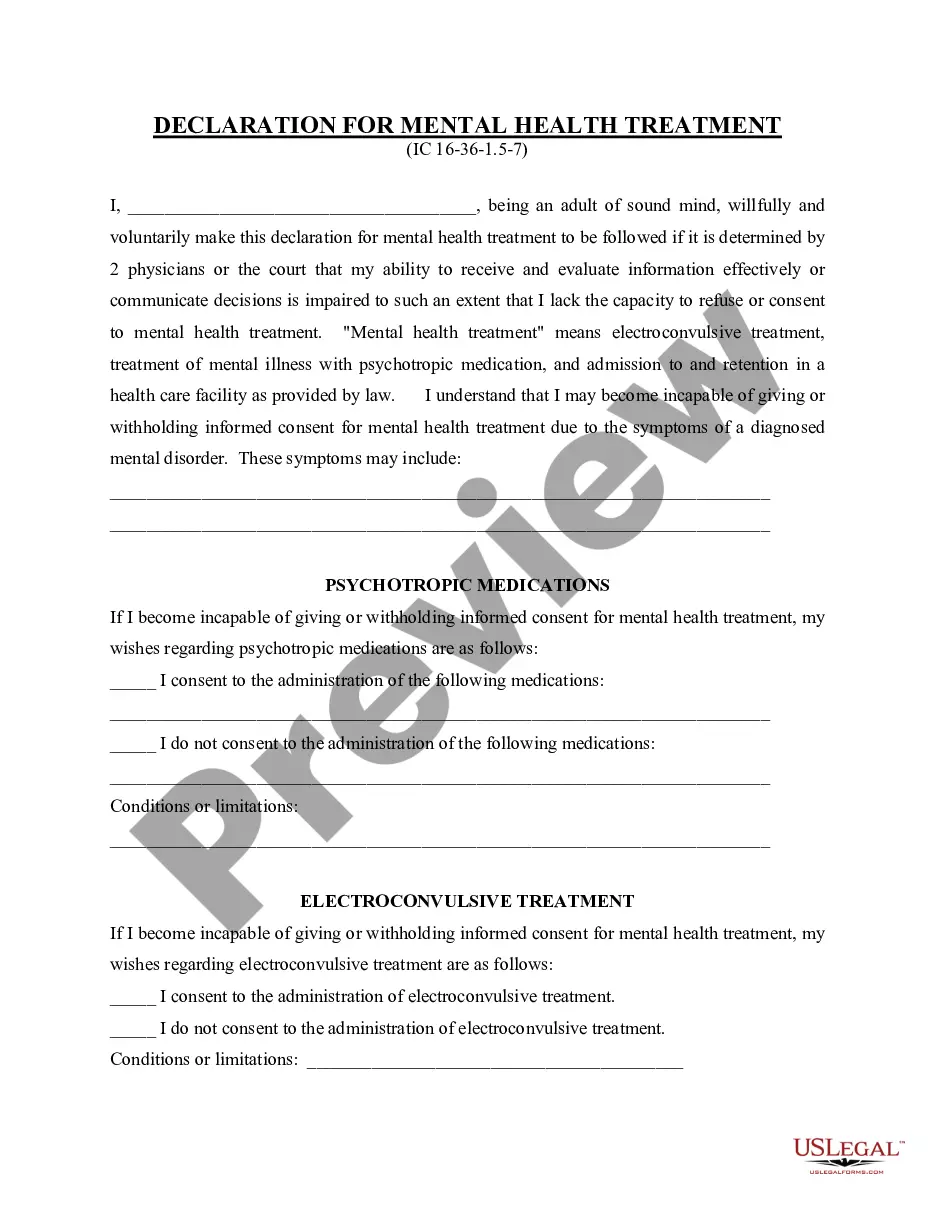
The Declaration of Mental Health Care Treatment is a legal document that specifies your preferences for future mental health treatment. It allows you to make decisions about psychotropic medication, electroconvulsive therapy, and admission to a treatment facility in advance. This form is particularly important as it clarifies your wishes in situations where you may be unable to make informed decisions regarding your mental health treatment due to a mental disorder.
Main sections of this form
- Identification of the declarant, ensuring they are an adult of sound mind.
- Details about future treatment preferences, including psychotropic medications.
- Consent provisions for electroconvulsive therapy.
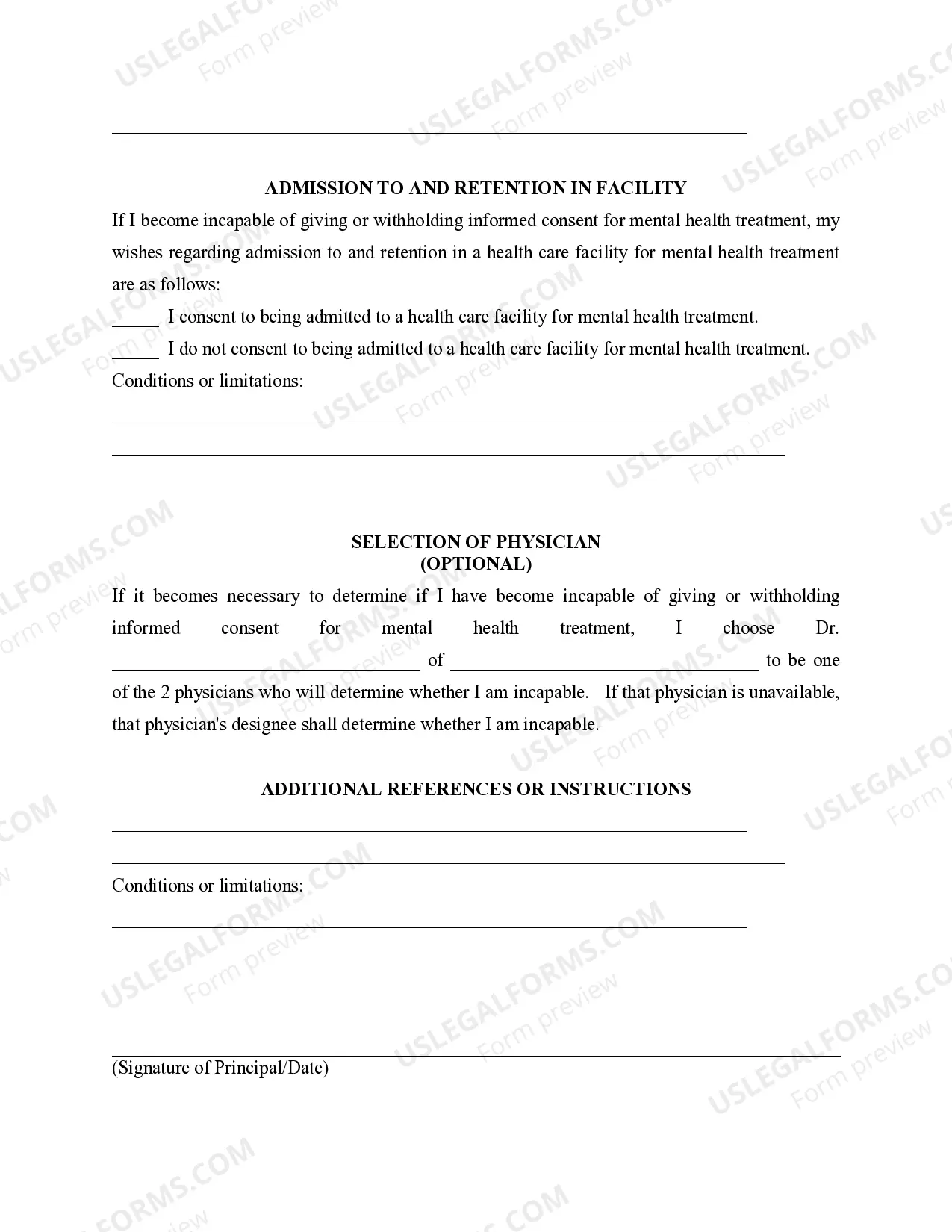
- Directions regarding admission to and retention in a healthcare facility for mental health treatment.
- Option to select physicians to determine incapacity for informed consent.
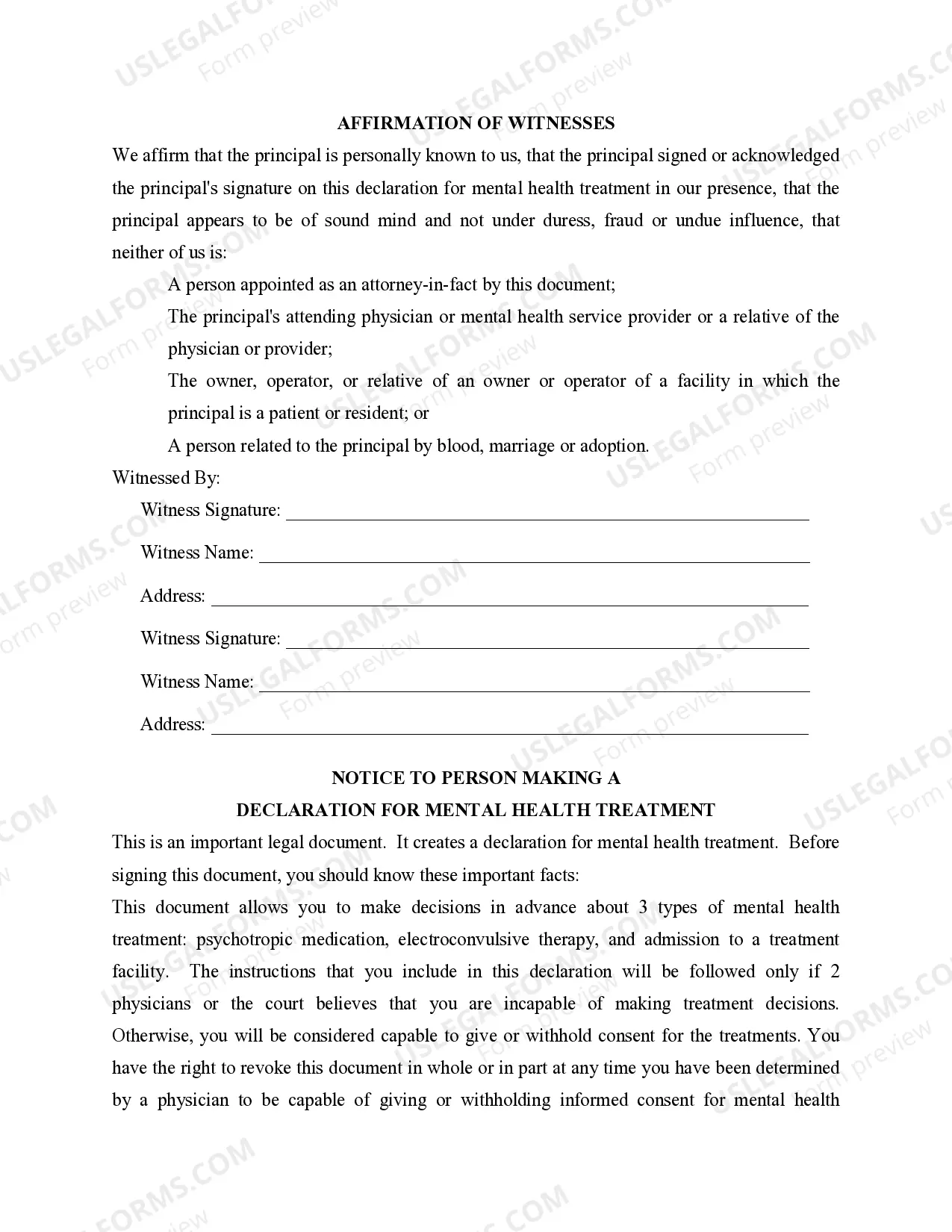
- Witness affirmation to ensure the declaration is made voluntarily without undue influence.
When this form is needed
This form should be used when you want to express your treatment preferences for mental health care in advance, particularly in situations where you may lose the capacity to make informed decisions. It is especially relevant for individuals diagnosed with severe mental illnesses or those undergoing treatment that may impact their decision-making abilities.
Who needs this form
- Individuals who have been diagnosed with a mental health disorder.
- Adults who wish to specify their treatment preferences regarding mental health care.
- Anyone concerned about their future ability to make informed decisions related to mental health.
Instructions for completing this form
- Enter your full name and affirm that you are an adult of sound mind.
- Outline your wishes regarding psychotropic medications, including any limitations.
- Specify your consent or refusal for electroconvulsive treatment, along with any conditions.
- Indicate your preferences for admission to a healthcare facility and any limitations.
- Choose physicians who will assess your capacity, if necessary, and provide their details.
- Sign the form in the presence of witnesses who attest to your mental competency.
Does this form need to be notarized?
This form does not typically require notarization unless specified by local law. It is essential to review your jurisdiction's requirements to ensure the declaration is legally binding.
Get your form ready online
Our built-in tools help you complete, sign, share, and store your documents in one place.
Make edits, fill in missing information, and update formatting in US Legal Forms—just like you would in MS Word.
Download a copy, print it, send it by email, or mail it via USPS—whatever works best for your next step.
Sign and collect signatures with our SignNow integration. Send to multiple recipients, set reminders, and more. Go Premium to unlock E-Sign.
If this form requires notarization, complete it online through a secure video call—no need to meet a notary in person or wait for an appointment.
We protect your documents and personal data by following strict security and privacy standards.

Make edits, fill in missing information, and update formatting in US Legal Forms—just like you would in MS Word.

Download a copy, print it, send it by email, or mail it via USPS—whatever works best for your next step.

Sign and collect signatures with our SignNow integration. Send to multiple recipients, set reminders, and more. Go Premium to unlock E-Sign.

If this form requires notarization, complete it online through a secure video call—no need to meet a notary in person or wait for an appointment.

We protect your documents and personal data by following strict security and privacy standards.
Typical mistakes to avoid
- Failing to clearly outline preferences for specific medications.
- Not including witness signatures, which may affect the validity of the declaration.
- Leaving blank sections that could lead to ambiguity in treatment wishes.
Advantages of online completion
- Convenience of completing and downloading the form from home.
- Ability to easily edit the document based on evolving preferences.
- Access to reliable templates created by licensed attorneys, ensuring legal validity.
Legal use & context
- This form is legally binding as long as it is completed according to the state's regulations.
- Your treatment preferences will be honored by health care providers only if you are deemed incapable of making informed decisions.
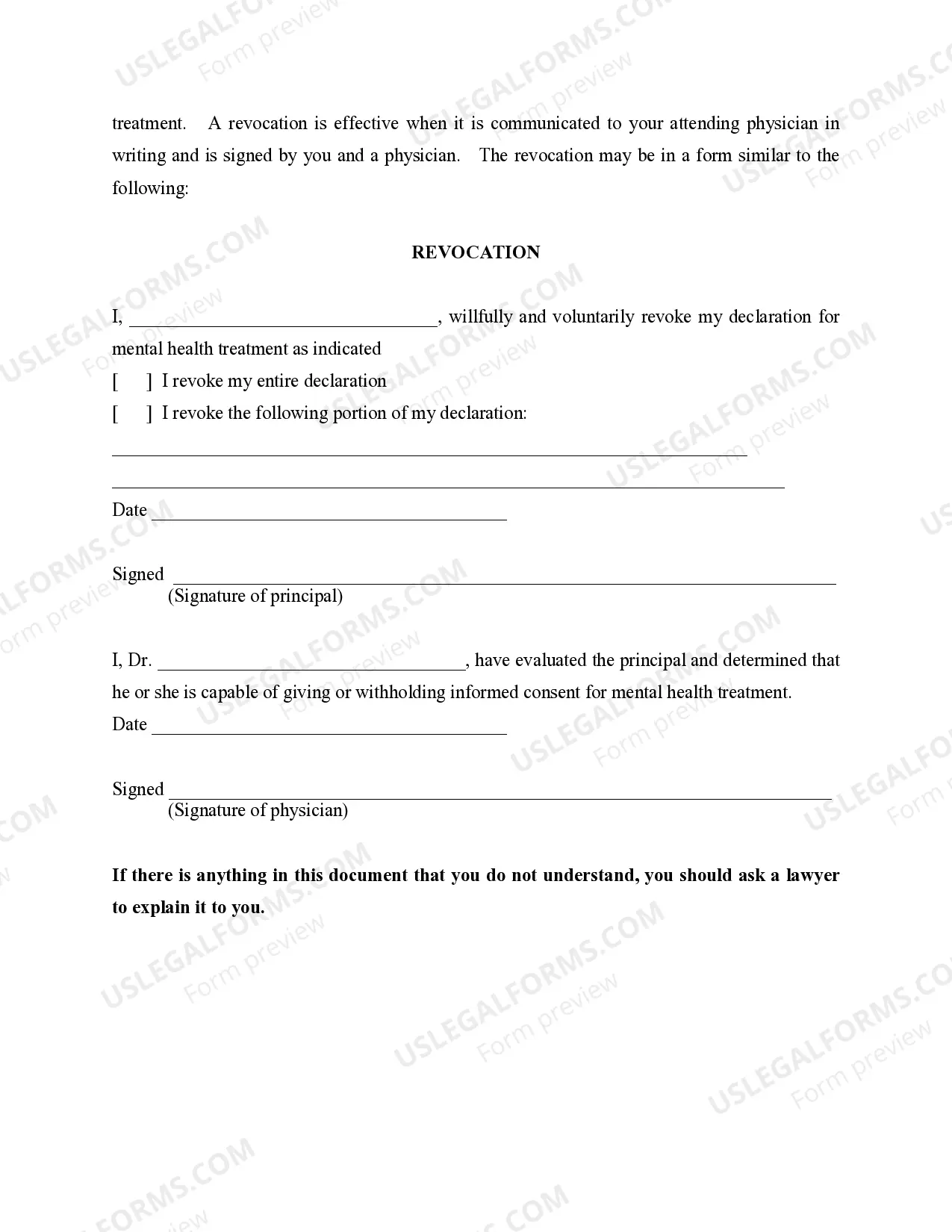
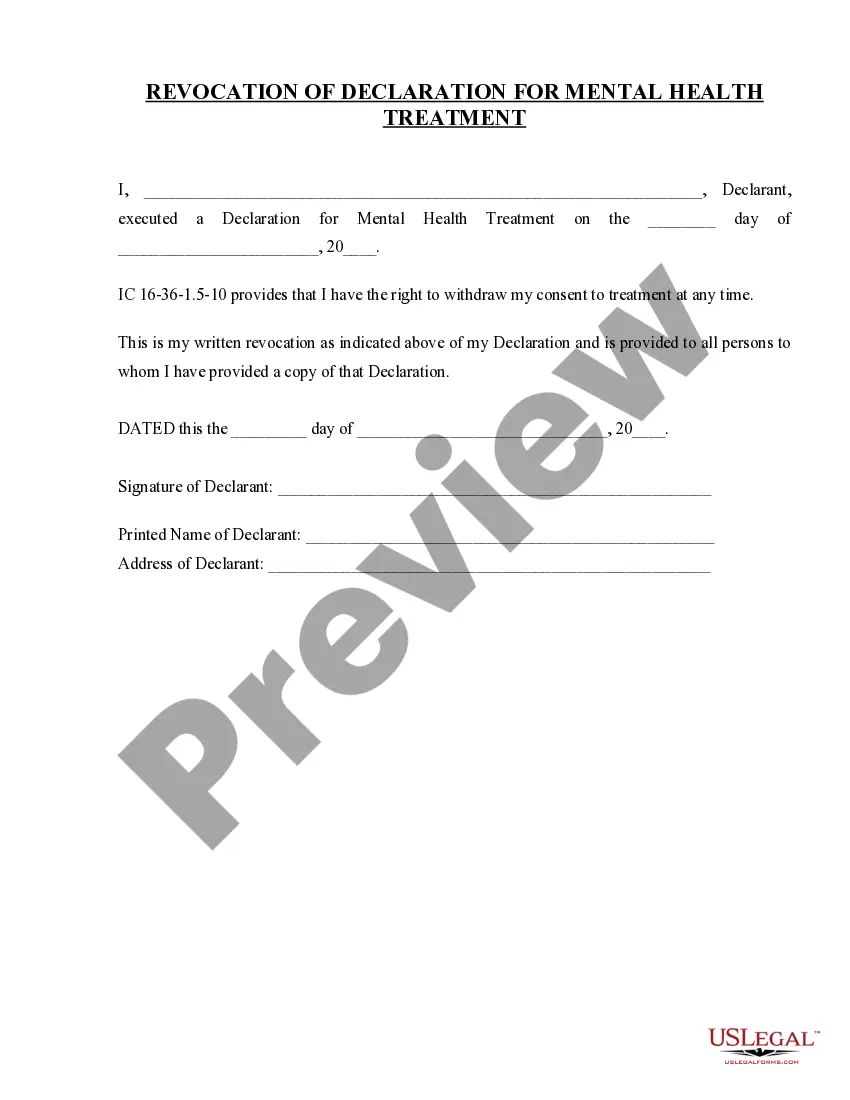
- Revocation of this declaration is permitted when you are determined to be capable of consenting to treatment.
Looking for another form?


Form popularity
FAQ
Step 1: Decide your wishes. The first step is to think through and write down how you want to be treated when you have a mental health crisis or are hospitalized. Step 2: Find your health care agent. Step 3: Write your advance directive. Step 4: Give out copies of your psychiatric advance directive.
If a person is suffering from a mental illness that causes them to lack the ability to consent to medical treatments, the court system and law enforcement can force them to be treated by medical professionals.
DECLARATION FOR MENTAL HEALTH TREATMENT It is a declaration that allows, or disallows, mental health treatment.
This document allows you to make decisions in advance about certain types of mental health treatment: psychoactive medication, short-term (not to exceed 17 days) admission to a treatment facility, convulsive treatment and outpatient services.
Be transparent and direct. One of the best things you can do is the one thing that everyone who has experienced this problem probably tries last. Convince them that it's their idea. Make it a "double-checkup" Make the rest of the day as enjoyable as possible. Get someone who is an authority figure to help.
How long does an advance directive for health care last? The advance directive will remain valid during your lifetime unless you revoke it or you sign a new advance directive unless or there is a specific time limit written in the advance directive. The health care representative's authority ends when you die.
If the person refuses to follow the treatment plan, he/she can be sent to jail. Mental health courts have been shown to be very effective in keeping people on medication, and in reducing rehospitalizations, incarcerations, and violent behavior.
Follow through on any consequences or boundaries you set. Recognize your role. Stop enabling. Prepare for their reaction. Educate yourself. Be patient. Encourage them. Plan an intervention.
If your nearest relative is concerned about your mental health, they can contact your local social services or community mental health team and apply to section you or place you under a guardianship. In reality though, it is normally an approved mental health professional who will make this application.