Idaho Warranty Deed from Individual to a Trust

Overview of this form
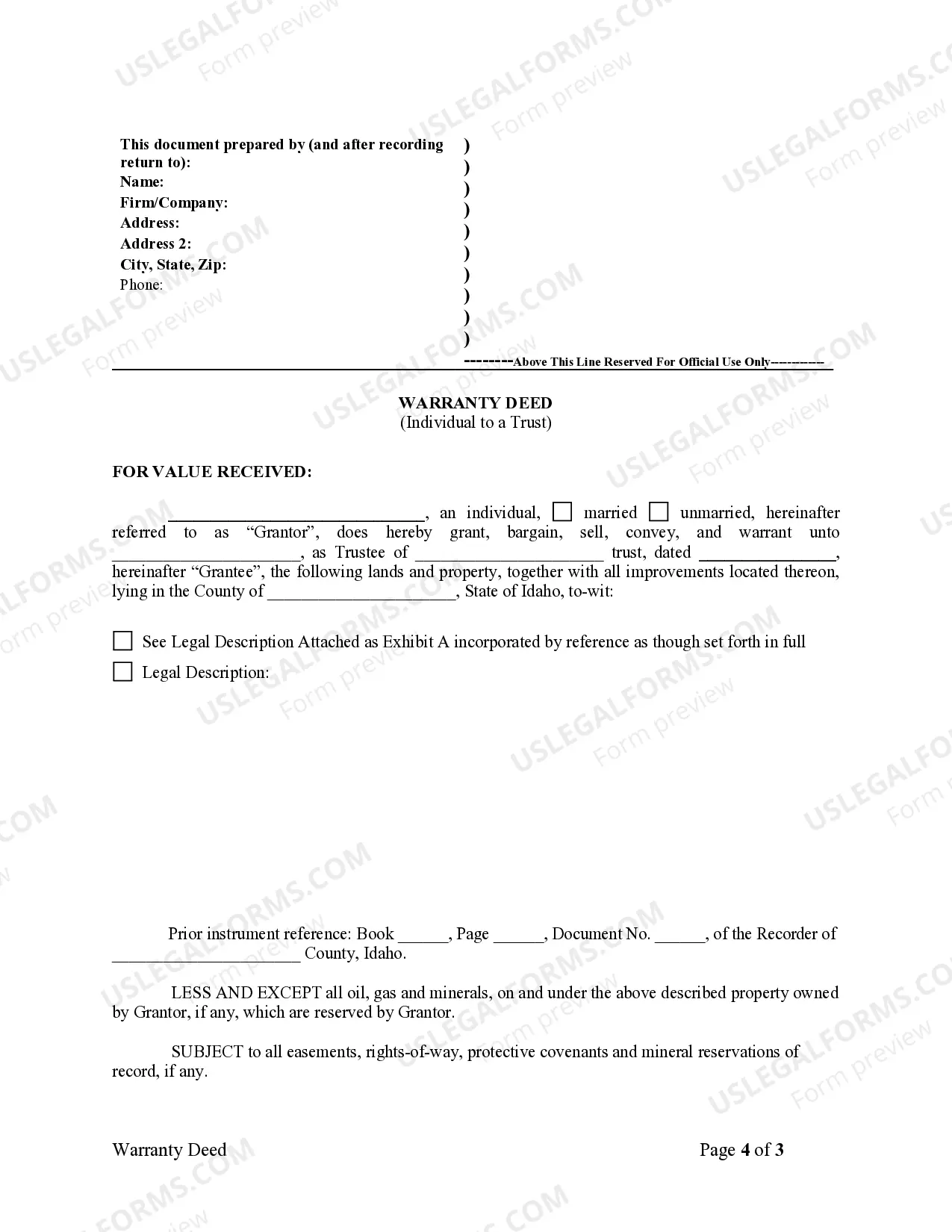
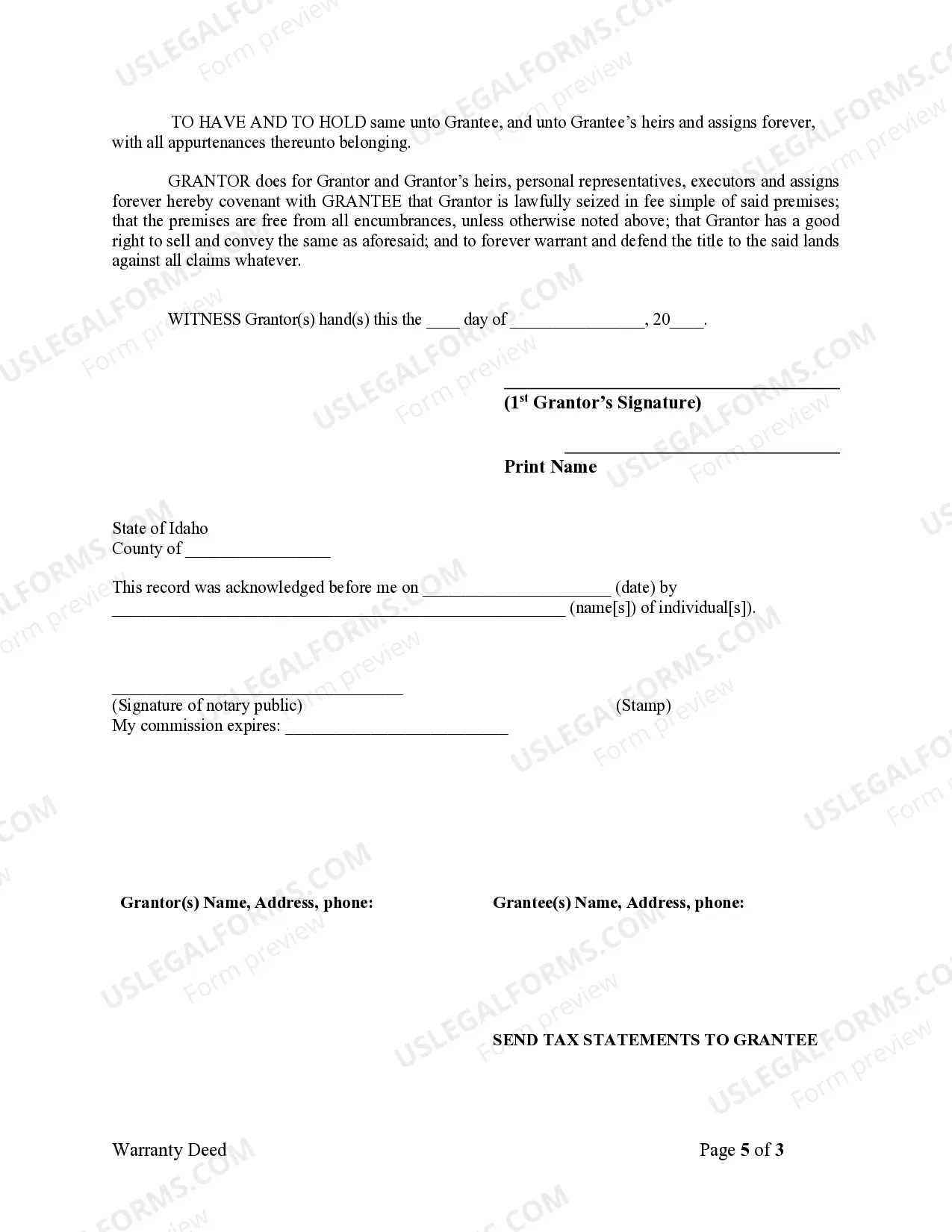
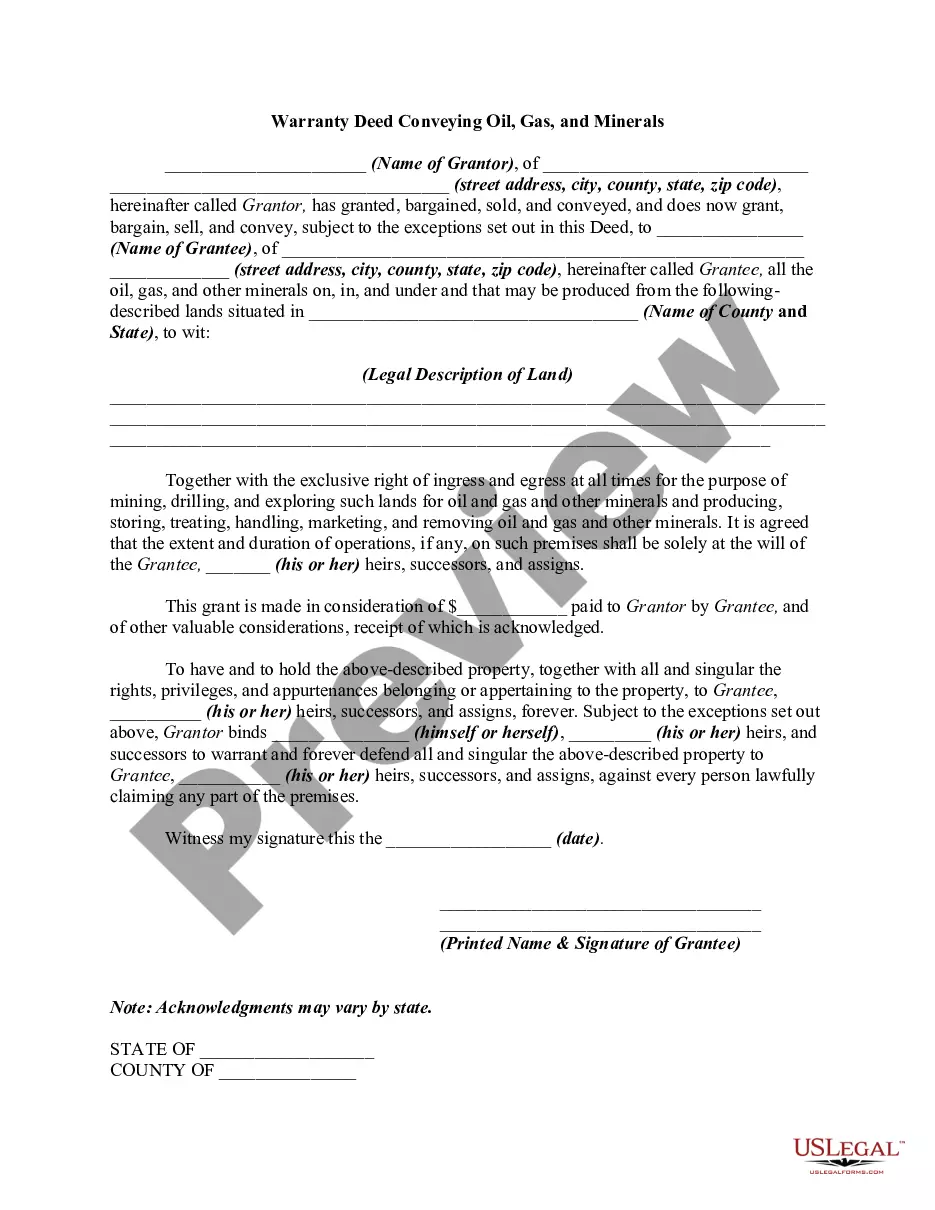
This form is a Warranty Deed from an individual to a trust. It allows the grantor (the individual) to transfer property ownership to the trustee of a trust while reserving rights to any oil, gas, and minerals found beneath the property. This type of deed ensures that the property is conveyed free of encumbrances, except for those explicitly noted. It differs from other forms of property transfer by specifically designating a trust as the recipient, which can have implications for estate planning and asset management.
Key components of this form
- Grantor (individual) and grantee (trust) identification.
- Description of the property being transferred.
- Reservations of any oil, gas, and minerals beneath the property.
- Covenant of seisin and assurance against encumbrances.
- Signature and date fields for the grantor and notary public.


Situations where this form applies
This Warranty Deed should be used when an individual wants to legally transfer ownership of real property to a trust. This might occur as part of estate planning, to manage assets for beneficiaries, or to simplify the transfer process after the grantor's death. It is essential when the grantor wishes to maintain control or specify terms of the property management through the trust framework.
Who should use this form
- Individuals transferring real property to a trust.
- Trustees managing a trust on behalf of beneficiaries.
- Estate planners looking to secure assets within a trust structure.
- Anyone needing to document the legal transfer of property ownership.
Steps to complete this form
- Identify the grantor and the grantee, ensuring correct names and designations.
- Specify the legal description of the property being transferred.
- Indicate any reservations for oil, gas, and minerals beneath the property.
- Have the grantor sign and date the document in the designated areas.
- Obtain the signature of a notary public to validate the deed.
Notarization requirements for this form
Notarization is required for this form to take effect. Our online notarization service, powered by Notarize, lets you verify and sign documents remotely through an encrypted video session, available 24/7.
Get your form ready online
Our built-in tools help you complete, sign, share, and store your documents in one place.
Make edits, fill in missing information, and update formatting in US Legal Forms—just like you would in MS Word.
Download a copy, print it, send it by email, or mail it via USPS—whatever works best for your next step.
Sign and collect signatures with our SignNow integration. Send to multiple recipients, set reminders, and more. Go Premium to unlock E-Sign.
If this form requires notarization, complete it online through a secure video call—no need to meet a notary in person or wait for an appointment.
We protect your documents and personal data by following strict security and privacy standards.

Make edits, fill in missing information, and update formatting in US Legal Forms—just like you would in MS Word.

Download a copy, print it, send it by email, or mail it via USPS—whatever works best for your next step.

Sign and collect signatures with our SignNow integration. Send to multiple recipients, set reminders, and more. Go Premium to unlock E-Sign.

If this form requires notarization, complete it online through a secure video call—no need to meet a notary in person or wait for an appointment.

We protect your documents and personal data by following strict security and privacy standards.
Common mistakes
- Failing to provide an accurate legal description of the property.
- Not including all required signatures and dates.
- Neglecting to reserve oil, gas, and mineral rights if applicable.
- Using incorrect terminology that does not align with the trust structure.
- Overlooking the notary requirement, which can invalidate the deed.
Advantages of online completion
- Conveniency of downloading the form for immediate use.
- Editability to customize the form as needed.
- Accessibility from anywhere, at any time, making it easier to complete tasks.
- Reliable document preparation with attorney-drafted templates.
Main things to remember
- The Warranty Deed from Individual to a Trust is essential for transferring property ownership securely.
- Ensure the property description is accurate and includes any mineral rights reservations.
- Notarization is a requirement for legal validity of the deed, adding protection against fraud.
Looking for another form?

Form popularity
FAQ
This deed transfers title from an individual (the grantor) to a trust (the grantee) while reserving rights to oil, gas, and minerals beneath the property. It conveys the property free of encumbrances except as noted and includes a covenant of seisin. It’s used for estate planning and asset management by placing real property into a trust.
A warranty deed for a trust transfers title from an individual to the trust and guarantees clear title, while documenting any reservations of oil, gas, or minerals. The form identifies the grantor and the trust, provides a property description, and includes covenants of seisin and against encumbrances, plus signature and notary fields for execution.
Yes, this Idaho Warranty Deed from Individual to a Trust can be prepared without a lawyer, but seek legal advice for complex transfers. The form requires clear identification of the grantor and the trust, a full property description, mineral reservations, covenants of seisin and no encumbrances, and proper signatures with a notary.
Yes, you can prepare your own warranty deed using this Idaho form. Fill in the grantor (individual) and grantee (the trust), provide a complete property description, note any oil, gas, or mineral reservations, include the covenants of seisin and no encumbrances, and obtain the grantor’s signature and a notary acknowledgment.
Using the Idaho Warranty Deed from Individual to a Trust can place the property into a trust for estate planning, allowing a trustee to manage the asset for heirs. It conveys title with mineral reservations and guarantees the title is free of encumbrances, aligning with common strategies to pass property to beneficiaries.
This form designates a trust as the grantee rather than an individual and explicitly reserves oil, gas, and minerals beneath the property. It also includes the typical covenants of seisin and no encumbrances, plus the grantor/notary requirements, tailoring the deed for transfer into a trust in Idaho estate planning.