Iowa Warranty Deed from Individual to a Trust
What this document covers
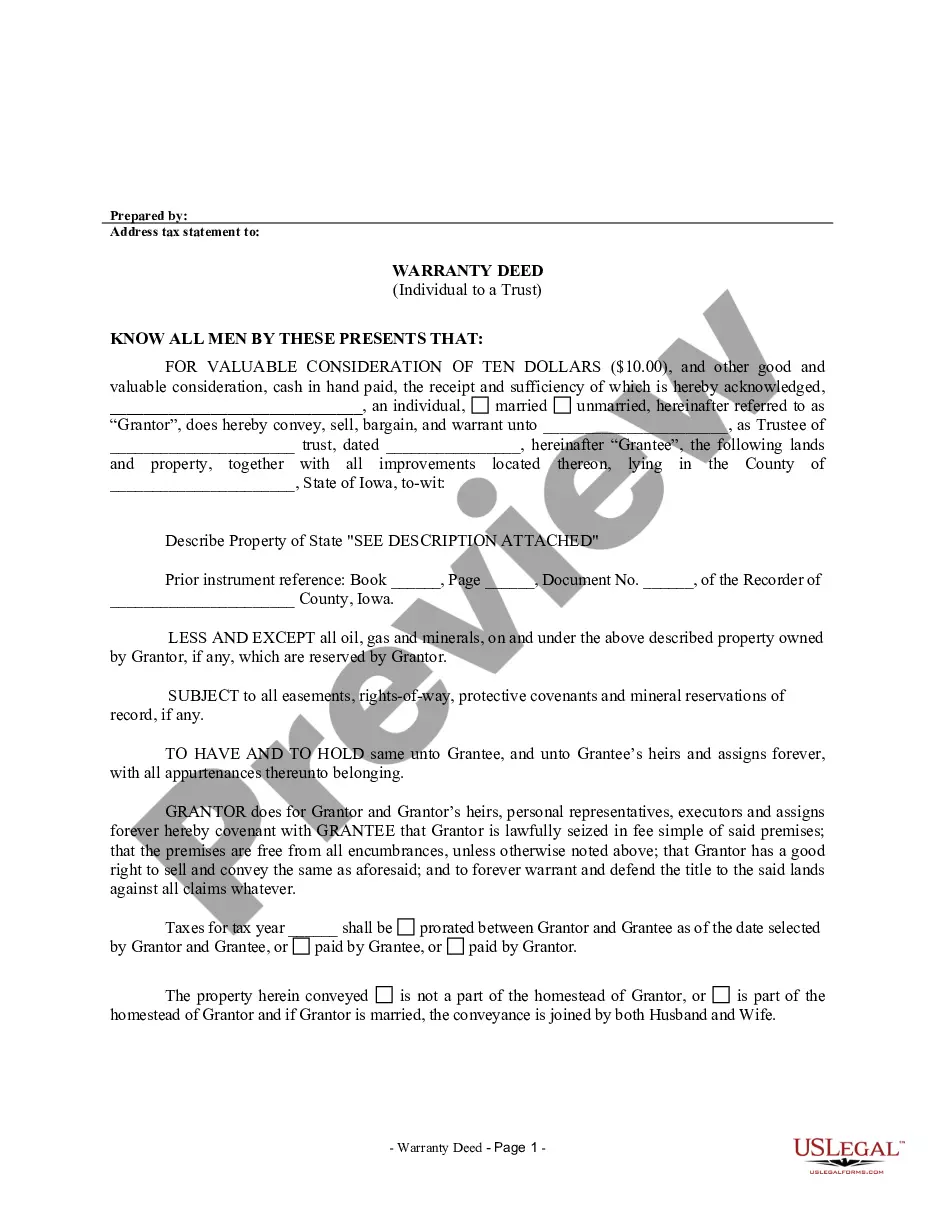
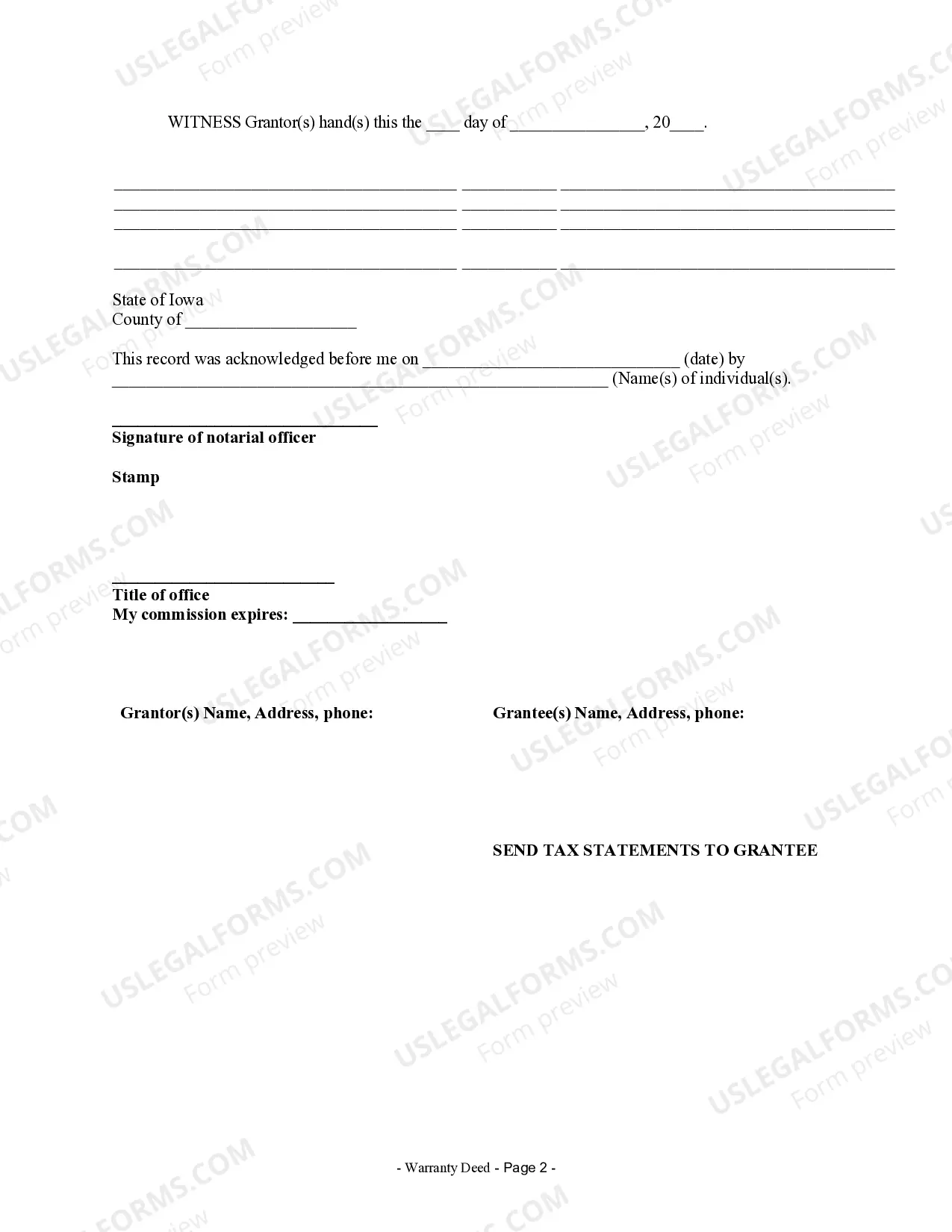
The Warranty Deed from Individual to a Trust is a legal document that allows an individual (the grantor) to transfer property ownership to a trust (the grantee). This deed provides a guarantee that the grantor holds a clear title to the property and is legally entitled to convey it. Unlike other types of deeds, a warranty deed offers specific assurances to the buyer that the property is free of liens and encumbrances, unless otherwise stated. This form is particularly useful for estate planning, allowing assets to be managed and protected within a trust structure.
Key parts of this document
- Identification of the grantor and grantee.
- A declaration of the valuable consideration provided by the grantor.
- Detailed description of the property being conveyed.
- Reservation of rights concerning oil, gas, and minerals.
- Assurances regarding the grantor's clear title to the property.
- Signatures of the grantor and notary acknowledgment.




When this form is needed
This form should be used when an individual wishes to transfer real estate to a trust for estate planning purposes, asset protection, or to simplify the inheritance process. It is also appropriate when transferring property as part of a financial strategy, ensuring the property is managed according to the terms of the trust.
Who can use this document
This form is intended for:
- Individuals looking to transfer property into a trust.
- Trustees managing property assets on behalf of the trust beneficiaries.
- Anyone involved in estate planning who wants to ensure a clear title transfer.
Instructions for completing this form
- Identify the parties: Enter the names and addresses of the grantor and grantee.
- Specify the property: Describe the property in detail, including any attached legal descriptions.
- Select the date: Fill in the date of the transfer.
- Sign the document: Have the grantor sign in the presence of a notary public.
- Get notarization: Ensure that the notary public completes the acknowledgment section.
Notarization requirements for this form
Yes, this form must be notarized to be legally valid. The notarization confirms the identity of the grantor and the voluntary nature of the signing. US Legal Forms offers integrated online notarization services, allowing you to complete this process securely via video call, ensuring convenience without the need for travel.
Get your form ready online
Our built-in tools help you complete, sign, share, and store your documents in one place.
Make edits, fill in missing information, and update formatting in US Legal Forms—just like you would in MS Word.
Download a copy, print it, send it by email, or mail it via USPS—whatever works best for your next step.
Sign and collect signatures with our SignNow integration. Send to multiple recipients, set reminders, and more. Go Premium to unlock E-Sign.
If this form requires notarization, complete it online through a secure video call—no need to meet a notary in person or wait for an appointment.
We protect your documents and personal data by following strict security and privacy standards.

Make edits, fill in missing information, and update formatting in US Legal Forms—just like you would in MS Word.

Download a copy, print it, send it by email, or mail it via USPS—whatever works best for your next step.

Sign and collect signatures with our SignNow integration. Send to multiple recipients, set reminders, and more. Go Premium to unlock E-Sign.

If this form requires notarization, complete it online through a secure video call—no need to meet a notary in person or wait for an appointment.

We protect your documents and personal data by following strict security and privacy standards.
Mistakes to watch out for
- Failing to accurately describe the property being transferred.
- Not obtaining the necessary notarization for the deed.
- Leaving out required signatures or dates.
- Ignoring potential encumbrances or rights of way on the property.
Benefits of using this form online
- Immediate access to a professionally drafted document.
- Convenience of completing the form at your own pace.
- Editability allows for customized entries specific to your situation.
- Ensures compliance with relevant state laws for validity.
Legal use & context
- This form creates a legally binding transfer of property rights from an individual to a trust.
- It is enforceable in court, provided it adheres to state requirements.
- Using a warranty deed offers stronger protection against future claims compared to a quitclaim deed.
Summary of main points
- A Warranty Deed from Individual to a Trust transfers property ownership while providing title guarantees.
- It is essential for estate planning and efficient property management.
- The form requires specific information and must be notarized to ensure validity.
Looking for another form?
Form popularity
FAQ
Yes, you can transfer a warranty deed. Specifically, when dealing with an Iowa Warranty Deed from Individual to a Trust, this process involves creating a new deed that designates the trust as the new owner of the property. It’s essential to follow state regulations to ensure a valid transfer, which may include notarizing the deed and filing it with the county recorder's office. For a seamless experience, consider using US Legal Forms to access templates and guidance that simplify the process.
The main disadvantage of a warranty deed is that it provides the buyer with full ownership rights while also exposing the grantor to liability for any title defects. If issues arise, the grantor may need to resolve them financially. Understanding these implications can help you decide on property transactions.
One disadvantage of a trust deed is that it allows the lender to initiate foreclosure without court involvement if the borrower defaults. This can make losing your property faster and more challenging to contest. Knowing this can help you weigh your financing options wisely.
Yes, you can write your own deed, including an Iowa Warranty Deed from Individual to a Trust. However, it is essential to ensure that all legal requirements are met for it to be valid. If you are unsure about the process, using a reliable platform like US Legal Forms can simplify the task and provide you with proper templates to follow.
Yes, you can sell a house that has a warranty deed. When you hold an Iowa Warranty Deed from Individual to a Trust, you can transfer ownership to the buyer effectively. Ensure all legal requirements are followed to complete the sale properly and protect the interests of all parties involved.
Yes, holding a warranty deed typically means you own the property outright. An Iowa Warranty Deed from Individual to a Trust provides assurance that the grantor has clear ownership without any claims against it. It's important to review this document carefully to confirm your rights and ownership.
To transfer a warranty deed, begin by preparing a new deed that specifies the transfer. You must sign the deed in the presence of a notary and then record it with the appropriate county office. Using a service like USLegalForms can help simplify the process of transferring your Iowa Warranty Deed from Individual to a Trust.
Yes, a trustee has the authority to give a warranty deed on behalf of the trust. When the trust holds an Iowa Warranty Deed from Individual to a Trust, the trustee can transfer the property using this type of deed. This ensures that the trustees convey full ownership and protect the rights of the beneficiaries.
Yes, a warranty deed can be transferred from one party to another. If you hold an Iowa Warranty Deed from Individual to a Trust, you can transfer the property to the trust. It's important to follow the legal procedures for transferring ownership and ensure that the deed reflects this change.
Choosing between a quitclaim deed and a trust depends on your objectives. A quitclaim deed transfers ownership without warranties, making it suitable for quick transfers. Conversely, a trust, especially an Iowa Warranty Deed from Individual to a Trust, offers asset protection and can help avoid probate. Consider your long-term goals before deciding.