Iowa Quitclaim Deed from Corporation to Husband and Wife
Understanding this form
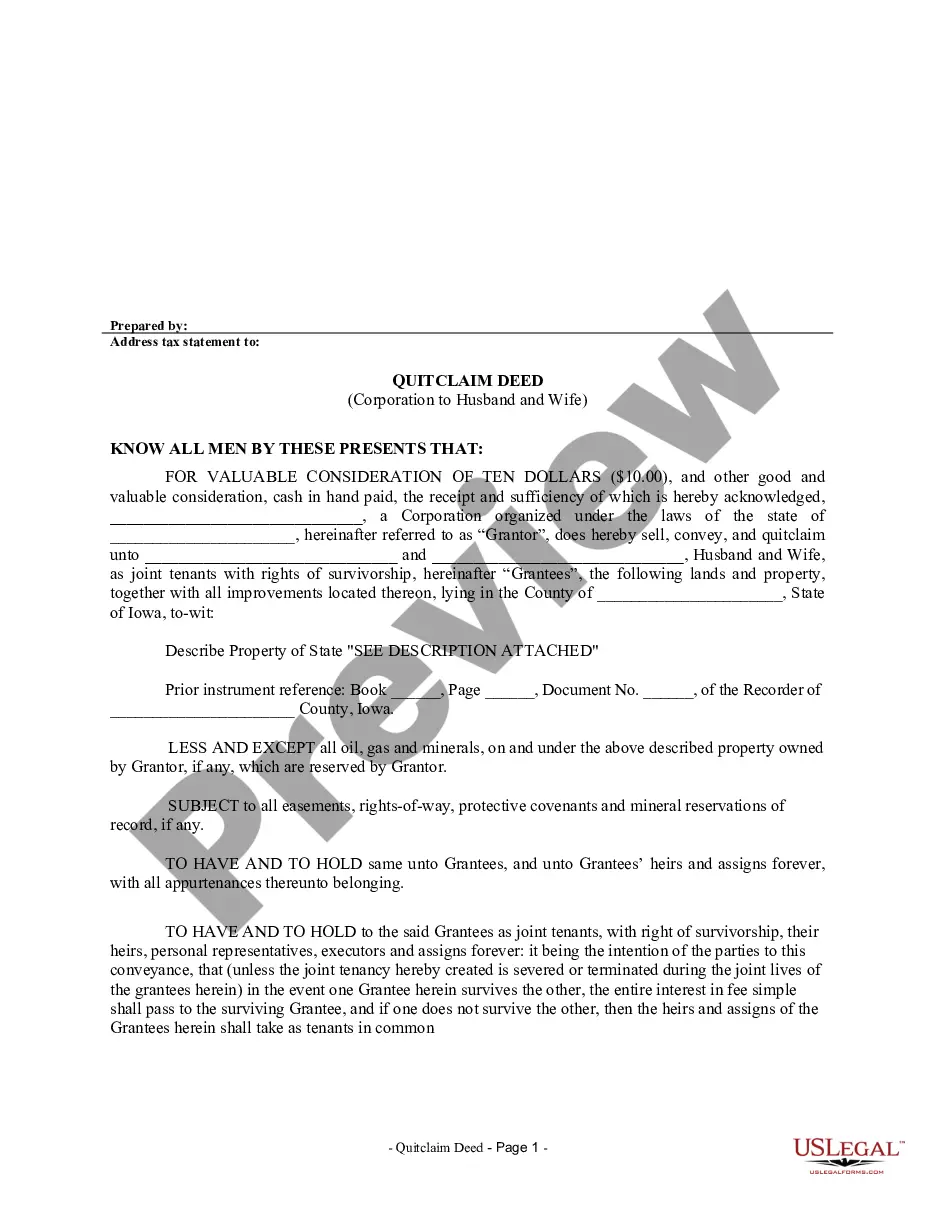
The Quitclaim Deed from Corporation to Husband and Wife is a legal document that transfers ownership of property from a corporation to a married couple. Unlike other types of deeds, a quitclaim deed does not guarantee that the property is free of any claims; it simply relinquishes the corporation's interest in the property. This form is essential for simplifying property transfer processes between entities and individuals, ensuring that both parties have a clear understanding of their rights to the property.
Main sections of this form
- Identification of the Grantor (the corporation) and Grantees (the husband and wife).
- Description of the property being transferred.
- Provisions for reserving rights to oil, gas, and minerals.
- Joint tenancy with rights of survivorship clause for the Grantees.
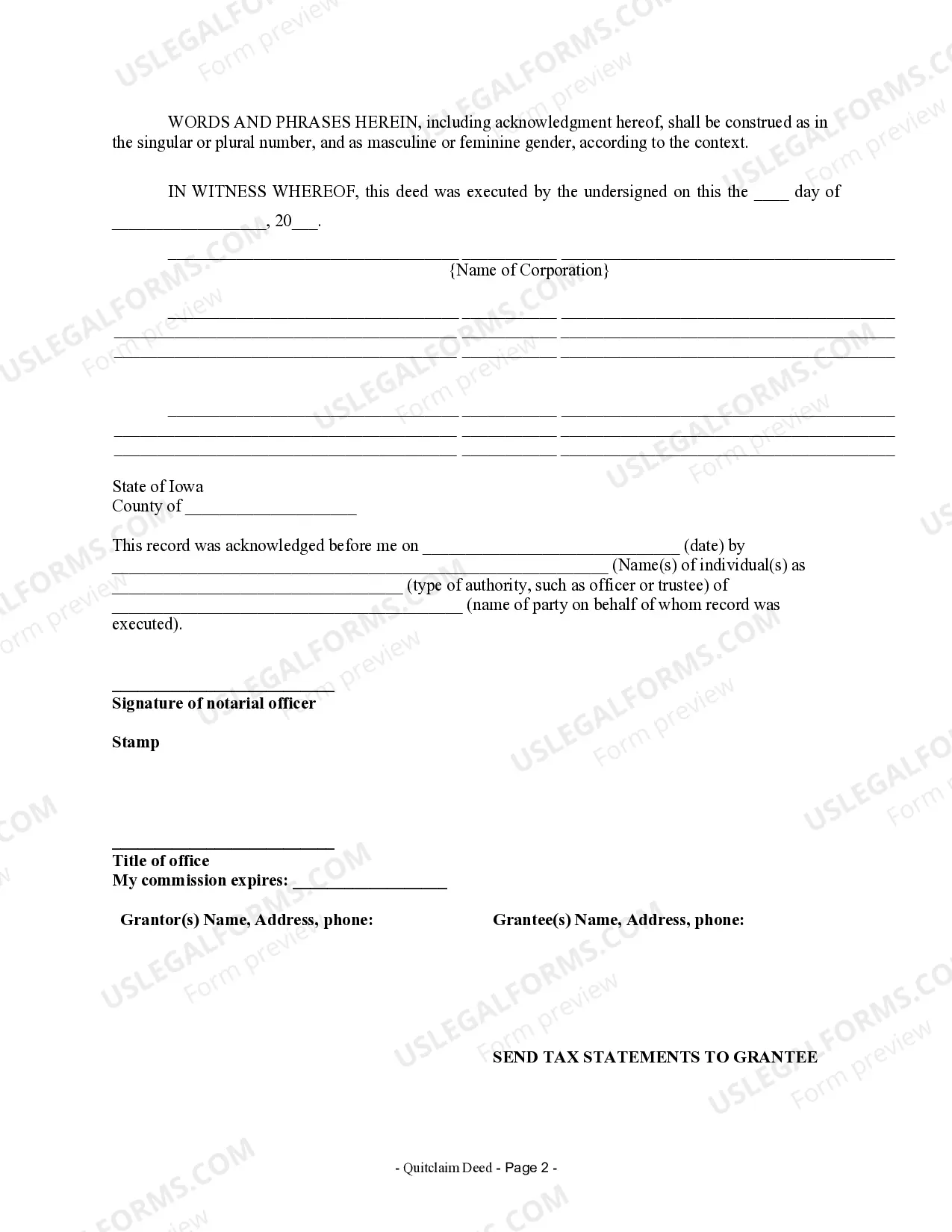
- Signatures of corporate officers and notary acknowledgment.




When to use this form
This form is typically used when a corporation wishes to transfer property to a husband and wife, often as part of a family estate planning process or to simplify the ownership structure of a property. It is useful when the corporation no longer needs ownership of the property or when transferring property as part of a personal financial arrangement.
Who this form is for
This form is intended for:
- Corporations that wish to transfer ownership of property to a married couple.
- Husbands and wives receiving property as joint tenants.
- Legal representatives of corporations handling property transfers.
Steps to complete this form
- Identify the corporation as the Grantor and enter the names of the couple as Grantees.
- Describe the property being transferred, including the street address and legal description.
- Insert the date of the transfer and the signatures of authorized corporate officers.
- Obtain a notary acknowledgment to validate the execution of the deed.
- File the deed with the appropriate county recorderâs office to make the transfer official.
Notarization requirements for this form
Yes, this form must be notarized to be legally valid. US Legal Forms provides integrated online notarization services, making it easy to complete your deed securely via video call, without the need to travel.
Get your form ready online
Our built-in tools help you complete, sign, share, and store your documents in one place.
Make edits, fill in missing information, and update formatting in US Legal Forms—just like you would in MS Word.
Download a copy, print it, send it by email, or mail it via USPS—whatever works best for your next step.
Sign and collect signatures with our SignNow integration. Send to multiple recipients, set reminders, and more. Go Premium to unlock E-Sign.
If this form requires notarization, complete it online through a secure video call—no need to meet a notary in person or wait for an appointment.
We protect your documents and personal data by following strict security and privacy standards.

Make edits, fill in missing information, and update formatting in US Legal Forms—just like you would in MS Word.

Download a copy, print it, send it by email, or mail it via USPS—whatever works best for your next step.

Sign and collect signatures with our SignNow integration. Send to multiple recipients, set reminders, and more. Go Premium to unlock E-Sign.

If this form requires notarization, complete it online through a secure video call—no need to meet a notary in person or wait for an appointment.

We protect your documents and personal data by following strict security and privacy standards.
Common mistakes to avoid
- Failing to include a complete legal description of the property.
- Not obtaining notarization, which is crucial for the deed's validity.
- Leaving out the necessary corporate officer signatures.
- Not specifying whether the property is held as joint tenants.
Benefits of completing this form online
- Convenience of accessing and downloading the form at any time.
- Editability allows customization to fit specific needs.
- Reliability of professionally drafted templates to ensure legal compliance.
Legal use & context
- This form is officially recognized in the state of Iowa for property transfers.
- Using a quitclaim deed does not guarantee title; it transfers whatever interest the Grantor may have in the property.
- This document is typically used for straightforward transfers and involves less legal complication than warranty deeds.
Quick recap
- The Quitclaim Deed from Corporation to Husband and Wife is a simple way to transfer property ownership.
- Proper completion and notarization of the form are essential for legal validity.
- Always verify any state-specific requirements before using the deed.
Looking for another form?
Form popularity
FAQ
In Iowa, a quitclaim deed transfers ownership without warranties or guarantees about the property. When you file an 'Iowa Quitclaim Deed from Corporation to Husband and Wife,' you simply convey your interest in the property to your spouse. This type of deed is often used in marital situations, seamlessly transitioning property rights. Always consult legal advice to ensure your deed serves your intentions effectively.
Yes, a title company can assist with a quitclaim deed. When executing an 'Iowa Quitclaim Deed from Corporation to Husband and Wife,' a title company can provide guidance and ensure that the document complies with state laws. They can also help facilitate the required title search and any necessary closing procedures, making the process smoother for you.
To fill out a quitclaim deed to add your spouse, start by downloading the appropriate form for your state, ensuring it reflects the 'Iowa Quitclaim Deed from Corporation to Husband and Wife.' Include the names of both spouses and a legal description of the property. After completing the form, sign it in front of a notary public. Finally, file the deed with your local county recorder’s office to finalize the addition.
Despite its simplicity, a quitclaim deed carries some risks. Most notably, it does not guarantee clear title, which means creditors can still pursue claims against the property. Users should also consider that once the deed is executed, there may be limited recourse for reclaiming ownership or addressing disputes. Consulting with a legal expert is advisable when contemplating an Iowa Quitclaim Deed from Corporation to Husband and Wife.
In Iowa, a quitclaim deed must be in writing, signed by the grantor, and typically notarized. Additionally, it should include a description of the property, ensuring clarity in the transfer. Utilizing a reputable platform like US Legal Forms can simplify this process, providing you with the necessary templates and guidance to comply with Iowa's rules.
A quitclaim deed does not override a will; instead, it transfers ownership of a property directly. With the quitclaim deed, the property immediately goes to the new owner, which can be independent of any will provisions. Therefore, if you are considering an Iowa Quitclaim Deed from Corporation to Husband and Wife, it’s important to review both the deed and any existing wills to avoid conflicts.
Quitclaim deeds are most often used to transfer property between family members or close associates. They are commonly employed in divorce settlements or to add a spouse to the title, ensuring a smooth and quick transfer of ownership. An Iowa Quitclaim Deed from Corporation to Husband and Wife can effectively facilitate these transitions without the complexities of traditional sales.
The primary beneficiaries of an Iowa Quitclaim Deed from Corporation to Husband and Wife are the individuals involved in the transfer. Typically, this deed suits couples wishing to simplify their property ownership without engaging in lengthy legal processes. Since it allows for easy transfer of property rights, family members or partners commonly utilize it to strengthen joint ownership.
Legally, you cannot add someone to a deed without their knowledge, as their consent is required to execute an Iowa Quitclaim Deed from Corporation to Husband and Wife. This type of transaction necessitates the agreement of both parties involved in the ownership. Furthermore, any added individual must sign the deed to ensure a valid transfer of interest.
A quitclaim deed cannot be used to transfer property that is subject to a mortgage without the lender's consent. Additionally, it is not appropriate in transfers involving liens or pending disputes regarding property ownership. You should also consider that a quitclaim deed does not guarantee clear title, so it may not be suitable in complex property situations.