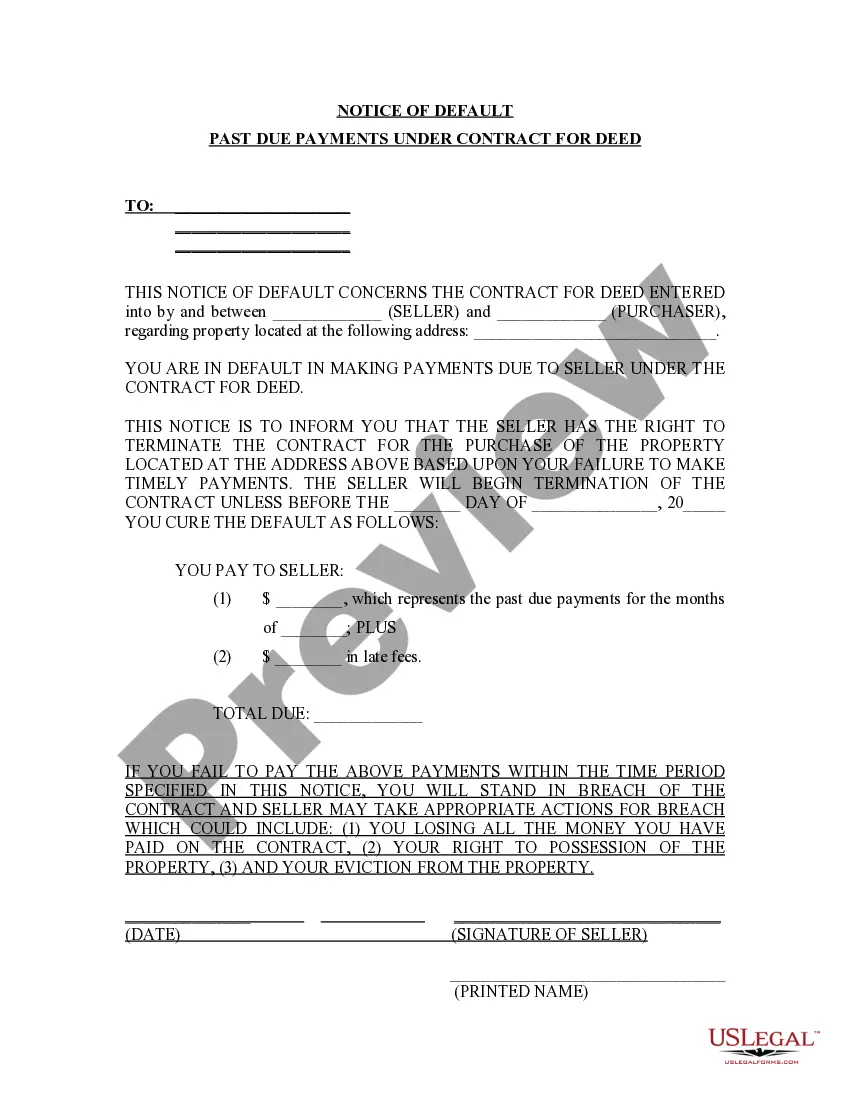
Georgia Notice of Default for Past Due Payments in connection with Contract for Deed
What is this form?
The Notice of Default for Past Due Payments in connection with Contract for Deed is a formal document that notifies a purchaser of late payments concerning a property bought under a contract for deed. This form serves as the seller's initial notification that the payment terms have not been met. It is crucial in informing the purchaser that failure to resolve the overdue payments could lead to a default on the contract.
Main sections of this form
- Identification of the seller and purchaser involved in the contract.
- Details of the contract for deed, including payment terms and due dates.
- Explicitly states the amount past due and any accrued penalties.
- A statement of the consequences of failing to cure the default.
- Instructions on how the purchaser can rectify the situation.
When to use this document
This form is used when a purchaser has failed to make timely payments as outlined in the contract for deed. It is important for sellers to send this notice as part of the formal process to document the default and provide the purchaser an opportunity to rectify their payment situation before further legal action may be taken.
Intended users of this form
- Sellers of real estate under a contract for deed.
- Purchasers who are late on payments and need to understand the default process.
- Real estate professionals involved in contract for deed transactions.
How to prepare this document
- Identify the parties involved: enter the names of the seller and purchaser.
- Specify the property: provide details including the address and legal description of the property.
- Detail the payment information: indicate the amount past due and any penalties accrued.
- State the consequences of non-compliance: clearly outline what will happen if the default is not cured.
- Include dates: make sure to sign and date the form as required.
Does this form need to be notarized?
Notarization is required for this form to take effect. Our online notarization service, powered by Notarize, lets you verify and sign documents remotely through an encrypted video session, available 24/7.
Get your form ready online
Our built-in tools help you complete, sign, share, and store your documents in one place.
Make edits, fill in missing information, and update formatting in US Legal Forms—just like you would in MS Word.
Download a copy, print it, send it by email, or mail it via USPS—whatever works best for your next step.
Sign and collect signatures with our SignNow integration. Send to multiple recipients, set reminders, and more. Go Premium to unlock E-Sign.
If this form requires notarization, complete it online through a secure video call—no need to meet a notary in person or wait for an appointment.
We protect your documents and personal data by following strict security and privacy standards.

Make edits, fill in missing information, and update formatting in US Legal Forms—just like you would in MS Word.

Download a copy, print it, send it by email, or mail it via USPS—whatever works best for your next step.

Sign and collect signatures with our SignNow integration. Send to multiple recipients, set reminders, and more. Go Premium to unlock E-Sign.

If this form requires notarization, complete it online through a secure video call—no need to meet a notary in person or wait for an appointment.

We protect your documents and personal data by following strict security and privacy standards.
Common mistakes to avoid
- Failing to accurately identify the parties involved in the contract.
- Not specifying the exact amount that is past due.
- Omitting date fields or signature necessary for the document to be effective.
- Not providing clear instructions for remedying the default.
Why use this form online
- Convenience: access and complete the form at any time from anywhere.
- Editability: easily make adjustments and personalize the form to fit your situation.
- Reliability: ensure you are using a legally sound document drafted by licensed attorneys.
Looking for another form?
Form popularity
FAQ
Yes, it is possible to default on a contract if one party fails to fulfill their obligations. For example, missing payments on a Contract for Deed can constitute a default. This situation can lead to significant legal repercussions, including the issuance of a Georgia Notice of Default for Past Due Payments. To mitigate such risks, users can leverage the resources available on USLegalForms, which provides essential templates and information to help manage contract defaults effectively.
The default rule in a contract refers to the standard conditions that apply if no specific terms are mentioned. In the context of a Contract for Deed, if a buyer defaults on payment, the seller may have the right to terminate the agreement and reclaim the property. Understanding these default rules is crucial, as they help both parties navigate potential conflicts. Initiating a Georgia Notice of Default for Past Due Payments can clarify these expectations and protect the seller's rights.
A default occurs when one party fails to meet the terms outlined in a contract. For instance, if a buyer fails to make timely payments on a Contract for Deed, this can be categorized as a default. In Georgia, a Notice of Default for Past Due Payments serves as a formal notification to the buyer, indicating their payment obligations have not been fulfilled. This document outlines the consequences of continued non-payment, urging the buyer to take action.
Typically, the buyer is responsible for paying property taxes in a Contract for Deed arrangement. However, this can vary based on the agreement's specifics. If you are faced with a Georgia Notice of Default for Past Due Payments, understanding your financial responsibilities, including property taxes, becomes even more critical. Always clarify these details before entering into such agreements to avoid surprises down the line.
One disadvantage of a Contract for Deed is that the seller retains the legal title until all payments are made, which limits the buyer's rights. Another disadvantage is that if a payment is missed, the buyer may receive a Georgia Notice of Default for Past Due Payments, leading to potential loss of the property without the usual foreclosure process. Understanding these risks can help you make an informed decision about your investment. It’s essential to weigh these factors carefully.
You can default on a contract by failing to meet the agreed terms, such as making late payments or not making payments at all. When you miss a payment on a Contract for Deed, it may lead to a Georgia Notice of Default for Past Due Payments. This notice serves as a formal reminder of the missed obligations and can initiate a process to resolve the default. It is crucial to address these issues quickly to avoid further penalties.