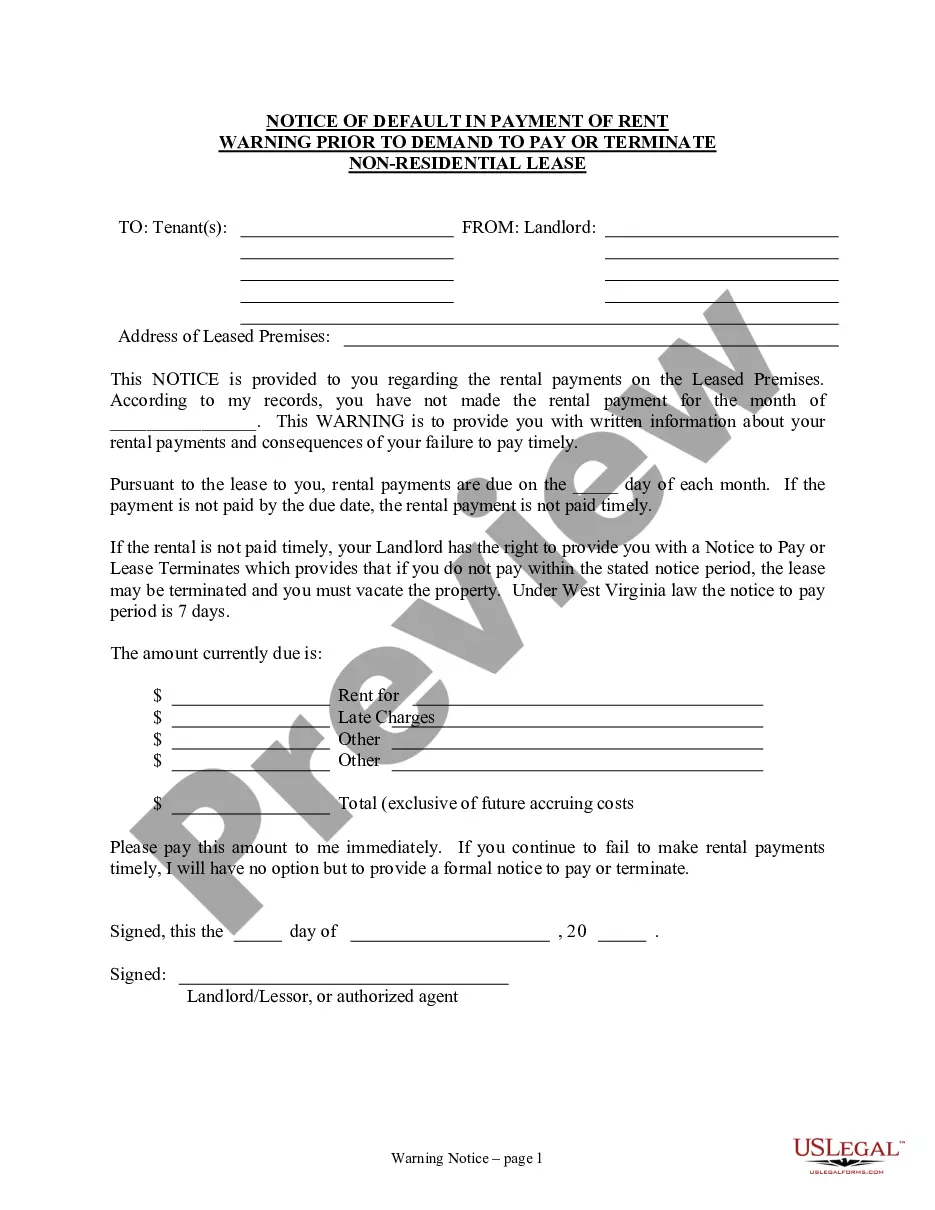
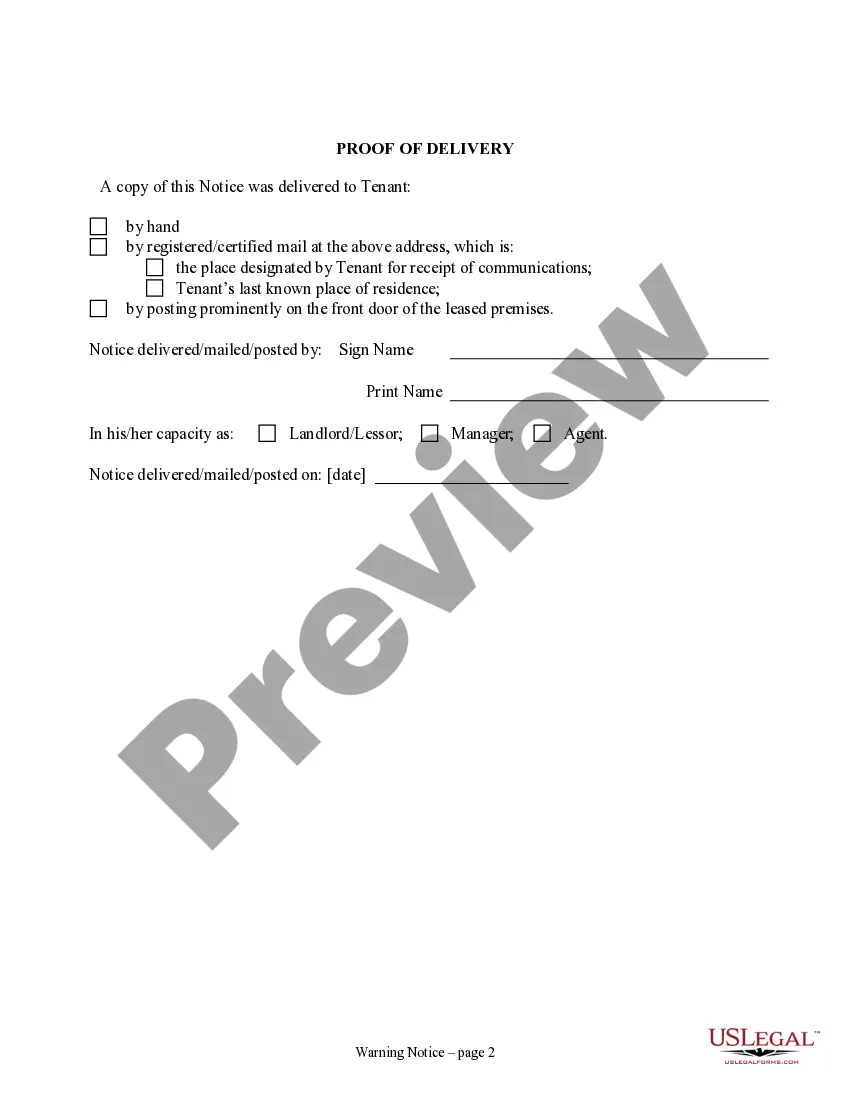
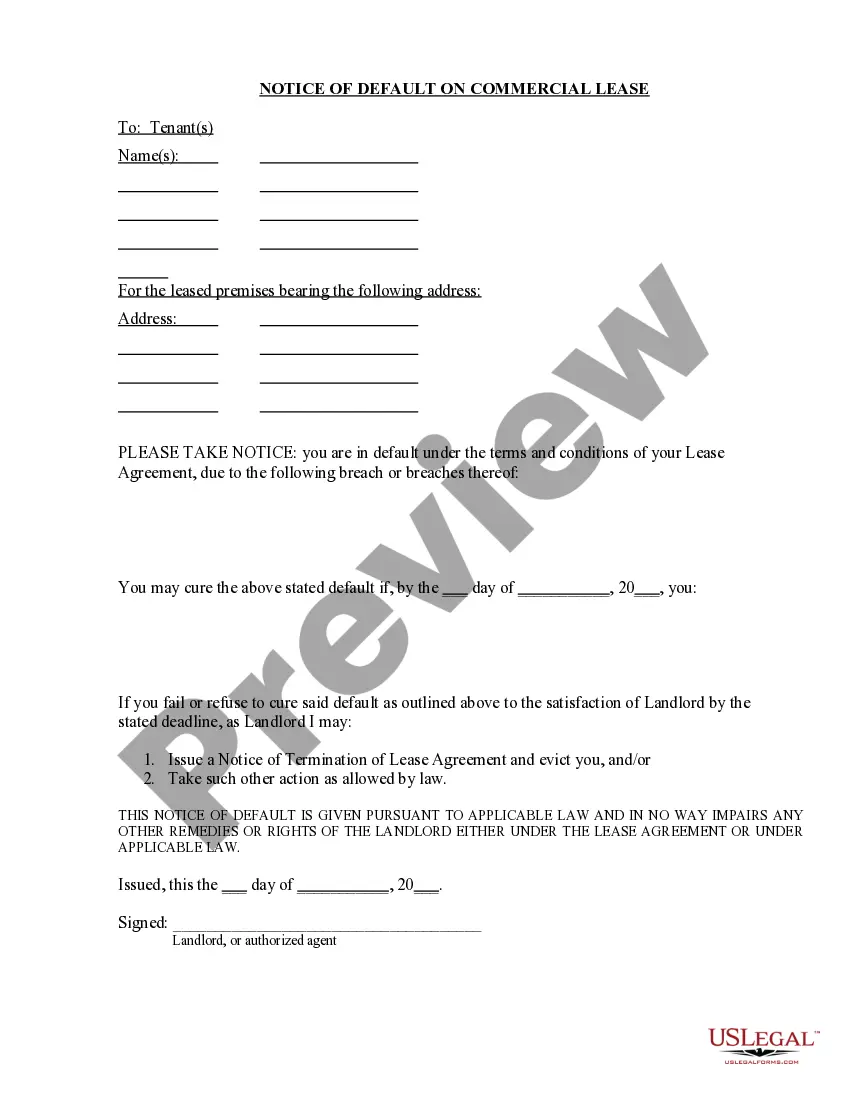
This Notice of Default in Payment of Rent as Warning Prior to Demand to Pay or Terminate for Non-Residential or Commercial Property form is for use by a Landlord to inform Tenant of Tenant's default in the payment of rent as a warning prior to a pay or terminate notice. The form advises the Tenant of the due date of rent and the consequences of late payment. This form may be used where you desire to remind the Tenant of payment terms, the default, demand payment and inform the Tenant that under the laws of this state or lease, the Landlord may terminate if rent is not paid timely.
West Virginia Notice of Default in Payment of Rent as Warning Prior to Demand to Pay or Terminate for Nonresidential or Commercial Property
State:
West Virginia
Control #:
WV-1301LT
Format:
Word;
Rich Text
Instant download
Description
Free preview


How to fill out West Virginia Notice Of Default In Payment Of Rent As Warning Prior To Demand To Pay Or Terminate For Nonresidential Or Commercial Property?
Out of the large number of platforms that provide legal samples, US Legal Forms offers the most user-friendly experience and customer journey while previewing templates before purchasing them. Its comprehensive catalogue of 85,000 templates is grouped by state and use for simplicity. All the documents on the service have already been drafted to meet individual state requirements by accredited lawyers.
If you already have a US Legal Forms subscription, just log in, look for the form, click Download and obtain access to your Form name from the My Forms; the My Forms tab holds all of your downloaded forms.
Stick to the guidelines below to obtain the form:
- Once you see a Form name, make sure it is the one for the state you really need it to file in.
- Preview the form and read the document description just before downloading the template.
- Search for a new sample using the Search engine in case the one you’ve already found isn’t proper.
- Just click Buy Now and choose a subscription plan.
- Create your own account.
- Pay with a card or PayPal and download the template.
When you’ve downloaded your Form name, you may edit it, fill it out and sign it with an web-based editor that you pick. Any document you add to your My Forms tab might be reused many times, or for as long as it remains the most up-to-date version in your state. Our platform provides fast and easy access to samples that fit both legal professionals and their clients.
Form popularity
FAQ
A landlord cannot legally evict you without a court order, whether or not you have a lease.) How long does it take for a landlord to evict a tenant? A landlord can evict a tenant only by going through a formal eviction proceeding, which can take a few weeks from start to finish.
State law prohibits landlords from entering rental housing without either the consent of the tenant or providing reasonable notice in advance, unless circumstances require the landlord to perform emergency repairs.
West Virginia Eviction Process Timeline Initial Notice Period 30-90 days, but only required for no lease/end of lease evictions. Issuance/Service of Summons and Complaint Within 10 days before the hearing; but if not served within 120 days, the eviction case may be dismissed.
In some circumstances, a tenant can break a fixed-term agreement early without penalty. A tenant can give 14 days' written notice to end an agreement early without penalty if: they have accepted an offer of social housing (e.g. from DCJ Housing)
A landlord who wants to evict a tenant must have a good reason (legal cause) to do so. West Virginia defines legal cause as failing to pay rent, violating the lease or rental agreement, or damaging the rental unit. To evict the tenant for one of these reasons, the landlord must first terminate the tenancy.
Give the landlord/agent a written termination notice and vacate move out and return the keys according to your notice, and/or. apply to the NSW Civil & Administrative Tribunal (NCAT) for a termination order.
Notice to Terminate Tenancy Month to Month Lease: For any lease under the term of one year, either party can terminate the lease by providing the other party written notice prior to the end of the lease. For a month to month lease, 30 days must be given. pursuant to §37-6-5.
This notice will inform the tenant that the tenant has 21 days to either remedy the violation or move out of the rental unit. If the tenant does not remedy the violation or move, then the landlord can file an eviction lawsuit against the tenant at the end of the 30 days. (Va. Code Ann.
Tenants may also file a complaint with the Attorney General's Consumer Protection Division if landlords fail to return damage deposits. Complaint forms may be obtained by calling the consumer protection hotline, toll-free, at 1-800-368-8808.