West Virginia Boarding Stable Agreement - Horse Equine Forms
Understanding this form
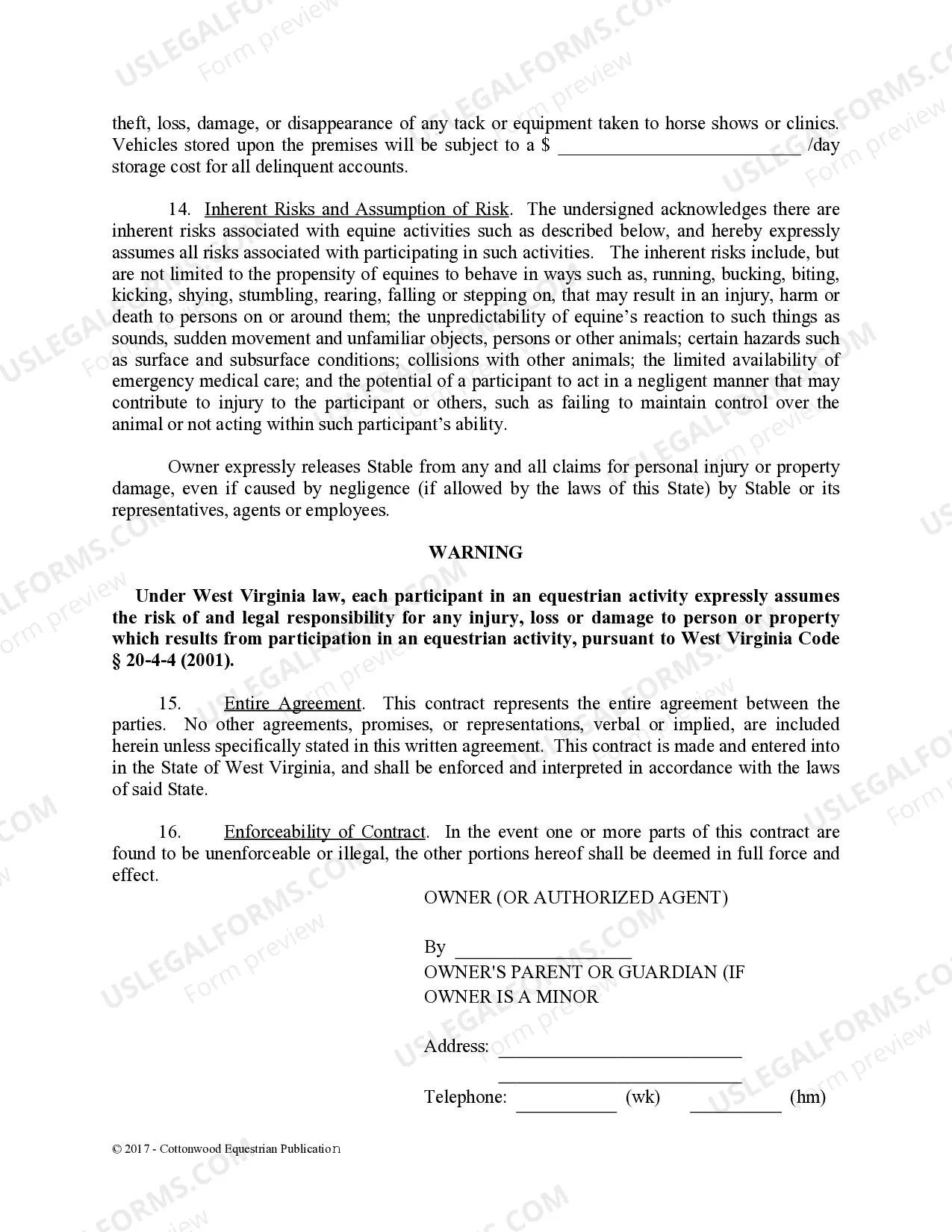
The Boarding Stable Agreement is a legal document that outlines the terms between a stable owner and a horse owner regarding the care and boarding of horses. This agreement is essential for defining the responsibilities, fees, and liabilities of both parties, ensuring clarity and protection for everyone involved. Unlike informal agreements, this comprehensive document includes critical provisions related to fees, care standards, and risk management, making it a vital resource for horse owners seeking secure boarding options.
What’s included in this form
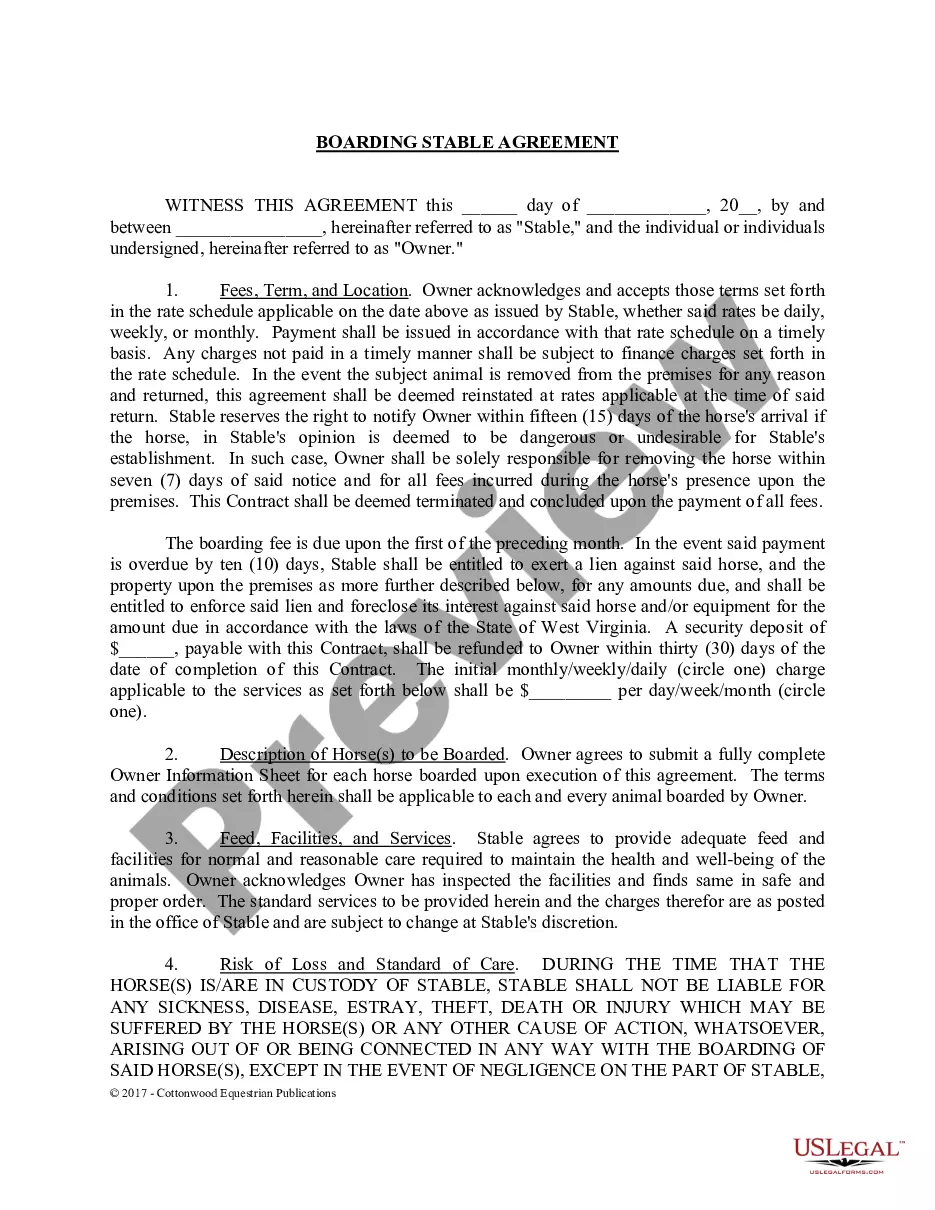
- Fees, terms, and boarding location details.
- Description of horse(s) to be boarded.
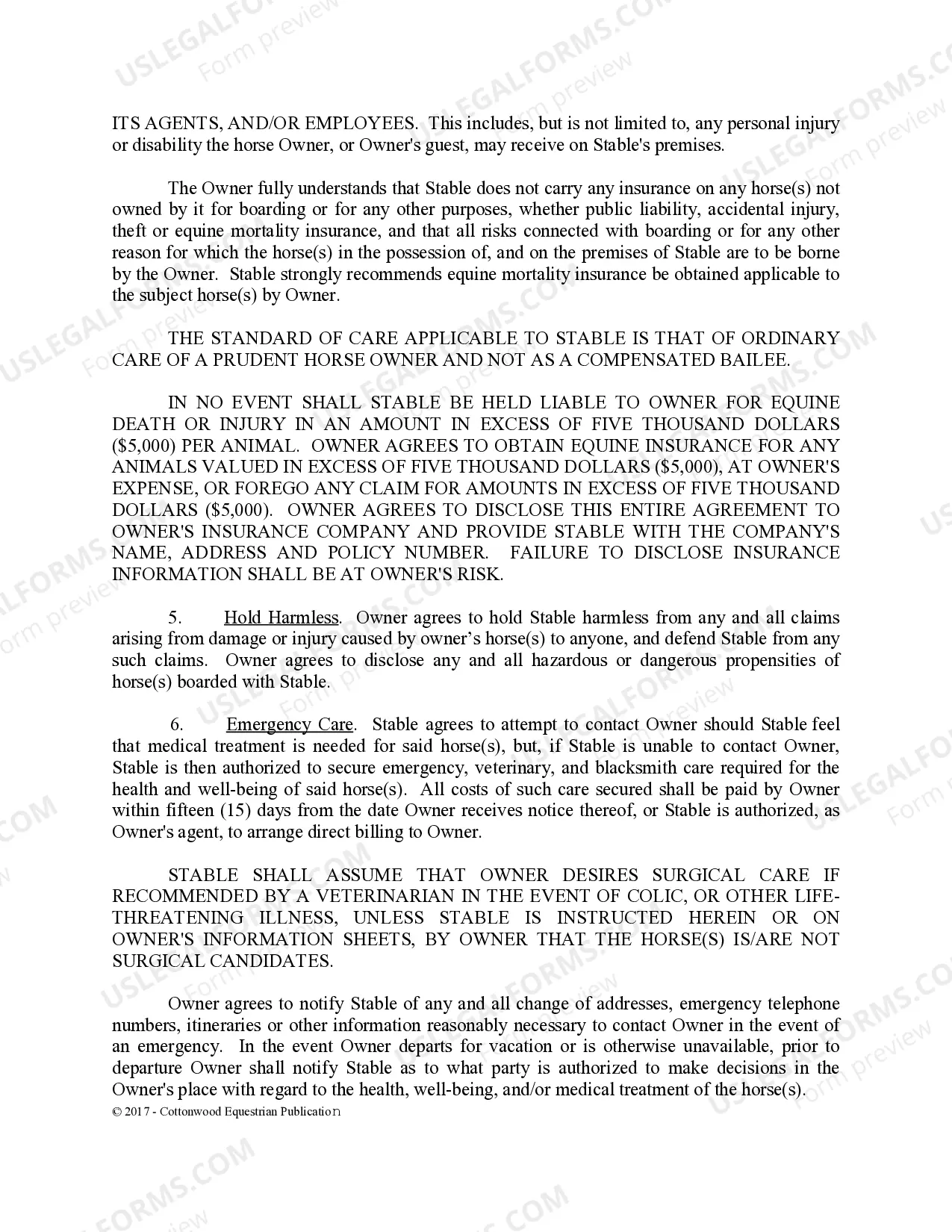
- Standard of care and risk of loss clauses.
- Emergency care provisions and responsibilities.
- Hold harmless agreement for liability protection.
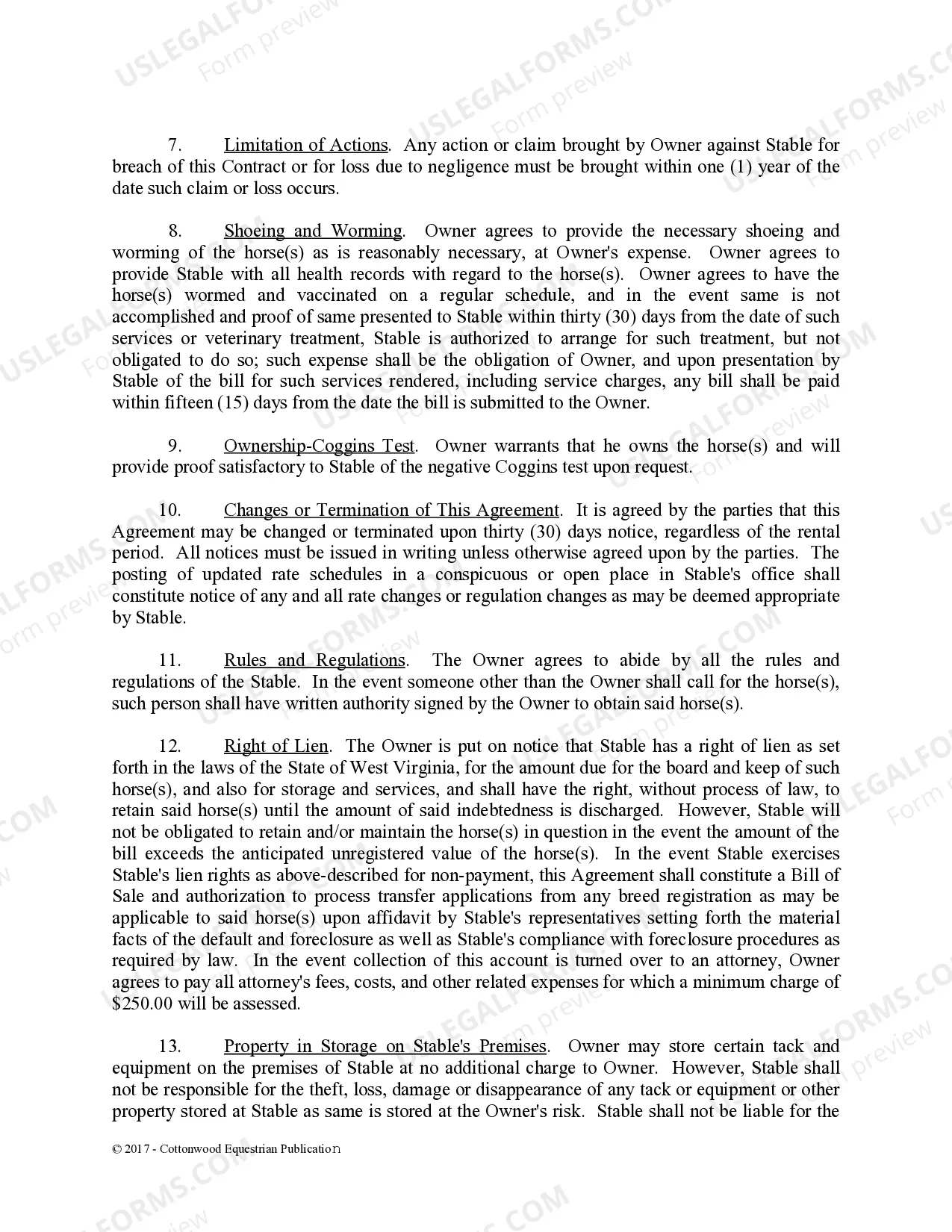
- Termination and modification terms of the agreement.
- Right of lien for unpaid fees.
- Rules and regulations compliance for all boarders.

When to use this document
This form should be used whenever a horse owner wishes to board their horse at a stable. It is particularly useful in situations where the horse owner wants to ensure clear terms regarding fees, responsibilities for care, and liability concerns. This agreement is ideal for both new arrangements and existing boarding situations that need formalization or clarity regarding the terms of service.
Who can use this document
This form is suitable for:
- Horse owners seeking boarding facilities for their horses.
- Stable owners and managers providing boarding services.
- Individuals or parties responsible for multiple horses needing a boarding agreement.
- Any party looking to clarify responsibilities and liabilities in a horse boarding scenario.
How to complete this form
- Identify the parties involved: fill in the stable name and owner's details at the start of the agreement.
- Specify the fees: enter the applicable boarding fees and payment schedule based on the stable's rate schedule.
- Describe the horse(s): provide required information for each horse that will be boarded.
- Review and acknowledge care responsibilities: read and agree to the standard of care, emergency protocols, and liability terms.
- Ensure compliance with rules: familiarize yourself with and agree to the stable's rules and regulations section of the agreement.
Is notarization required?
Notarization is not commonly needed for this form. However, certain documents or local rules may make it necessary. Our notarization service, powered by Notarize, allows you to finalize it securely online anytime, day or night.
Get your form ready online
Our built-in tools help you complete, sign, share, and store your documents in one place.
Make edits, fill in missing information, and update formatting in US Legal Forms—just like you would in MS Word.
Download a copy, print it, send it by email, or mail it via USPS—whatever works best for your next step.
Sign and collect signatures with our SignNow integration. Send to multiple recipients, set reminders, and more. Go Premium to unlock E-Sign.
If this form requires notarization, complete it online through a secure video call—no need to meet a notary in person or wait for an appointment.
We protect your documents and personal data by following strict security and privacy standards.

Make edits, fill in missing information, and update formatting in US Legal Forms—just like you would in MS Word.

Download a copy, print it, send it by email, or mail it via USPS—whatever works best for your next step.

Sign and collect signatures with our SignNow integration. Send to multiple recipients, set reminders, and more. Go Premium to unlock E-Sign.

If this form requires notarization, complete it online through a secure video call—no need to meet a notary in person or wait for an appointment.

We protect your documents and personal data by following strict security and privacy standards.
Mistakes to watch out for
- Failing to provide complete and accurate horse description information.
- Not reviewing the boarding fees and payment terms thoroughly.
- Overlooking the emergency care clause and implications of not notifying the stable.
- Neglecting to read and understand the liability and risk of loss conditions.
- Not using the correct state-specific terms or failing to verify local regulations.
Benefits of using this form online
- Instant access to the form allows for quick completion and use.
- Downloadable format enables easy printing and sharing.
- Clear formatting and structure make it user-friendly, even for those unfamiliar with legal documents.
- Flexibility in editing ensures it can be customized to suit specific boarding situations.
- Availability of legal guidance helps ensure all necessary terms are included.
What to keep in mind
- The Boarding Stable Agreement formalizes the relationship between horse owners and stable managers, protecting both parties legally.
- Understanding each component of the agreement is crucial for ensuring proper care and management of the horse.
- Always review the specific conditions and regulations that apply at the stable being used to avoid misunderstandings.
Looking for another form?

Form popularity
FAQ
On top of the Full Mortality (life insurance) on your horse, you should consider Major Medical Insurance (health insurance). Upwards of 90% of the claims we see in our office are Major Medical claims, and not mortality claims. Horses tend to get sick or hut more than they die.
There really is no set definition. Basically, it can be defined as the practice of law that involves all types of horses, horse-related activities, horse businesses, horse organizations, and horse facilities.Others handle disputes and litigation arising from an equine transaction.
Horse Insurance Cost In general, you can expect to pay roughly $150-200 per year for $5,000 worth of major medical coverage expenses. Surgical coverage rates vary widely. Mortality premiums are based on the age, use, and value of your horse.
The cost of boarding averages $400 to $500 per month but can go as high as $1,200 to $2,500 in metropolitan areas. Services such as mucking out stalls, feeding and turning out your horse to pasture may not be included in the price. For those lucky enough to own sufficient land, there are still costs to consider.
AS an instructor, you obviously need insurance cover to protect you in the course of your commercial activities. Anyone involved in business-related equestrian activities should have public liability insurance.
Scope out legalities. Consider zoning, business permits and your state's lien laws. Evaluate your facilities. Investigate the cost of liability insurance. Research your market. Crunch the numbers. Draw up a legal boarding contract.
Numbers Game. The reality is that boarding facilities operate on slim profit margins. By the time costs are considered for hay, grain, bedding, labor for feeding, cleaning stalls, doing turnout, etc., the board fees typically do not leave a lot left over, Sherrick-von Schiller said.Labor costs are also significant.
While boarding horses is satisfying work, you won't want to do it for free. Expect to charge between $200 and $800 or more per month for full-board depending on your geographic locale, facilities and the type and quality of services you offer. Make certain it's enough!
Equine/Stable Liability will be required; Care, Custody, Control to provide coverage for the non-owned boarded horses; General Liability and Property insurance.