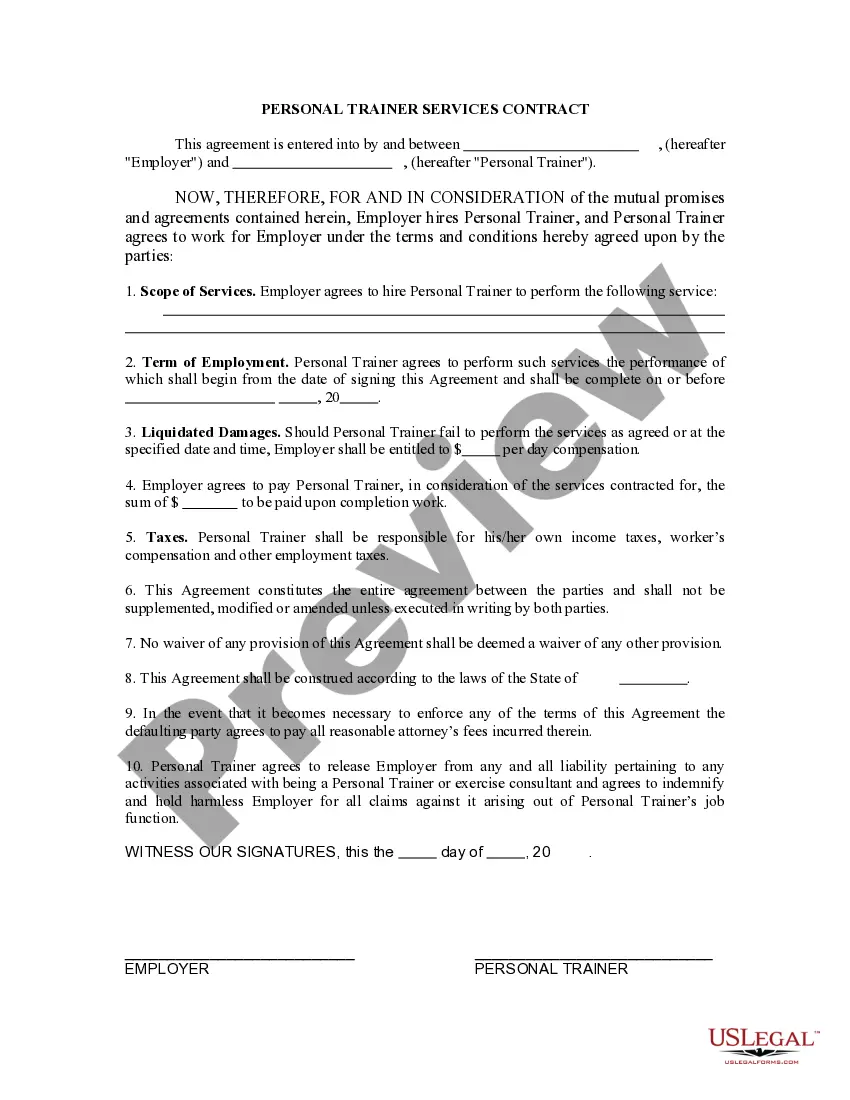
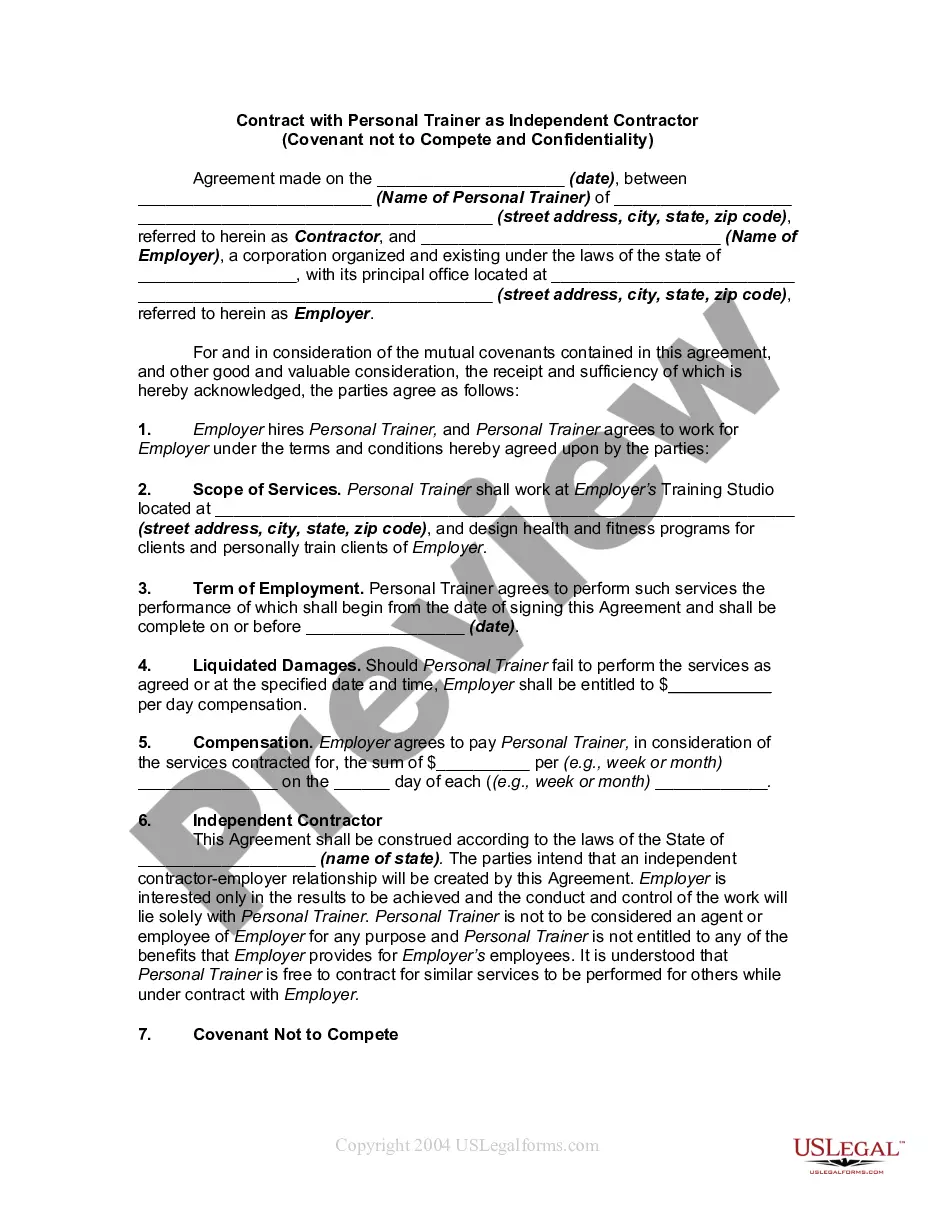
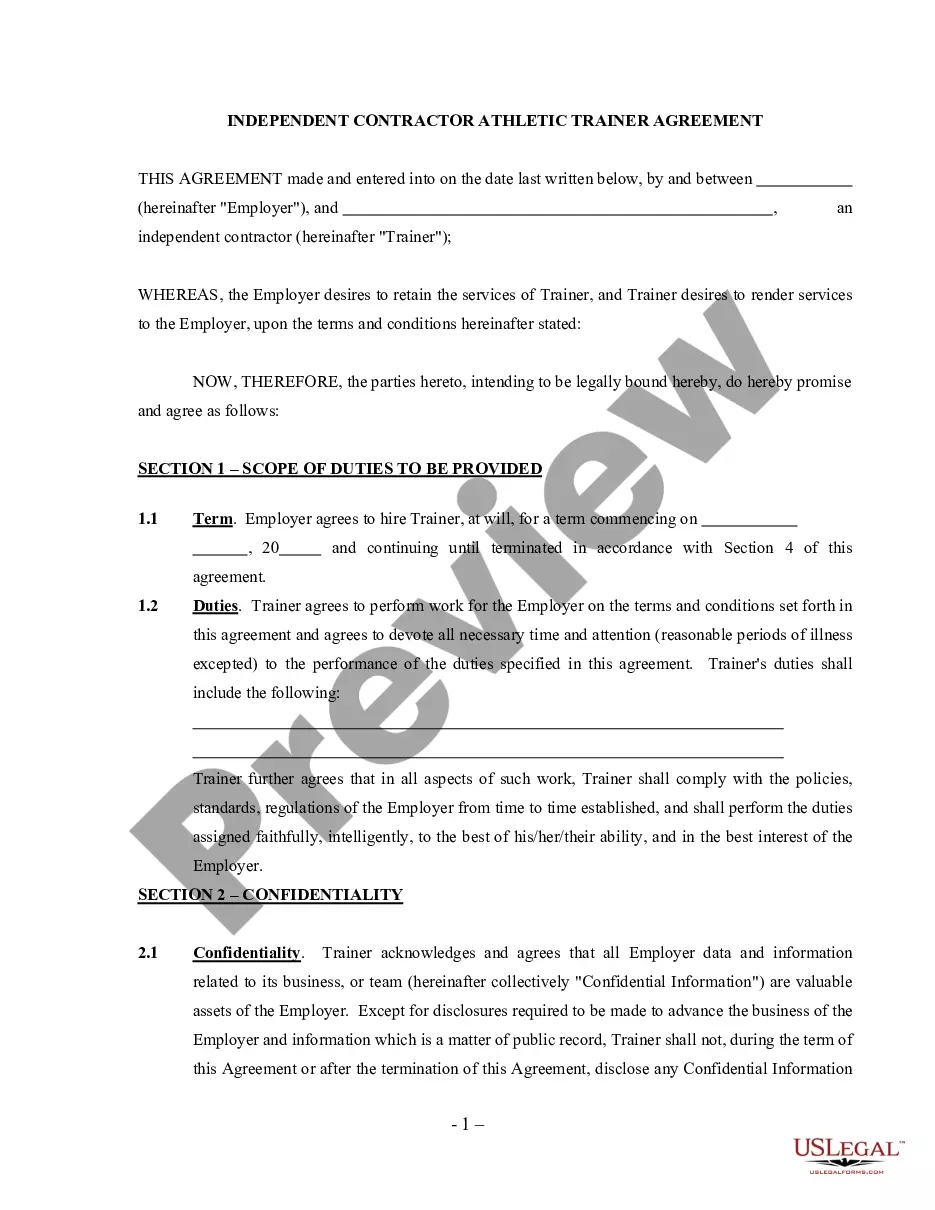
This is a contract whereby a personal trainer is hired by an employer to train clients or customers in a workout facility or gym. This contract also includes a release from liability releasing the owner from liability to clients.
Wisconsin Self-Employed Personal Trainer or Training Services Contract
State:
Multi-State
Control #:
US-INDC-49
Format:
Word;
Rich Text
Instant download
Description

Get your form ready online
Our built-in tools help you complete, sign, share, and store your documents in one place.
Built-in online Word editor
Make edits, fill in missing information, and update formatting in US Legal Forms—just like you would in MS Word.
Export easily
Download a copy, print it, send it by email, or mail it via USPS—whatever works best for your next step.
E-sign your document
Sign and collect signatures with our SignNow integration. Send to multiple recipients, set reminders, and more. Go Premium to unlock E-Sign.
Notarize online 24/7
If this form requires notarization, complete it online through a secure video call—no need to meet a notary in person or wait for an appointment.
Store your document securely
We protect your documents and personal data by following strict security and privacy standards.

Make edits, fill in missing information, and update formatting in US Legal Forms—just like you would in MS Word.

Download a copy, print it, send it by email, or mail it via USPS—whatever works best for your next step.

Sign and collect signatures with our SignNow integration. Send to multiple recipients, set reminders, and more. Go Premium to unlock E-Sign.

If this form requires notarization, complete it online through a secure video call—no need to meet a notary in person or wait for an appointment.

We protect your documents and personal data by following strict security and privacy standards.
Looking for another form?





How to fill out Self-Employed Personal Trainer Or Training Services Contract?
If you need to obtain, download, or create legal document templates, utilize US Legal Forms, the largest assortment of legal forms available online.
Take advantage of the site’s straightforward and user-friendly search feature to find the documents you need.
Various templates for business and personal purposes are categorized by types and states, or keywords.
Step 4. Once you have found the form you need, click the Buy Now button. Choose the pricing plan you prefer and enter your information to register for an account.
Step 5. Process the payment. You can use your credit card or PayPal account to complete the transaction. Step 6. Select the format of the legal document and download it to your device. Step 7. Fill out, modify, and print or sign the Wisconsin Self-Employed Personal Trainer or Training Services Agreement. Each legal document template you purchase is yours permanently. You have access to every form you downloaded in your account. Choose the My documents section and select a form to print or download again. Compete and download, and print the Wisconsin Self-Employed Personal Trainer or Training Services Agreement with US Legal Forms. There are millions of professional and state-specific forms available for your business or personal needs.
- Employ US Legal Forms to locate the Wisconsin Self-Employed Personal Trainer or Training Services Agreement with just a few clicks.
- If you are already a US Legal Forms user, Log In to your account and click the Download button to obtain the Wisconsin Self-Employed Personal Trainer or Training Services Agreement.
- You can also access forms you previously downloaded from the My documents section of your account.
- If you are using US Legal Forms for the first time, follow the steps below.
- Step 1. Ensure you have selected the form for the correct city/state.
- Step 2. Use the Preview option to review the form’s content. Remember to read the description.
- Step 3. If you are not satisfied with the form, use the Search field at the top of the screen to find other forms from the legal document template.
Form popularity
FAQ
In Wisconsin, personal trainers typically operate as 1099 independent contractors rather than traditional employees. This classification means they are self-employed and responsible for their own taxes, insurance, and benefits. To formalize this relationship, a Wisconsin Self-Employed Personal Trainer or Training Services Contract is essential. This contract outlines the terms of service, payment agreements, and expectations, ensuring clarity for both trainers and clients.
Determining whether $300 a month is a lot for a personal trainer depends on various factors, such as location and training frequency. In Wisconsin, this rate might be reasonable for personalized attention and tailored programs. Consider comparing this rate to other local trainers and the services they offer. Ultimately, the value of your investment in a Wisconsin Self-Employed Personal Trainer lies in the results and improvements you achieve.
To create a personal training contract, you should clearly define your services and responsibilities as a Wisconsin Self-Employed Personal Trainer. Include sections on client expectations, liability waivers, and payment arrangements. Utilizing tools from US Legal Forms can streamline this process, allowing you to customize a contract that meets your specific needs. A well-crafted contract fosters trust and professionalism.
Creating a contract as a Wisconsin Self-Employed Personal Trainer involves outlining key aspects of your services. Start by detailing the scope of your training services, payment terms, and cancellation policies. You can use templates from platforms like US Legal Forms to ensure you include all necessary legal elements. This step helps protect both you and your clients.
Yes, a personal trainer can be self-employed, which many choose to achieve greater flexibility in their careers. As a self-employed personal trainer, you can work with clients independently, set your rates, and create personalized training programs. Establishing a Wisconsin self-employed personal trainer or training services contract can help clarify your responsibilities and agreements with clients, ensuring a professional relationship.
Personal trainers file taxes as self-employed individuals, typically using Schedule C to report earnings and expenses. It is crucial to keep accurate records of all income and expenses related to your training services, as these can significantly impact your tax liability. Consider using accounting software or consulting with a tax professional familiar with the specifics of a Wisconsin self-employed personal trainer's tax obligations.
To register as a self-employed personal trainer in Wisconsin, you typically need to obtain a business license and register your business name. You may also need to apply for an Employer Identification Number (EIN) if you plan to hire employees. Using a Wisconsin self-employed personal trainer or training services contract can streamline your registration process and provide the necessary legal framework for your business.
Setting up an LLC as a personal trainer can provide benefits such as liability protection and tax advantages. An LLC can help separate your personal and business finances, reducing personal risk in case of legal issues. If you are considering becoming a Wisconsin self-employed personal trainer, consulting with a legal advisor can help you determine if forming an LLC is the right choice for your situation.
The income of a self-employed personal trainer can vary significantly based on factors like location, client base, and service offerings. On average, a Wisconsin self-employed personal trainer can earn anywhere from $30,000 to over $100,000 annually. By providing specialized training services and building a loyal clientele, you can increase your earnings and create a sustainable income.
Yes, you can be a self-employed personal trainer. Many trainers choose this path to have more freedom and control over their work schedules and client relationships. As a self-employed professional, it is essential to have a solid business plan and a Wisconsin self-employed personal trainer or training services contract to protect your interests and ensure clarity in your agreements.