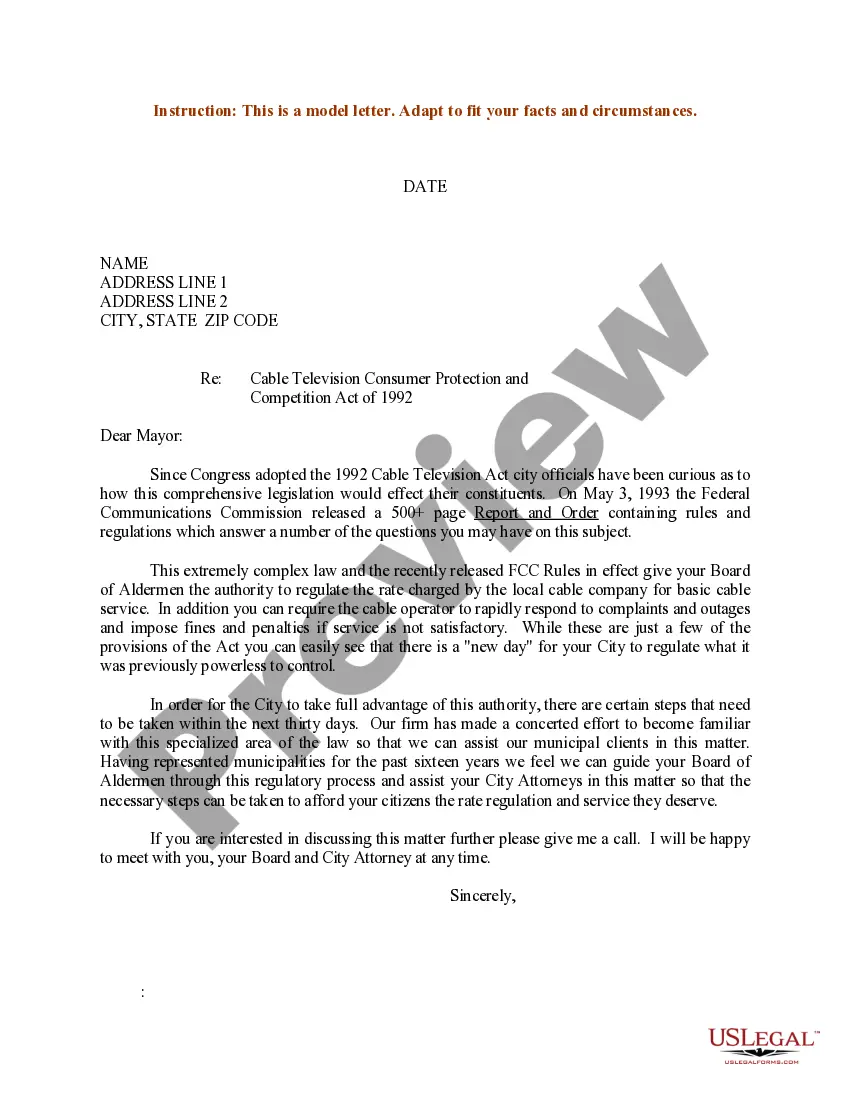
Wisconsin Sample Letter to Mayor concerning Cable Television Consumer Protection and Competition Act of 1992
Description
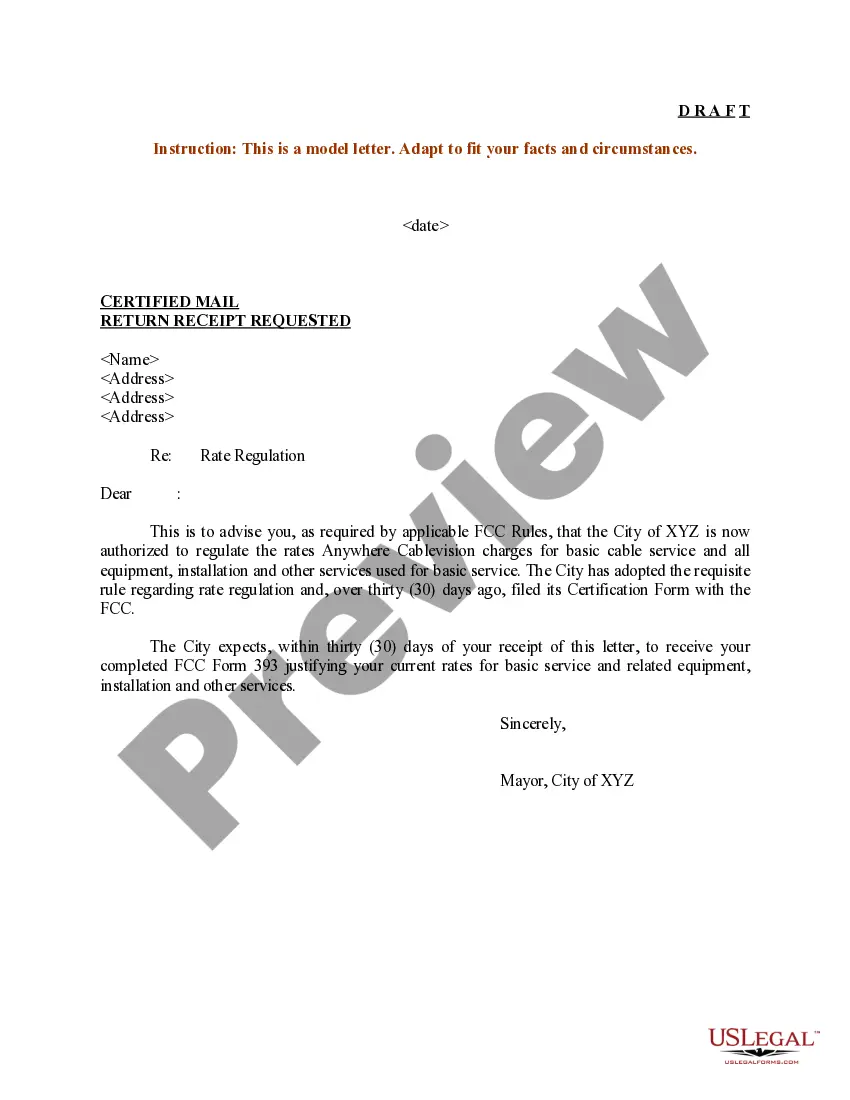
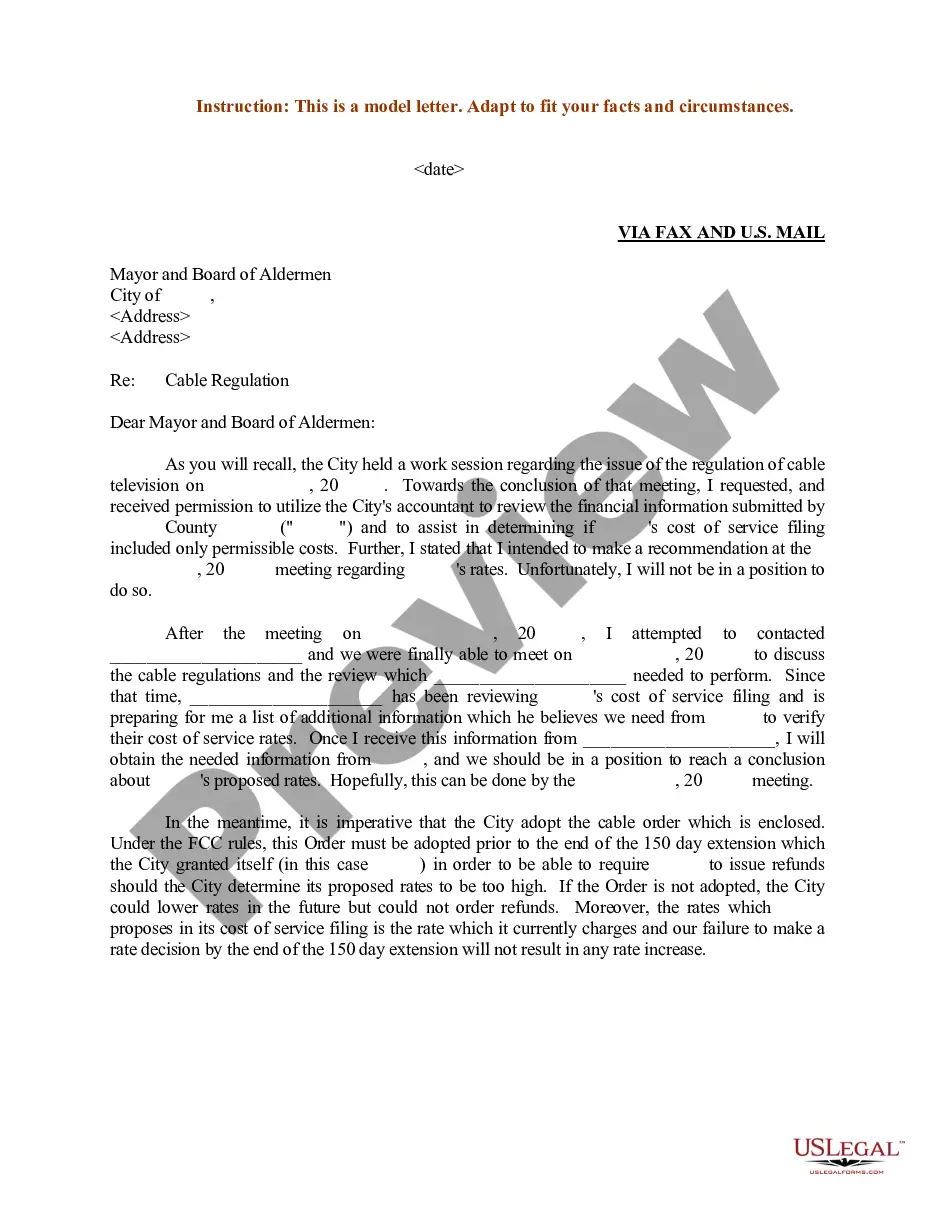
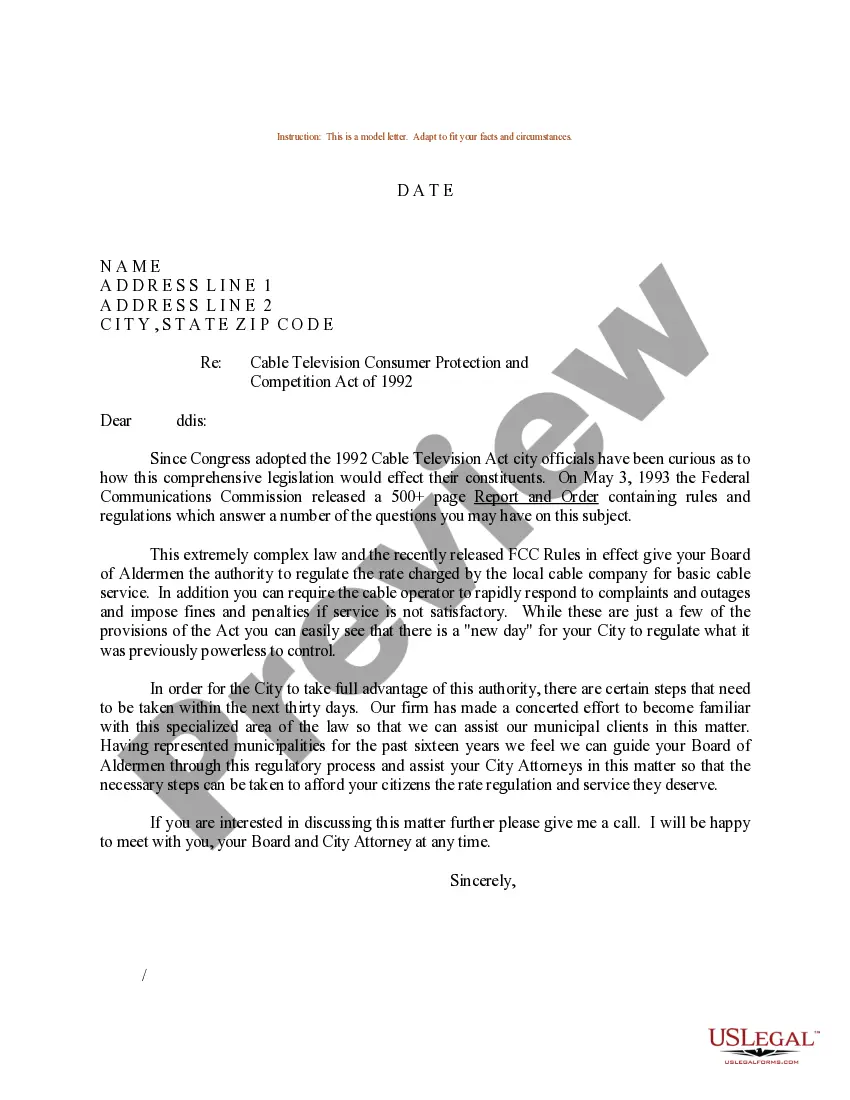
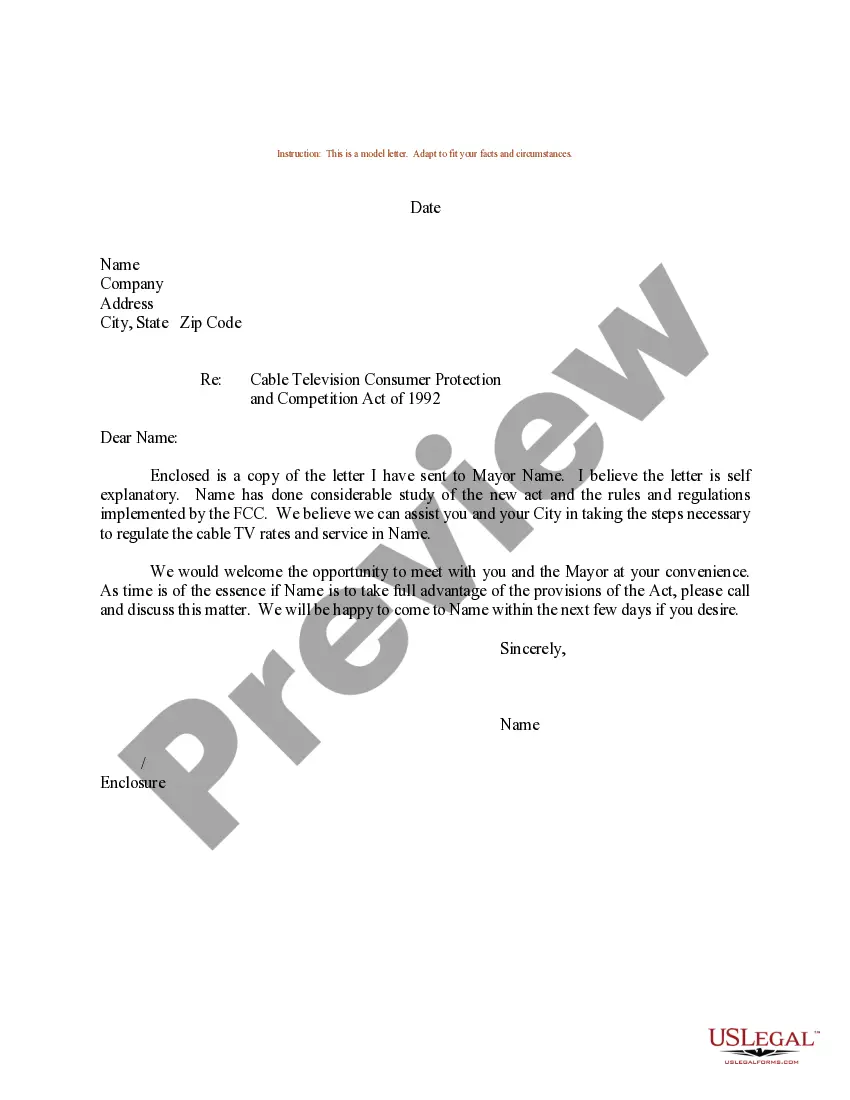





How to fill out Sample Letter To Mayor Concerning Cable Television Consumer Protection And Competition Act Of 1992?
If you need to compile, obtain, or print sanctioned document templates, utilize US Legal Forms, the most extensive collection of legal forms available online.
Take advantage of the site's straightforward and user-friendly search function to locate the documents you need.
A wide array of templates for business and personal purposes are categorized by types and states, or keywords. Use US Legal Forms to find the Wisconsin Sample Letter to Mayor regarding the Cable Television Consumer Protection and Competition Act of 1992 in just a few clicks.
Every legal document template you obtain is yours permanently. You will have access to every form you downloaded within your account. Go to the My documents section and choose a form to print or download again.
Be proactive and download, and print the Wisconsin Sample Letter to Mayor regarding the Cable Television Consumer Protection and Competition Act of 1992 with US Legal Forms. There are numerous professional and state-specific forms available for your business or personal needs.
- If you are already a US Legal Forms user, Log In to your account and click the Download button to retrieve the Wisconsin Sample Letter to Mayor regarding the Cable Television Consumer Protection and Competition Act of 1992.
- You can also access forms you have previously downloaded in the My documents section of your account.
- If you are using US Legal Forms for the first time, follow the instructions below.
- Step 1. Ensure you have selected the form for the correct city/state.
- Step 2. Utilize the Preview feature to review the form's content. Remember to check the summary.
- Step 3. If you are not satisfied with the form, use the Search box at the top of the page to find alternative versions of the legal form template.
- Step 4. Once you have found the form you need, click the Get now button. Choose the pricing plan you prefer and enter your details to register for an account.
- Step 5. Complete the payment process. You can use your credit card or PayPal account to finalize the transaction.
- Step 6. Select the format of the legal form and download it to your device.
- Step 7. Fill out, modify, and print or sign the Wisconsin Sample Letter to Mayor regarding the Cable Television Consumer Protection and Competition Act of 1992.
Form popularity
FAQ
The Cable Television Consumer Protection and Competition Act of 1992 (also known as the 1992 Cable Act) is a United States federal law which required cable television systems to carry most local broadcast television channels and prohibited cable operators from charging local broadcasters to carry their signal.
The Cable Television Consumer Protection and Competition Act of 1992 addressed various areas such as ensuring the growth of cable operators under effective competition, expanding the diversity of view and information through increased availability of cable television to the public, and protecting the interests of video ...
Further deregulation provided by the 1984 Cable Act enabled the industry to expand even further, and by the end of the 1980s, nearly 53 million households subscribed to cable television (see Section 6.3 ?Current Popular Trends in the Music Industry?).
The Telecommunications Act of 1996?Between 1984 and 1996, cable rules continue to change Telecommunications Act of 1996: Brought cable under federal rules ?Rules that had long governed the telephone, radio, and TV industries Phone companies, long-distance carriers, and cable operators could enter one another's markets ...
The Cable Communications Policy Act of 1984 (codified at 47 U.S.C. ch. 5, subch. V?A) was an act of Congress passed on October 30, 1984 to promote competition and deregulate the cable television industry.
The 1984 Cable Act established policies in the areas of ownership, channel usage, franchise provisions and renewals, subscriber rates and privacy, obscenity and lockboxes, unauthorized reception of services, equal employment opportunity, and pole attachments.
It is claimed that the first cable television system in the United States was created in 1948 in Mahanoy City, Pennsylvania by John Walson to provide television signals to people whose reception was poor because of tall mountains and buildings blocking TV signals.