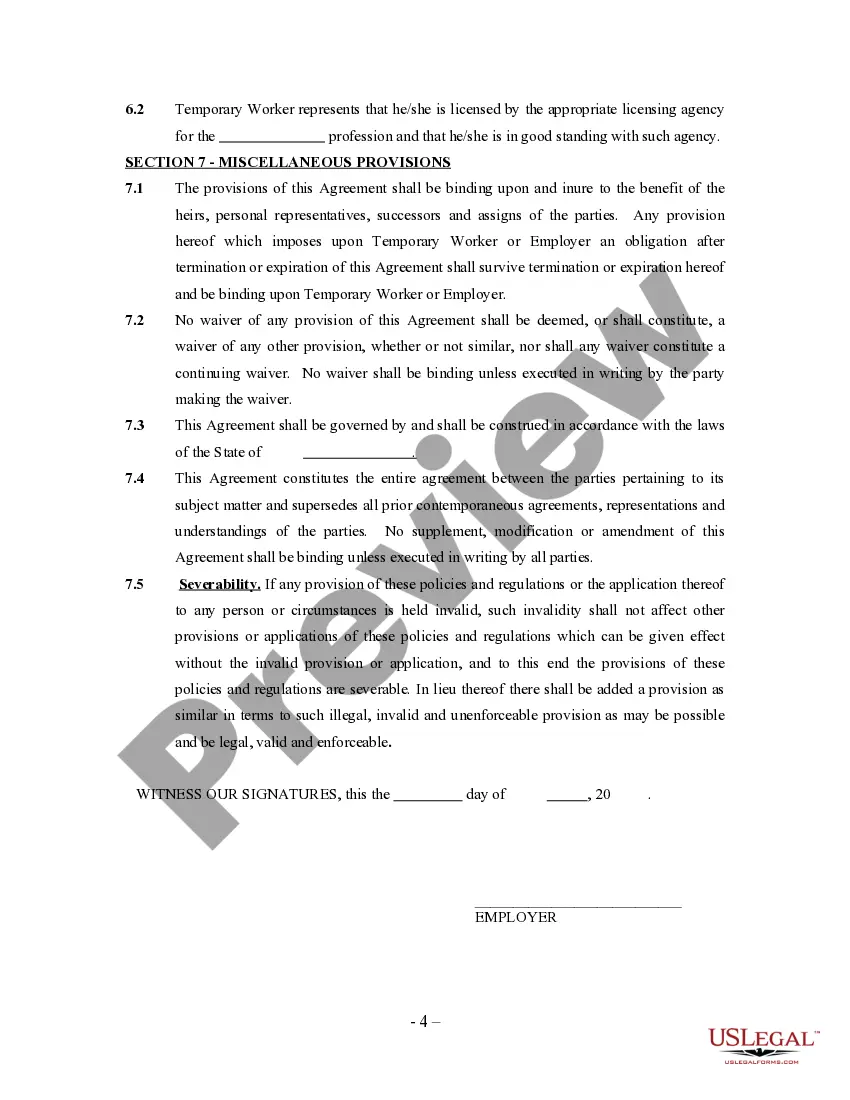
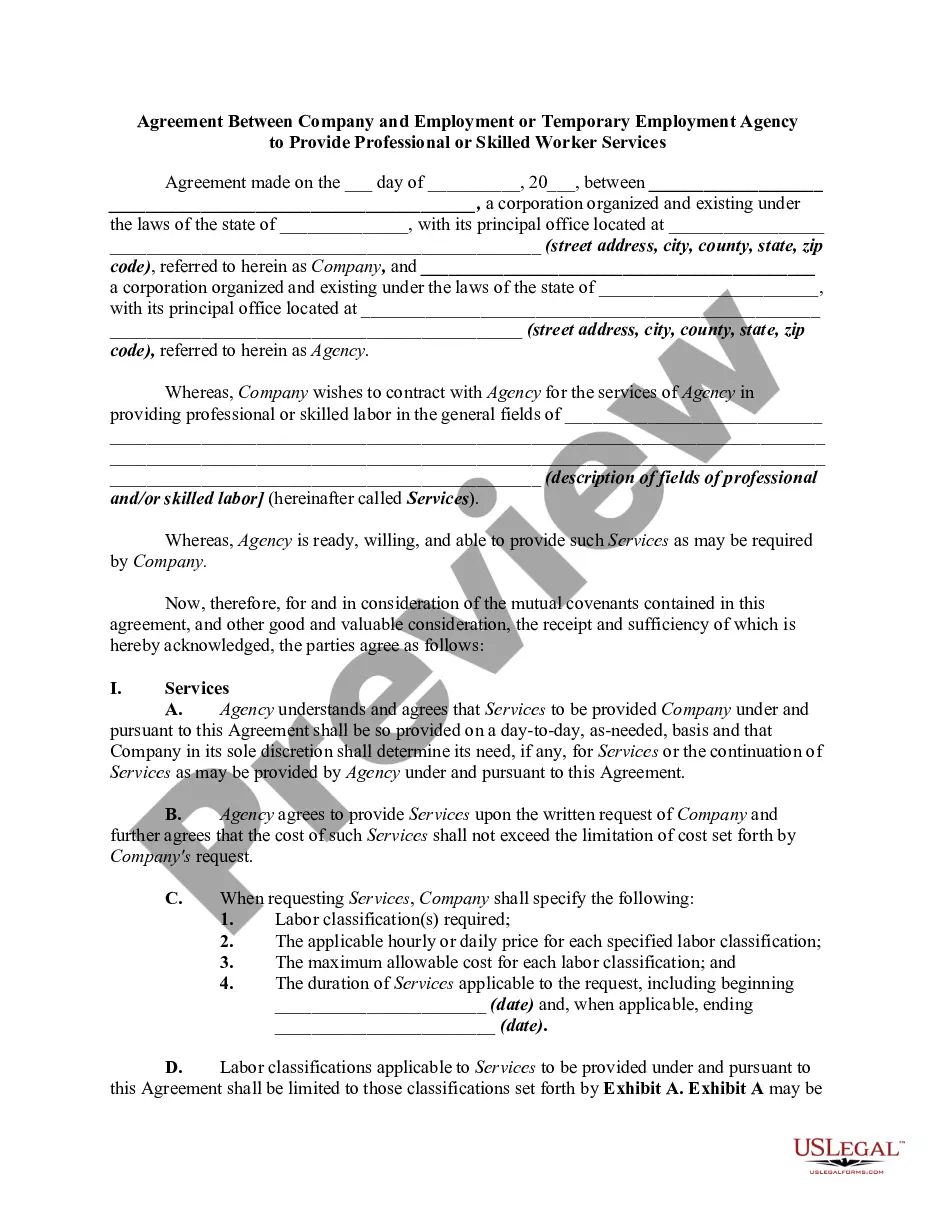
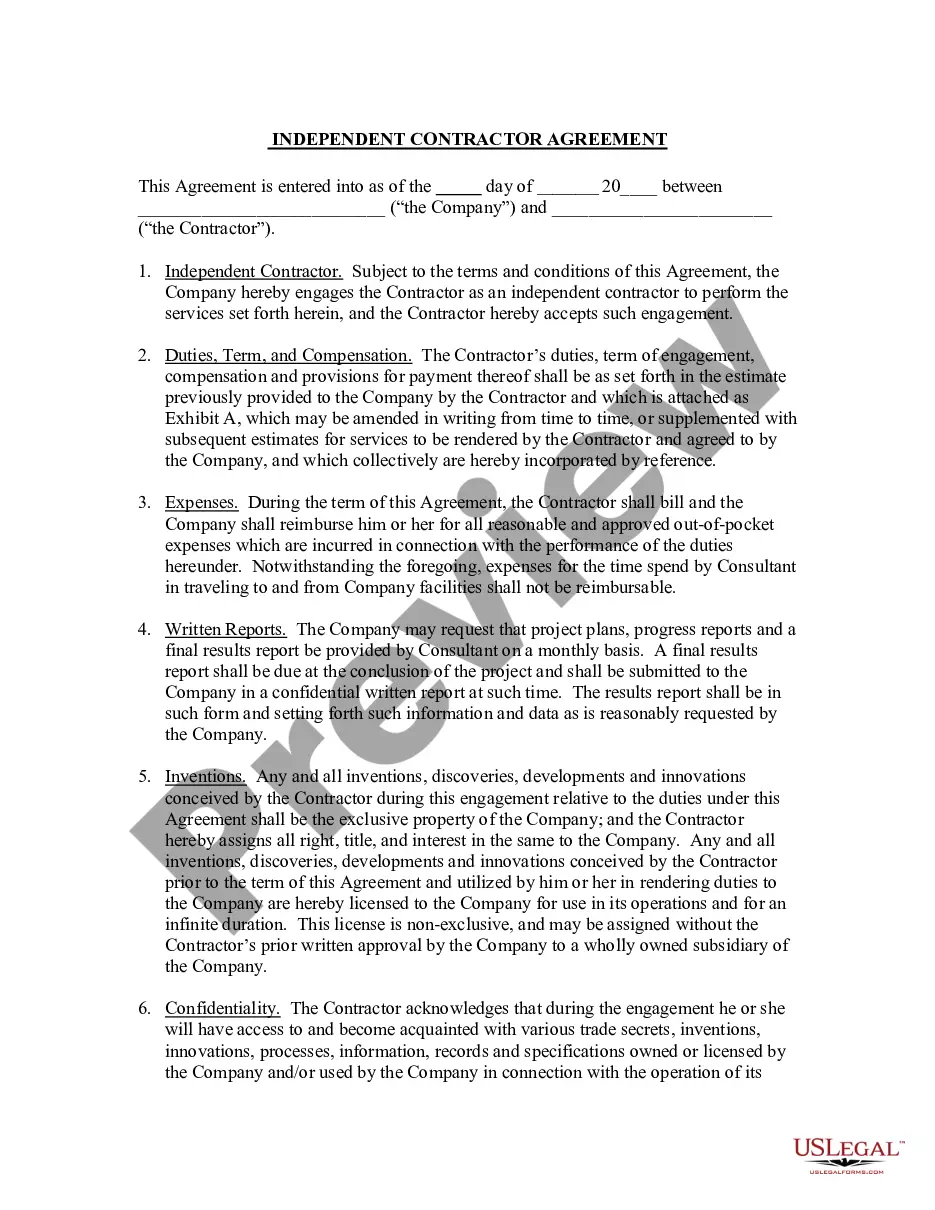
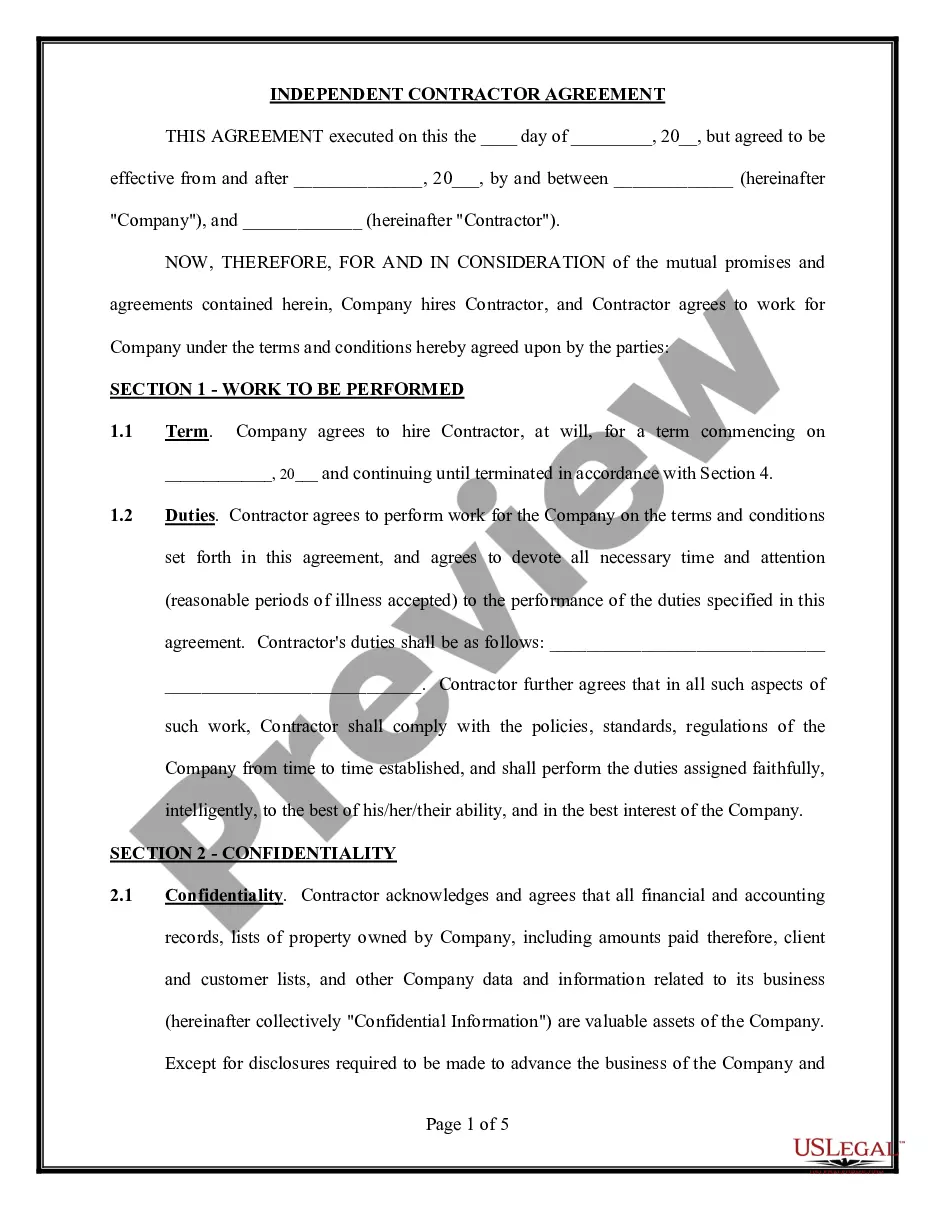
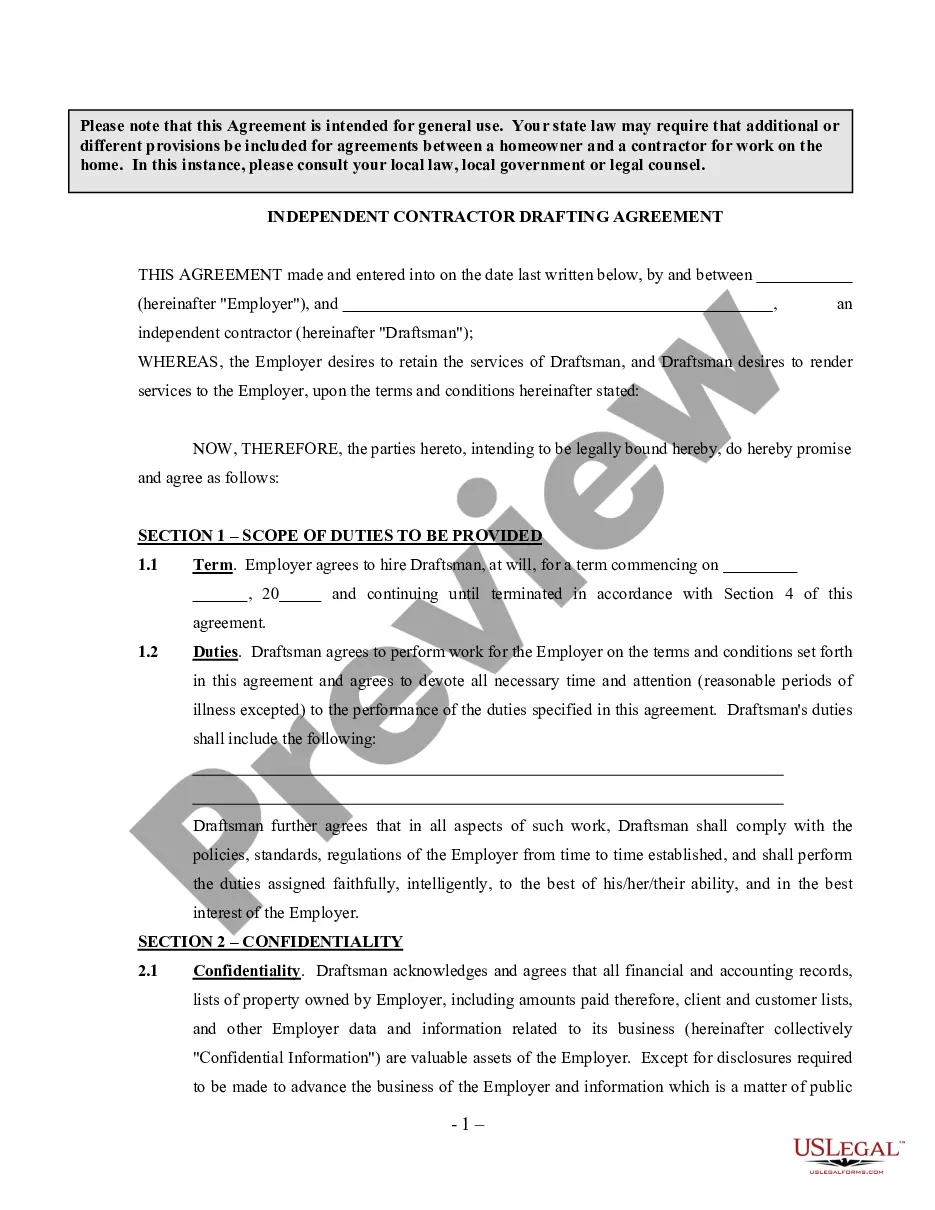
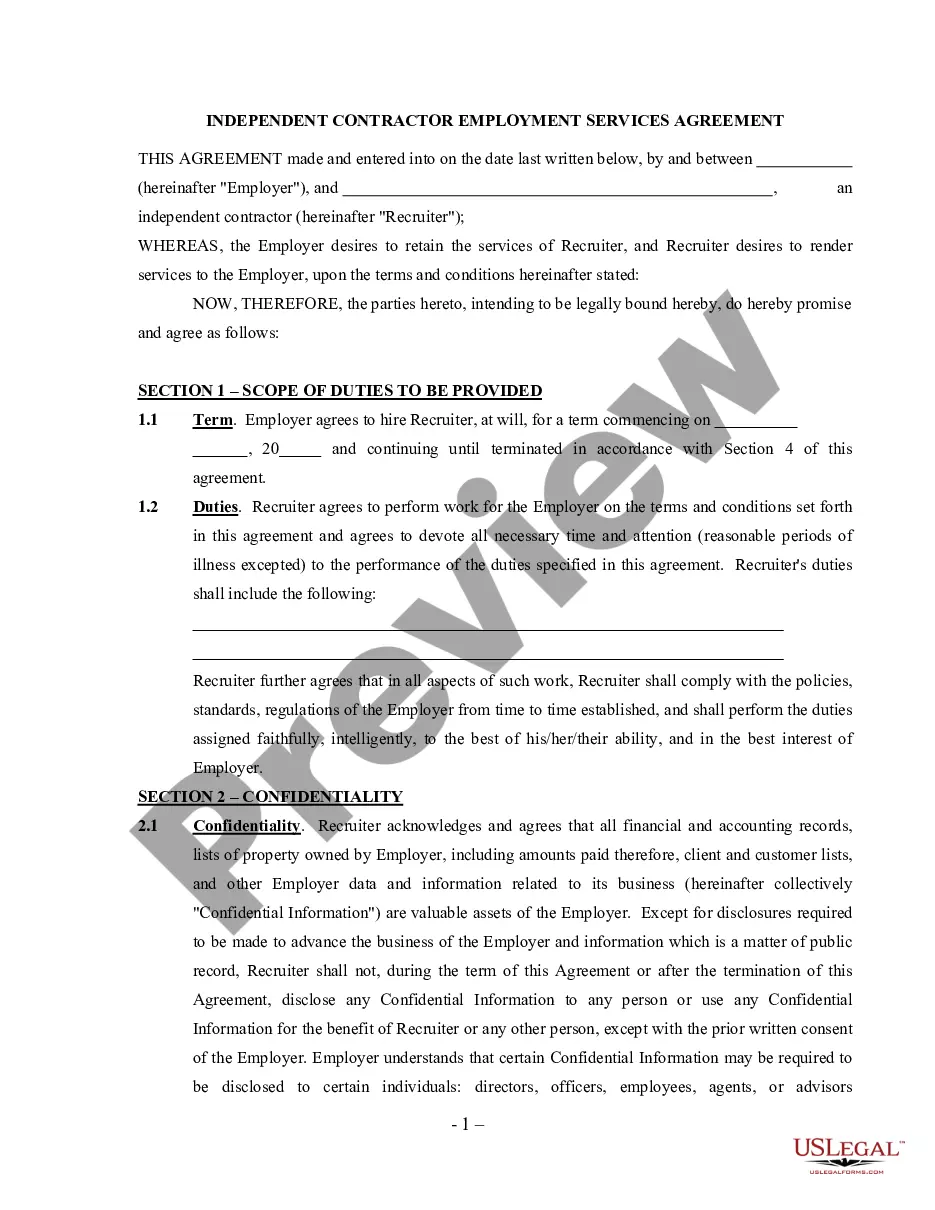
Employer hires a temporary worker or temporary staff as an independent contractor to provide services for Employer as specified in the Agreement. Confidentiality clause included.
Washington Temporary Worker Agreement - Self-Employed Independent Contractor
State:
Multi-State
Control #:
US-INDC-187
Format:
Word;
Rich Text
Instant download
Description
Free preview
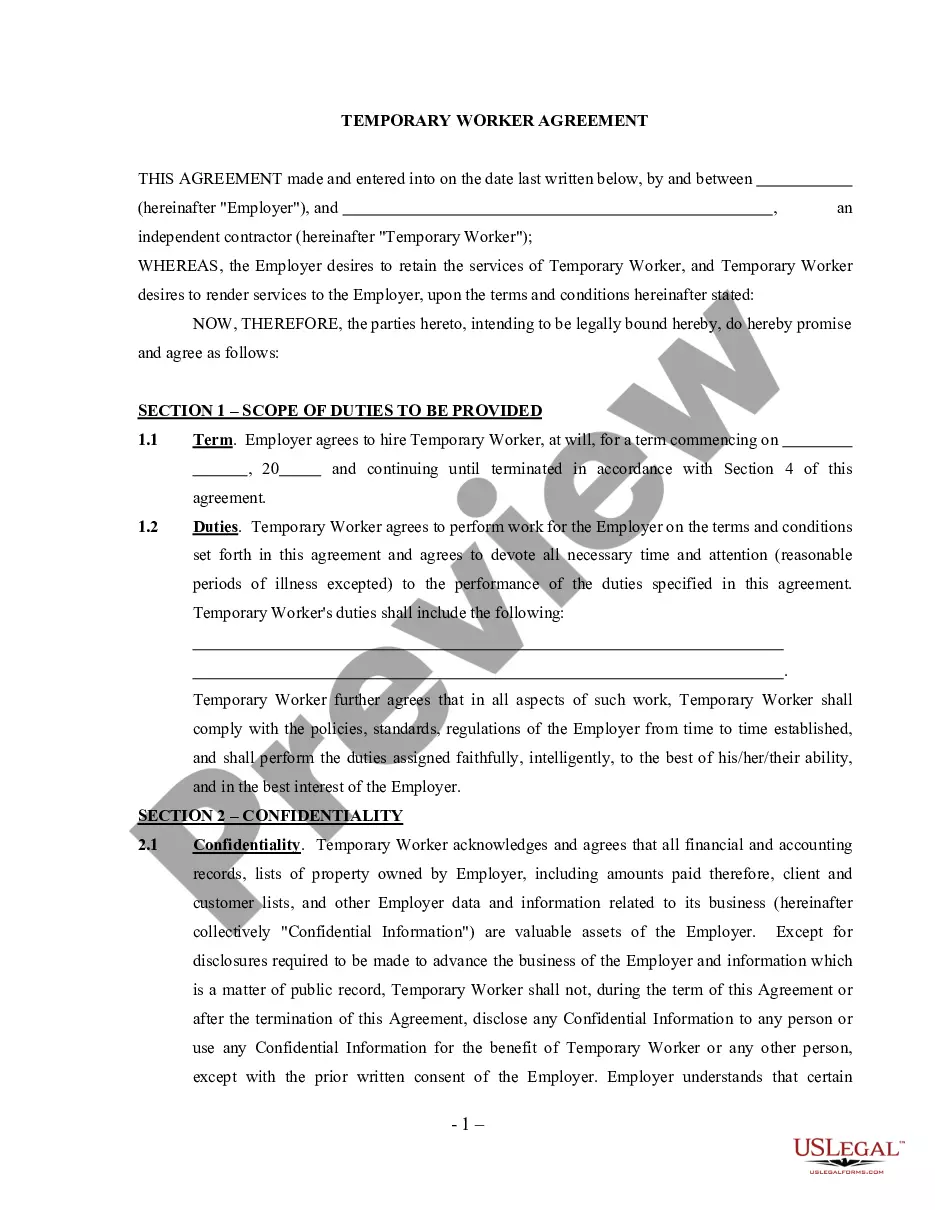
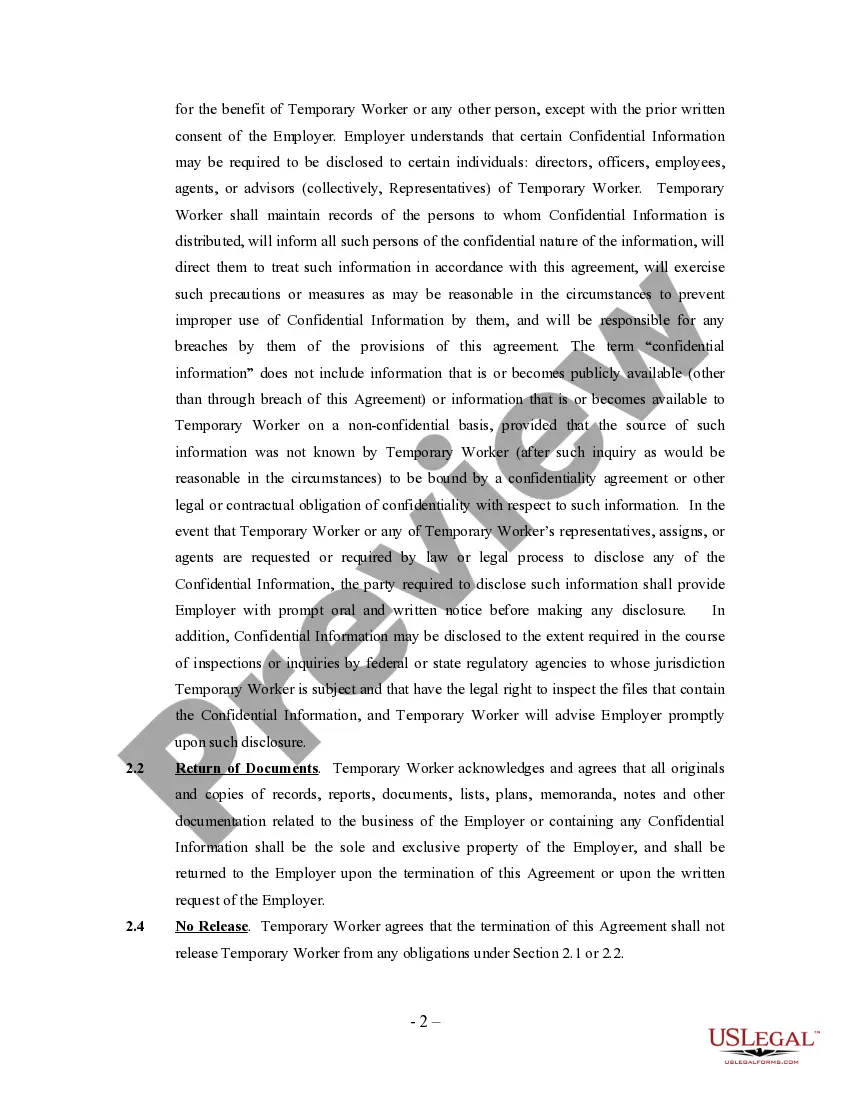
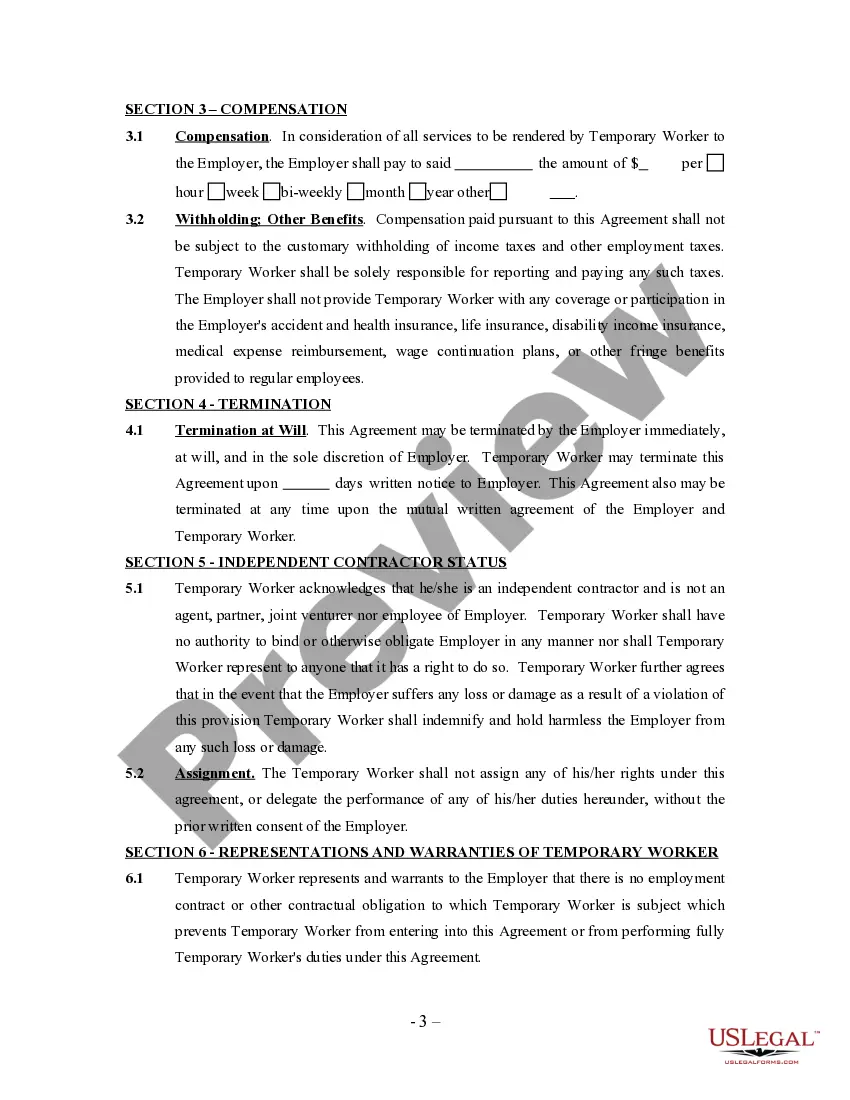

Get your form ready online
Our built-in tools help you complete, sign, share, and store your documents in one place.
Built-in online Word editor
Make edits, fill in missing information, and update formatting in US Legal Forms—just like you would in MS Word.
Export easily
Download a copy, print it, send it by email, or mail it via USPS—whatever works best for your next step.
E-sign your document
Sign and collect signatures with our SignNow integration. Send to multiple recipients, set reminders, and more. Go Premium to unlock E-Sign.
Notarize online 24/7
If this form requires notarization, complete it online through a secure video call—no need to meet a notary in person or wait for an appointment.
Store your document securely
We protect your documents and personal data by following strict security and privacy standards.

Make edits, fill in missing information, and update formatting in US Legal Forms—just like you would in MS Word.

Download a copy, print it, send it by email, or mail it via USPS—whatever works best for your next step.

Sign and collect signatures with our SignNow integration. Send to multiple recipients, set reminders, and more. Go Premium to unlock E-Sign.

If this form requires notarization, complete it online through a secure video call—no need to meet a notary in person or wait for an appointment.

We protect your documents and personal data by following strict security and privacy standards.
Looking for another form?







How to fill out Temporary Worker Agreement - Self-Employed Independent Contractor?
Are you presently in an area where you need documents for either business or personal reasons almost every working day.
There are numerous authentic document templates available online, but finding ones you can trust is not easy.
US Legal Forms provides thousands of form templates, including the Washington Temporary Worker Agreement - Self-Employed Independent Contractor, which are designed to meet state and federal requirements.
Once you have the correct form, click on Acquire now.
Select the payment plan you prefer, fill in the required details to create your account, and pay for the order using your PayPal or Visa or Mastercard. Choose a suitable file format and download your copy. Access all the document templates you have purchased in the My documents menu. You can obtain another copy of the Washington Temporary Worker Agreement - Self-Employed Independent Contractor at any time if needed. Just click the required form to download or print the document template. Use US Legal Forms, the most extensive collection of legal forms, to save time and avoid mistakes. The service provides professionally created legal document templates that can be used for various purposes. Create an account on US Legal Forms and start making your life a bit easier.
- If you are currently familiar with the US Legal Forms website and have an account, simply Log In.
- Then, you can download the Washington Temporary Worker Agreement - Self-Employed Independent Contractor template.
- If you do not have an account and wish to start using US Legal Forms, follow these steps.
- Find the form you need and ensure it is for your appropriate city/county.
- Use the Preview button to review the form.
- Check the information to ensure you have selected the correct form.
- If the form is not what you are looking for, use the Lookup section to find the form that meets your needs.
Form popularity
FAQ
Filling out an independent contractor form involves providing detailed information about both the contractor and the hiring entity. Start by entering contact details, the nature of the work, and payment arrangements. Be sure to review the sections related to the Washington Temporary Worker Agreement - Self-Employed Independent Contractor to ensure all necessary legal aspects are covered. Platforms such as UsLegalForms provide user-friendly forms and instructions, making this process straightforward and efficient.
To write an independent contractor agreement, start by defining the working relationship and outlining the scope of work. Include payment terms, deadlines, and any specific requirements that apply to the project. It’s essential to also state the nature of the agreement clearly, specifically referring to the Washington Temporary Worker Agreement - Self-Employed Independent Contractor, to ensure compliance with local laws. Using a platform like UsLegalForms can simplify this process, offering templates that guide you through each necessary component.
In Washington state, independent contractors typically do not need workers' compensation insurance unless they choose to cover themselves. However, depending on the nature of the work and specific projects, it may be beneficial to have coverage. Businesses hiring independent contractors under a Washington Temporary Worker Agreement - Self-Employed Independent Contractor should carefully review their insurance needs to mitigate risks.
Independent contractors generally do not qualify for unemployment benefits in Washington state because they do not have traditional employer-employee relationships. However, during certain economic conditions, such as the COVID-19 pandemic, independent contractors may qualify for special programs. It is essential to stay informed about any changes in legislationrelated to unemployment benefits for those engaged under a Washington Temporary Worker Agreement - Self-Employed Independent Contractor.
A temporary employee is not the same as an independent contractor. While both may work on a short-term basis, a temporary employee typically has a relationship with an employer and follows their instructions. In contrast, an independent contractor operates independently and sets their own work terms. Understanding this distinction is crucial for those entering into a Washington Temporary Worker Agreement - Self-Employed Independent Contractor.
Filling out a Washington Temporary Worker Agreement - Self-Employed Independent Contractor is straightforward. Begin by clearly stating the names of both parties involved, as well as the scope of work to be performed. Next, define the payment terms, including rates and deadlines. Additionally, ensure you outline the duration of the agreement and any relevant confidentiality clauses to protect sensitive information.
To show proof that you are self-employed, you can gather tax documents such as your most recent tax returns and 1099 forms. Additionally, having a business license or registration and client contracts can reinforce your self-employed status. By utilizing a Washington Temporary Worker Agreement - Self-Employed Independent Contractor, you can effectively outline your business operations, which supports your position as an independent contractor.
You can provide proof of employment as an independent contractor using several documents. Contracts with clients are a strong starting point, as they define your roles and responsibilities. Furthermore, providing invoices and payment receipts can substantiate your claims. The Washington Temporary Worker Agreement - Self-Employed Independent Contractor can offer a solid framework for demonstrating engagement with clients.
To show proof of income as a 1099 contractor, one can provide tax documents such as the 1099-MISC or 1099-NEC forms received from clients. Additionally, maintaining detailed records of invoices and payments can support income claims. These documents reflect your earnings and establish that you operate under a Washington Temporary Worker Agreement - Self-Employed Independent Contractor. Having organized records is beneficial for tax purposes and when applying for loans.
1099 employees are typically classified as independent contractors rather than temporary employees. They usually work on a project-by-project basis, which allows for flexibility. While their engagements can be temporary, their classification does not fit the definition of traditional temporary employees. Understanding these distinctions is crucial, especially when using a Washington Temporary Worker Agreement - Self-Employed Independent Contractor.