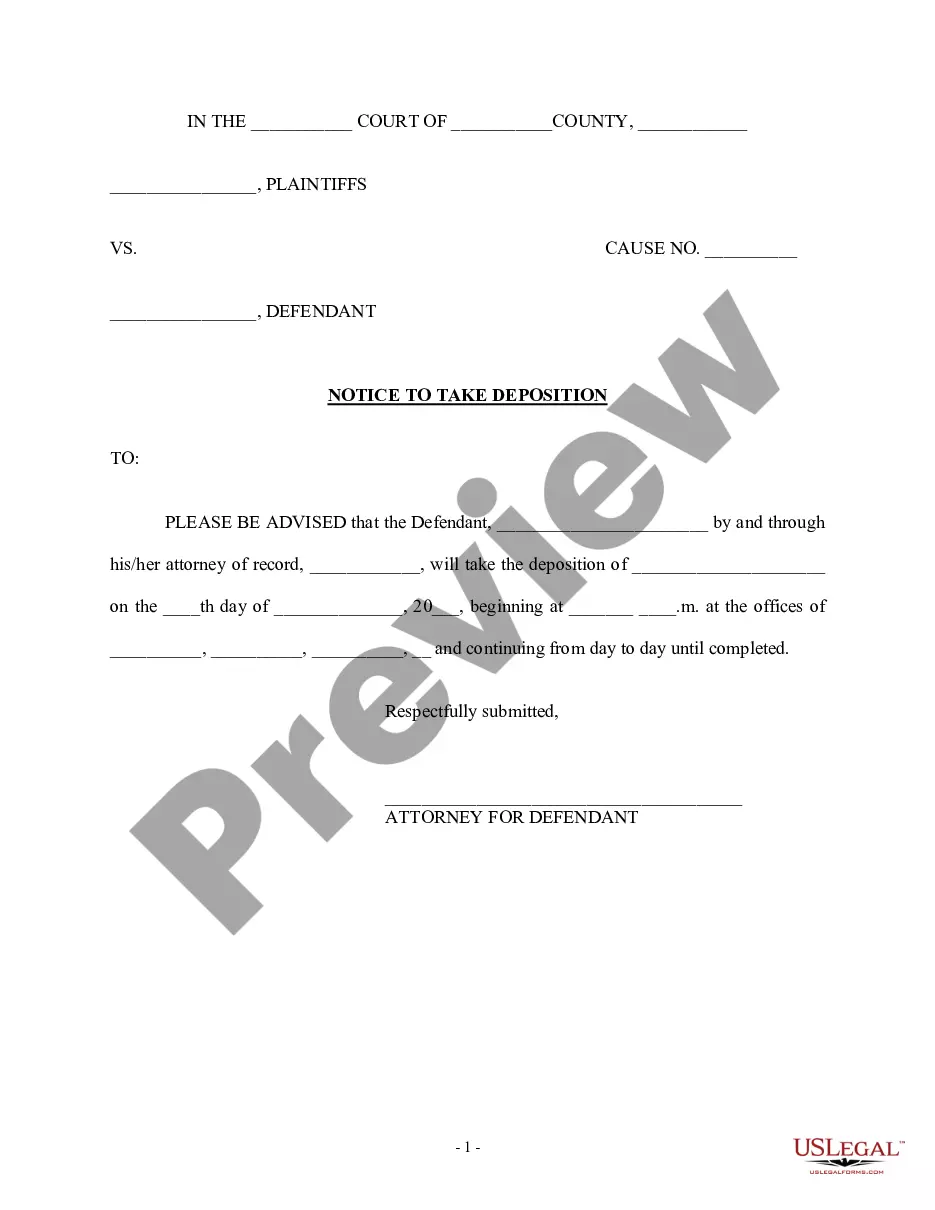
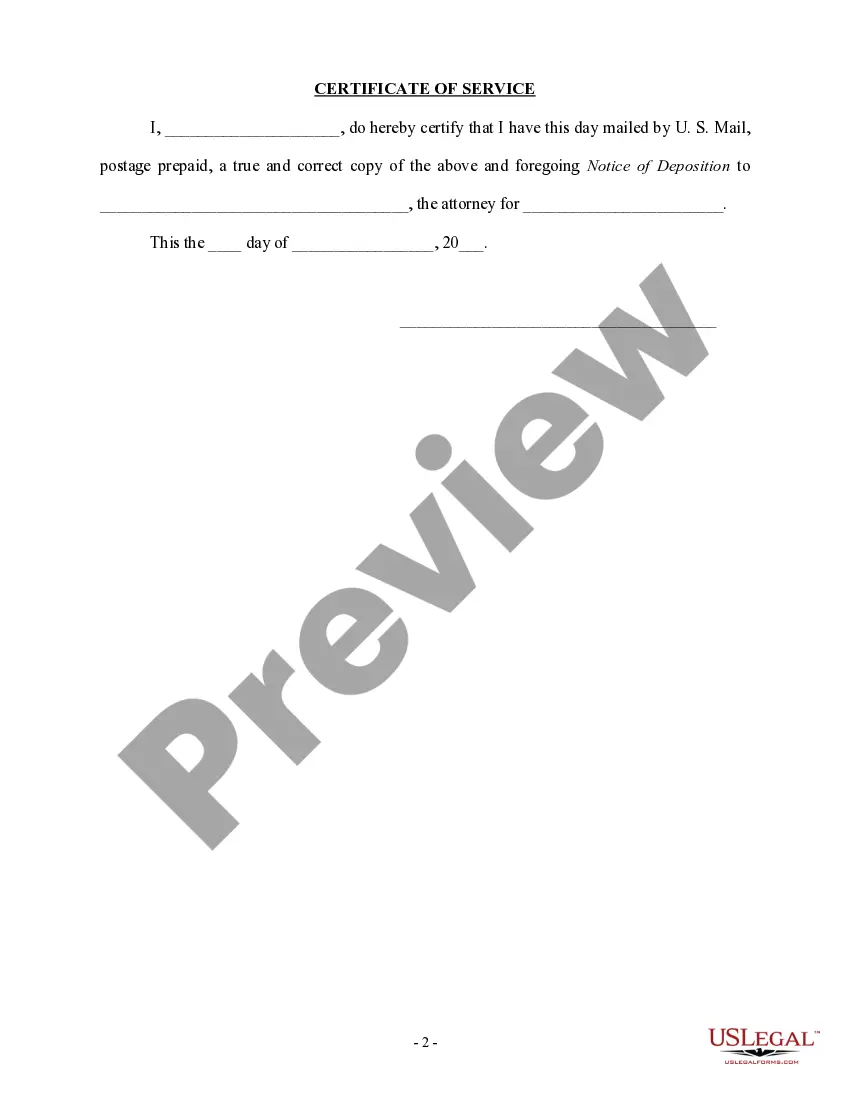
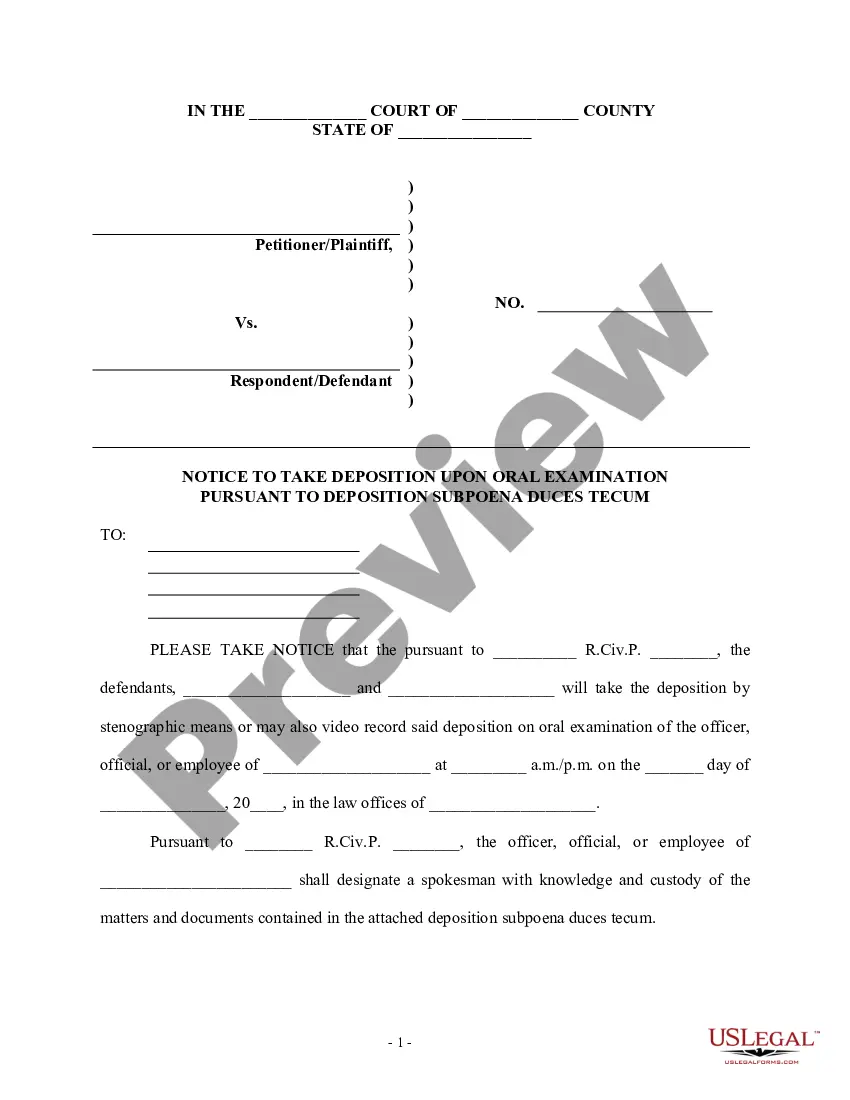
Defendant submits his/her notice to take depositions from day to day until completed. The form also contains a Certificate of Service which states that a true and correct copy of the Notice to Take Deposition was mailed via U.S. Mail and
Washington Notice to Take Deposition - Discovery
State:
Multi-State
Control #:
US-00904
Format:
Word;
Rich Text
191 downloads
Description
Free preview
Get your form ready online
Our built-in tools help you complete, sign, share, and store your documents in one place.
Built-in online Word editor
Make edits, fill in missing information, and update formatting in US Legal Forms—just like you would in MS Word.
Export easily
Download a copy, print it, send it by email, or mail it via USPS—whatever works best for your next step.
E-sign your document
Sign and collect signatures with our SignNow integration. Send to multiple recipients, set reminders, and more. Go Premium to unlock E-Sign.
Notarize online 24/7
If this form requires notarization, complete it online through a secure video call—no need to meet a notary in person or wait for an appointment.
Store your document securely
We protect your documents and personal data by following strict security and privacy standards.

Make edits, fill in missing information, and update formatting in US Legal Forms—just like you would in MS Word.

Download a copy, print it, send it by email, or mail it via USPS—whatever works best for your next step.

Sign and collect signatures with our SignNow integration. Send to multiple recipients, set reminders, and more. Go Premium to unlock E-Sign.

If this form requires notarization, complete it online through a secure video call—no need to meet a notary in person or wait for an appointment.

We protect your documents and personal data by following strict security and privacy standards.
Looking for another form?
How to fill out Notice To Take Deposition - Discovery?
Are you presently in a situation where you require documents for either business or personal purposes nearly every day? There are numerous legal document templates available online, but locating reliable versions isn’t straightforward. US Legal Forms provides thousands of form templates, such as the Washington Notice to Take Deposition - Discovery, which are designed to meet federal and state regulations.
If you are already acquainted with the US Legal Forms website and possess an account, just Log In. Then, you can download the Washington Notice to Take Deposition - Discovery template.
If you lack an account and wish to start utilizing US Legal Forms, follow these instructions: Find the document you require and ensure it is for the correct city/region. Utilize the Review button to scrutinize the document. Check the description to confirm that you have chosen the right form. If the form isn’t what you’re looking for, use the Search box to locate the form that fits your needs and specifications. When you find the right form, click Get now. Select the pricing plan you prefer, fill in the required information to create your account, and pay for your order using your PayPal or credit card. Choose a convenient file format and download your file.
- Access all the document templates you have purchased in the My documents section. You can retrieve another copy of the Washington Notice to Take Deposition - Discovery at any time if needed. Just select the desired form to download or print the document template.
- Utilize US Legal Forms, the most extensive collection of legal forms, to save time and prevent errors. The service offers professionally crafted legal document templates that can be used for various purposes.
- Create an account on US Legal Forms and start making your life simpler.
Form popularity
FAQ
One of the most common methods of discovery is to take depositions. A deposition is an out-of-court statement given under oath by any person involved in the case. It is to be used at trial or in preparation for trial.
What is the Discovery Rule in Washington State? Under the discovery rule, the statute of limitations does not start ticking down until an injured party knows, or should reasonably have known that they were injured due to the negligence of another.
JF: A deposition is an opportunity for parties in a civil lawsuit to obtain testimony from a witness under oath prior to trial. It's part of the discovery process by which parties gather facts and information so they can be better prepared at trial to present their claims and defenses.
(1) A party desiring to take the deposition of any person upon oral examination shall give reasonable notice in writing of not less than 5 days pursuant to CR 6 to every other party to the action and to the deponent, if not a party or a managing agent of a party.
Steps Of The Discovery Process. There are four key actions in the discovery process which include interrogatories, request for documents, request for admissions, and depositions.
What Is a Notice of Deposition? Witnesses are needed by a legal team to answer questions under oath pertaining to their knowledge relating to a lawsuit before the case is tried in the court. The law firm sends a document called a notice of deposition to the witness and all other parties involved in the lawsuit.
During the discovery phase, both parties learn what the other knows about the evidence by asking for certain documents, asking for answers to interrogatories, and taking depositions of witnesses who are under oath.
The discovery phase is the stage in a lawsuit where both parties gather and exchange information and evidence relevant to their respective cases. This process enables the two sides to build strong arguments, understand the other party's claims, and, in some instances, reach a settlement without the need for a trial.