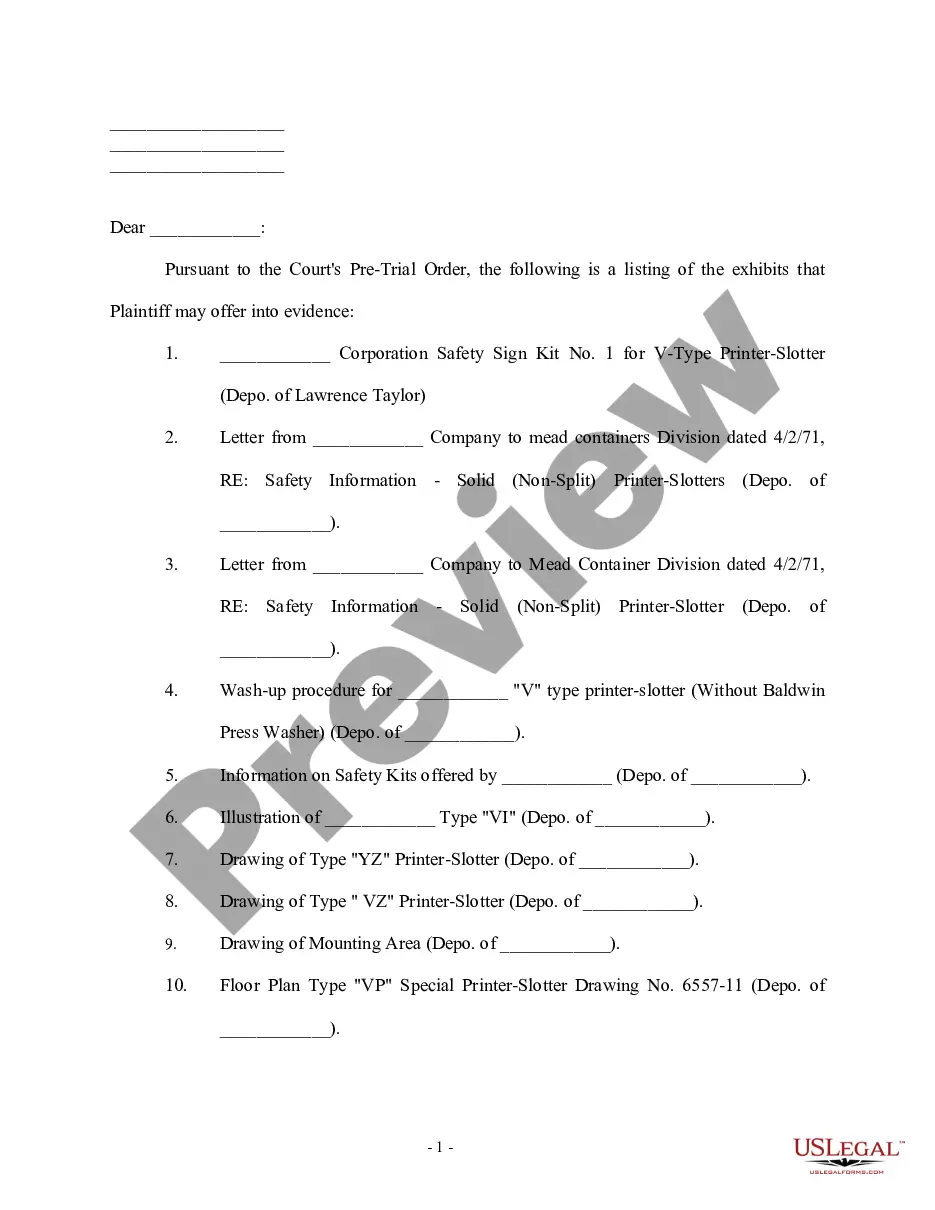
Vermont Sample Letter for Anticipated Exhibits to be Offered at Trial
Description


Get your form ready online
Our built-in tools help you complete, sign, share, and store your documents in one place.
Make edits, fill in missing information, and update formatting in US Legal Forms—just like you would in MS Word.
Download a copy, print it, send it by email, or mail it via USPS—whatever works best for your next step.
Sign and collect signatures with our SignNow integration. Send to multiple recipients, set reminders, and more. Go Premium to unlock E-Sign.
If this form requires notarization, complete it online through a secure video call—no need to meet a notary in person or wait for an appointment.
We protect your documents and personal data by following strict security and privacy standards.

Make edits, fill in missing information, and update formatting in US Legal Forms—just like you would in MS Word.

Download a copy, print it, send it by email, or mail it via USPS—whatever works best for your next step.

Sign and collect signatures with our SignNow integration. Send to multiple recipients, set reminders, and more. Go Premium to unlock E-Sign.

If this form requires notarization, complete it online through a secure video call—no need to meet a notary in person or wait for an appointment.

We protect your documents and personal data by following strict security and privacy standards.
Looking for another form?







How to fill out Sample Letter For Anticipated Exhibits To Be Offered At Trial?
Discovering the right authorized papers format can be quite a struggle. Of course, there are plenty of themes available on the Internet, but how would you find the authorized type you want? Use the US Legal Forms site. The support delivers thousands of themes, such as the Vermont Sample Letter for Anticipated Exhibits to be Offered at Trial, that you can use for organization and private requirements. Every one of the types are inspected by professionals and satisfy federal and state requirements.
When you are presently registered, log in to your bank account and then click the Obtain switch to have the Vermont Sample Letter for Anticipated Exhibits to be Offered at Trial. Utilize your bank account to search with the authorized types you might have ordered previously. Check out the My Forms tab of the bank account and acquire an additional copy in the papers you want.
When you are a fresh end user of US Legal Forms, listed here are basic instructions for you to follow:
- Initial, ensure you have chosen the correct type for the area/area. You can examine the form while using Preview switch and look at the form explanation to guarantee it is the best for you.
- In case the type is not going to satisfy your requirements, make use of the Seach industry to discover the right type.
- Once you are certain that the form is acceptable, select the Get now switch to have the type.
- Opt for the rates strategy you need and enter in the needed info. Create your bank account and pay money for the transaction with your PayPal bank account or credit card.
- Opt for the submit file format and obtain the authorized papers format to your gadget.
- Total, change and printing and indication the acquired Vermont Sample Letter for Anticipated Exhibits to be Offered at Trial.
US Legal Forms will be the largest collection of authorized types for which you will find numerous papers themes. Use the service to obtain skillfully-produced papers that follow condition requirements.
Form popularity
FAQ
Many paralegals know the correct way to assign letters for exhibits. The first 26 exhibits are easy, EX-A through EX-Z, and the next exhibit is also usually correct, EX-AA, but it's after that where things can go awry. The 28th exhibit should be EX-AB (not EX-BB) followed by EX-AC, EX-AD, EX-AE, EX-AF and so on.
Include a typed notation within the body of the legal document where the exhibit should be referenced. Thereafter, assign the exhibit with an identifying number or letter. For instance, this notation can state either "See Exhibit A" or "See Exhibit 1". Label the exhibit with the assigned identifying number or letter.
Label them so they are identifiable (ex. Exhibit A, B, C, etc) Mention them in the text of the motions (ex. Attached hereto as Exhibit A is a letter Defendant received from Plaintiff and which shows?"
(f) Format of exhibits (1) An index of exhibits must be provided. The index must briefly describe the exhibit and identify the exhibit number or letter and page number.
The plaintiff's exhibits are traditionally numbered (?Exhibit 1?), while the defendant's exhibits are lettered (?Exhibit A?). Your court may want you to label your own exhibits as you introduce them or the court may prefer that the court clerk labels the exhibits instead.