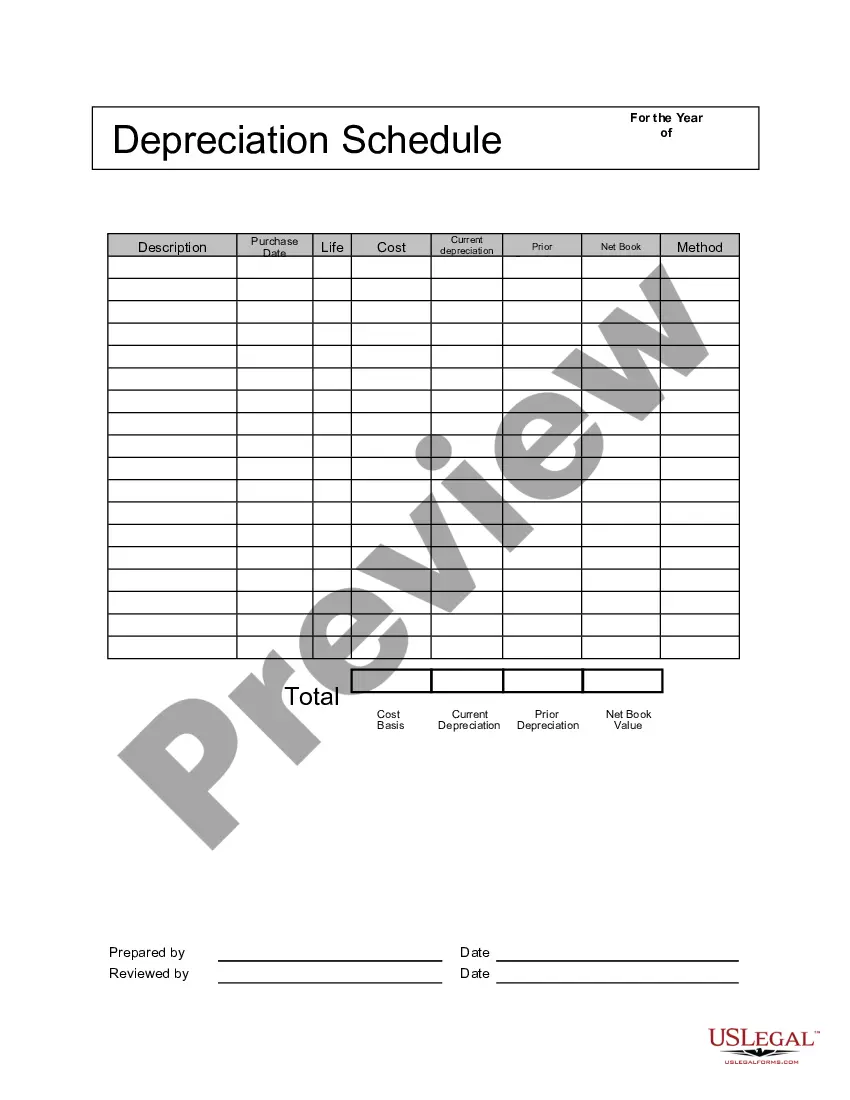
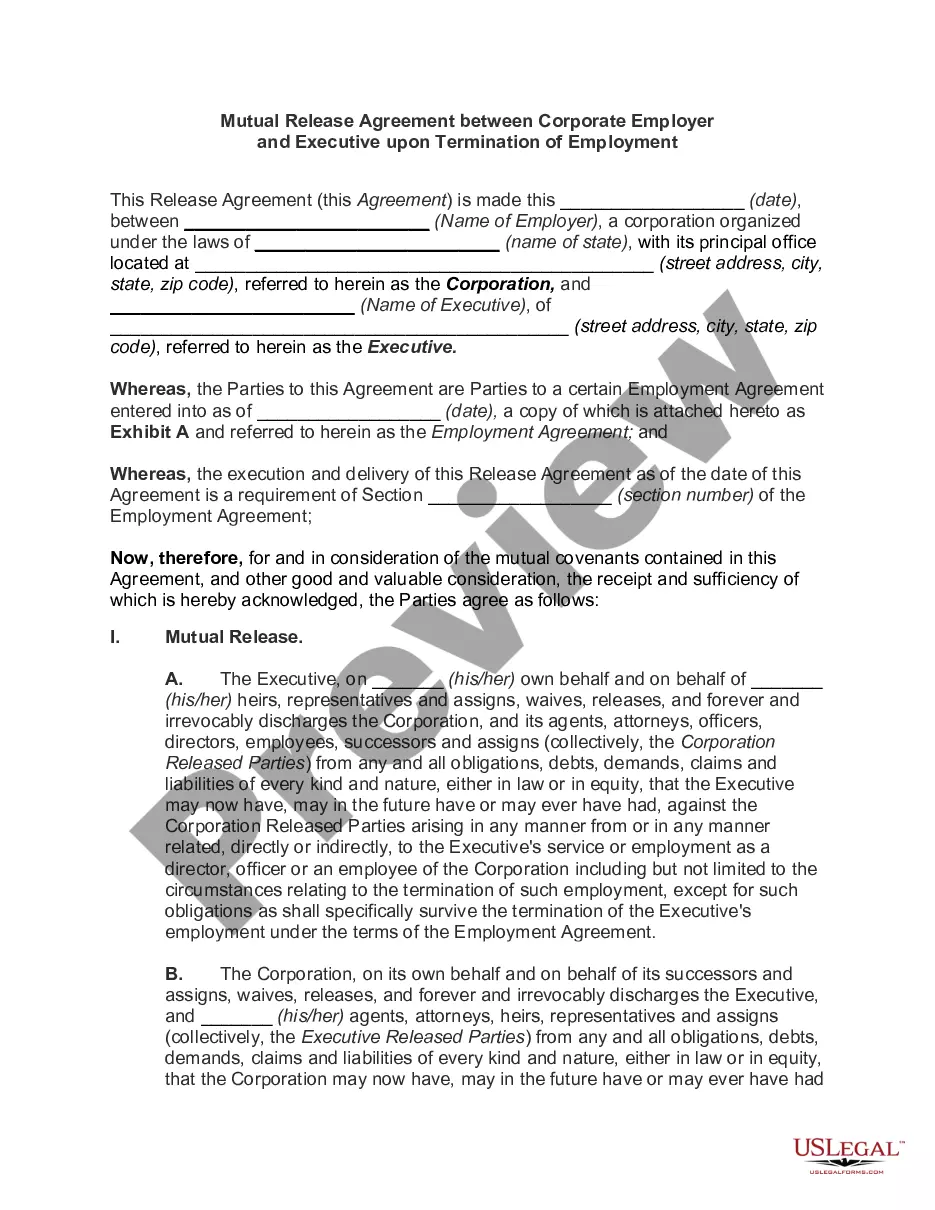
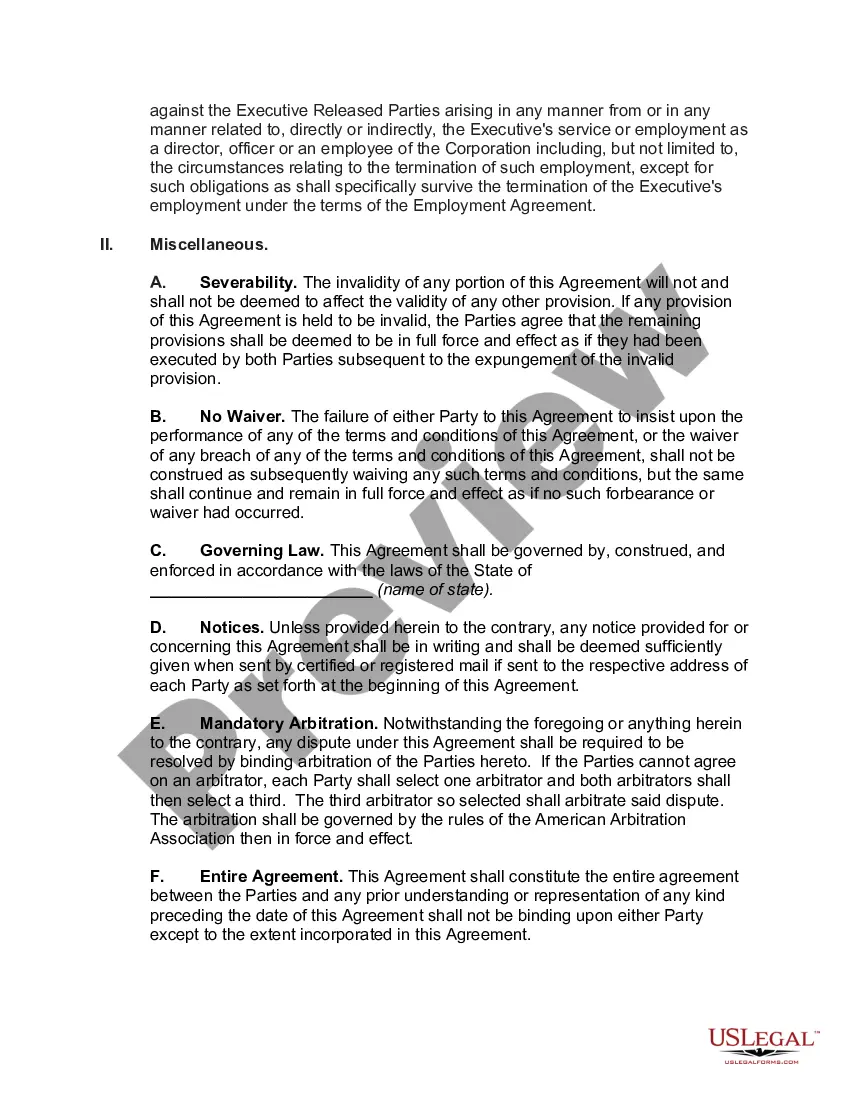
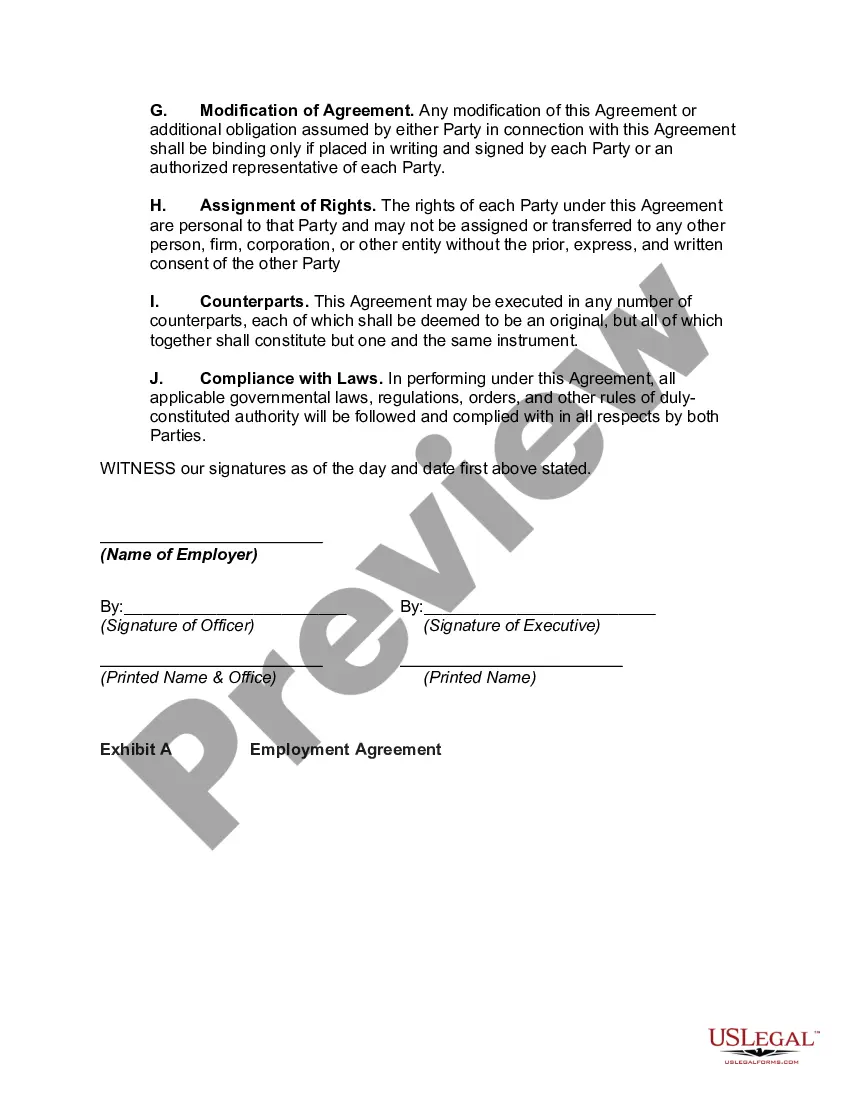
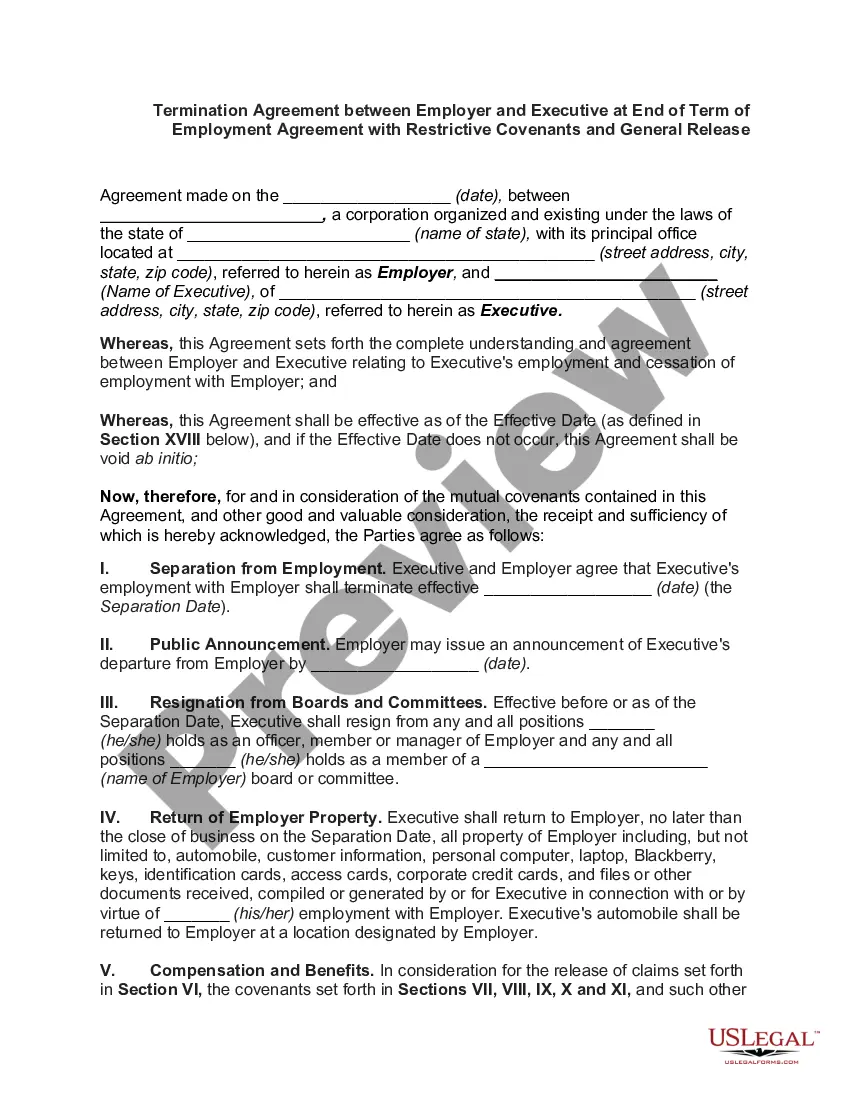
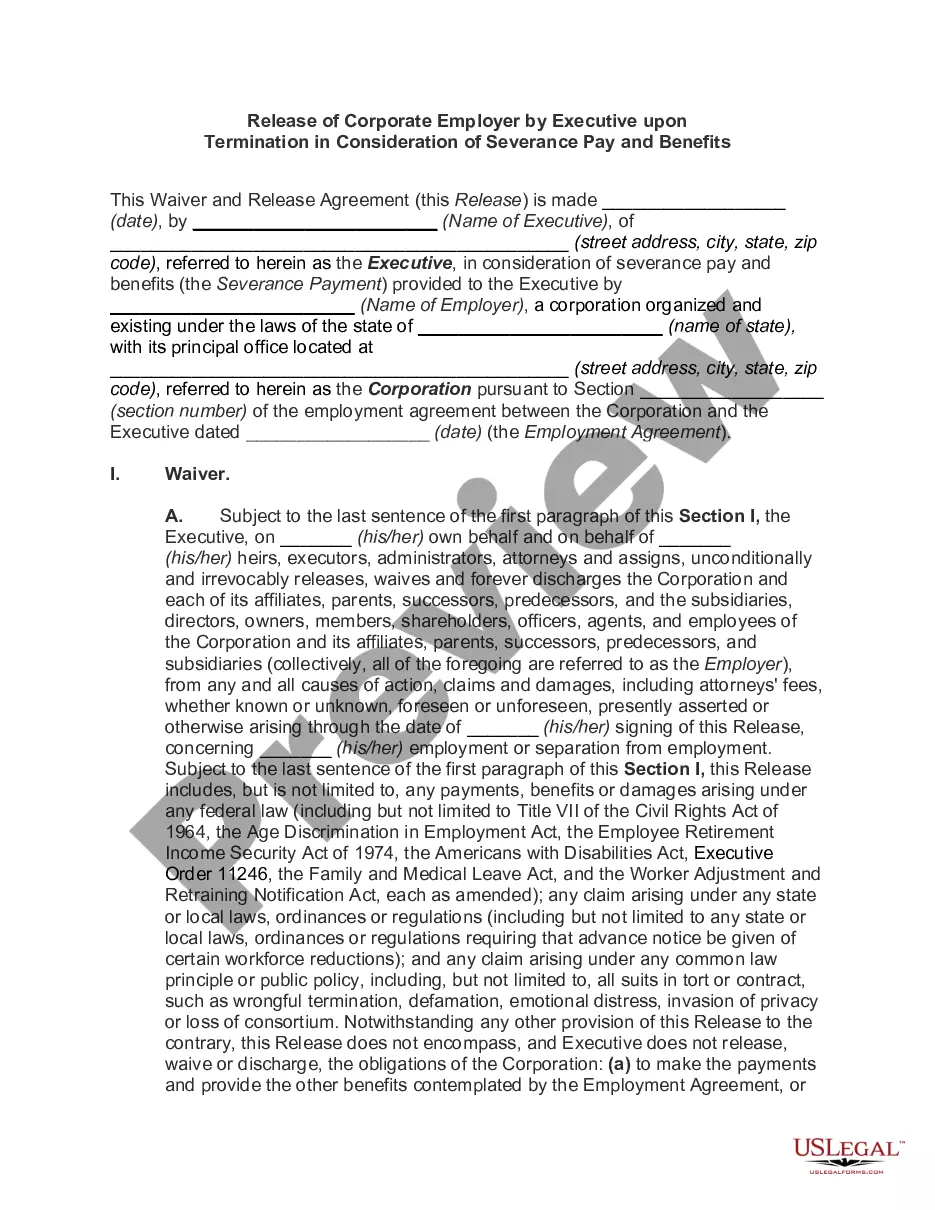
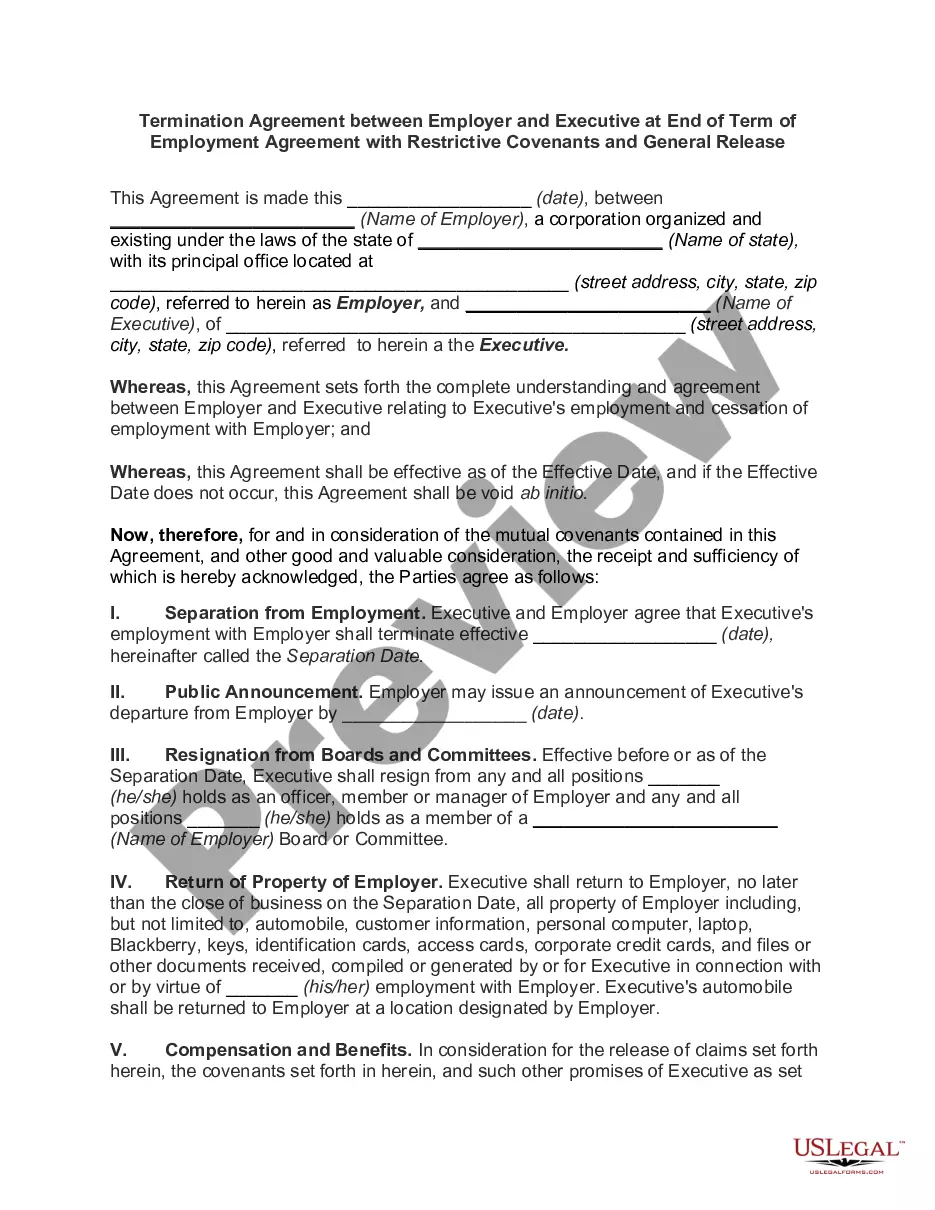
Virginia Mutual Release Agreement between Corporate Employer and Executive upon Termination of Employment
Description

Get your form ready online
Our built-in tools help you complete, sign, share, and store your documents in one place.
Make edits, fill in missing information, and update formatting in US Legal Forms—just like you would in MS Word.
Download a copy, print it, send it by email, or mail it via USPS—whatever works best for your next step.
Sign and collect signatures with our SignNow integration. Send to multiple recipients, set reminders, and more. Go Premium to unlock E-Sign.
If this form requires notarization, complete it online through a secure video call—no need to meet a notary in person or wait for an appointment.
We protect your documents and personal data by following strict security and privacy standards.

Make edits, fill in missing information, and update formatting in US Legal Forms—just like you would in MS Word.

Download a copy, print it, send it by email, or mail it via USPS—whatever works best for your next step.

Sign and collect signatures with our SignNow integration. Send to multiple recipients, set reminders, and more. Go Premium to unlock E-Sign.

If this form requires notarization, complete it online through a secure video call—no need to meet a notary in person or wait for an appointment.

We protect your documents and personal data by following strict security and privacy standards.
Looking for another form?

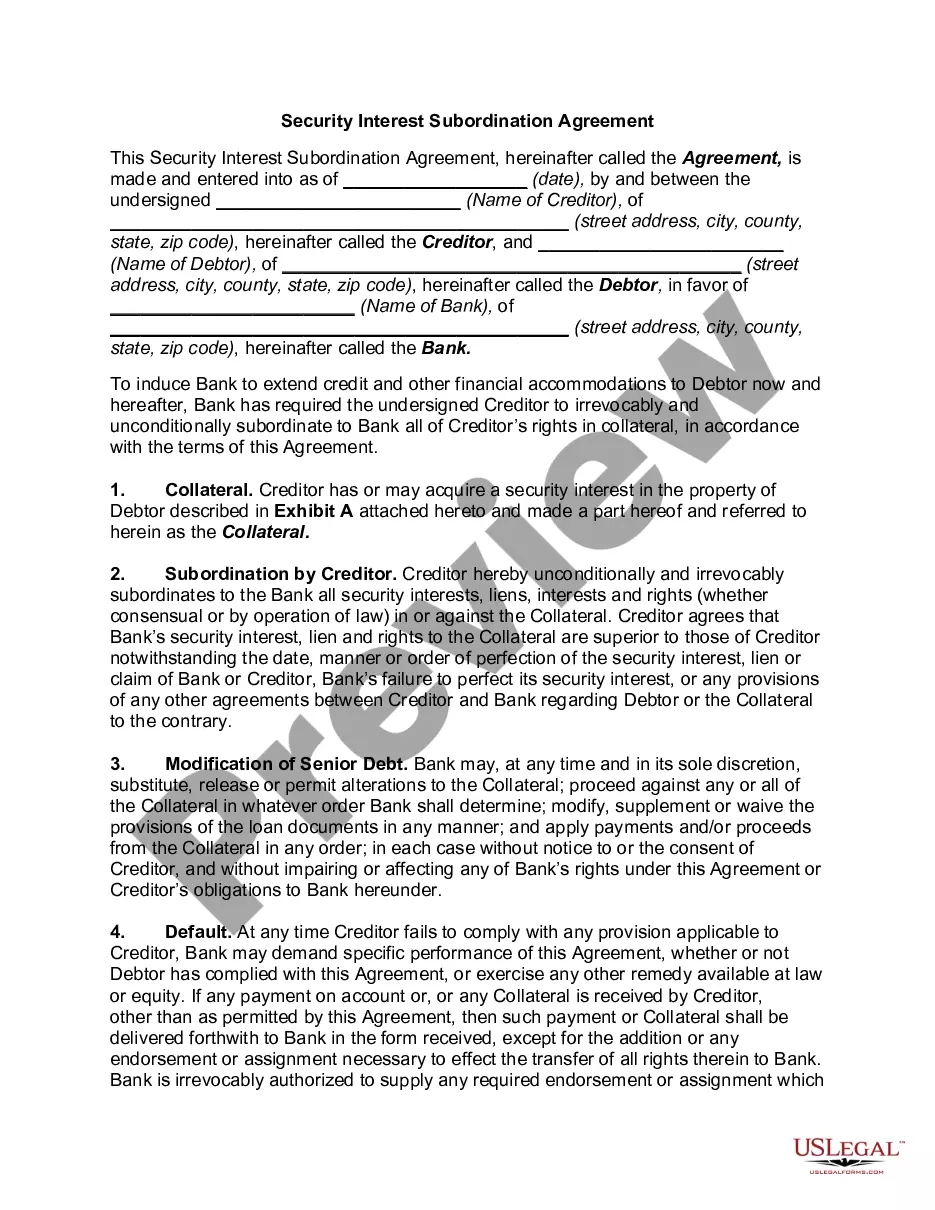
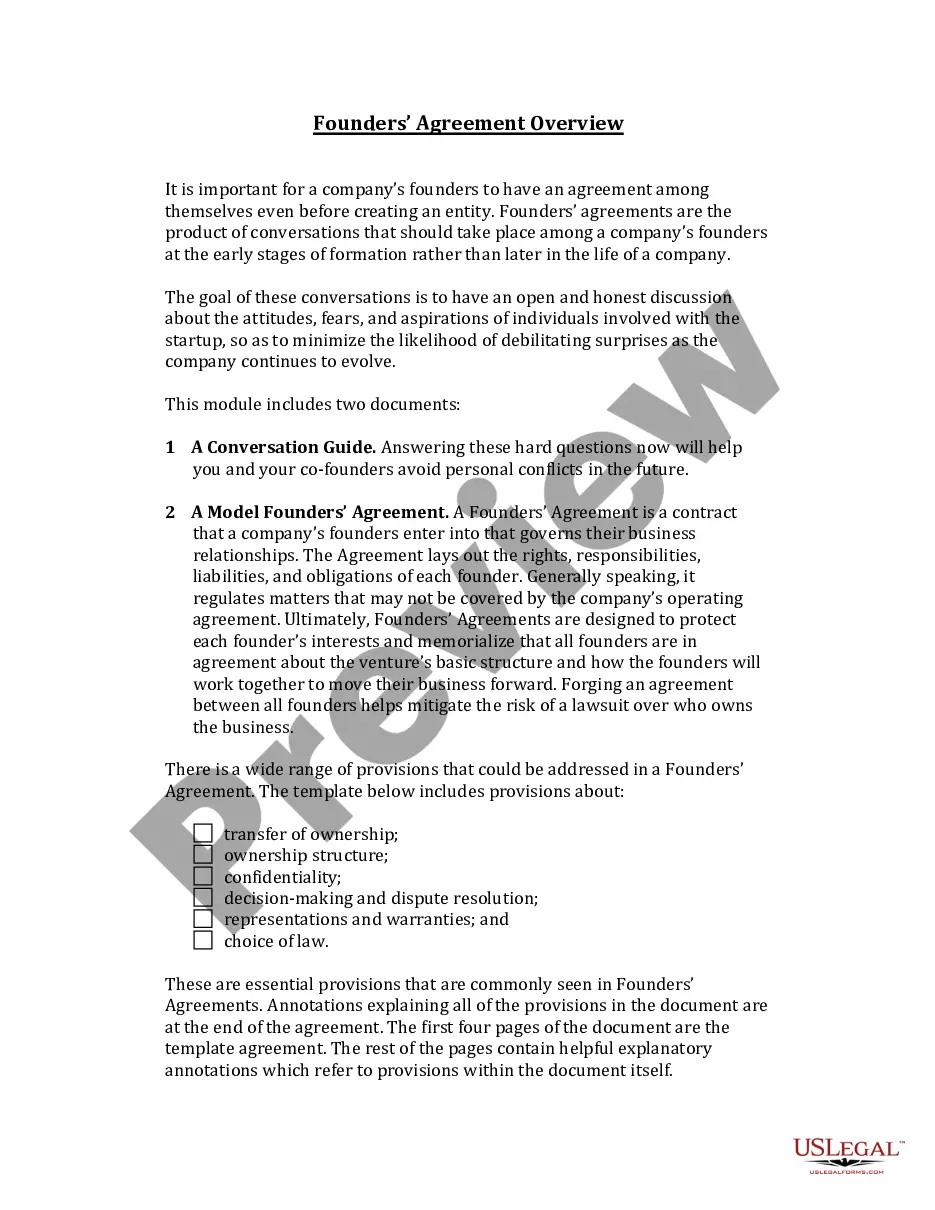
How to fill out Mutual Release Agreement Between Corporate Employer And Executive Upon Termination Of Employment?
Selecting the ideal legal document template can be challenging.
Indeed, there are numerous templates accessible online, but how do you find the legal form you require.
Utilize the US Legal Forms website.
For new users of US Legal Forms, here are straightforward steps to follow: First, ensure you have selected the correct form for your region/county. You can view the document using the Preview option and examine the form description to confirm it is the appropriate one for you. If the form does not meet your requirements, utilize the Search field to locate the suitable form. Once you are confident that the document works, click the Get now button to acquire the form. Choose the payment plan you prefer and enter the necessary details. Create your account and pay for your order using your PayPal account or credit card. Select the file format and download the legal document template to your device. Complete, modify, print, and sign the downloaded Virginia Mutual Release Agreement between Corporate Employer and Executive upon Termination of Employment. US Legal Forms represents the premier repository of legal templates where you can explore a variety of document formats. Utilize the service to download expertly crafted documents that adhere to state requirements.
- The platform offers thousands of templates, including the Virginia Mutual Release Agreement between Corporate Employer and Executive upon Termination of Employment, suitable for both business and personal purposes.
- All templates are reviewed by professionals and comply with federal and state regulations.
- If you are currently registered, sign in to your account and click the Download button to obtain the Virginia Mutual Release Agreement between Corporate Employer and Executive upon Termination of Employment.
- Use your account to search through the legal documents you have previously purchased.
- Navigate to the My documents section of your account to retrieve another copy of the document you need.
Form popularity
FAQ
Virginia Code Section 40.1-28.7 relates to employment regulations within the state, including directives for workplace rights. Understanding this code is essential for corporate employers and executives as it impacts the Virginia Mutual Release Agreement between Corporate Employer and Executive upon Termination of Employment. Adequate knowledge of these laws can help ensure compliance and protect both parties' interests during separation.
A mutual agreement is a binding contract between two or more parties and can cover any contingency. The difference between a mutual agreement and a settlement not creating a trust, is determined by the operative words, ie "mutually agrees" or "settles".
THE BASICS. A severance agreement is a legally enforceable agreement between you and your employer. You can negotiate it up front or upon exit. Once you sign the agreement, you give up any chance of suing the employer in the future.
Release Agreement means an agreement, substantially in a form approved by the Company, pursuant to which Executive releases all current or future claims, known or unknown, arising on or before the date of the release against the Company, its subsidiaries and its officers. Sample 2.
A mutual release agreement occurs between two parties that are involved in a legal dispute. By agreeing to mutually release, each party agrees to give up any claims against the other. This includes known claims as well as those that aren't yet known.
Updated October 28, 2020: Termination of contract by mutual consent takes place when a contract is no longer being followed, if the contract can no longer be performed, or the parties involved ceased operating the business. When these situations occur, the parties can formally terminate the agreement in writing.
In general, the effect of the termination of a contract is to discharge the parties from their unperformed obligations under the contract. However, termination does not affect liabilities of the parties for breaches of the contract that occurred prior to the contract being terminated.
Severance contracts that contain a release of all claims against an employer in exchange for severance pay or other benefits are legal, enforceable, and binding.
When a party to a contract wants to notify another party (or parties) of their intent to end their relationship, as well as disclose a date for contract expiration, they will send a notice of termination. Simply put, it is a formal declaration of to another party that you plan to end a contract.
All employment agreements are legally binding on the employer and, therefore, employers are best served by having them drafted and reviewed by an experienced employment law attorney. Contract law is a particularly complex discipline that relies largely on common law, which is law as developed by judges and court cases.