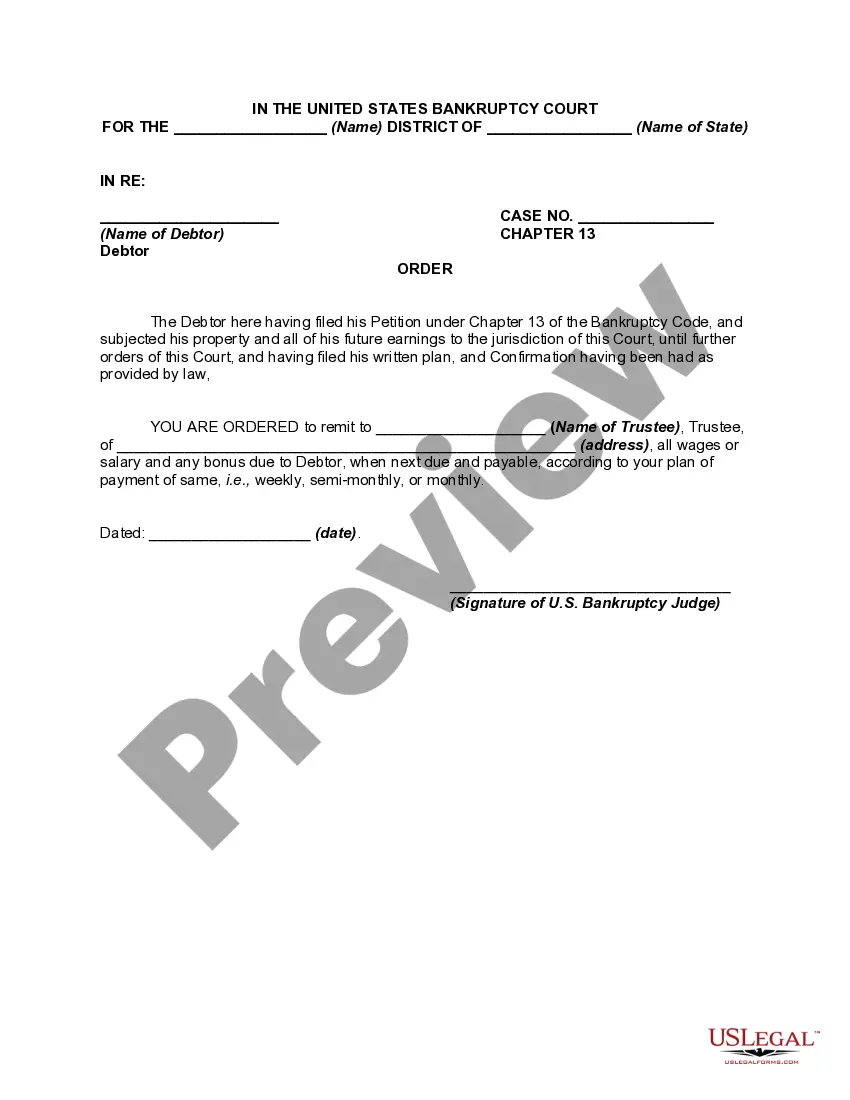
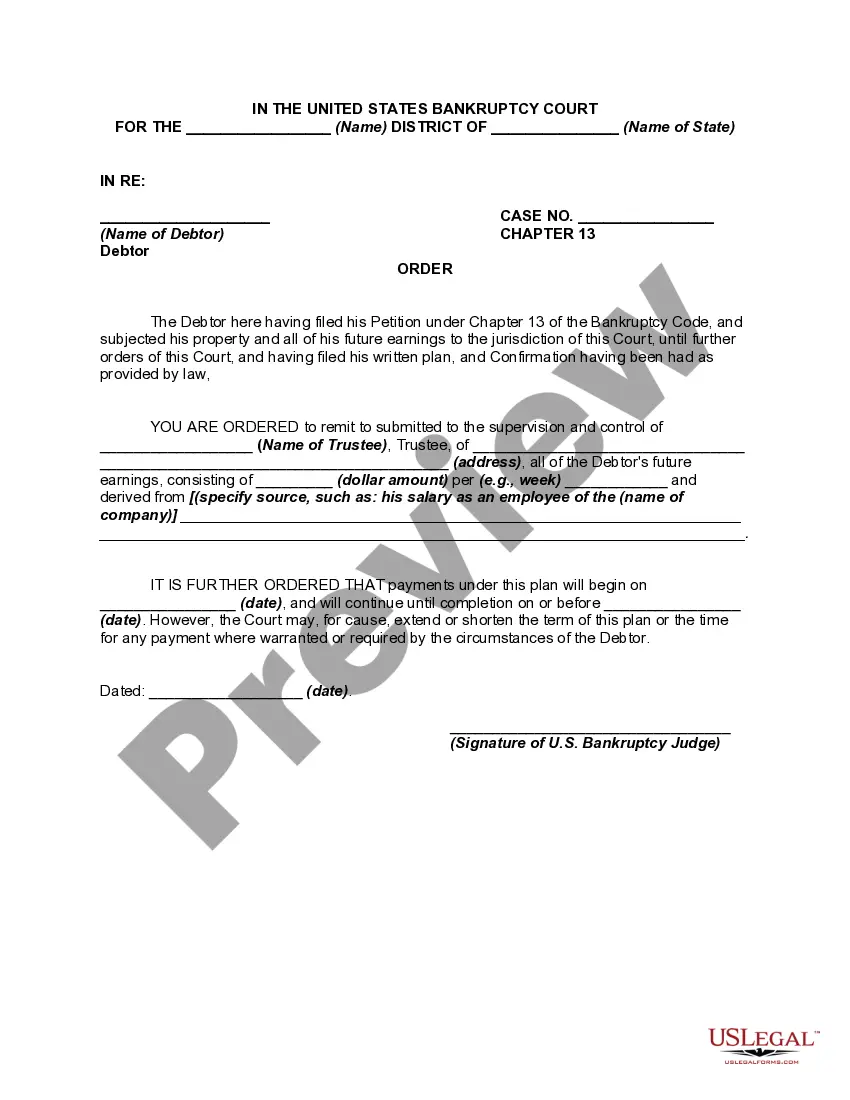
Virginia Order Requiring Debtor's Employer to Remit Deductions from a Debtor's Paycheck to Trustee

State:
Multi-State
Control #:
US-02136BG
Format:
Word; 
Rich Text
Instant download

Description

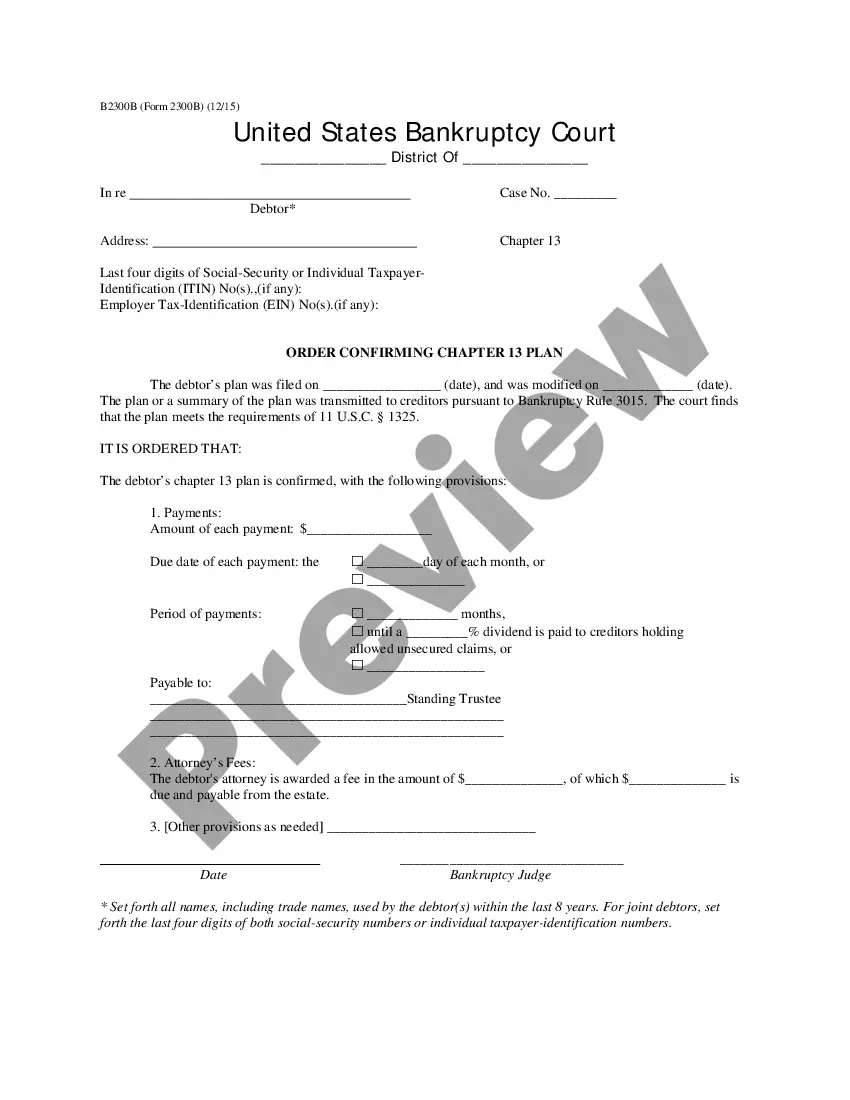
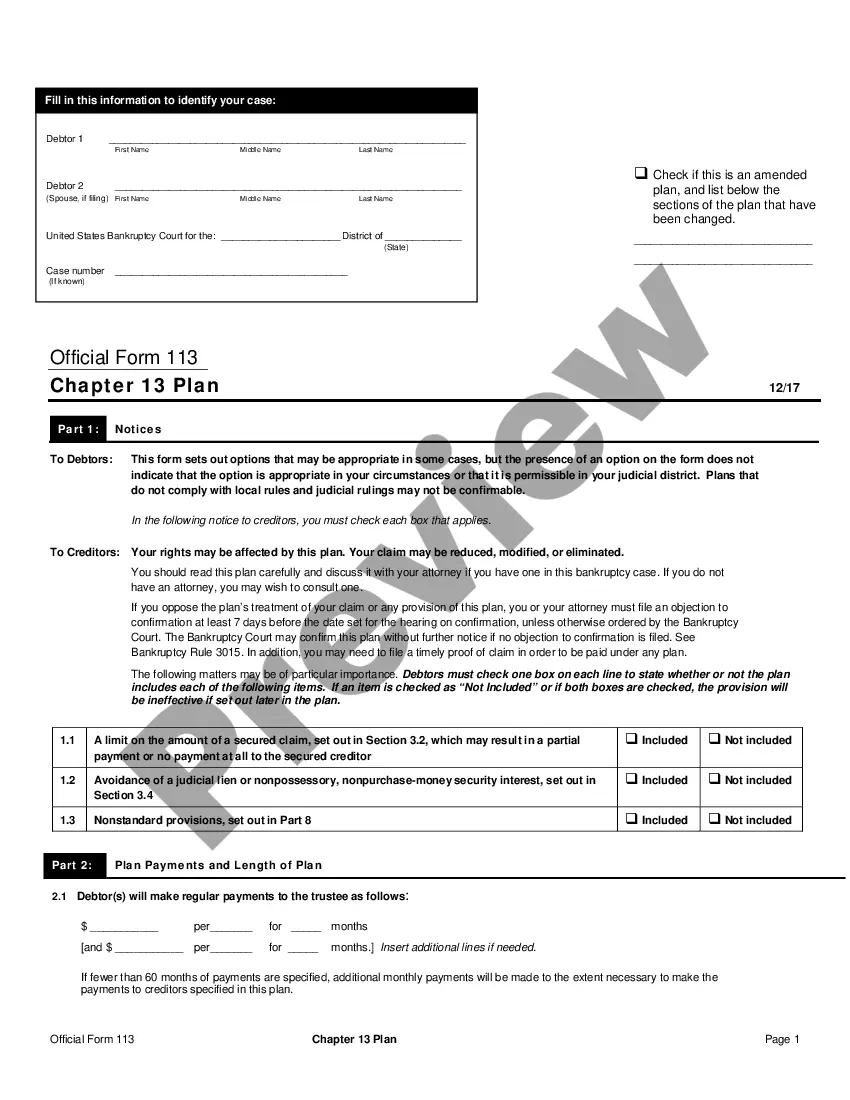
The U.S. Bankruptcy Code also allows individual debtors who meet certain financial criteria to adopt extended time payment plans for the payment of debts. An individual debtor on a regular income may submit a plan for installment payment of outstanding debts. This is called a Chapter 13 Plan. This plan must be confirmed by the court. Once it is confirmed, debts are paid in the manner specified in the plan. After all payments called for by the plan are made, the debtor is given a discharge. The plan is, in effect, a budget of the debtor's future income with respect to outstanding debts. The plan must provide for the eventual payment in full of all claims entitled to priority under the Bankruptcy Code. The plan will be confirmed if it is submitted in good faith and is in the best interest of the creditors.


A Chapter 13 plan must provide for the submission of all or such portion of future earnings or other future income of the debtor to the supervision and control of the trustee as is necessary for the execution of the plan. After the confirmation of a Chapter 13 plan, the court may exercise its discretion and order any entity from whom the debtor receives income to pay all or part of such income to the trustee.
How to fill out Order Requiring Debtor's Employer To Remit Deductions From A Debtor's Paycheck To Trustee?

If you need to total, obtain, or print legal papers web templates, use US Legal Forms, the biggest collection of legal varieties, that can be found on the Internet. Use the site`s simple and convenient search to find the papers you will need. A variety of web templates for enterprise and specific functions are sorted by categories and claims, or search phrases. Use US Legal Forms to find the Virginia Order Requiring Debtor's Employer to Remit Deductions from a Debtor's Paycheck to Trustee in just a number of clicks.

If you are previously a US Legal Forms buyer, log in to your bank account and then click the Down load option to find the Virginia Order Requiring Debtor's Employer to Remit Deductions from a Debtor's Paycheck to Trustee. You may also entry varieties you in the past saved from the My Forms tab of your respective bank account.

If you are using US Legal Forms initially, refer to the instructions listed below:

  • Step 1. Be sure you have chosen the form for your right city/country.
  • Step 2. Use the Preview solution to examine the form`s information. Don`t overlook to see the information.
  • Step 3. If you are not satisfied with the develop, use the Lookup industry near the top of the monitor to discover other versions from the legal develop design.
  • Step 4. After you have located the form you will need, click the Purchase now option. Pick the pricing plan you like and add your qualifications to register on an bank account.
  • Step 5. Procedure the purchase. You may use your credit card or PayPal bank account to complete the purchase.
  • Step 6. Pick the file format from the legal develop and obtain it on the gadget.
  • Step 7. Full, change and print or signal the Virginia Order Requiring Debtor's Employer to Remit Deductions from a Debtor's Paycheck to Trustee.

Each and every legal papers design you get is yours forever. You might have acces to each and every develop you saved within your acccount. Select the My Forms segment and pick a develop to print or obtain yet again.

Remain competitive and obtain, and print the Virginia Order Requiring Debtor's Employer to Remit Deductions from a Debtor's Paycheck to Trustee with US Legal Forms. There are millions of expert and condition-specific varieties you may use to your enterprise or specific requires.

Form popularity

FAQ

Guide. You must deduct the amount of child maintenance stated on the deduction from earnings order (DEO) from your employee's net earnings or pension. By law you must send payments to the Child Maintenance Service. They'll send the money to the other parent to help cover their child's living costs.

That employers shall remit payments on each regular pay date of the obligor, or instance of compensation if the obligor is an independent contractor, or, if electronic funds transfer is used, within four days of the pay date, directly to the Division of Child Support Enforcement for disbursement.

An Attachment of Earnings Order (AEO) is where a creditor applies to the court for an order to allow them to take funds direct from your wages, if you fail to keep up repayments on a debt. The type of debt you might have where your creditor applies for an AEO include: Rent or mortgage arrears.

This is called a 'consolidated attachment of earnings order'. If you get a consolidated order, the money you owe will be taken out of your wages by your employer and sent to the court. The court will pay each of your creditors.

A wage garnishment is any legal or equitable procedure through which some portion of a person's earnings is required to be withheld for the payment of a debt. Most garnishments are made by court order.

Garnishment is a legal process that allows a third party to seize assets of a debtor. For example, a creditor, who can be a winning party in a suit or a creditor in a bankruptcy case, can acquire the wage of the debtorthrough the debtor's employer.

Types of AEOs Attachment typeDescription1971 priorityPayment of unpaid TV licence or road traffic fines.Child support (CS)Issued by the Child Support Agency (CSA) for child maintenance payments.Child support 2012From April 2012, issued by the Child Support Agency (CSA) for child maintenance payments.12 more rows ?

Wage garnishment is a legal procedure in which a person's earnings are required by court order to be withheld by an employer for the payment of a debt such as child support.

Trusted and secure by over 3 million people of the world’s leading companies

Virginia Order Requiring Debtor's Employer to Remit Deductions from a Debtor's Paycheck to Trustee