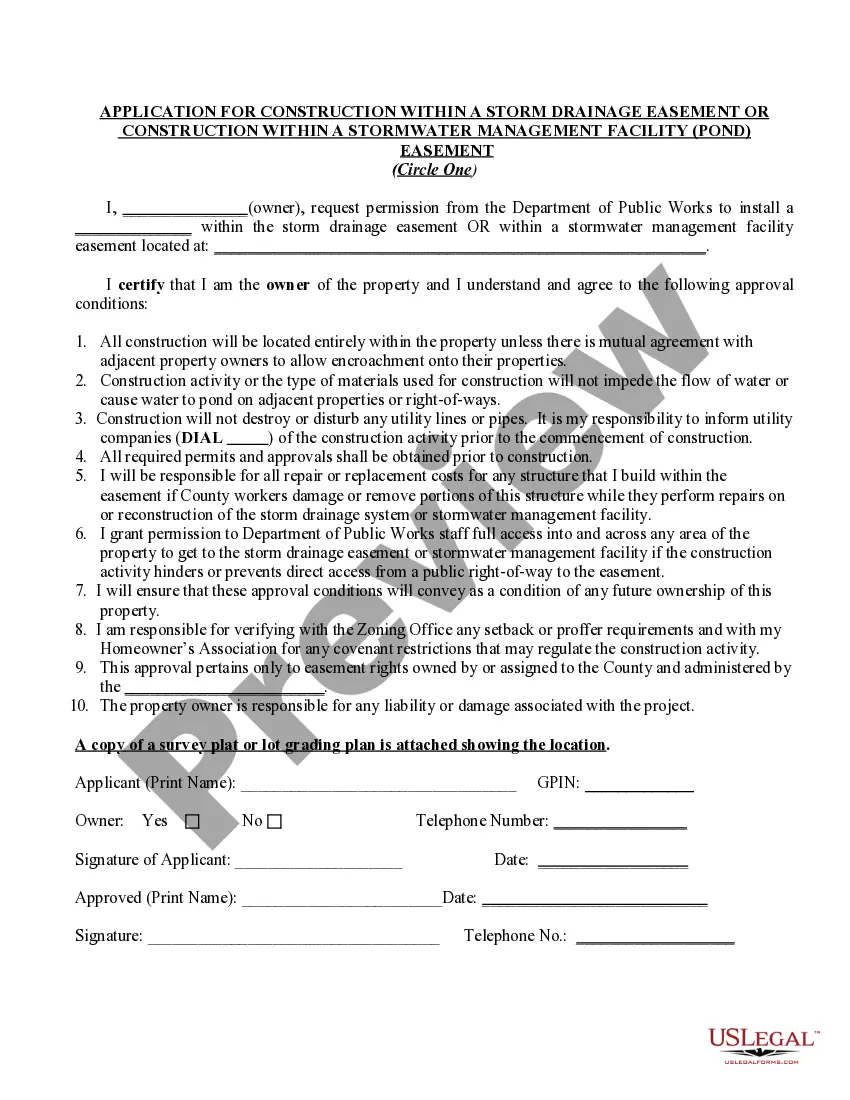
Virginia Application for Construction with Storm Drainage Easement
Understanding this form
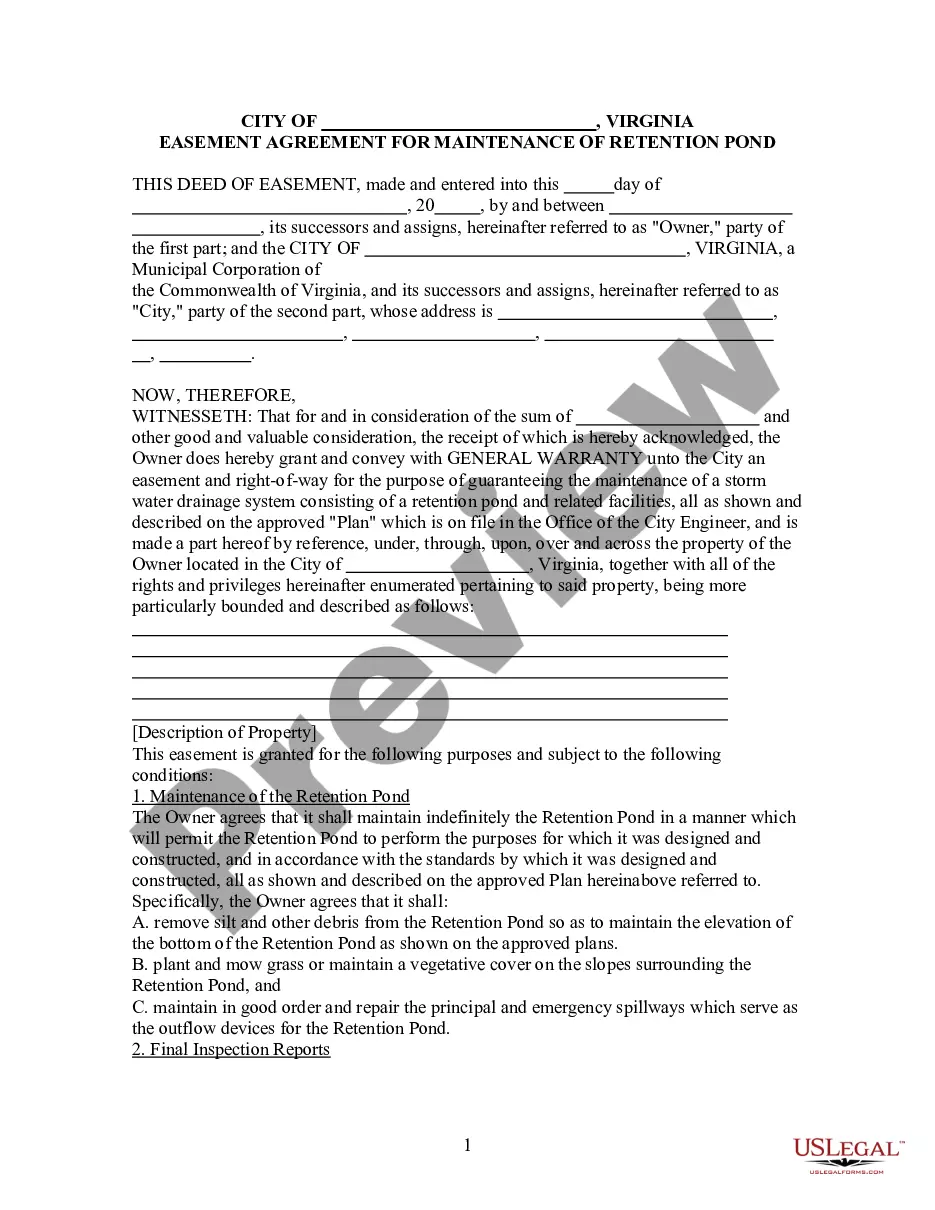
The Application for Construction with Storm Drainage Easement is a legal document that authorizes property owners to seek permission from local authorities to conduct construction activities within designated storm drainage easements. This application is essential for ensuring that construction does not interfere with public drainage systems and complies with municipal regulations. Unlike general construction permits, this form specifically targets construction activities that impact storm drainage facilities or easements.
Form components explained
- Property owner's details, including name and contact information.
- Specification of the type of installation or construction requested.
- Property location details where construction is to take place.
- Certification of ownership and understanding of approval conditions.
- Declaration of responsibility for damages and repair costs related to the construction.
- Signature and date fields for both the applicant and the approving authority.
When to use this form
This form is necessary when a property owner wishes to undertake construction activities within a storm drainage easement or stormwater management facility, such as ponds. You should use this application if you plan to install structures like fences, driveways, or other improvements that may impact drainage. It's crucial to obtain approval before starting any project that falls within the defined easement areas to prevent legal issues or complications with local authorities.
Who this form is for
This form is intended for:
- Property owners looking to construct within a storm drainage easement.
- Developers planning projects that affect stormwater management facilities.
- Contractors working on behalf of property owners who need to request permission for construction.
Instructions for completing this form
- Enter the full name of the property owner and their contact number.
- Specify the type of installation or construction to be performed.
- Provide the exact location of the property where the construction will occur.
- Sign the application to certify understanding and acceptance of the conditions outlined.
- Attach a survey plat or lot grading plan showing the proposed location of the construction.
Notarization requirements for this form
This form does not typically require notarization unless specified by local law. However, it is advisable to check with local authorities for any additional requirements in your area.
Get your form ready online
Our built-in tools help you complete, sign, share, and store your documents in one place.
Make edits, fill in missing information, and update formatting in US Legal Forms—just like you would in MS Word.
Download a copy, print it, send it by email, or mail it via USPS—whatever works best for your next step.
Sign and collect signatures with our SignNow integration. Send to multiple recipients, set reminders, and more. Go Premium to unlock E-Sign.
If this form requires notarization, complete it online through a secure video call—no need to meet a notary in person or wait for an appointment.
We protect your documents and personal data by following strict security and privacy standards.

Make edits, fill in missing information, and update formatting in US Legal Forms—just like you would in MS Word.

Download a copy, print it, send it by email, or mail it via USPS—whatever works best for your next step.

Sign and collect signatures with our SignNow integration. Send to multiple recipients, set reminders, and more. Go Premium to unlock E-Sign.

If this form requires notarization, complete it online through a secure video call—no need to meet a notary in person or wait for an appointment.

We protect your documents and personal data by following strict security and privacy standards.
Mistakes to watch out for
- Failing to provide complete contact information for the property owner.
- Neglecting to attach the required survey plat or lot grading plan.
- Overlooking any necessary permits that must be obtained prior to submitting the application.
- Not verifying easement boundaries before commencing construction.
Why complete this form online
- Convenience of accessing the form from anywhere, anytime.
- Editability of the form allows for easy updates and corrections.
- Reliability of having a legal document that is drafted and reviewed by licensed attorneys.
Looking for another form?
Form popularity
FAQ
How to Drain Downspout Water Flow Away from a House This Old House YouTube Start of suggested clip End of suggested clip With fabric put some stone. And then take a perforated pipe with the holes. Down. Put it like thisMoreWith fabric put some stone. And then take a perforated pipe with the holes. Down. Put it like this the water will come through go down in the stone. And weep into the soil.
To stop water runoff coming from the neighbor's yard, you should set up a dry well, and make a swale, you can also plant vegetation, trees and shrubs. You may also build a retaining wall, or dig a trench, a French drain, and place sand bags, or consult them.
Redirect Runoff. Intercepting and redirecting runoff provides an opportunity to safely discharge the volume to a place beyond the problem area. This can be done using swales, French drains, catch basins or downspout and sump pump extensions.
A property owner with a drainage easement is restricted from erecting both temporary (such as a shed) and permanent structures (such as a driveway) within the easement area. Such structures can reduce the efficiency of drainage and increase the possibility of flooding.
What is a Storm Drain? Runoff from paved or impervious surfaces, such as roads, parking lots, driveways and rooftops, can contribute large amounts of polluted stormwater. To prevent flooding, parking lots and streets are often lined with storm drains to quickly move stormwater off the pavement.
Under Virginia's common law, the courts view surface water as a ?common enemy.? By general rule, owners may ?fight off? surface water by construction or changing drainage conditions to their own property, even if this discharges additional water onto an adjoining parcel.
A storm drain is a closed conduit that conveys storm water that has been collected by inlets to an outfall. It generally consists of laterals or leads, and trunk lines or mains. Culverts connected to the storm drainage system are considered part of the system.
The Top 3 Ways to Redirect Water Away From Your Foundation Strategy #1: a French Drain, But Do It Properly.Strategy #2: Use Gutters and Downspouts.Strategy #3: a Swale on the Property.Why Residential Storm Water Management Is Important.